What if the most effective way of reducing the environmental impact of coach travel isn’t choosing a different vehicle, but planning a better journey? Two practical steps are to coordinate passengers so seats are well used and to avoid unnecessary journey legs. A coach can carry a group together, but its impact per passenger depends on how many people travel and how efficiently the itinerary is arranged.
That nuance matters when comparing a coach with cars, trains or flights. Headline figures can mislead if they use different assumptions about occupancy, distance or which emissions are counted. Sustainable planning needn’t mean sacrificing comfort or cutting meaningful stops. It means comparing equivalent journeys and shaping the route around the group’s real needs.
This guide explains what affects coach emissions and how group size, routing and coordinated logistics can reduce avoidable travel. BELUNE brings more than 20 years of group travel experience and its own modern coach fleet to itinerary planning, helping organisers consider transport alongside accommodation and activities.
Key Takeaways
- Separate emissions from operating a journey from wider lifecycle effects to understand what an environmental comparison includes.
- Use passenger-kilometres to compare equivalent journeys, accounting for distance and the number of travellers.
- No transport mode is automatically the greener choice. Occupancy, route and trip assumptions shape the result.
- Practical steps for reducing the environmental impact of coach travel include coordinating passengers, choosing direct routes and avoiding unnecessary mileage.
- A joined-up itinerary for transport, accommodation and activities can help groups travel more coherently without sacrificing the experience.
What determines the environmental impact of coach travel?
A journey’s environmental impact includes emissions produced while a vehicle is operating and may also include the wider effects of making, fuelling and eventually disposing of it. The result depends on more than the coach itself: energy use, route length, passenger numbers and vehicle characteristics all shape the footprint. When reducing the environmental impact of coach travel, it is important to know which parts of the journey a comparison counts.
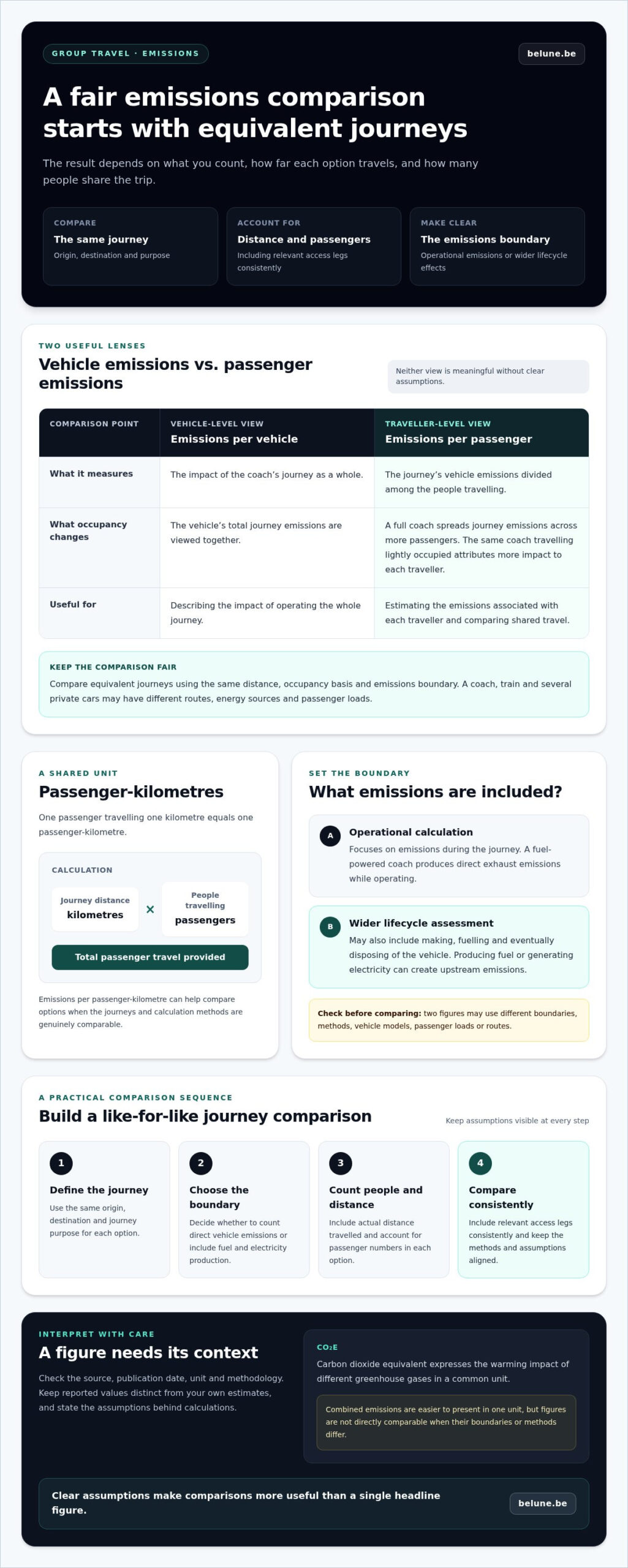
Two measures answer different questions. Emissions per vehicle describe the impact of the coach’s journey as a whole. Emissions per passenger divide that impact among the people travelling, helping organisers estimate the emissions associated with each traveller. Neither measure is meaningful without clear assumptions about distance, occupancy and which emissions are included.
Which parts of a coach journey create environmental impact?
During operation, a fuel-powered coach produces direct exhaust emissions. The energy source can also have upstream effects: extracting and producing fuel, or generating electricity, may create emissions before the vehicle moves. A lifecycle assessment may include vehicle manufacture and disposal, while an operational calculation focuses on emissions during the journey.
Route length and driving conditions affect how much energy a journey requires. Traffic, gradients, speed and stops can influence vehicle efficiency, as can characteristics such as vehicle size and design. A precise footprint can give a misleading impression of certainty if its boundary, method and data source are unclear.
Why does coach occupancy matter?
A per-person calculation divides the journey’s vehicle emissions among its passengers. A full coach spreads journey emissions across more passengers. A well-used shared trip can therefore have a lower attributed impact per traveller than the same coach travelling lightly occupied, even when the route and vehicle are unchanged.
Occupancy is important, but it doesn’t settle every comparison. A fair assessment also considers how far each option travels, how many people are travelling together and which emissions are counted. A train, a coach and several private cars may use different energy sources, routes and passenger loads. An overview of intercity bus services discusses the environmental advantages of coach travel, but a specific group’s comparison still depends on its journey and the assumptions used.
For organisers, the practical lesson is to look beyond a vehicle’s total emissions. Consider how many travellers share the trip and whether the route serves the group efficiently. These details provide a clearer basis for comparing transport choices.
How to measure coach travel emissions fairly
A useful comparison starts with a clear question: what journey are you measuring, and whose emissions are you counting? For a group trip, define the journey, choose the emissions boundary, count the passengers, then compare equivalent transport options. This sequence helps distinguish published figures from estimates based on your own assumptions.
Passenger-kilometres offer a straightforward unit for comparing travel. One passenger travelling one kilometre equals one passenger-kilometre. Multiply the distance by the number of passengers to calculate the total passenger travel provided. If a source reports emissions per passenger-kilometre, the figure can help compare options, provided the journeys and calculation methods are genuinely comparable.
What should a like-for-like transport comparison include?
Use the same origin, destination, passenger count and journey purpose for each option. Then compare the actual distance travelled by each mode, including relevant access legs consistently. Decide whether the calculation covers direct vehicle emissions only or also includes emissions from producing fuel or supplying electricity. Comparisons need the same distance, occupancy basis and emissions boundary to be meaningful.
For example, comparing one coach carrying a group with several cars requires knowing how many people are in each car and how far each vehicle travels. The American Bus Association’s report describes motorcoach travel as the most sustainable and energy-efficient transportation option. Treat this as the association’s reported conclusion, not a universal result for every route or group. Its relevance depends on the report’s scope and assumptions.
How can organisers interpret emissions figures responsibly?
Check the source, publication date, unit and methodology before using a figure. A government conversion factor, an operator’s fleet-specific estimate and an industry report may use different vehicle models, passenger loads or emissions boundaries. Keep reported values distinct from your own estimates, and state the assumptions behind any calculations you make.
CO2e, or carbon dioxide equivalent, expresses the warming impact of different greenhouse gases in a common unit. It helps present combined emissions, but two figures are not directly comparable if they use different boundaries or methods. Vehicle model, load and route can all affect the result.
For a real group itinerary, consistent assumptions matter more than a single headline figure. BELUNE coordinates coach transport, accommodation and group logistics, helping organisers plan a coherent journey. Explore BELUNE’s group travel planning as you consider how itinerary design can support more informed comparisons.
Is coach travel always the greener group transport choice?
No. A coach isn’t automatically the lowest-impact option for every group or route. The outcome depends on how many people travel together, the distance and route, the available transport options and the boundaries used in an emissions comparison. A shared coach may replace several separate car journeys, but that advantage depends on whether the group uses it.
| Mode | When it may suit a group | What affects the comparison |
|---|---|---|
| Coach | Travellers share a destination or coordinated itinerary. | Passenger uptake, route length, vehicle occupancy and any extra mileage. |
| Rail | Routes, timetables and onward connections work for the group. | Train service, group access and travel to and from stations. |
| Multiple private cars | Travellers have separate origins, destinations or schedules. | Number of cars, occupancy, total distance and any shared travel. |
This is a framework, not a universal ranking. Comparisons are most useful when they cover the same journey and passenger needs, including relevant travel at either end. A mode that looks favourable on its main leg may involve extra transfers or access trips that change the full journey’s impact.
When can a shared coach make practical sense?
A coach can be a practical choice when a group is travelling to one destination or moving together through a planned itinerary. Instead of each traveller arranging a separate car journey, one shared trip can bring the group together. The environmental outcome depends on passenger uptake and routing: a well-used, direct journey differs from a lightly occupied coach making substantial detours.
Group logistics matter, too. Coordinating departure points and timings can make shared transport workable while preserving the rhythm of the trip. When reducing the environmental impact of coach travel, consider whether one coherent route serves the group better than a collection of individual journeys.
When should organisers compare other transport modes?
Rail deserves consideration when a suitable service fits the group’s timetable and provides workable access to the destination. The comparison should account for reaching stations and completing onward travel, not just the train segment. For travellers starting or finishing in different places, separate cars may be more practical, but their total distance and passenger loads still matter.
Map each option from the group’s actual starting points to its final destinations. Include transfers, pickups and other necessary legs. Then compare convenience and itinerary fit alongside emissions, using consistent assumptions rather than treating any mode as inherently greener.
How can organisers reduce the environmental impact of coach travel?
Thoughtful planning can reduce avoidable mileage without making a trip feel rushed or less comfortable. The aim isn’t simply to choose the shortest route. It is to coordinate passengers, stops and activities so each journey leg serves a clear purpose.
- Coordinate passenger numbers: Gather registrations and likely attendance before arranging transport. A reliable count helps with vehicle planning, though it doesn’t guarantee a particular emissions outcome.
- Plan direct, connected routes: Arrange pickups and stops in a logical sequence to avoid backtracking and unnecessary transfers.
- Make stops purposeful: Where practical, combine rest breaks with group needs rather than adding detours for convenience alone.
- Bring related activities together: Group nearby visits and consider accommodation in relation to the day’s route.
- Record the journey: Note route distance, passenger numbers and the assumptions used in any emissions comparison. Review those details when planning future trips.
How can itinerary design avoid unnecessary travel?
Start with the shape of the experience. If a group has several activities in the same area, arrange them in a sensible sequence to avoid repeated journeys between the same points. Include accommodation and pickups in the plan: a well-placed departure point can help the day flow naturally and limit extra legs.
The shortest route isn’t always the best route. A slightly longer journey may better suit the group’s timing, access needs or planned stops. Balance distance with a calm, workable itinerary so environmental considerations support the experience rather than dictate it.
What can group organisers do before departure?
Coordinate passengers early. Confirm expected numbers in time to plan transport, then share clear joining instructions, pickup details and timings with everyone. When people know where to meet and how the shared journey works, there is less reason for separate transfers or individual car trips caused by uncertainty.
After the trip, compare the plan with what happened. Record final passenger numbers, actual route distance and any unplanned mileage. These notes provide a more useful basis for future planning than relying on a generic emissions estimate. For broader organiser considerations, see The Definitive Guide to Choosing a Group Travel Agency in 2026.
Reducing the environmental impact of coach travel often comes down to coordination: connecting transport with accommodation, activities and the group’s real needs. Plan a coordinated group journey with BELUNE, drawing on more than 20 years of group travel experience and its own modern coach fleet.
How BELUNE can help groups plan more considered coach journeys
Environmental choices become more practical when transport is planned as part of the whole trip. A coach route, hotel location, activity schedule and pickup plan all influence how a group moves. Coordinating these elements can create a coherent itinerary and avoid journey legs that don’t serve a clear purpose, while keeping the experience comfortable and well paced.
What does coordinated group transport planning involve?
Start with the group’s schedule and priorities. Considering activities and accommodation alongside coach movements helps organisers build a logical sequence rather than treating each transfer as a separate decision. For example, the order of planned visits and the location of an overnight stay can affect how much backtracking the itinerary requires.
Clear coordination matters to passengers, too. Shared pickup information, well-planned timings and a route that reflects the day’s activities can make group travel feel smooth and connected. These are planning priorities, not guarantees of a particular environmental result. Any impact assessment still depends on the actual journey, passenger numbers and the method used to measure emissions.
BELUNE brings more than 20 years of group travel experience to itinerary and logistics coordination and operates its own modern coach fleet. Its hotel accommodation management and local guide services can be considered alongside transport and activities when planning a group itinerary. Careful comparisons remain important, while coordinated planning brings routing, schedules and group movement into one discussion.
What is a sensible next step for a group organiser?
Begin with the fundamentals: expected group size, journey purpose, key dates, schedule and transport priorities. Note where passengers will join, which activities need transfers and how accommodation fits into the route. A clear starting brief helps identify where the itinerary can be more direct and which stops are essential to the group’s experience.
From there, organisers can plan transport and logistics around efficient routing and a comfortable pace. If reducing the environmental impact of coach travel is a priority, keep the assumptions visible: anticipated passenger numbers, planned distance and any detours or connections. This makes future reviews more meaningful and avoids relying on broad sustainability claims.
Explore BELUNE’s group travel services to consider how coordinated coach transport, accommodation and activities can come together in a more considered group itinerary.
Make your next group journey more considered
Reducing the environmental impact of coach travel starts with understanding what shapes a journey’s footprint: distance, vehicle use, passenger numbers and the boundaries used to measure emissions. Fair comparisons use the same route and occupancy assumptions. Practical planning focuses on coordinating travellers, avoiding unnecessary mileage and connecting activities with accommodation.
No transport mode is right in every situation. Make an informed decision based on the group’s actual itinerary and needs. Clear passenger plans and thoughtfully arranged routes can support a smoother experience while helping organisers make more considered choices.
BELUNE brings more than 20 years of group travel experience, its own modern coach fleet and expertise coordinating itineraries, accommodation and logistics. These elements can be considered together when shaping a coherent journey. Explore BELUNE’s group travel services and take the next step towards planning a group trip with care and confidence.
Frequently Asked Questions
Is coach travel better for the environment than travelling by car?
It can be, particularly when a coach carries many passengers who might otherwise travel in separate cars, but it isn’t always the lower-impact choice. The comparison depends on the coach’s occupancy, the number of people in each car and the distance each option travels. For a fair assessment, compare the same journey and passenger numbers, using emissions figures with consistent boundaries and assumptions.
Can a coach reduce the environmental impact of group travel?
Yes, a shared coach can reduce the need for multiple separate vehicle journeys when a group travels together. The potential benefit depends on how many people use the coach and whether its route avoids unnecessary detours. A lightly occupied coach or an indirect itinerary can change the comparison. Consider the complete trip, including pickups and onward travel, rather than assuming shared transport always has the lowest impact.
How are emissions from coach travel calculated per passenger?
To estimate emissions per passenger, calculate emissions for the coach journey using a stated method, then divide that total across the passengers. Distance and occupancy both matter: a longer route adds travel, while more passengers share the journey’s emissions. Check whether the calculation covers direct vehicle emissions or also fuel production. Cite the methodology and report its assumptions, since different boundaries can produce different results.
What factors affect the environmental impact of a coach journey?
A coach journey’s impact depends on the vehicle and its efficiency, the fuel or energy it uses, route distance, driving conditions and passenger load. Traffic, stops and route changes can affect the energy needed to complete the trip. The result also depends on what the calculation includes, such as direct operating emissions alone or upstream fuel and energy effects. A precise comparison needs a clear method.
Does a fuller coach always have a lower environmental impact per passenger?
Usually, more passengers mean the journey’s vehicle emissions are divided among more travellers, lowering the amount attributed to each person, all else being equal. But occupancy alone doesn’t determine the full environmental comparison. Route length, vehicle characteristics and the emissions boundary matter, as do the occupancy and distance assumptions for other transport modes. A full coach isn’t automatically the best option for every group or journey.
What can group organisers do to make coach travel more sustainable?
Start with a realistic passenger count, then plan pickups and stops in a logical sequence. Group nearby activities and consider accommodation alongside the daily route to limit backtracking and unnecessary mileage. Share clear joining instructions so travellers can coordinate their arrival and avoid separate transfers caused by uncertainty. Record passenger numbers, route distance and calculation assumptions after the trip to inform future planning and comparisons.
Should organisers compare coach travel with rail for a group trip?
Yes, if rail could serve the group’s route and schedule. Compare complete journeys, not just the coach leg with the train ride: include travel to stations, transfers and onward connections. Consider group size, access and timetable suitability, then use emissions data based on the same distance, occupancy basis and boundary for both modes. Neither rail nor coach is automatically the lower-impact choice in every situation.