Tag: Coach Tours

  • Organising Group Tours: A Guide for Travel Professionals

    Organising Group Tours: A Guide for Travel Professionals

    When organising group tours in bruges, the smoothest programme isn’t necessarily the one with the fullest schedule. It’s the one where each detail supports the next. Travel professionals know that a memorable group tour depends on more than compelling experiences: transport, accommodation, guiding and realistic pacing all need to work together, while allowing for different interests and practical needs.

    Coordinating those elements takes careful planning. Supplier bookings and travel times matter, but so do rest breaks, accessibility needs and the transitions between activities. Build these considerations into the itinerary from the start, rather than trying to fit them around a schedule that is already full.

    This guide explains how to develop a coherent group tour, from shaping a balanced programme to coordinating coaches, accommodation and local guides. It offers practical ways to match the itinerary to travellers’ interests and pace, and to keep the logistics clear as plans take shape.

    With more than 20 years of experience in group travel, BELUNE brings itinerary design and on-the-ground coordination together through tailored programmes, its own coach fleet, accommodation management and expert local guidance. A considered plan helps every part of the journey work together.

    Key Takeaways

    • Start with the group’s profile, purpose, interests and practical needs to guide itinerary decisions.
    • Build a connected programme by choosing a theme, mapping experiences, testing the pace and coordinating logistics.
    • Align coach movements, accommodation, local guiding and booked experiences so each element supports the traveller experience.
    • Plan for comfort: explain meeting arrangements clearly, allow time for transitions and leave room to adapt.
    • Tailored planning and coordinated delivery can turn a group brief into a more cohesive tour.

    What Does Organising a Group Tour Actually Involve?

    A group tour is more than a sequence of appealing stops. It’s a coordinated programme that brings together travellers, transport, accommodation, guiding and experiences, shaped around the group’s purpose, interests and practical needs. A well-designed itinerary gives the trip a clear character; careful coordination makes its moving parts work together.

    Group-tour planning combines the design of a meaningful journey with the coordination needed to deliver it. A package tour offers a useful starting point for understanding how travel components can be combined. Organised group travel also requires attention to how those elements connect in practice. A booking list can show what’s planned, but not necessarily whether the day will flow comfortably from one activity to the next.

    For a visual sense of what a guided experience can add, watch this video:

    What does a group travel organiser coordinate?

    Planning starts with the group’s brief and continues through itinerary design, booking coordination and on-the-ground delivery. Accommodation choices affect where the day begins and ends. Coach movements shape how experiences connect, while guiding and activities need to fit the programme’s timing and tone. Because a change to one element can affect others, treat them as connected workstreams rather than separate tasks.

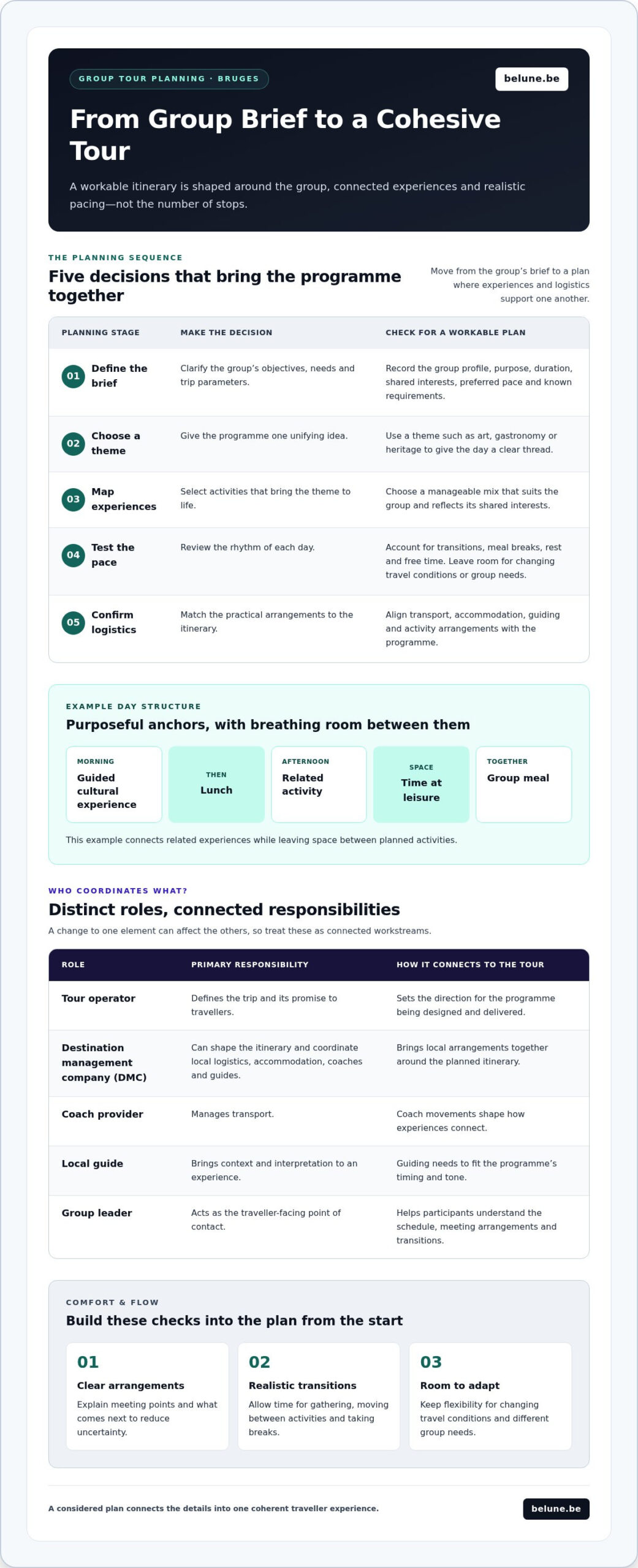
    The roles are distinct. The tour operator defines the trip and its promise to travellers. A destination management company (DMC) can shape the itinerary and coordinate local logistics, accommodation, coaches and guides. The coach provider manages transport, while the local guide brings context and interpretation to an experience. The group leader is the traveller-facing point of contact, helping participants understand the schedule, meeting arrangements and transitions.

    Why does a joined-up itinerary matter to travellers?

    A clear programme reduces uncertainty about what comes next and makes room for the experiences that matter. That clarity comes from choices based on shared interests, individual needs and a comfortable pace, not simply on how many attractions can fit into a day. Realistic transitions and breathing room support a more considered experience, while exact timings depend on the programme and conditions on the ground.

    In practice, organising group tours in bruges means looking beyond the headline attractions. The quality of the experience also depends on how thoughtfully the details fit together.

    How to Build a Cohesive Group-Tour Itinerary

    A strong itinerary starts with the group, not a checklist of attractions. For professionals organising group tours in bruges, the same principle applies: first understand who is travelling and why, then shape a programme whose experiences, transitions and pace serve that purpose.

    Itinerary quality depends on fit and flow, not the number of stops. A cultural programme might pair a guided heritage experience with time to reflect on what the group has seen. A food-focused tour could balance tastings with a relaxed meal. The aim is to create a clear thread through the day, rather than fill every available space.

    How should organisers turn a group brief into a programme?

    Translate the brief into practical decisions. Record the group profile, trip purpose, duration, shared interests, preferred pace and known requirements. Then choose a central theme and a manageable mix of experiences that supports it. For further inspiration on cultural programming, explore this cultural group-tour design guide. Group Tour Magazine can also offer ideas for professional group travel planning.

    Use this five-step sequence to move from concept to workable plan:

    • Define the brief: Clarify the group’s objectives, needs and trip parameters.
    • Choose a theme: Give the programme a unifying idea, such as art, gastronomy or heritage.
    • Map experiences: Select activities that bring the theme to life and suit the group.
    • Test the pace: Review transitions, meal breaks, rest and free time across each day.
    • Confirm logistics: Align transport, accommodation, guiding and activity arrangements with the itinerary.

    How can organisers balance highlights with breathing room?

    Where possible, sequence experiences by location or theme so the programme feels connected and avoids unnecessary movement. Build each day around a few purposeful anchors instead of filling every gap. For example, a morning guided cultural experience could lead into lunch, followed by a related afternoon activity, time at leisure and a group meal. This creates a clear structure while leaving space between planned activities.

    Plan transitions as part of the experience. Allow time for the group to gather, move between activities and take breaks. Keep some flexibility for changing travel conditions or group needs. Clear decisions about pace can make a programme more inclusive and enjoyable for travellers with different interests and energy levels.

    For tour operators developing a tailored programme, BELUNE’s group-tour planning brings itinerary design together with accommodation management, coach transport and local guidance.
    Organising Group Tours: A Guide for Travel Professionals

    How to Coordinate Transport, Accommodation, Guides and Experiences

    A coherent itinerary depends on operational details working together. Coach movements, overnight stays, local guidance and booked experiences each have a distinct role, yet travellers experience them as parts of one programme. For professionals organising group tours in bruges, treating these as connected workstreams helps keep plans aligned and reduces avoidable handoffs.

    Use this overview to clarify each element’s purpose and the organiser’s planning task:

    Planning element Purpose Organiser’s task Group benefit
    Coach transport Links accommodation with scheduled programme elements. Coordinate departures, boarding arrangements and luggage considerations with the itinerary. A clearer movement plan between activities.
    Accommodation Shapes the tour’s overnight rhythm. Align accommodation management with the group’s needs and programme structure. A stay considered as part of the overall journey.
    Local guidance Adds interpretation and context to experiences. Connect the guide’s role to the itinerary and group interests. More context for the experiences on the programme.
    Booked experiences Bring the itinerary’s theme to life. Sequence activities in relation to transport, meals and group pace. A programme that feels connected rather than pieced together.

    How does coach transport support a group itinerary?

    Coach movements connect accommodation, activities and other planned stops, so departure arrangements should fit the day’s sequence. Set out where the group boards, how boarding will be coordinated and how luggage fits into movements between programme points. BELUNE’s own modern coach fleet supports group transport, with arrangements tailored to the itinerary. When organising group tours in bruges, plan transport as part of the wider programme rather than as a separate booking.

    What makes accommodation and local guidance part of one plan?

    Accommodation management shapes the tour’s overnight rhythm and works best when considered alongside arrivals, departures and the wider programme. Local guides bring expert context to experiences and help travellers engage with the itinerary as it unfolds. For professionals organising group tours in bruges, aligning these elements can reduce avoidable handoffs and help each part of the programme feel connected.

    Consider how changes may ripple across the plan. A revised departure time could affect a coach movement, an activity arrival, a guide’s schedule or a later transition. Review connected arrangements together and communicate meaningful updates clearly to the group leader. BELUNE brings tailored itineraries, accommodation management, its own coach fleet and local guidance together for professional travel partners.

    How to Keep Group Tours Comfortable, Inclusive and on Schedule

    A full timetable can look impressive on paper and feel exhausting in practice. A considered programme leaves room for meals, rest and transitions, helping the day feel coherent rather than hurried. For professionals organising group tours in bruges, comfort and inclusion start with planning around the people taking part, not just the attractions on the schedule.

    How can organisers make a group programme easier to follow?

    Set expectations before travel and keep key information consistent throughout the programme. A clear itinerary explains the sequence of activities, meeting points, transitions and what travellers need to know at each stage. During the tour, the group leader can share updates and help coordinate headcounts before departures and at agreed meeting points.

    Build a simple communication checklist into planning:

    • Before travel: Share the itinerary, meeting instructions and a clear way to receive updates.
    • At each transition: State the next destination or activity, the meeting point and the planned departure arrangement.
    • As the group moves: Agree how headcounts will be handled and who will communicate schedule changes.
    • During planning: Invite relevant information about access, mobility, dietary needs and preferred ways to participate, then use it to shape programme decisions.

    Ask about practical needs early enough to consider them alongside the itinerary. A dietary requirement may affect meal planning; mobility information may influence the pace or sequence of activities. Treat these details thoughtfully and communicate relevant arrangements clearly, without assuming one solution suits every traveller.

    What should a group-tour contingency plan cover?

    Preparation can’t prevent disruption, but it can help organisers respond if travel times or other conditions change. Identify possible alternatives for key activities, consider how a delay could affect later transitions, and agree how the group leader will receive meaningful updates.

    Keep revised instructions concise: explain what’s changing, what the group should do next and where to meet. Review connected arrangements before sharing an update, since a change to one activity may affect transport or subsequent plans. This gives the group a clear reference point while the organiser manages the wider programme.

    Thoughtful coordination brings practical planning and traveller care into the same itinerary. BELUNE’s tailored group-travel support brings these elements together in programmes shaped around a group’s needs and pace.

    How BELUNE Turns a Group-Tour Brief into a Tailored Experience

    A successful group programme starts with listening. BELUNE works with professional travel partners to understand what a group wants from its journey, then shapes an itinerary and coordinates the practical details that support it. With more than 20 years of group-travel industry experience, we bring programme design and logistics into one considered process.

    What does a tailored group-tour planning process look like?

    First, we build a picture of the group: its purpose, interests, travel requirements and the experience the operator wants to create. An art and culture group may need a different rhythm from travellers drawn to gastronomy or heritage. These priorities guide the itinerary, rather than forcing the group into a preset format.

    From there, we shape the programme and coordinate the relevant elements, including accommodation management, coach transport through our own fleet, and local guidance. Each component is planned in relation to the others, so the itinerary reflects the group’s objectives as well as the practical flow of its travel. The details are tailored to the brief.

    For a broader perspective on working with a travel partner, read our group travel agency guide. It offers additional context for professional operators considering the planning and coordination behind a group programme.

    What should travel professionals prepare for an initial discussion?

    A clear brief helps turn an early conversation into useful planning decisions. Gather the information you already have, and note where the programme still needs shaping:

    • Group profile: Group size and any known practical requirements.
    • Travel outline: Preferred dates and trip duration.
    • Purpose and interests: The reason for the trip and the experiences travellers value.
    • Desired coordination: The elements you want brought together, such as itinerary planning, accommodation management, coaches and local guidance.

    You don’t need every detail resolved before discussing the programme. A clear sense of the intended experience gives us a useful starting point, while open questions can be developed as the itinerary takes shape. This is especially useful when a group has several interests or when the operator wants practical logistics coordinated alongside programme design.

    Share your group brief with BELUNE to discuss a tailored programme and the coordination it calls for. Discuss your group programme.

    Shape Your Next Group Tour with Confidence

    A memorable group programme is built on more than an appealing list of stops. A clear theme, realistic pace and thoughtful coordination connect the itinerary with travellers’ interests and practical needs. For professionals organising group tours in bruges, keeping transport, accommodation, local guidance and experiences aligned is central to creating a coherent journey.

    BELUNE brings more than 20 years of experience in transport and tour operations to tailored group travel. Our own modern coach fleet, accommodation management and expert local guidance support itineraries designed around each group’s objectives. By considering practical details as part of the programme, travel professionals can shape an experience that feels purposeful from beginning to end.

    Start with your group’s interests, preferred pace and travel requirements. Discuss a tailored group-tour programme with BELUNE.

    Frequently Asked Questions

    Can one itinerary work for travellers with different interests?

    Yes. A group itinerary can bring varied interests together through a shared theme, a mix of experiences, meals and time for personal choice. Start by identifying common priorities, then avoid letting one interest dominate the entire programme. For example, a cultural focus could include guided visits alongside relaxed meals and independent time. Explain which activities are shared and where travellers can choose how to spend their time.

    How do you organise transport for a group tour?

    Begin by mapping the group’s movements between accommodation, activities and other planned elements. Set out departure points, allow realistic time for boarding and transitions, and make clear who communicates updates to travellers. Coordinate transport with the itinerary so a change in one part can be considered alongside the rest. BELUNE coordinates group transport through its own modern coach fleet as part of tailored travel programmes.

    What should a group-tour itinerary include?

    A useful itinerary shows the sequence of experiences and the practical details travellers need to follow it. Include transport movements, accommodation arrangements, meals or breaks, meeting instructions, guided activities and time for rest or independent exploration. Make clear when the group is together and when travellers have personal time. The programme should prepare people for the journey while leaving room to respond to changing needs or conditions.

    How much time should organisers allow between group activities?

    Allow enough time for travellers to finish one activity, move to the next meeting point and regroup before continuing. The right buffer depends on the group, transport arrangements and programme details, so don’t base the schedule on ideal travel times alone. Consider the group’s pace and practical requirements, and protect time for meals and rest. A thoughtfully paced itinerary also leaves room to adjust if plans take longer than expected.

    What happens if a group-tour schedule changes?

    Communicate the change clearly, explain how it affects the next programme element and share revised meeting or departure instructions. A contingency plan should identify which parts of the itinerary might be adapted while keeping the group’s main objectives in view. Keep the group leader informed so they can relay relevant details to travellers. Preparation helps organisers respond thoughtfully, but it can’t guarantee that disruptions will be avoided or every activity rescheduled.

    Is a destination management company useful for group tours?

    Yes, a destination management company can connect itinerary planning with local logistics, including accommodation management, coach transport and local guidance. This gives travel professionals one partner to coordinate related parts of a group programme. BELUNE works with tour operators and travel agents to develop tailored itineraries and coordinate group-travel arrangements. The programme can be shaped around the group’s interests, travel objectives and practical requirements rather than a fixed format.

    What information should I prepare before planning a group tour?

    Prepare the approximate group size, preferred dates, trip duration, travel purpose, shared interests and known practical requirements. It also helps to consider the pace travellers would enjoy and what you want them to take away from the experience. You don’t need every programme detail decided. A clear brief gives the planning process a useful starting point and helps shape an itinerary that connects the group’s priorities with its logistics.

    Ready to plan a cohesive group programme? Share your brief with BELUNE to discuss tailored itinerary planning, accommodation management, coach transport and local guidance.
  • Benelux Group Tour Logistics: VAT Reclaim Guide

    Benelux Group Tour Logistics: VAT Reclaim Guide

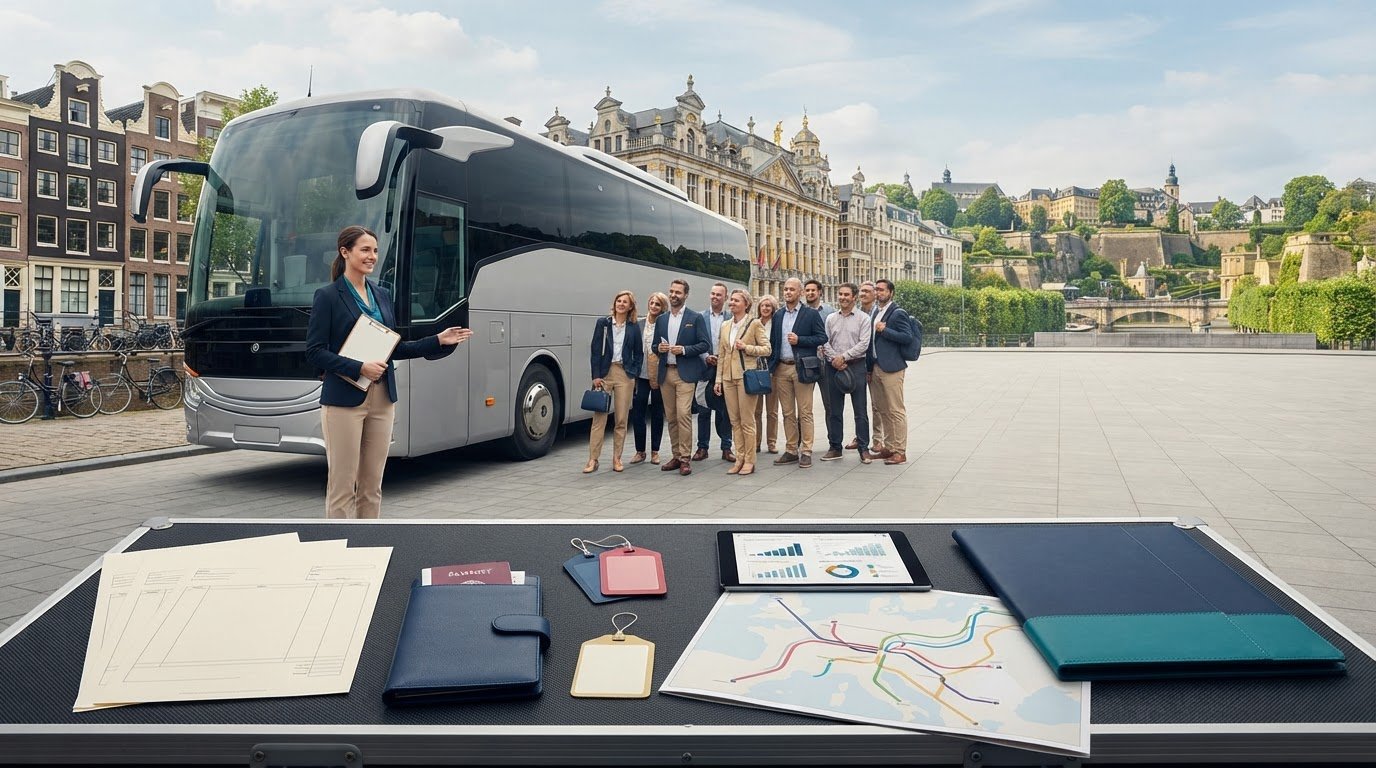
    What if VAT reclaim readiness begins before the tour departs, not when receipts reach the finance team? Cross-border group tour logistics Benelux itineraries can spread records across coach transport, accommodation, activities and several countries. A changed schedule or missing invoice can make those records harder to organise later.

    It’s understandable to focus first on getting the group smoothly from one experience to the next. A clear documentation process supports that journey and makes post-trip preparation more manageable. This guide explains how to organise trip records before and after departure, understand the main VAT reclaim routes, and separate operational documentation from decisions about tax eligibility.

    We’ll cover practical ways to track supplier invoices, services delivered and itinerary changes, while keeping in mind that VAT treatment depends on the business and purchase. Coordinated planning matters: BELUNE brings more than 20 years of group travel experience, arranging coach transport, accommodation, local guides and customised itineraries. That operational coordination can help create a clearer record of the journey, while tax decisions remain with the tour operator and its tax adviser.

    Key Takeaways

    • Map each itinerary segment to its supplier, service, invoice, payment record and an owner responsible for follow-up.
    • Use an expense register to flag unanswered VAT questions without assuming every tour cost is eligible for reclaim.
    • Compare record ownership and hand-offs across internal finance review, direct handling and specialist tax support.
    • Build a version-controlled tour file that links booking changes to supporting documents from planning through post-trip reconciliation.
    • Well-coordinated cross-border group tour logistics benelux can make itinerary updates and supplier records easier for operators to organise.

    Why cross-border group tour logistics make VAT reclaim harder to manage

    One group itinerary can involve accommodation, coach transport, local guides, activities and other suppliers, each with its own booking trail and invoice. For operators managing cross-border group tour logistics benelux, the challenge is more than collecting receipts. Records need to stay connected to the right service, supplier, transaction and country as plans evolve.

    VAT reclaim readiness means having organised evidence for review, not assuming every expense qualifies. Operational coordination helps establish what was booked and delivered. Tax eligibility depends on the operator’s circumstances and the applicable rules. Organise records around the trip’s services and transactions, not just its headline itinerary.

    This short video offers a broader look at cross-border logistics as a coordinated process:

    Which parts of a group tour create separate records?

    Accommodation, coach transport, guiding, admissions and hosted experiences may each involve a different supplier and service. Keep their records distinct. An invoice documents a charge, a booking confirmation records the agreed arrangements, a payment record shows settlement, and the itinerary places the service within the trip. Together, these documents help create a coherent file, but no single document proves every detail.

    Keep a clear trail when arrangements change. If a booking is amended, cancelled or replaced, retain the updated confirmation and note which itinerary version reflects the change. Otherwise, an invoice may describe a service that no longer matches what the group received.

    Why a single trip does not mean one VAT treatment

    A package may feel like one experience to the traveller, but the country, supplier, service type and operator’s circumstances can all affect how a purchase is treated. The EU has a common system of value-added tax, but that does not mean every expense across member states follows an identical route or qualifies for recovery. Current rules, conditions and exceptions need specialist verification before decisions are made.

    Keep the operational file factual, then direct open tax questions to the operator’s finance team or tax adviser. A DMC can coordinate itinerary components and supplier updates, helping keep the operational record orderly without deciding eligibility. For a wider view of this operational role, see the Benelux incoming tour operator guide.

    How to map VAT reclaim questions across a multi-country tour

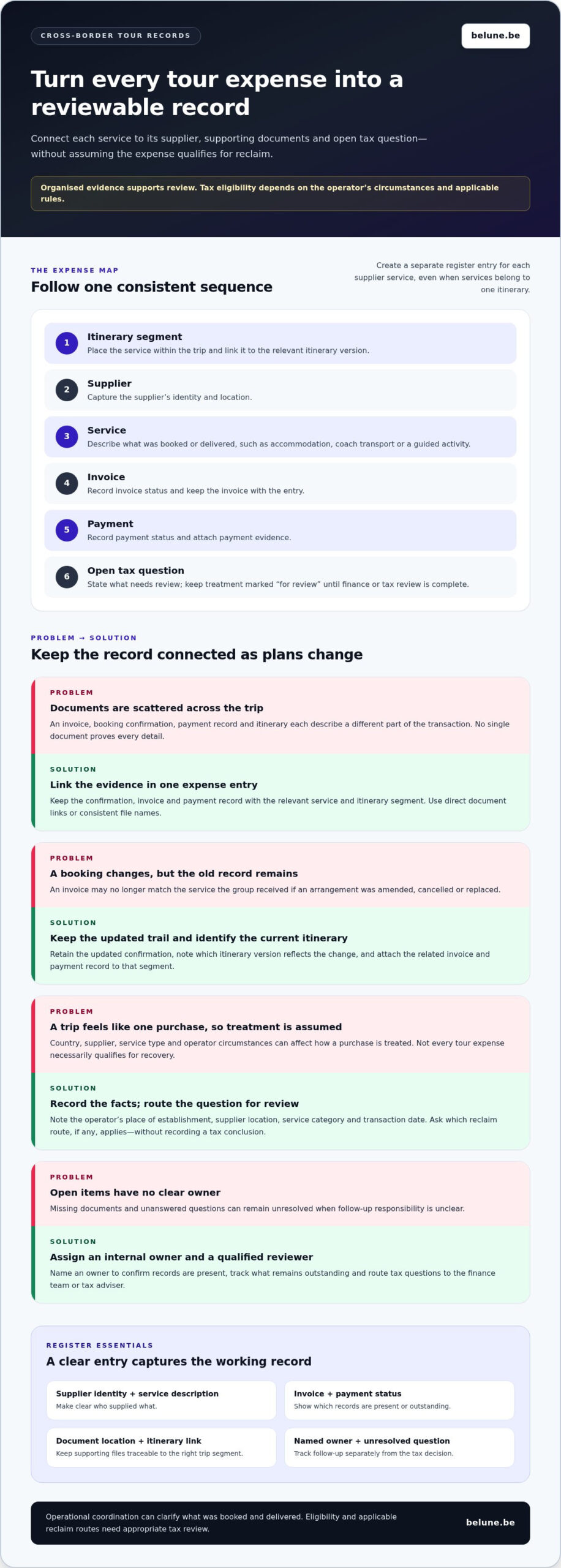
    A working expense map turns a complex itinerary into a series of reviewable records. For cross-border group tour logistics benelux, use the same sequence for each purchase: itinerary segment, supplier, service, invoice, payment, open tax question. This helps trace an expense from the group’s plans to its supporting paperwork without turning the operational record into a tax decision.

    Build an expense map before confirming the itinerary

    Create one register entry for each supplier service, then connect it to the relevant trip segment. An accommodation booking, coach service and guided activity should each have their own record, even when they form part of one itinerary. Every expense needs traceable supporting documentation.

    Capture the supplier’s identity, a clear service description, invoice status, payment status, document location and a named internal owner. Link source documents directly where possible, or use consistent file names that make them easy to retrieve. Keep tax treatment marked “for review” until the appropriate finance or tax review is complete.

    Flag items that may need closer attention, such as bundled services, shared costs or amended arrangements. For example, if a coach booking is replaced, attach the updated confirmation, invoice and payment record to the relevant itinerary segment. This reduces the chance of someone mistaking an old document for the final arrangement.

    Record the questions that determine the next step

    Alongside each expense, record the details a qualified tax adviser may need to assess its treatment: the operator’s place of establishment, the supplier’s location, the service category and the transaction date. Add a concise question rather than a conclusion, such as “Which reclaim route, if any, applies to this service?” The European Commission’s EU VAT information provides an official starting point for understanding the framework. An adviser can assess how current rules and the operator’s circumstances apply.

    Assign one person internally to follow each item through to resolution. They can confirm that records are present, note what remains outstanding and route the question to the right reviewer. This keeps operational coordination separate from decisions about eligibility or filing.

    • Map: Connect each service to its itinerary segment and supplier.
    • Attach: Store confirmations, invoices and payment evidence with the entry.
    • Assign: Name an owner and record the unresolved tax question.
    • Review: Have a qualified adviser assess the applicable rules and route.

    Clear supplier details and itinerary links also support smoother coordination across accommodation, coach transport and local services. Explore BELUNE’s group travel coordination for an operational perspective on bringing those elements together.

    Benelux Group Tour Logistics: VAT Reclaim Guide

    How to compare VAT reclaim routes without confusing them with tour logistics

    Once trip records are organised, the next decision is who will review and manage the VAT questions. Treat this as a workflow choice, not a conclusion about eligibility. The appropriate route depends on current rules and the operator’s circumstances. Cross-border VAT refunds guidance from the European Commission is a useful starting point, but procedures must be checked for the relevant jurisdiction and transaction.

    Three common workflow models can help clarify responsibilities. None is universally faster, cheaper or more advantageous. Compare them by who owns the work, which records they need and where specialist review enters.

    Workflow model Ownership Records and review points Typical hand-off
    Direct operator handling Operator staff manage the process. Supplier documents, payment evidence and transaction details; internal checks and tax review where needed. Finance gathers the file and refers unresolved questions to a qualified adviser.
    Internal finance review Finance leads reconciliation and issue tracking. Expense register, source documents and a log of open questions; review focuses on completeness and consistency. Finance escalates jurisdiction-specific or complex matters for specialist assessment.
    Specialist tax support A qualified external specialist reviews applicable tax issues. Organised transaction records and details about the operator, supplier, service and timing. Operations and finance provide evidence; the specialist advises on the relevant process.

    What operators can handle internally

    Teams can collect supplier documents, reconcile payments against invoices and maintain a consistent expense register. They can also assign owners, flag missing records and track each question’s status, such as “documents outstanding,” “ready for review” or “advice received.” This brings structure to cross-border group tour logistics benelux, but record organisation alone does not establish whether a transaction qualifies for reclaim.

    When a tax review becomes essential

    Seek qualified review for mixed-service packages, cross-border transactions or unusual supplier arrangements, especially when records do not clearly describe what was supplied. Ask the reviewer to verify applicable procedures, deadlines and required documents for each relevant jurisdiction using current information. Keep the operational file separate from the tax conclusion: tour teams record what was booked, changed and delivered, while finance and tax reviewers assess the treatment.

    The hand-off works best when the file is orderly and the questions are specific. A DMC can help coordinate accommodation, coach transport and local services, while the operator retains responsibility for tax decisions and reclaim arrangements.

    How to prepare a cross-border tour VAT file before departure and after return

    A reliable file takes shape over the life of the trip, not in a last-minute search for receipts. For cross-border group tour logistics benelux, use a simple sequence: plan the record system, capture documents as bookings are made, track changes, reconcile after travel, then prepare questions for review. Keep operational evidence separate from tax conclusions, which a qualified adviser must validate.

    Before departure: establish the record system

    Assign a document owner for each supplier or trip segment, and agree on a consistent naming format. For example, use the segment, supplier and document type so a coach confirmation can be found without searching through unrelated accommodation files. Keep one controlled itinerary as the current version, and retain dated versions when arrangements change.

    Collect booking confirmations, invoices and payment evidence as they arise. Maintain a short review list for missing documents and unresolved VAT questions. This gives the team a clear view of what is ready, what needs follow-up and what belongs with finance or a tax adviser.

    • Plan: Set up folders, naming conventions, owners and the itinerary version log.
    • Book: File each supplier confirmation against the relevant segment.
    • Collect: Add invoices and payment evidence as they arrive.
    • Track: Record amendments and link each change to its supporting document.
    • Reconcile: After the tour, compare the file with services delivered.
    • Prepare: Index the evidence and list questions for review.

    After the tour: reconcile and close the file

    Compare final supplier invoices and payments with the itinerary the group actually followed. If a planned activity was substituted or a booking cancelled, retain the original record alongside the updated confirmation, credit or cancellation document. A brief change note should state what changed, when it changed and which itinerary version reflects the final arrangement.

    Then create an index that points to each supplier record and flags anything missing or unclear. Keep the documents operators collect distinct from judgments about reclaim eligibility. Ask a qualified tax adviser to validate applicable procedures, required evidence and record-retention rules for the relevant circumstances and jurisdictions.

    A well-ordered operational file is easier to hand over and review. For broader partner context, read the group travel agency selection guide. BELUNE coordinates accommodation, coach transport and local services as part of customised group itineraries. Explore BELUNE’s group travel coordination for an approach to bringing those moving parts together.

    How a DMC can support smoother Benelux group tour logistics

    A multi-country group itinerary is a connected operation: accommodation, coach transport and local guidance need to fit around the group’s schedule. A destination management company (DMC) can coordinate those moving parts, helping the operator work from clear booking details and consistent itinerary updates. For cross-border group tour logistics benelux, that operational structure can also make it easier to organise trip records by service and supplier.

    Coordinate trip services while keeping tax responsibilities clear

    Consider a tour that combines hotel stays, coach transfers and guided visits. If an arrangement changes, a coordinated update can help the operator identify which service, booking and itinerary segment were affected. Keeping those details aligned supports orderly record-keeping, but it does not determine the VAT treatment of a purchase.

    Operational coordination and tax decisions are separate responsibilities. VAT eligibility and reclaim filings depend on applicable rules and the operator’s circumstances, and remain matters for the operator and its qualified tax adviser. BELUNE coordinates group travel; it does not provide VAT advice or determine reclaim outcomes.

    Turn a complex itinerary into a more manageable operation

    Accommodation, coaches and local guidance work best when planned as parts of one considered itinerary. A change to a service may affect the group’s timing or surrounding arrangements, so keeping the operational picture current helps the operator track what was planned and what was delivered. Clear supplier and service details also give the finance team a more coherent starting point for organising records.

    BELUNE brings more than 20 years of group travel and transport experience, with accommodation management, local guide services, customised itineraries and its own fleet of modern coaches. This practical coordination supports professional group operators in shaping trips around their objectives while keeping the travel components connected.

    For a tailored itinerary, share your group profile, travel dates and goals with BELUNE. Discuss a customised group itinerary with BELUNE.

    Build a smoother journey from the first booking

    Strong cross-border group tour logistics benelux begin with two clear practices: connect each supplier record to the service and itinerary segment it supports, and keep operational documentation separate from decisions about VAT eligibility. A consistent process for collecting confirmations, invoices, payment records and change notes makes post-trip review more orderly. Tax treatment and reclaim routes still depend on the operator’s circumstances and current rules, so those decisions belong with the operator and its qualified tax adviser.

    Good coordination supports the journey itself, too. With more than 20 years of group travel and transport experience, BELUNE brings together accommodation management, local guidance, customised itineraries and its own modern coach fleet. Each element can be planned as part of a connected group experience, while the operator retains responsibility for tax matters.

    Give your next itinerary a thoughtful operational foundation. Plan a tailored group itinerary with BELUNE and take the next step toward a well-coordinated trip your group can enjoy with confidence.

    Frequently Asked Questions

    Can tour operators reclaim VAT on cross-border group travel expenses?

    Sometimes, but tour operators may reclaim VAT on eligible expenses only when applicable rules and their circumstances permit it. A cross-border trip does not make every supplier charge reclaimable. The operator’s establishment, service type, transaction and supporting documentation can all matter. Keep records organised, then have a qualified tax adviser verify eligibility and the appropriate refund procedure before treating an amount as recoverable.

    How do tour operators manage VAT records for a multi-country group tour?

    Use one expense register to connect each purchase to its itinerary segment, supplier, service, invoice and payment record. For cross-border group tour logistics benelux, assign an internal owner to each entry and track missing documents or open tax questions. Keep dated itinerary versions and link amendments to the relevant confirmations. This creates a clear operational record without turning the register into a decision about tax eligibility.

    What documents should operators keep for a tour VAT reclaim?

    Keep supplier invoices, booking confirmations, payment evidence and contracts or service details where available. Retain itinerary versions and records of changes, cancellations, substitutions or credits so the file reflects what the group actually received. Link documents to the supplier and trip segment in an indexed register. A qualified tax adviser can identify any additional evidence required for the operator’s circumstances and relevant jurisdiction.

    Does VAT reclaim work the same way in every Benelux country?

    No. VAT treatment and refund procedures can differ by country, transaction and operator circumstances, even when services belong to the same tour. Do not assume that a document or process suitable for one jurisdiction applies unchanged in another. Identify where each service and transaction belongs, then ask a qualified tax adviser to verify current local requirements, applicable procedures and relevant exceptions before preparing a claim.

    Can coach transport and accommodation be treated as one tour expense?

    They may be coordinated as parts of one itinerary, but keep coach transport and accommodation identifiable as separate supplier services in the operational records. Their invoices, booking details and payment evidence may differ, and tax treatment can depend on the specific arrangements. If they are sold or invoiced together, preserve the package documentation and ask a qualified tax adviser how the transaction should be assessed.

    When should a tour operator review VAT reclaim requirements?

    Start when planning the itinerary, before records become difficult to reconstruct. Review again as bookings are confirmed, services change and the trip is reconciled after return. Early review gives the operator time to identify missing documents and direct questions to a qualified tax adviser. Verify current procedures, required evidence and deadlines for each relevant jurisdiction rather than relying on assumptions from a previous tour.

    What is the role of a DMC in cross-border tour VAT administration?

    A DMC coordinates operational elements such as accommodation, coach transport, local guidance and itinerary updates. Consistent booking details can help an operator organise supplier records and understand which services were planned or changed. A DMC’s operational role is distinct from tax administration: the operator and its qualified tax adviser assess VAT eligibility and reclaim procedures. A DMC does not determine tax outcomes simply by coordinating the trip.

  • Strategic Benelux Tour Operator Partner: A Masterclass in Group Travel Logistics for 2026

    Strategic Benelux Tour Operator Partner: A Masterclass in Group Travel Logistics for 2026

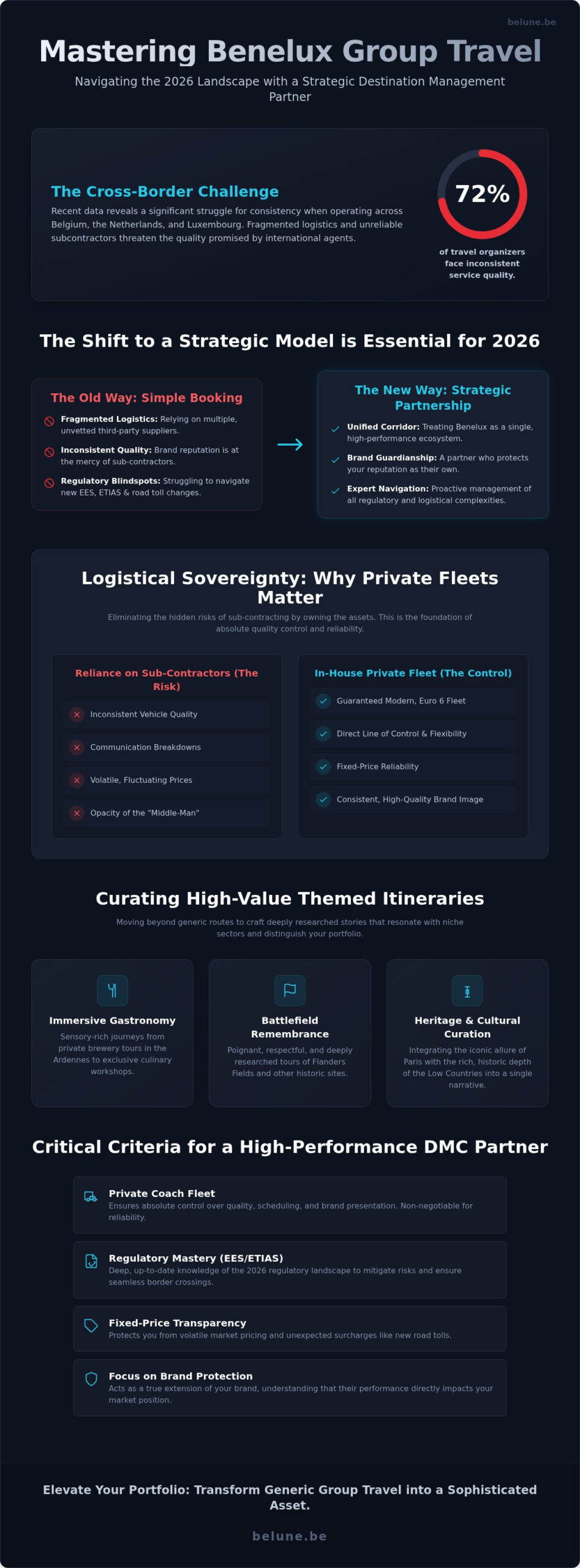
    Recent data from Global Group Insights reveals that 72% of travel organizers struggle to maintain a consistent quality of service when crossing the borders of Belgium, the Netherlands, and Luxembourg. It’s a frustrating reality for international agents who promise excellence but often find themselves at the mercy of fragmented logistics and unreliable local sub-contractors. You’ve likely felt the tension of managing high-end expectations against the backdrop of rising road tolls and complex new EU mobility regulations. Choosing the right benelux tour operator partner isn’t just about booking a bus; it’s about securing a strategic ally who treats these three nations as a single, unified corridor of opportunity.

    This masterclass explores how a partnership built on logistical sovereignty can transform your 2026 group travel offerings. You’ll discover how owning the assets, from a private fleet of modern coaches to deeply researched heritage itineraries, ensures your brand remains protected and your execution remains seamless. We’ll reveal the technical precision required to navigate the new EES and ETIAS landscape while delivering the soulful, gastronomy-led experiences your clients crave. We’re moving beyond simple procurement to a vision where every mile is an art form and every itinerary is a masterpiece of cultural curation.

    Key Takeaways

    • Learn why shifting from simple bookings to a strategic destination management model is essential for navigating the complex 2026 regulatory landscape.
    • Understand how choosing a benelux tour operator partner with a private coach fleet eliminates the risks of sub-contracting and ensures absolute quality control.
    • Discover the art of curating high-value themed tours, from specialized battlefield remembrance to immersive gastronomy experiences that resonate with niche sectors.
    • Identify the critical criteria for selecting a high-performance DMC, focusing on fixed-price transparency and deep regional expertise.
    • Explore how professional management in the Benelux region transforms generic group travel into a sophisticated portfolio asset. It’s the key to enhancing your brand’s market position.

    Defining the Role of a Strategic Benelux Tour Operator Partner

    The evolution of group travel in Western Europe has reached a pivotal junction. For international travel agents, the era of simply booking a bus or reserving a block of rooms is over. Success in 2026 requires a deeper alliance. A strategic benelux tour operator partner acts as an extension of your own brand; a guardian of your reputation who understands that logistical failure is a direct threat to your market position. We see the Benelux Union not just as a geographic cluster, but as a fluid, high-performance travel ecosystem that demands technical mastery and local intuition. Integrating the sophisticated charm of Paris with the historic depth of the Low Countries creates a narrative that requires more than just a supplier; it requires a visionary strategist.

    The DMC Advantage for International Agents

    The landscape of 2026 is defined by shifting regulations, from the full implementation of the Entry/Exit System (EES) to the introduction of ETIAS. These aren’t just administrative hurdles; they’re logistical variables that can derail a group tour if not managed with local authority. A dedicated Benelux incoming tour operator provides the essential risk mitigation required to navigate these changes. We move beyond the role of a mere booking agent to become a strategic partner, ensuring that your groups move seamlessly across borders while adhering to the latest EU Mobility Package updates and regional road toll increases. It’s about maintaining absolute sovereignty over the entire chain of service to protect your brand’s promise of excellence.

    Visionary Itinerary Design

    True luxury in travel is found in the narrative. It’s the difference between seeing a monument and understanding the pulse of a nation. With over 20 years of regional experience, we don’t just design routes; we curate stories. This involves a delicate balance of technical precision and artistic travel experiences. Whether it’s the poignant silence of a battlefield in Flanders or the sensory richness of a private brewery tour in the Ardennes, our itineraries are deeply researched and themed to resonate with niche sectors. We integrate the iconic allure of Paris with the heritage of the Benelux, creating a cohesive journey that feels like a single, thoughtfully composed masterpiece. This level of cultural storytelling is non-negotiable for agents who want to distinguish their portfolio in a crowded market.

    Logistical Sovereignty: Why Private Coach Fleets Matter

    Logistical sovereignty is the silent foundation of every successful group tour. For an international agent, the transport component is often the most volatile variable. When you engage a benelux tour operator partner who relies on third-party sub-contractors, you inherit a chain of hidden risks. Vehicle quality becomes inconsistent. Communication breaks down. Pricing fluctuates with the whims of a volatile market. We eliminate these vulnerabilities by maintaining our own private fleet of modern coaches. This ownership isn’t just about assets; it’s about absolute control over the guest experience from the moment they arrive in the heart of Europe until their final departure.

    Asset Control and Group Reliability

    Ownership removes the opacity of the “middle-man” in transport logistics. In the Benelux region, where precision is a cultural expectation, a fifteen-minute delay can compromise a meticulously curated itinerary. By owning the fleet, we offer a level of flexibility that sub-contractors simply cannot match. Last-minute adjustments to a schedule or a sudden change in a group’s pace are managed internally, without the friction of external negotiations. This direct line of control ensures a consistent brand image for your agency. Your clients don’t see a generic rental bus; they see a high-quality, modern vehicle that reflects the sophistication of your travel portfolio.

    Technical Specifications for Modern Group Travel

    Navigating the Benelux landscape in 2026 requires more than just a map; it requires technical compliance. With the Dutch truck toll and the Belgian road toll increase both taking effect on July 1, 2026, fixed-price reliability becomes a critical competitive advantage. Our fleet is fully Euro 6 compliant, a necessity for entering the Low Emission Zones (LEZ) of Amsterdam, Antwerp, and Brussels. We manage the intricacies of the EU Mobility Package, ensuring driver work hours and the 9-hour daily driving limit are planned with surgical precision. This level of technical oversight allows you to secure your 2026 logistics with total confidence.

    According to Belgian travel statistics, the demand for organized, high-quality collective travel continues to evolve, with travelers placing a higher premium on seamless execution and comfort. Our drivers act as logistical ambassadors, blending technical mastery with the social grace required to handle international groups. They don’t just navigate roads; they protect your brand’s reputation at every stop. This human element, combined with modern vehicle comfort, transforms a simple transfer into an integral part of the travel experience.

    Strategic Benelux Tour Operator Partner: A Masterclass in Group Travel Logistics for 2026

    Curating High-Value Themed Itineraries for International Groups

    Generic “highlights” tours have become a commodity in a market that increasingly demands depth and authenticity. For the modern traveler, a trip is no longer just a sequence of sights; it’s a curated narrative. To command premium interest, international agents must offer itineraries that reflect a sophisticated understanding of regional heritage. This is where a strategic benelux tour operator partner becomes indispensable. We provide the intellectual capital and local access required to transform a standard route into an immersive masterclass. According to the OECD Tourism Trends and Policies, there’s a significant shift toward niche, experiential travel that prioritizes cultural immersion over mass tourism. We meet this demand by blending technical logistical precision with an artistic approach to storytelling.

    Battlefield Tourism and Remembrance

    Organizing pilgrimages and remembrance tours requires a delicate balance of historical accuracy and logistical sensitivity. Our approach to Flanders Fields and other significant sites goes beyond simple transport. We provide specialized guides who possess the academic depth to engage both school groups and serious historians. Managing the logistics for commemorative events, such as the Last Post ceremony at the Menin Gate, demands a partner who understands the local protocol and timing constraints of 2026. These aren’t just tours; they’re profound human experiences that require a respectful, expert-led framework to ensure their emotional resonance isn’t lost in logistical friction.

    Gastronomy and Sensory Experiences

    The culinary landscape of the Benelux region is a tapestry of artisanal tradition and modern innovation. We don’t just book restaurants; we curate Belgium gastronomy tours that offer exclusive access to the people behind the craft. This might include a private tasting with a master brewer in the Ardennes or a chocolate-making workshop with a world-renowned chocolatier. By integrating these sensory experiences into a broader cultural itinerary, we create a multi-layered journey that appeals to the discerning traveler’s palate. It’s about finding those hidden, exclusive venues that aren’t accessible to the general public, ensuring your group feels the true pulse of local life.

    Connecting the artistic heritage of the Dutch Masters in the Netherlands to the timeless elegance of Paris requires a cohesive vision. We bridge these worlds by designing tours that trace the evolution of art and culture across borders. Whether your group is exploring the Rijksmuseum or the Louvre, our role as your benelux tour operator partner is to ensure the transition is seamless. We handle the international train and flight bookings, the hotel management, and the local guide services, allowing you to focus on the creative development of your portfolio while we manage the technical execution.

    Criteria for Selecting a High-Performance DMC Partner

    Selecting a benelux tour operator partner requires a shift from superficial vetting to a rigorous assessment of technical infrastructure. In a market where last-minute procurement can lead to price surges of 15%, your partner’s ability to provide stability is your greatest asset. High-performance destination management is defined by the depth of local networks and the physical assets a partner brings to the table. It’s about finding a visionary ally who views your brand’s reputation as their own. We believe that true excellence in travel isn’t found in the absence of challenges, but in the presence of a partner capable of preempting them.

    Financial and Operational Transparency

    Financial security for international agents starts with fixed-price group packages. This structure protects your profit margins against the volatility of the 2026 travel landscape, including the new Belgian road tolls and Dutch truck levies taking effect on July 1, 2026. Verifying a partner’s logistical assets is equally critical. Choosing a group travel agency that owns its fleet significantly reduces financial risk. You aren’t just buying a service; you’re securing a guarantee of quality and reliability that sub-contractors cannot provide. Operational transparency means having clear insight into insurance coverage and safety protocols, ensuring every mile of the journey is backed by professional accountability.

    Accommodation and Local Management

    Managing group-friendly hotels requires more than just making reservations. It involves vetting properties for quality, location, and their ability to handle large-scale logistics with grace. A sophisticated partner ensures that accommodation management is a seamless component of the larger narrative. This extends to the human element of the tour. Multi-lingual local guides are essential for bridge-building in a region where Dutch, French, and German are the official languages. They act as the cultural translators who turn a simple transfer into an experience.

    Coordinating complex logistics across borders, specifically from the Benelux nations to Paris, requires a partner with a unified command structure. This ensures communication remains fluid and on-the-ground support is always available. Whether it’s managing the new EES digital records at the border or coordinating a private event in Brussels, the infrastructure must be fail-safe. If you’re ready to elevate your group travel offerings with a partner that values excellence as much as you do, partner with a Benelux travel expert to secure your 2026 allocations.

    Elevating Your Portfolio with Professional Benelux Management

    The 2026 landscape demands more than just logistical efficiency; it requires a commitment to sustainability and ethical tourism. As Low Emission Zones expand across Amsterdam, Antwerp, and Brussels, your partner’s investment in Euro 6 compliant fleets becomes a cornerstone of your own brand’s environmental responsibility. Leveraging local innovation allows you to stay ahead of travel trends, ensuring your offerings remain relevant in a rapidly changing market. Building a long-term alliance with us provides the consistency of excellence required to maintain high client retention rates. We don’t just manage trips; we help you build a legacy of quality that withstands the test of time and shifting regulations.

    Seamless Integration and Onboarding

    Initiating a partnership for the 2026 season is a collaborative process designed for clarity and precision. It begins with custom itinerary design, where your vision is mapped against our 20 plus years of regional expertise. We establish dedicated communication channels for real-time support, ensuring you’re never left without an answer during on-the-ground execution. This is where you experience the true difference of logistical sovereignty. By securing your allocations by the first quarter of 2025, you avoid the price surges often associated with last-minute procurement, which can reach 15% according to industry reports. This proactive approach ensures your margins remain protected while your quality remains uncompromised.

    The BELUNE commitment is a promise of seamless integration. We become a structural component of your service, handling everything from hotel accommodation management to specialized battlefield guides with the same care you’d apply yourself. This professional management allows you to scale your operations without sacrificing the personal touch that defines your brand. It’s time to move beyond simple procurement and embrace a strategic alliance that magnifies the value of every journey you create. Together, we can transform the Benelux region into a canvas for your most ambitious travel projects.

    Securing Your Vision for the 2026 Travel Landscape

    The future of group travel in the heart of Europe depends on a delicate balance of technical precision and artistic depth. We’ve explored how logistical sovereignty, rooted in the ownership of a private, eco-compliant coach fleet, effectively eliminates the volatility of sub-contracted transport. You now understand that a sophisticated benelux tour operator partner acts as much more than a simple supplier; they’re a vigilant guardian of your brand’s reputation. By prioritizing expert-led heritage programs and transparent fixed-price structures, you secure both your profit margins and your promise of excellence to your clients. Our team brings over 20 years of bespoke DMC expertise to every itinerary, ensuring that the complex regulations of 2026 become seamless background elements to a profound cultural narrative. It’s time to move beyond generic bookings and embrace a strategic alliance built on absolute trust and artisanal quality. We’re ready to help you elevate your portfolio with the rigour and sensitivity your international groups deserve.

    Request your bespoke Benelux group itinerary from our experts today

    Let’s design a journey that resonates for years to come.

    Frequently Asked Questions

    What are the primary benefits of partnering with a DMC that owns its own coach fleet?

    Partnering with a DMC that owns its private fleet provides you with absolute logistical sovereignty. It effectively eliminates the risks associated with unreliable sub-contractors and ensures a consistent brand image across every mile. You gain direct control over vehicle quality and scheduling flexibility, which is critical for complex 2026 itineraries. This asset ownership allows your benelux tour operator partner to respond instantly to last-minute adjustments while maintaining the highest safety and environmental standards.

    How does a Benelux tour operator partner handle multi-country itineraries involving Paris?

    We manage multi-country journeys by treating the Benelux region and Paris as a single, cohesive narrative. Our team coordinates international train and flight bookings alongside our private coach transfers to ensure fluid transitions. By maintaining a unified command structure, we eliminate the friction of cross-border logistics. This approach allows international agents to offer integrated Western European portfolios where the transition from Amsterdam’s canals to the boulevards of Paris feels effortless and technically perfect.

    What specialized themes are most popular for group travel in the Benelux region for 2026?

    High-value themes for the 2026 season focus on immersive cultural storytelling rather than generic sightseeing. Remembrance tourism in Flanders Fields remains a cornerstone, alongside specialized gastronomy and beer masterclasses in Belgium. Art history tours connecting the Dutch Masters to Parisian galleries are also in high demand. Your benelux tour operator partner can also integrate major events like F1 Francorchamps or international music festivals into these curated experiences to create truly unique selling points.

    Can a local partner provide fixed-price guarantees for large group packages?

    Providing financial security through fixed-price group tour packages is a core part of our professional commitment. This transparency allows international agents to protect their profit margins against the volatility of the 2026 travel market. We account for all variables, including the upcoming Belgian road toll increases and Dutch truck levies, within our initial proposals. You receive a guaranteed price that ensures your financial planning remains as robust as the logistical execution we provide.

    What level of support can international travel agents expect during on-the-ground operations?

    Agents can expect a level of on-the-ground support that functions as a seamless extension of their own team. We establish dedicated communication channels to provide real-time updates and immediate problem-solving during tour execution. This proactive management style ensures that any logistical challenges are handled before they impact the guest experience. It’s a strategic alliance built on technical rigour and a shared commitment to protecting your brand’s reputation at every stop.

    How are local guides selected for specialized tours like battlefield or art history?

    Our local guides are selected through a rigorous process that prioritizes academic expertise and the ability to weave technical facts into emotive narratives. For specialized sectors like battlefield tourism or art history, we only work with experts who possess deep regional knowledge and multilingual proficiency. These individuals are more than just guides; they’re cultural ambassadors who transform a trip into a profound human experience through their passion and precision.

    What makes the Benelux region a strategic choice for group travel in Western Europe?

    We ensure safety and comfort by maintaining absolute control over our entire service chain. Our private fleet of modern coaches is Euro 6 compliant and equipped with the latest comfort features for multi-day tours. We strictly adhere to the 2026 EU Mobility Package regulations, including driving time limits and rest cycles, to protect both guests and staff. This technical oversight, combined with our 20 plus years of experience, guarantees a secure and serene travel environment.