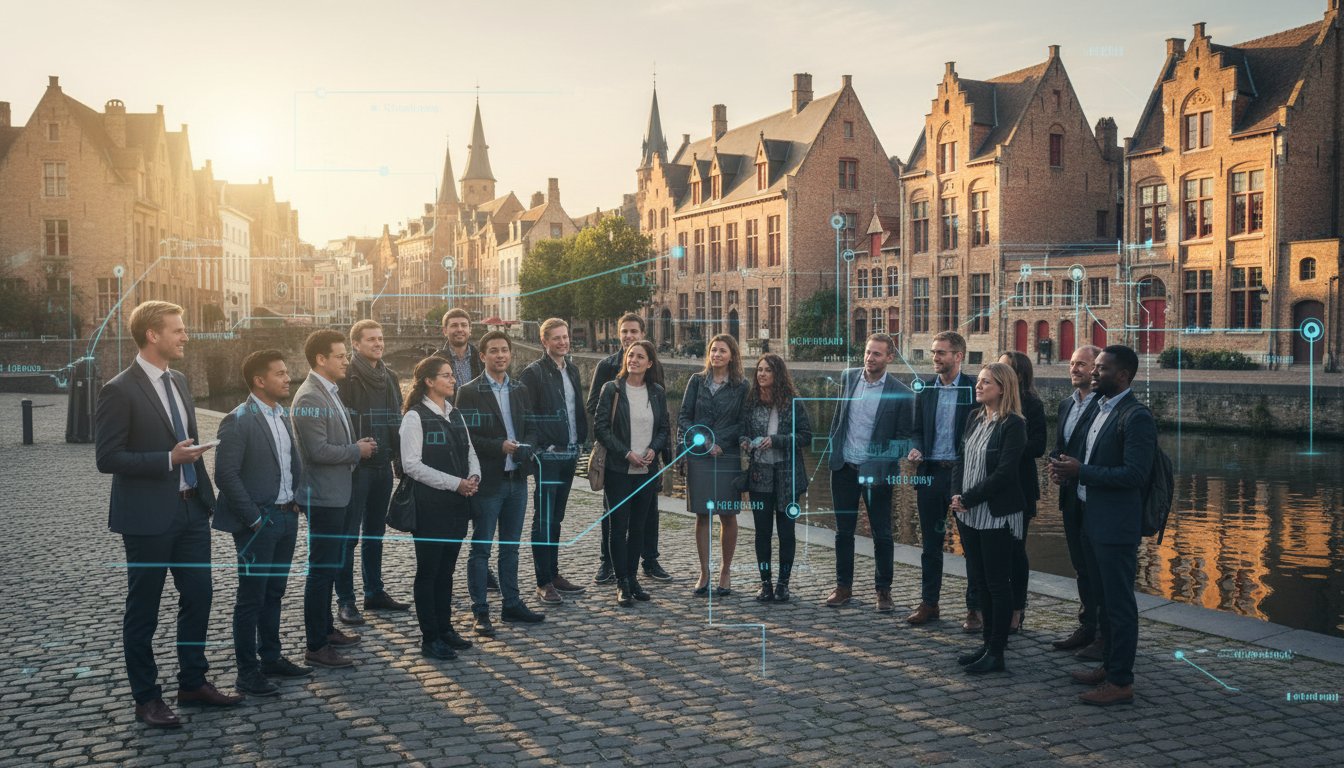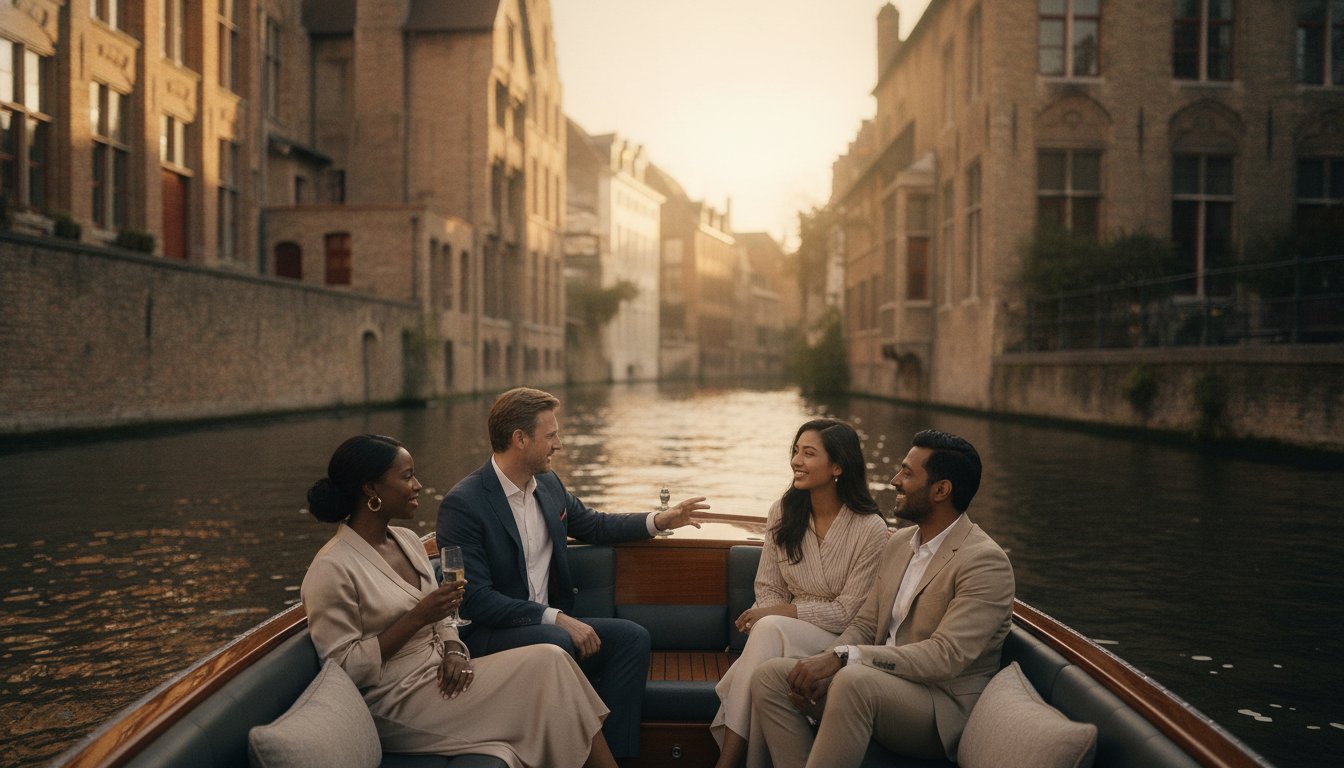
Brugge is not a museum to be visited; it is a stage to be choreographed. In a city that welcomed nearly eight million visitors in 2024, the difference between a standard excursion and an exclusive heritage experience lies in the precision of the planner. Designing a sophisticated Brugge group tour itinerary for 2026 requires more than just a list of landmarks. It demands an intimate understanding of a shifting landscape where the new 20-person limit on walking tours and the €4.20 daily tourist tax are just the start of the logistical puzzle.
You know that true luxury is found in seamless movement and quiet moments away from the crowds. This guide helps you master the logistical choreography and cultural depth required to design a high-end experience in the heart of Flanders. We’ll explore how to navigate the 2026 coach parking fees at Bargeweg, manage the rising VAT adjustments on hotel stays, and secure exclusive access to heritage sites that remain hidden from the average traveler. From securing private canal tours to selecting authentic dining that avoids the tourist traps, we provide the technical rigueur and artistic vision to transform your next project into an effortless masterpiece.
Key Takeaways
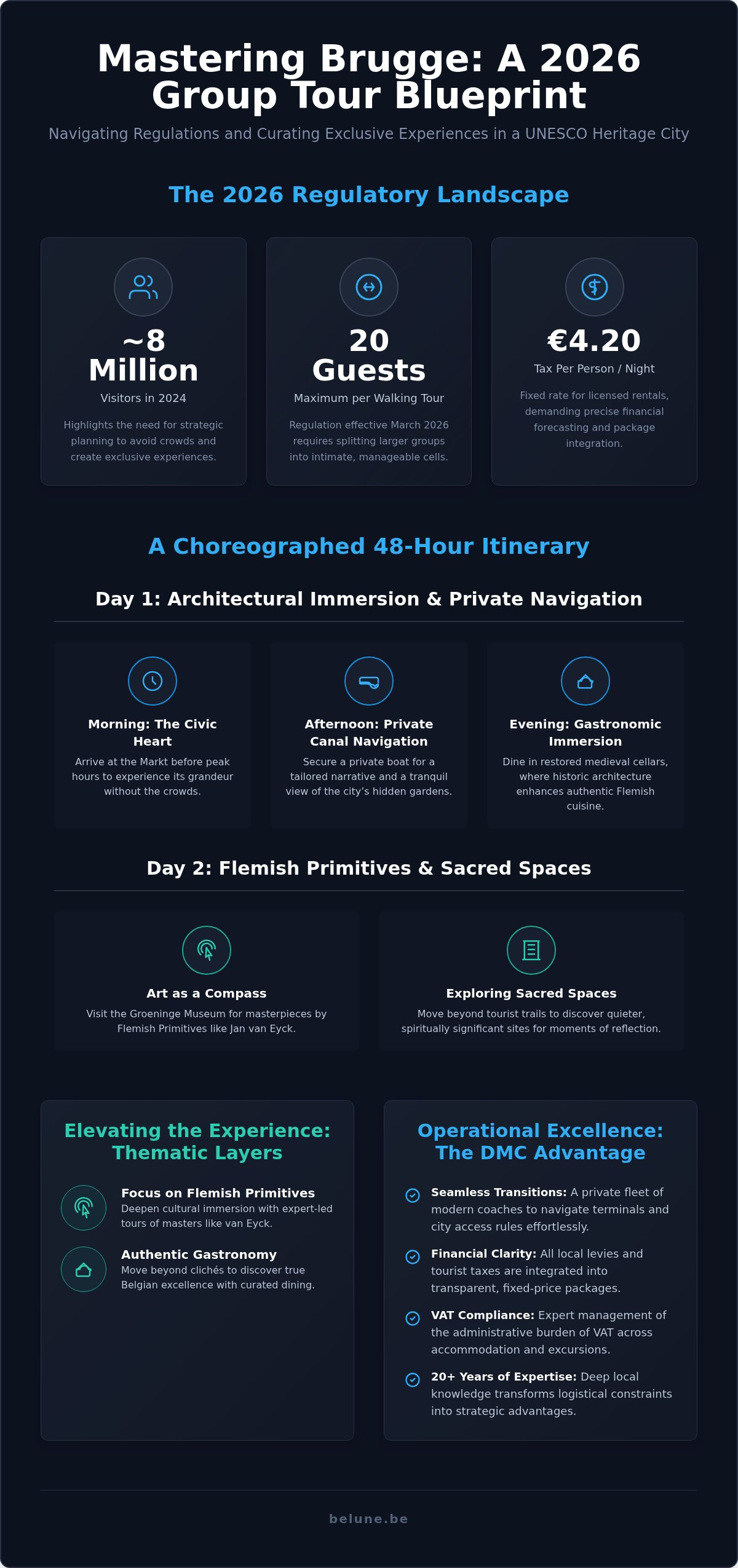
- Master the 2026 regulatory landscape, including the 20-person limit for walking tours and updated tourist taxes, to ensure a smooth guest experience.
- Discover a refined 48-hour Brugge group tour itinerary that balances the city’s civic heart with its spiritual soul through private canal navigation and exclusive gallery access.
- Elevate your programming with thematic layers focusing on the Flemish Primitives and authentic gastronomy that moves beyond clichés to true Belgian excellence.
- Navigate the complexities of the Kanaaleiland terminal and city access rules using a private fleet of modern coaches for seamless transitions.
- Leverage 20+ years of DMC expertise to transform logistical constraints into a strategic advantage for your international travel projects.
The 2026 Brugge Group Landscape: Heritage Meets Regulation
Brugge presents a unique challenge for the modern strategist. We call it the Brugge Paradox. It’s the delicate tension between the city’s status as a premier global destination and the rigorous preservation required to maintain its soul. In 2024, nearly eight million visitors traversed these cobblestone streets, mostly as day-trippers. For a Brugge group tour itinerary to succeed in 2026, it can’t simply follow the path of the crowd. It must be an exercise in logistical precision and artistic curation.
The UNESCO Framework for Group Planning
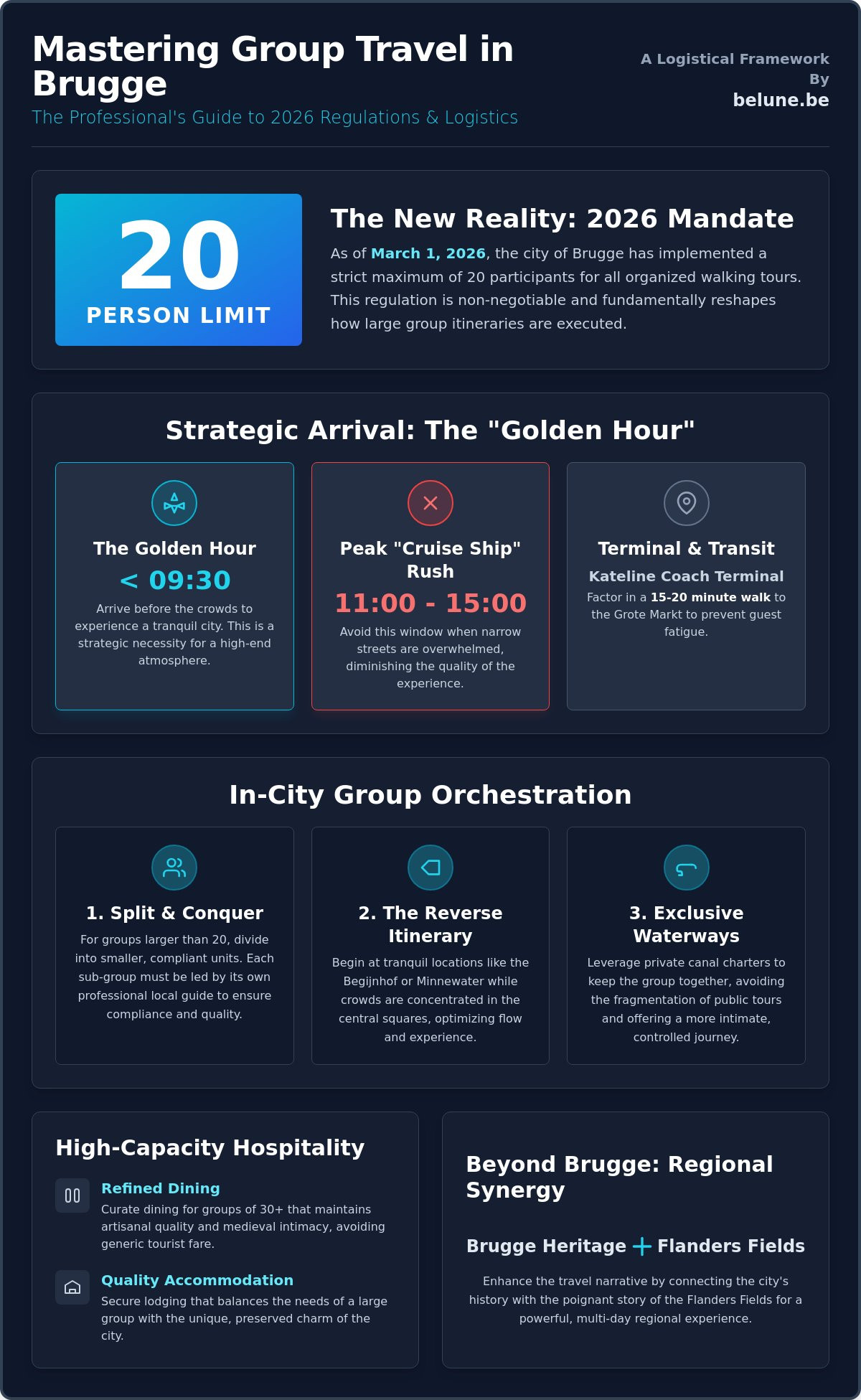
The Historic Centre of Bruges is a living tapestry of medieval architecture. This UNESCO designation isn’t just a badge of honor; it’s a regulatory framework that dictates how we move through the space. Since March 1, 2026, the city has enforced a strict limit of 20 participants per organized walking tour, excluding the guide. This shift demands a modular approach to group management. Large delegations must now be split into smaller, intimate cells to respect both the law and the spatial constraints of the city’s narrow arteries. Timing is equally critical. We advise scheduling major movements for early morning or late afternoon to maintain a sense of exclusivity and avoid the midday swell of day visitors.
Fiscal Readiness: Taxes and VAT in 2026
Financial planning for 2026 requires a sharp eye on local fiscal shifts. As of March 1, 2026, the tourist tax for licensed holiday rentals is fixed at €4.20 per adult per night. These costs, combined with specific VAT requirements for multi-service packages, can create administrative friction for international partners. Navigating these details is where a strategic ally becomes essential.
Our team at BELUNE simplifies this complexity through several key interventions:
- We integrate all local levies and tourist taxes into transparent, fixed-price group packages for our B2B partners.
- We manage the administrative burden of VAT compliance across hotel accommodation management and local excursions.
- We provide a single point of financial contact, ensuring no hidden costs or regulatory surprises disrupt your project margins.
Viewing Brugge as a logistical puzzle rather than a mere destination is the hallmark of a professional strategist. It’s about transforming these heritage constraints into a curated, high-end experience that feels effortless to the end client. Success in 2026 depends on this ability to choreograph movement within a highly regulated, historic environment.
A Choreographed 48-Hour Brugge Group Itinerary
A successful Brugge group tour itinerary is more than a sequence of stops; it’s a rhythmic exploration of space and time. We design these 48 hours to minimize friction and maximize sensory impact. The transition from the coach drop-off at Bargeplein to the medieval heart is the first movement in this choreography. By utilizing our private fleet of modern coaches, we ensure your guests arrive refreshed and ready to step into the 14th century without the fatigue of complex public arrivals.
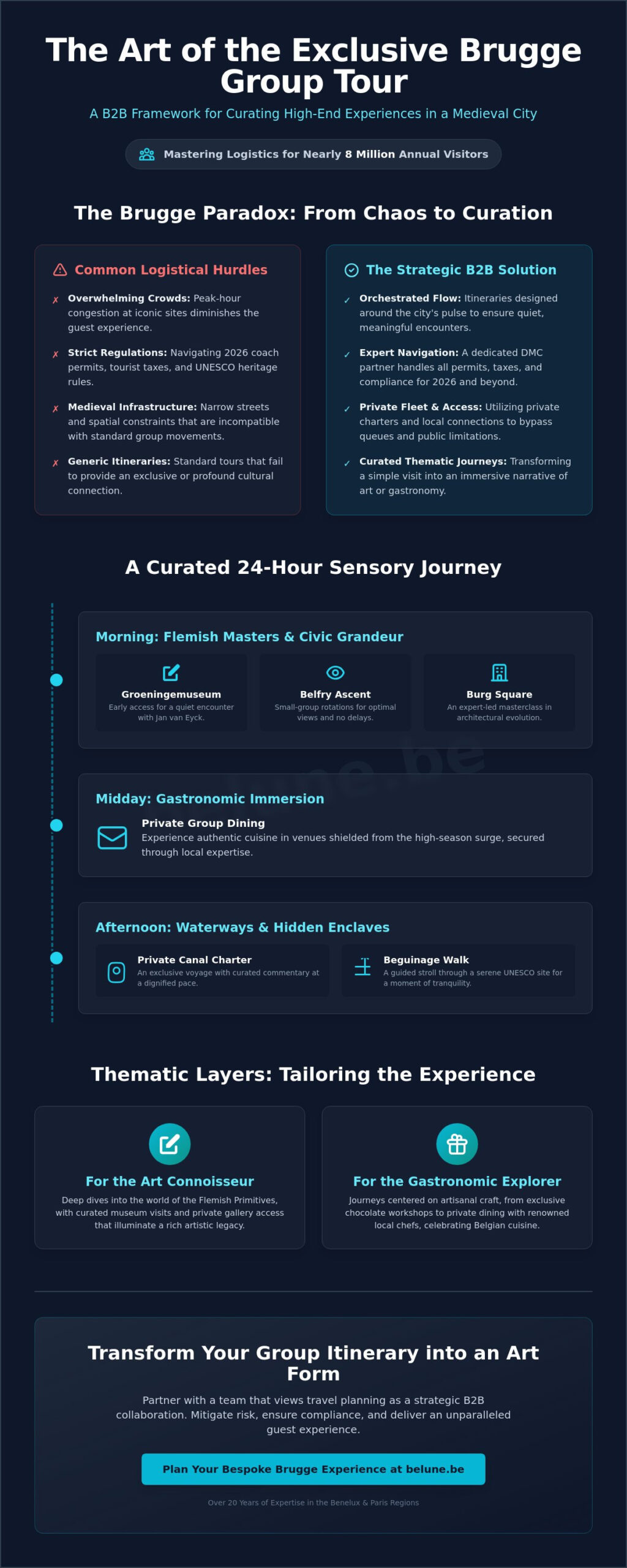
Day 1: Architectural Immersion and Private Navigation
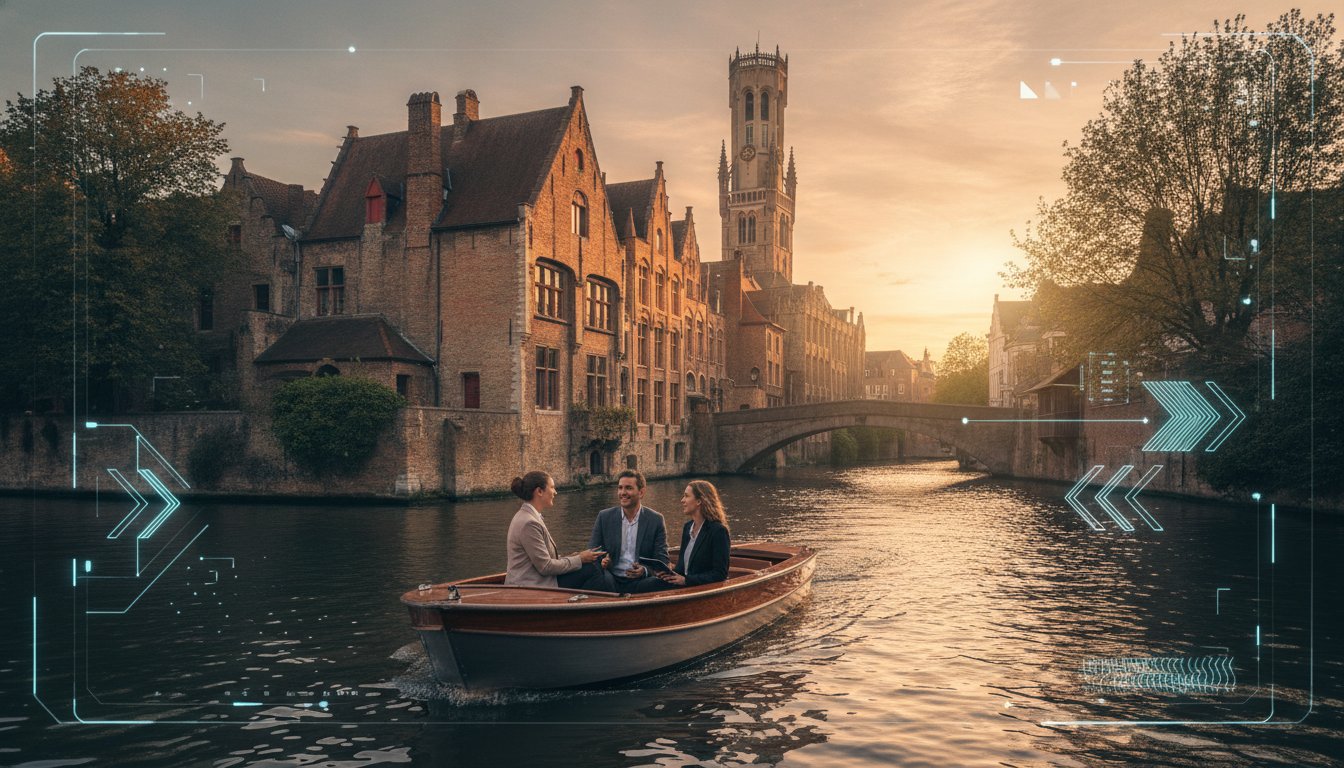
The morning begins at the Markt. To capture the square’s grandeur without the distraction of thousands of day-trippers, we arrive before the peak hours. The Belfry stands as a silent sentinel over the civic heart. After a curated walk, we move to the water. While standard canal tours are a staple, we prioritize private group boats. This allows for a tailored narrative and a tranquil perspective on the city’s hidden “back gardens.” For the most current schedules and event overlays, we always cross-reference with official Bruges tourism information to ensure no local festivities disrupt the planned flow.
The first day concludes with a gastronomic dinner. We select restored medieval cellars where the architecture enhances the flavors of Flemish cuisine. It’s an immersive experience that grounds the group in the city’s historical weight. If you’re looking to elevate these moments, our Belgium gastronomy tours offer a deeper dive into the region’s culinary heritage, moving beyond the standard fare to find true artisanal excellence.
Day 2: The Flemish Primitives and Sacred Spaces
Art serves as our compass for the second day. The Groeninge Museum offers an encounter with the Flemish Primitives, including the intricate masterpieces of Jan van Eyck. This is where technical mastery meets spiritual depth. To avoid the standard tourist trails, we lead groups through the Prinsenhof area. These hidden enclaves provide the “breathing space” essential for a high-end experience. It allows guests to process the visual richness they’ve encountered at their own pace, fostering a deeper connection to the environment.
The journey finds its resolution at the Beguinage. This tranquil UNESCO site, with its white-washed houses and monastic silence, offers a profound contrast to the morning’s artistic intensity. We ensure the walk back to the coach is unhurried, allowing the city’s atmosphere to linger. This balance of structured discovery and quiet reflection is what transforms a simple visit into a lasting memory. Our team at BELUNE acts as your strategic ally to ensure every detail of this heritage journey is executed with flawless precision.
Thematic Layers: Customizing for Art and Gastronomy
A sophisticated Brugge group tour itinerary is a multi-dimensional canvas. We don’t just show sights; we layer experiences that resonate with the intellectual and sensory desires of high-end travelers. For the discerning planner, art and gastronomy are not separate activities. They are intertwined narratives of Flemish identity. By weaving these themes into a cohesive “Benelux Discovery” program, we transform a simple visit into a profound cultural immersion.
The Flemish Primitive Art Deep-Dive
The legacy of Jan van Eyck and Hans Memling defines the visual language of the city. We coordinate expert-led tours of the Sint-Janshospitaal (St. John’s Hospital), where the proximity to 15th-century masterpieces creates an intimate atmosphere. Managing group flow in these small, fragile chapel environments is a technical challenge we solve through precise scheduling and the 20-person modular cell approach mentioned earlier. As noted in expert travel tips for Bruges, prioritizing these core artistic sites ensures a high-impact journey that avoids the fatigue of over-saturated sightseeing.
For groups with a deeper interest in art history, a natural itinerary extension includes a short journey to nearby Ghent. Here, the “Adoration of the Mystic Lamb” provides the ultimate resolution to the Flemish Primitive narrative. This cross-city coordination requires the logistical backbone of a private coach fleet to maintain a seamless transition between these two medieval powerhouses.
Gastronomy and the Belgian Beer Experience
True luxury in Flanders is found at the table. We move beyond the common waffle stalls to curate authentic Belgium gastronomy tours that highlight the region’s culinary evolution. This involves sourcing group-friendly venues that maintain Michelin-level standards while offering the warmth of a private estate. Chocolate workshops also provide significant B2B team-building value; they offer a hands-on technical challenge that mirrors the artisanal precision of the city itself.
Beer heritage remains a structural component of the local experience. We organize private tastings in historic breweries like De Halve Maan, where the narrative of the underground beer pipeline meets modern brewing innovation. A “Beer and Heritage” walk through the city’s quiet backstreets allows groups to discover hidden taverns that remain invisible to the average day-tripper. These thematic layers ensure that every guest finds a personal connection to the city, whether through the stroke of a painter’s brush or the complex notes of a local gueuze.
Operational Excellence: Coaches and Accommodations
Operational precision is the silent foundation of a high-end Brugge group tour itinerary. In a city where the medieval layout remains largely unchanged, the logistical choreography of arrivals and departures determines the guest’s initial impression. The core of this operation is the Bargeweg coach terminal. For 2026, planners must account for structured parking fees: €29.00 for short stays up to four hours, rising to €55.00 for stays exceeding 12 hours. These are not merely costs; they are variables in a complex spatial equation that requires expert management.
2026 Coach Regulations and Fleet Standards
Navigating the “Last Mile” requires more than just a map. It requires strict compliance. Every vehicle in our private fleet meets the rigorous 2026 Belgian Low Emission Zone (LEZ) standards, ensuring uninterrupted access to the city’s perimeter. Because we own our coaches, we bypass the reliability risks associated with third-party sub-contracting. Our drivers are local experts. They understand the specific drop-off windows at Bargeplein and the permit requirements for luggage transfers to hotels within the car-free zone. For hotels located deep within the historic center, a special permit is mandatory for luggage drop-off. We secure these authorizations well in advance, ensuring that your guests’ transition from the coach to their suite is invisible and effortless.
Sourcing and Managing Group-Friendly Hotels
Selecting the right group hotel accommodation in Brugge is a balancing act between historical charm and modern operational capacity. Many heritage properties offer breathtaking aesthetics but lack the elevator capacity or room uniformity required for large delegations. We bridge this gap through 20 years of established relationships with local hoteliers. We negotiate allotment blocks and manage the 2026 VAT requirements for hotel stays, ensuring your margins remain protected against fiscal shifts.
Our team handles the technical rigueur of rooming lists and the specific nuances of historical room layouts. We ensure that guest expectations regarding modern amenities are met without sacrificing the soul of the medieval setting. This level of control is what transforms a standard booking into a strategic partnership. For a seamless execution of your next project, partner with our logistical experts today to secure the best allotments for the 2026 season.
Partnering with BELUNE: Your DMC for Benelux Success
Excellence in group travel is rarely accidental. It’s the result of a deliberate, technical choreography that spans decades of local mastery. With over 20 years of experience across the Benelux region, we position ourselves not as a mere supplier, but as a strategic ally for international tour operators. Designing a sophisticated Brugge group tour itinerary requires a partner who understands the friction between historic preservation and modern guest expectations.
Predictability is the cornerstone of professional trust. In an era of shifting fiscal policies, our fixed-price group tours provide the financial clarity required for complex project management. We absorb the volatility of the 2026 tourist taxes and VAT adjustments discussed earlier, allowing you to present a stable, high-end proposal to your final clients without the risk of hidden costs.
The DMC Advantage in Logistics and Sourcing
The value of a specialized DMC lies in access. We maintain “locked” slots at high-demand heritage sites, ensuring your groups bypass the constraints of public availability. This is particularly vital for the 20-person modular cell approach we implement to comply with the city’s latest regulations. Our role is to streamline the technical layers of a journey into a singular, effortless experience. We consolidate coach hire, expert local guides, and hotel management into a single B2B contract, providing a level of reliability that third-party providers cannot match. Our on-the-ground team provides real-time support, managing logistical shifts before they ever impact the guest experience.
Request Your Custom 2026 Brugge Itinerary
The planning process is a collaborative evolution. We begin by listening to your vision, then apply our technical expertise to transform that vision into a feasible, high-impact program. The timeline for 2026 is already active. To secure premium hotel allotments and exclusive access to the Flemish Primitive galleries, we recommend initiating the planning phase at least 12 months in advance. This lead time ensures we can leverage our private fleet and preferred partner network to your maximum advantage.
Your project deserves the precision of a specialist. Whether you’re designing a gastronomy-centric weekend or a deep-dive into medieval art history, we provide the logistical backbone to make it an effortless masterpiece. Contact our team today to co-create a bespoke 2026 program that sets a new standard for excellence in Flanders. Let’s transform the logistical puzzle of Brugge into your next success story.
Mastering the Art of the Flemish Journey
Creating an exceptional Brugge group tour itinerary for 2026 requires more than just a map; it demands a vision that balances historic preservation with logistical mastery. We’ve explored how to navigate the city’s latest regulations, from the 20-person limit on walking tours to the strict LEZ standards for modern coach fleets. Success lies in these technical details. By layering profound artistic narratives with authentic gastronomic experiences, you transform a standard visit into a sensory masterpiece that resonates with the discerning traveler.
Our team at BELUNE stands ready to act as your strategic ally. With over 20 years of Benelux expertise and our own private fleet of modern coaches, we provide the technical rigueur and local access required for seamless execution. We invite you to Request your bespoke 2026 Brugge group itinerary today. Let’s collaborate to choreograph a journey that transcends expectations and celebrates the timeless soul of Flanders. The future of high-end group travel is built on this foundation of trust and excellence.
Frequently Asked Questions
What are the coach parking regulations in Brugge for 2026?
Coach parking in 2026 is centralized at the Bargeweg terminal near the city’s perimeter. The city enforces a tiered pricing structure: 1 to 4 hours cost €29.00; 5 to 11 hours are €44.00; and stays exceeding 12 hours are €55.00. All group drop-offs and pick-ups must occur at the designated Bargeplein point. We ensure our drivers are fully briefed on these windows to maintain a seamless flow within your Brugge group tour itinerary.
How much is the tourist tax in Brugge for group travelers in 2026?
Starting March 1, 2026, the tourist tax for licensed holiday rentals is set at €4.20 per adult per night. This figure includes VAT and applies to all guests aged 18 and older. For our B2B partners, we integrate these mandatory levies into our fixed-price packages. This approach ensures total budget predictability, protecting your project margins from local fiscal adjustments while maintaining a high-end guest experience for every traveler.
Is Brugge accessible for large groups with limited mobility?
Navigating a medieval UNESCO site with limited mobility requires specific logistical choreography. While the cobblestone streets present a technical challenge, we select routes and venues that prioritize accessibility without sacrificing the city’s aesthetic soul. We utilize our private fleet of modern coaches to minimize walking distances. By coordinating with local partners, we ensure that every guest experiences the same cultural depth, regardless of physical constraints or the city’s ancient architecture.
Can we combine a Brugge group tour with Ghent or Antwerp?
Combining these historic Flemish cities is a natural extension of our national service scope across the Benelux region. Our 20 years of industry experience allow us to design multi-city programs that feel unified and effortless. We manage the transitions between Brugge, Ghent, and Antwerp using our private coach fleet. This ensures your group maintains a consistent standard of luxury and logistical precision throughout their entire regional discovery without the friction of multiple contracts.
What is the best time of year to plan a group tour to Brugge to avoid crowds?
To avoid the peak day-tripper volume, we recommend planning your visit during the shoulder seasons of spring and autumn. Mid-week departures often provide a more exclusive atmosphere in the historic center. If your schedule requires a summer visit, we choreograph movements for early morning or late afternoon. This timing allows your group to appreciate the city’s architectural volumes when the light is most evocative and the midday crowds have thinned significantly.
Do we need a local guide for our Brugge group itinerary?
Professional local guidance is mandatory for all organized groups visiting the city. Since March 1, 2026, walking tours are limited to 20 participants and must be led by a guide wearing an official authorization badge. We provide these expert local guide services as part of our comprehensive management. Our guides are trained to navigate the restricted streets where stopping is forbidden, ensuring your Brugge group tour itinerary remains compliant and sophisticated.
How does BELUNE manage luggage transfers for hotels in the car-free zone?
Managing the “last mile” in a car-free zone is a technical specialty we’ve perfected over two decades. For hotels located within the historic center, we secure special permits that allow our coaches to access designated points for luggage drop-off and pick-up. Our team coordinates these transfers with surgical precision, ensuring that guest belongings arrive at their suites before they do. This invisible service layer is a hallmark of our commitment to operational excellence and guest comfort.
Are there specific VAT exemptions for international tour operators in Belgium?
VAT regulations for international operators in Belgium involve complex service-specific rates that vary by activity. Rather than navigating these legal nuances alone, our partners benefit from our fixed-price group packages. We handle the technical rigueur of VAT compliance for hotel stays and local excursions within our B2B contracts. This streamlines your accounting processes and provides a single point of financial contact, ensuring your international project remains fiscally sound and transparent from start to finish.