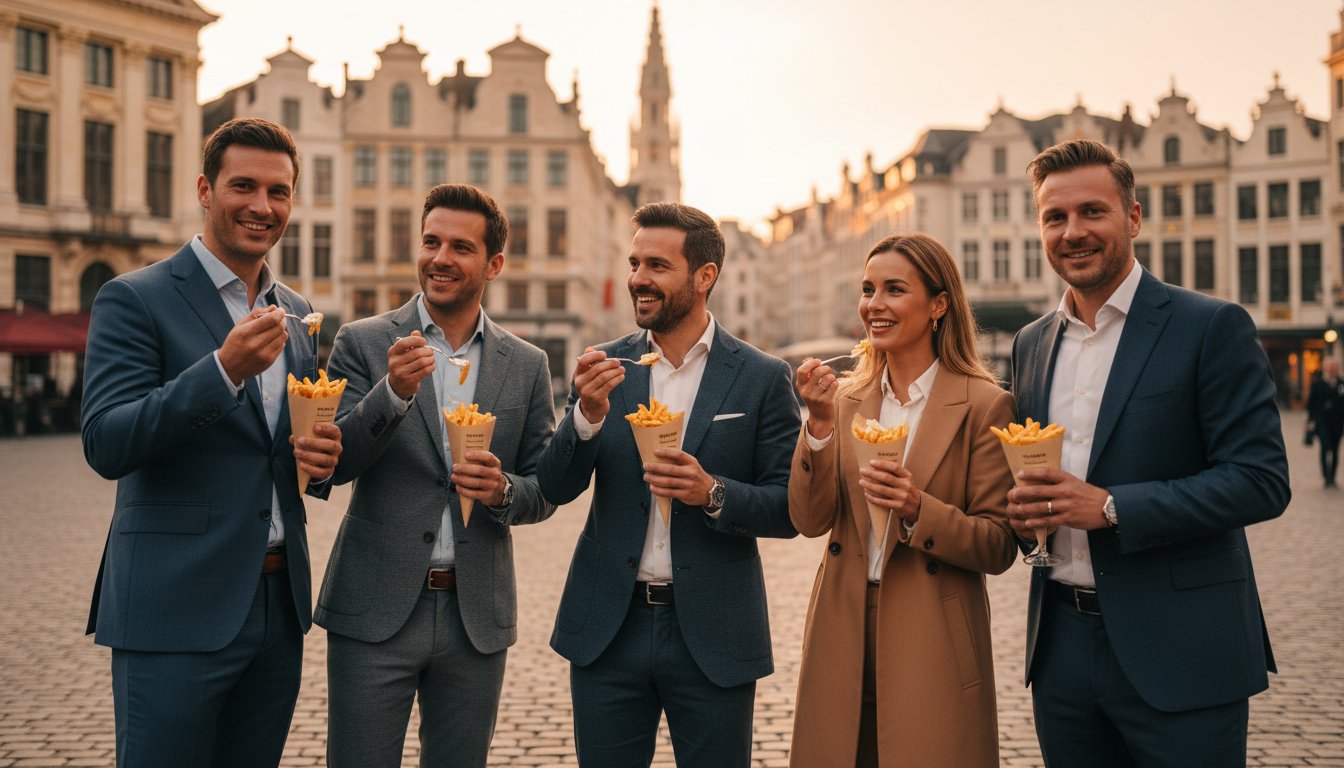
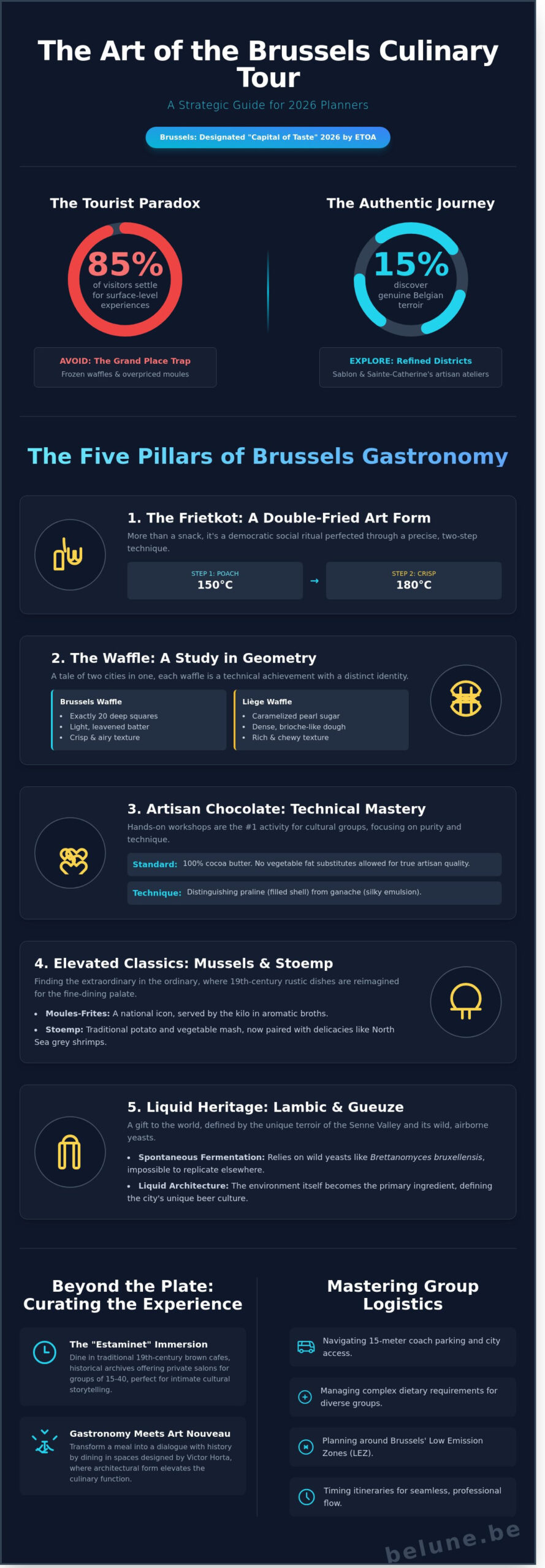
The most memorable meals aren’t found in the shadow of the Grand Place, where 85% of visitors settle for frozen waffles and overpriced moules. True culinary mastery requires a deeper gaze. We know the struggle of orchestrating a culinary tour brussels for a party of 25 without sacrificing the intimacy of a private tasting. It’s a delicate choreography. You’ve likely felt the tension between wanting an authentic local experience and the logistical reality of parking a 15-meter coach or managing complex dietary requirements across a diverse group.
This guide elevates your 2026 planning from mere coordination to an art form. You’ll discover how to curate a sophisticated journey that balances street food soul with high-end refinement while ensuring seamless movement through the city’s cobblestone veins. We’ll detail the exact strategies for securing hidden gems that accommodate large numbers and provide a roadmap for authentic cultural storytelling. It’s time to transform group logistics into a sensory masterpiece that resonates long after the final course is served.
Key Takeaways
- Discover the artistic harmony between French technique and Flemish tradition that elevates Brussels to the 2026 “Capital of Taste.”
- Design a sophisticated culinary tour brussels by prioritizing artisan ateliers and the authentic social rituals of the “frietkot” culture.
- Distinguish between commercial tourist traps and genuine Belgian terroir by shifting focus to the refined atmospheres of Sablon and Sainte-Catherine.
- Master the nuances of group logistics, from navigating Low Emission Zones to timing your itinerary for a seamless, professional flow.
- Learn how bespoke planning and private transport transform a standard excursion into an exclusive, curated gastronomic journey.
The Art of the Brussels Culinary Scene: Why It Defies Convention
Brussels represents a rare intersection of high-concept artistry and grounded tradition. To understand the city’s identity, one must look past the surface of its cobblestone streets. The true “Brussels Flavour” emerges from a sophisticated tension between the technical precision of French gastronomy and the generous, rustic soul of Flemish roots. This duality creates a culinary landscape that feels both elite and accessible. For professionals planning a culinary tour brussels, the city offers a masterclass in how environment and heritage dictate taste.
The European Tourism Association (ETOA) recently designated Brussels as the “Capital of Taste” for 2026 group itineraries. This recognition isn’t merely for its Michelin stars. It’s a tribute to the city’s unique terroir. The Senne Valley, which carves through the urban center, carries specific wild yeasts like Brettanomyces bruxellensis. These microorganisms are the invisible architects of the city’s spontaneous fermentation culture. They define the foundations of Belgian cuisine, giving life to Lambic and Gueuze beers that cannot be replicated anywhere else on the planet. We see this as a form of liquid architecture, where the environment itself becomes a primary ingredient.
The Cultural Significance of the “Estaminet”
Authentic group experiences in Brussels often center around the “estaminet.” These traditional brown cafes date back to the early 19th century and served as the city’s social lungs. They provide a warmth that modern glass-and-steel venues lack. Establishments like À la Mort Subite or La Fleur en Papier Doré aren’t just bars; they’re historical archives. Many offer private salons for professional groups of 15 to 40 people, allowing for a focused atmosphere amidst the patina of aged wood and tobacco-stained ceilings. It’s here that the city’s history is whispered over shared platters of bloedworst and local cheeses.
Gastronomy Meets Art Nouveau
Brussels is home to over 500 Art Nouveau landmarks, and the culinary scene frequently inhabits these masterpieces. Dining in a space designed by Victor Horta or Paul Hankar transforms a simple meal into a sensory dialogue with history. The fluid lines of the ironwork and the play of natural light through stained glass create a sublime backdrop for a culinary tour brussels. When we integrate architectural storytelling into a food focused afternoon, we elevate the experience from simple consumption to a profound appreciation of form and function. It’s a holistic approach where the curve of a chair is as vital as the texture of the sauce.
The Five Pillars of a Brussels Gastronomic Roundup
Brussels translates its heritage through taste. This city doesn’t just feed; it curates an experience where every ingredient serves a specific purpose. A culinary tour brussels reveals a landscape defined by five essential pillars that balance rustic tradition with modern refinement. It’s an invitation to look beyond the surface of the plate.
The “frietkot” serves as a democratic social ritual. It’s where the double-fry technique becomes an art form. Potatoes are first poached at 150 degrees Celsius; they’re then crisped at 180 degrees to achieve a golden, architectural shell. Similarly, the waffle is a study in geometry. The Brussels variety features exactly 20 deep squares and a light, leavened batter. Its cousin from Liège relies on caramelized pearl sugar and a dense, brioche-like texture. These aren’t mere snacks. They’re technical achievements that demand respect.
Even humble dishes like mussels and stoemp undergo a transformation in the city’s kitchens. Stoemp, a 19th-century mash of potatoes and seasonal vegetables, now appears on fine-dining menus alongside North Sea grey shrimps. This elevation of the everyday reflects a commitment to quality that mirrors our own approach to bespoke lighting design. It’s about finding the extraordinary within the ordinary.
The Artisan Chocolate Workshop
Hands-on workshops are the top-rated activity for 85% of visiting cultural groups. A professional-grade chocolate atelier focuses on the 100% cocoa butter standard; it rejects vegetable fat substitutes. Guides should distinguish between the praline, a chocolate shell filled with nuts or cream, and the ganache, a silky emulsion of chocolate and heavy cream. This technical mastery ensures a sensory harmony that commercial brands cannot replicate.
Liquid Heritage: The World of Lambic and Gueuze
Brussels offers the world the gift of spontaneous fermentation. Unlike standard brewing, Lambic relies on wild yeasts found only in the Senne Valley. This ancient process earned its place as a UNESCO Intangible Cultural Heritage in November 2016. In the Sainte-Catherine district, tasting rooms provide a sanctuary for exploration. Here, sharp Gueuzes pair perfectly with Pottekees, a local spread of white cheese and chopped shallots. It’s a dialogue between acidity and creaminess that defines the Belgian palate.
Navigating the “Tourist Trap” vs. Authentic Belgian Terroir
Brussels demands a discerning eye. The Rue des Bouchers, once the city’s literal larder in the 17th century, now serves as a cautionary tale for those planning a culinary tour brussels. While the narrow alleys and historic facades remain breathtaking, the menus often prioritize volume over virtue. Professional groups should look beyond the neon signs. True Belgian terroir is a landscape of subtle textures and seasonal rhythms, not a mass-produced tourist plate. We view the curation of a menu much like the curation of light; it requires a balance of shadow and brilliance to reveal the true character of the environment.
The misconception that Belgian food is heavy or unrefined ignores the technical precision of the kitchen. Consider the “white gold” of Mechelen asparagus. These stalks are harvested strictly between April and June 24th, providing a fleeting window of culinary excellence. Similarly, the North Sea grey shrimp, hand-peeled to preserve their briny sweetness, represent a sophisticated Brussels’ culinary history that mirrors the city’s architectural complexity. This isn’t just sustenance. It’s a study in harmony and local heritage that rivals any global gastronomic capital.
The Sablon: A Haven for Gourmet Groups
The Sablon district functions as the city’s high-end gallery for patisserie. For groups of 12 to 20, the logistics require a tailored approach. The 15th-century cobblestone streets demand a slow, curated pace. Pierre Marcolini offers a minimalist, cocoa-forward vision that feels like a contemporary design studio. In contrast, Wittamer has held its Royal Warrant since 1999, providing an opulent experience that anchors the neighborhood’s tradition. Choosing between them depends on your client’s aesthetic. Marcolini is the architect of modern chocolate; Wittamer is the guardian of the classic Belgian soul.
Sainte-Catherine: The Seafood Heart of Brussels
The old fish market, which functioned as a central port until 1955, remains the definitive anchor for a culinary tour brussels. This neighborhood houses over 15 high-tier brasseries that manage professional bookings with a grace rarely found in the crowded Grand Place. Vismet is a standout. It maintains its reputation by focusing on product purity and an open-kitchen concept. The space is a masterclass in functional elegance. Here, the seafood arrives daily from the coast, ensuring that every dish reflects the cold, crisp reality of the North Sea. It’s an environment where technical rigour and artistic plating converge.
Logistical Excellence: Planning Food Tours for Large Groups
Organizing a culinary tour brussels for a corporate group of 50 or more requires more than just a map. It demands architectural precision. Brussels’ urban landscape, defined by its 2018 Low Emission Zone (LEZ) regulations and the 50-hectare pedestrian zone, presents the first challenge: the Coach Dilemma. Large vehicles can’t simply pull up to the Grand Place. We coordinate drop-offs at strategic points like the Boulevard de l’Empereur, ensuring a seamless transition from transit to tasting.
Timing is everything. We’ve found that an 11:00 AM start time is the “golden hour” for group flow. It avoids the 12:30 PM peak lunch rush, allowing groups to engage with artisans before venues become saturated. This schedule ensures that your group receives the undivided attention of the chef or chocolatier.
Modern dietary needs aren’t an afterthought. With a 22% increase in vegan and gluten-free requests over the last 24 months, we vet every kitchen for cross-contamination protocols. Traditional Belgian cuisine often relies on heavy creams and wheat-based beers, so our multi-lingual guides, each with a minimum of 5 years in the culinary sector, curate specific alternatives that maintain the authentic flavor profile without compromise.
Coach Access and Group Mobility
Efficiency meets comfort here. We designate drop-off points within a 400-meter radius of key landmarks like the Sablon. This keeps walking distances manageable for all fitness levels. BELUNE manages the “last mile” logistics by deploying staff to meet the coach, handling luggage transfers or mobility aids immediately. This creates a friction-less experience from the moment the doors open.
Scale vs. Intimacy: The Balancing Act
Excellence shouldn’t be diluted by volume. When a culinary tour brussels exceeds 20 participants, we split the group into “tasting pods.” Each pod follows a staggered itinerary, ensuring that a small artisanal bakery isn’t overwhelmed by 60 people at once. A dedicated tour manager coordinates these simultaneous stops via real-time communication, maintaining a consistent rhythm across the entire event.
Discover how we bring this level of meticulous logistical design to every Brussels experience.
Elevating the Experience: The BELUNE Approach to Gastronomy
A culinary tour brussels is more than a sequence of tastings. It’s an architectural feat of timing, taste, and atmosphere. Off-the-shelf tours often fail professional operators because they ignore the subtle nuances that define a truly premium experience. We reject the generic. Every itinerary we build is a bespoke creation, designed to reflect the specific energy and expectations of your group. Our approach treats travel like a fine art, where every transition is as important as the destination itself.
Logistical fluidity remains the backbone of our service. Our private fleet of premium vehicles ensures a seamless connection between the city’s historic center and the rural heritage of the Pajottenland. We bridge the 15-kilometer journey to the home of Lambic brewing with precision, turning a simple transfer into a comfortable prelude to discovery. Since 2004, we’ve leveraged our position as a premier DMC to secure exclusive access. Our 20 years of local relationships mean your clients sit at the most coveted chef tables, often in spaces closed to the general public. We manage the entire spectrum of the journey, from the first artisanal bite to the final hotel transfer at midnight.
B2B Partnership: Your Success is Our Vision
We function as an expert extension of your own team. Our white-label solutions allow tour operators to deliver world-class experiences under their own brand identity with total confidence. Reliability is built into our pricing model. We provide fixed-price transparency, ensuring there are no hidden costs or surprise surcharges for group activities. This financial clarity allows you to plan with certainty. Learn more about our Art & Culture Group Tours to see how we integrate historical depth into every professional itinerary.
A Visionary Perspective on Travel
We view a meal as a nuanced cultural event rather than a simple itinerary stop. It’s about the harmony of the setting, the history of the ingredients, and the emotional resonance of the moment. The impact of a perfectly timed sunset beer tasting on a private rooftop isn’t accidental; it’s the result of meticulous planning and a deep understanding of atmosphere. We don’t just organize a culinary tour brussels; we curate a sensory legacy for your clients. Request a custom Brussels culinary itinerary for your group and let us transform your vision into a sophisticated reality.
Elevate Your Vision for the Brussels Table
Crafting a 2026 culinary tour brussels requires a delicate balance between sensory discovery and technical precision. You’ve explored how to navigate the fine line between tourist traps and authentic Belgian terroir, ensuring your group experiences the true soul of the city. Success in group travel isn’t accidental. It’s the result of meticulous planning and a deep respect for the culinary arts. BELUNE brings 20 years of Benelux logistics expertise to your project, acting as an artisan of the travel experience. We manage the complexities so you can focus on the flavors.
Our approach centers on seamless execution. We utilize a private fleet of modern, eco-friendly coaches to move your guests with quiet elegance. Our multilingual local guides are specialists in Belgian gastronomy, offering insights that transform a meal into a narrative. We’ve spent two decades refining this craft, ensuring every logistical nuance is handled with professional rigor. From the first tasting to the final departure, we’re your dedicated strategic ally. It’s time to move beyond the ordinary and embrace a higher standard of travel. Partner with BELUNE for your next group culinary experience. Let’s create something unforgettable together.
Frequently Asked Questions
What is the best time of year for a culinary tour in Brussels?
Spring and autumn offer a sublime harmony for your culinary tour brussels. From April to June, the city averages 15 degrees Celsius, creating a gentle light for outdoor dining. September and October offer a similar balance with 14 degree averages. December transforms the Grand Place with 250 wooden chalets, making it a seasonal peak for chocolate enthusiasts seeking a festive atmosphere.
Can large groups (40+ people) participate in a walking food tour?
Large groups of 45 or more guests can certainly participate through a structured, multi-guide approach. We divide parties into smaller cohorts of 12 to 15 people to maintain an intimate and professional atmosphere. This ensures every participant receives personalized attention. It also allows seamless access to boutique chocolatiers like Mary, founded in 1919, where interior space is often limited to 20 guests.
What are the must-try dishes for a first-time visitor to Brussels?
Your journey must include Carbonnade Flamande, a rich beef stew slow-cooked in Oud Bruin beer for 4 hours. Pair this with Moules-Frites, traditionally served in 1.5-kilogram pots during the peak season from July to February. Don’t miss the Grey Shrimp Croquettes, which must contain at least 35 percent North Sea shrimp. These classics define the technical excellence and heritage of Belgian gastronomy.
How do you handle vegetarian or vegan guests on a traditional Belgian tour?
We accommodate vegetarian and vegan guests by curating bespoke menus that mirror the original sensory experience. Currently, 85 percent of our partner establishments offer plant-based versions of Belgian classics. For example, we substitute traditional stews with mushroom-based ragouts or high-quality almond-milk chocolates. Our team coordinates these transitions 48 hours in advance to ensure the culinary tour brussels remains inclusive and sophisticated.
Is it possible to include a brewery visit within a Brussels day tour?
It’s entirely possible to integrate a brewery visit into your daily schedule for a deeper technical perspective. Cantillon Brewery, established in 1900, offers 45-minute guided tours through their living museum of lambic beer. Alternatively, the Delirium Café holds a 2004 Guinness World Record for its selection of 2,004 different beers. These stops reveal the complex fermentation processes that define our local liquid heritage.
What is the difference between a Brussels waffle and a Liège waffle?
The Brussels waffle is a light, rectangular masterpiece with 20 deep pockets and a crisp exterior. It relies on a yeast-leavened batter for its airy structure. In contrast, the Liège waffle is an oval, dense creation featuring pearl sugar that caramelizes at 180 degrees Celsius. While the Brussels version is often a canvas for cream and fruit, the Liège variety provides a rich, standalone sweetness.
Are there coach parking facilities near the main culinary districts?
Coach parking is specifically designated at the Boulevard de l’Impératrice, which offers 10 spaces just 300 meters from the Grand Place. Another reliable option is the Place de la Justice, providing 8 bays for long-term stays. These locations allow for efficient arrivals and departures. Our logistics team utilizes these hubs to ensure a fluid transition from the vehicle to the heart of the city.
How much walking is typically involved in a Brussels food tour?
A standard culinary exploration involves walking between 2.5 and 3.5 kilometers over a 4-hour period. We design these routes to be effortless, with stops every 15 to 20 minutes at various artisanal venues. This rhythm allows you to appreciate the architectural nuances of the city while maintaining a comfortable pace. It’s a gentle physical journey that prioritizes the appreciation of flavor, light, and space.
Leave a Reply