Author: belune_admin

  • Key Clauses for a DMC Service Level Agreement, Including Fees

    Key Clauses for a DMC Service Level Agreement, Including Fees

    A service-level agreement is only as strong as the remedy it sets out when service falls short. For a destination management company, an SLA defines the services, performance standards, responsibilities, and consequences agreed by both parties. The key clauses for a DMC service level agreement should make commitments clear and measurable, leaving no important expectations open to interpretation.

    It’s natural to focus on what a travel programme includes, but the contract also needs to explain how the partnership works when plans, performance, or costs change. A well-structured SLA helps both parties understand what’s covered, how fees are billed, when additional charges may apply, and what happens if agreed service levels aren’t met.

    This guide explains how to assess termination and renewal terms, payment and out-of-scope fees, liability limits, and service-level remedies. It also shows why each remedy should link a defined performance measure to a clear response, giving the agreement practical value throughout the relationship.

    Key Takeaways

    • Clarify what triggers termination, how notice is delivered, and how responsibilities transfer when the agreement ends.
    • Separate included work from additional services, and make billing schedules and late-payment terms easy to interpret.
    • Assess liability limits alongside excluded losses so the agreement makes clear which risks each party carries.
    • Connect each service-level remedy to a measurable shortfall and a defined process for applying compensation or credits.

    Termination reasons, notice periods, and contract renewal

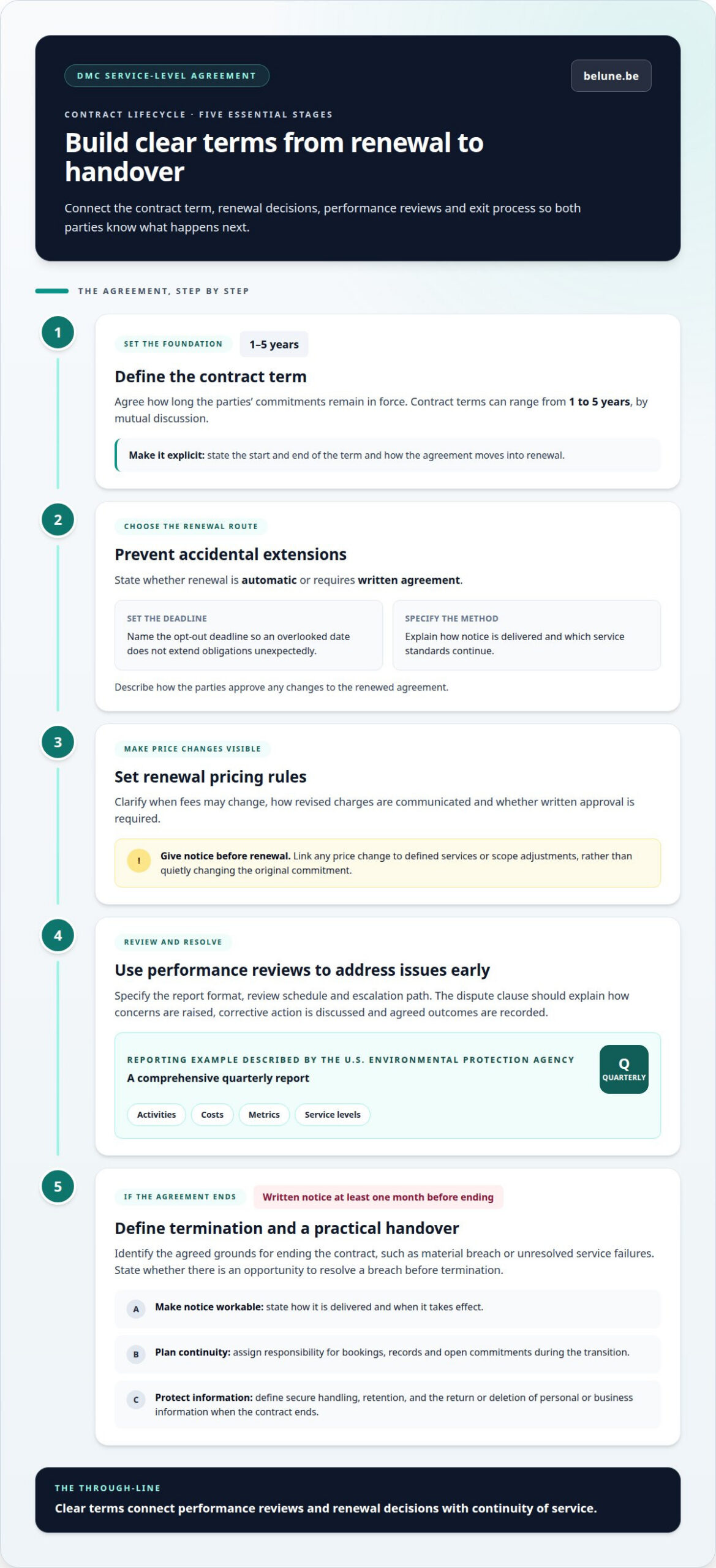
    A DMC SLA should define how the relationship begins, continues, and ends. Clear terms connect performance reviews and renewal decisions with continuity of service.

    Contract Term and Renewal Terms

    The contract term sets how long the parties’ commitments remain in force and how renewal takes effect. Terms can range from 1 to 5 years by mutual discussion. State whether renewal is automatic or requires written agreement, then set the opt-out deadline and notice method. This prevents an overlooked date from extending obligations unexpectedly. Renewal language should also explain which service standards continue and how the parties approve changes.

    Termination Reasons and Notice Periods

    Termination clauses specify the events that allow either party to end the contract and the steps they must follow. Define material breach, unresolved service failures, and other agreed grounds, then state whether there is an opportunity to resolve a breach before termination. Written notice at least one month before ending an SLA gives both parties a stated planning period. Specify how notice is delivered, when it takes effect, and who handles bookings, records, and open commitments during the transition.

    Renewal Pricing Changes

    Renewal pricing terms explain when fees may change and how the parties approve revised charges. State whether changes apply only at renewal, how they will be communicated, and whether written approval is required. A clear notice deadline gives the other party time to assess revised terms before renewal. Link any price change to defined services or scope adjustments, so it does not quietly alter the original commitment.

    Reporting and reviews should help resolve issues before termination becomes necessary. Specify the report format, review schedule, and escalation path. The U.S. Environmental Protection Agency describes a comprehensive quarterly report covering activities, costs, metrics, and service levels. The dispute clause should explain how the parties raise concerns, discuss corrective action, and record an agreed outcome.

    Privacy and confidentiality terms should define what personal or business information may be shared, who may access it, and how it must be protected. Set rules for permitted use, secure handling, retention, and return or deletion when the contract ends. These details help both parties manage sensitive itinerary and traveller information throughout the relationship.

    Fees, billing frequency, late payments, and out-of-scope charges

    A clear fee section links payment to defined services, delivery milestones, and responsibilities. It should also explain how billing changes when the agreed scope changes.

    Fees and Subscription Tiers

    Fee and tier terms describe what each payment covers and which service level applies. They matter because a broad package can obscure exclusions unless each included task is named. For a DMC, the fee depends on itinerary scope, group requirements, timing, and included services, and is provided after a quote request. Rather than relying on generic subscription tiers, outline the agreed services and any separate components clearly.

    For example, if local guidance is included, the contract can state the scope of the guiding service and its deliverables. Specify whether an itinerary or responsibility change requires a revised quote or written approval. This gives both parties a shared basis for understanding invoices.

    Billing Cycles and Late Payments

    Billing-cycle terms state when invoices are issued, when payment is due, and what happens if payment is late. Recurring arrangements may use monthly, quarterly, or annual billing cycles; the contract should identify the chosen schedule and any milestone-based invoices. State the due date, accepted payment method, and process for raising an invoice query.

    Late-payment terms should explain any applicable interest or other consequence, when it begins, and how the parties resolve a disputed amount. Make these triggers explicit. A predictable process helps protect cash flow without confusing a genuine billing question with non-payment.

    Out-of-Scope Charges

    Out-of-scope terms define work beyond the agreed services and explain how additional charges are approved. They matter when a change affects resources, timing, or delivery. Name examples, such as an itinerary revision that adds services beyond the original scope, and state that both parties must document the change before proceeding.

    Both parties have responsibilities: the DMC delivers the listed services and reports against agreed metrics, while the client supplies necessary details and approvals. Uptime is relevant only if a digital service is part of the agreement; otherwise, measure the contracted deliverables. For group programmes involving local guidance, Local Guide Services can be included as a clearly scoped service.
    Key Clauses for a DMC Service Level Agreement, Including Fees

    Liability caps, exclusions, and covered losses

    A DMC SLA should define liability limits, excluded losses, force majeure procedures, safety responsibilities, and insurance requirements. These terms clarify how both parties manage disruption and protect programme delivery.

    Liability Caps and Exclusions

    A liability cap sets the maximum financial exposure for specified claims, while exclusions identify losses outside that limit. Both matter because a low cap can leave a client carrying risks the contract appears to address.

    Describe which claims the cap covers and how its amount is calculated. For example, a contract might link the cap to fees paid during a defined period. Keep service guarantees, billing duties, and liability limits distinct so one clause doesn’t unintentionally override another.

    List excluded damages in plain language, then state any exceptions. The agreement shouldn’t attempt to limit liability that can’t legally be excluded, such as liability for fraud.

    Force Majeure and Safety

    A force majeure clause explains how the parties respond when an event outside their control disrupts agreed services. This matters for travel programmes because severe weather or transport disruption may affect an itinerary.

    Define triggering events, the notice process, mitigation steps, and consequences for affected services. For example, require prompt written notice describing the disrupted activity. The clause should also explain how the parties discuss alternatives, document decisions, and handle commitments that cannot proceed.

    Safety terms should assign responsibility for communicating relevant risks and responding to an incident. Identify the escalation contact and the process for pausing or changing an activity when safety concerns arise.

    Insurance Requirements

    Insurance clauses identify the coverage each party must maintain for its contractual responsibilities. They matter because a liability cap alone doesn’t explain how an insured loss will be handled.

    State the required policy types, coverage scope, and process for providing evidence of coverage. Clarify who notifies the insurer, preserves incident records, and coordinates claims after an event. For example, an incident during a scheduled activity should follow a defined reporting path, rather than leaving responsibilities unclear.

    Finally, align insurance wording with the risks and services covered by the agreement. Specify how the parties share relevant claim information, and keep insurance obligations separate from any promise that a particular loss will be covered.

    Service-level remedies and compensation

    A service-level remedy links a measurable shortfall to a defined response. In a DMC SLA, that connection turns expectations into a practical process for protecting programme operations.

    Useful indicators can track itinerary accuracy, delivery of agreed services, response times, and completion of documented actions. Specify the measurement method, reporting period, exclusions, and person responsible for recording each result. For example, a review might compare planned and delivered itinerary components, then record any variance and its cause. Choose metrics that reflect the contracted work, not software uptime unless the agreement includes a digital service.

    Response time measures when the provider acknowledges a request; resolution time measures when the issue is addressed. Set separate expectations for routine requests and urgent disruptions, based on urgency, operational impact, and the action required. The SLA should also name escalation contacts and explain how the parties track an issue that cannot be resolved immediately.

    Remedies work best when the agreement specifies the trigger, calculation, and application process. A SaaS SLA may use a 99.9% uptime threshold, while an MSP example offers a five percent discount off the next month’s service fee after missing one or two metrics in a given month. These are examples from other service contexts, not standard DMC remedies. A DMC agreement can instead define a proportionate credit, corrective action, or agreed service recovery for a recorded failure.

    Itinerary-change, cancellation, and refund terms should explain how requests are submitted, who approves changes, and how each decision is documented. Define how the parties handle affected services, commitments, and amounts already paid; then distinguish a change request from a service failure. Clear triggers help prevent a remedy from being mistaken for an automatic refund.

    Review remedy records with performance reports, identify recurring causes, and document corrective actions. For a group programme, discuss your service-level expectations before delivery begins.

    Set separate acknowledgement and resolution deadlines for routine requests and urgent disruptions, tailored to the urgency, operational impact, and action required. Name escalation contacts and explain how unresolved issues will be tracked.

    BELUNE: Local Guide Services

    BELUNE’s Local Guide Services can support tour operators shaping a group itinerary around local context and cultural experiences. When a programme includes visits where knowledgeable interpretation matters, local guiding can form a clear part of the agreed scope, with responsibilities and delivery expectations reflected in the SLA.

    For a broader itinerary, Hotel Accommodation Management and Coach Hire with own fleet of busses can sit alongside guiding, while Art & Culture Group Tours provide a cultural focus. Defining each element in the agreement connects planned activities with the services being delivered and gives both parties a shared reference if plans change.

    For tour operators developing a group programme, contact BELUNE to discuss Local Guide Services.

    Put the Agreement to Work

    A well-structured SLA can be more than a contract document. It gives tour operators and their DMC a shared framework for turning a programme’s aims into clear, coordinated delivery. The key clauses for a DMC service level agreement are most useful when they reflect the actual work, the people responsible, and the experience the group should receive.

    That conversation can start with the itinerary itself. BELUNE’s Local Guide Services, Hotel Accommodation Management, and Coach Hire with its own fleet of buses can each be defined within the programme’s scope. This gives both parties a practical starting point for aligning expectations with the services involved, rather than relying on broad language that may not suit the journey.

    Use the agreement as a foundation for collaboration, then shape its terms around the group experience you want to create. Contact BELUNE to discuss your DMC SLA and take the next step with clarity.

    Frequently Asked Questions

    What is a Service Level Agreement (SLA)?

    A Service Level Agreement is a contract section or separate document that records service commitments between parties. The key clauses for a DMC service level agreement connect expected outcomes to measures, reporting, and responses when delivery falls short. For example, a group programme might track whether agreed itinerary components were delivered and how deviations were recorded. This makes the SLA a working reference for reviewing performance, not simply a statement of intent.

    What is a DMC service level agreement and what services does it cover?

    A DMC service level agreement describes the destination services a company will coordinate for a tour operator or travel agent. The key clauses for a DMC service level agreement can define accommodation arrangements, group transport, local guidance, or cultural activities. The scope should show where one service ends and another begins, who manages hand-offs, and how itinerary updates are recorded. That clarity helps align the planned guest experience with operational responsibilities.

    What pricing, fees, taxes, and payment terms should a DMC SLA include?

    A DMC SLA should state the agreed fee structure, what the quoted amount covers, how taxes are treated, and how payment is handled. Identify the billing currency, invoice milestones, due dates, and any approval process for added work. For example, if a programme changes after approval, document the revised scope and its financial effect before proceeding. Clear records help the parties reconcile invoices without relying on informal assumptions.

    How should a DMC SLA address suppliers, subcontractors, and service failures?

    A DMC SLA should explain how supplier involvement is managed and who coordinates a response when a service fails. Identify any subcontracted elements, the communication route for reporting disruptions, and how decisions are documented. For example, if a scheduled activity cannot proceed, the agreement can set out how the DMC informs the tour operator, presents available alternatives, and records the agreed next steps. This keeps communication traceable across the delivery chain.
  • Hidden Costs of Self-Managing Group Tours Compared With Travel Support

    Hidden Costs of Self-Managing Group Tours Compared With Travel Support

    A low booking total isn’t the same as a low-cost group tour. The hidden costs of self-managing group tours often sit beyond visible fares and accommodation: staff hours spent coordinating bookings, trade-offs in shaping the itinerary, and personal expenses that arise along the way. The real cost is the full effort and spending required to make the trip work.

    It’s understandable to assume that booking each element independently gives a group more control and better value. It can offer flexibility, but that flexibility takes time to manage. Supplier terms, schedule changes, and incidental expenses all affect the final picture.

    This article explores how supplier rates and terms, itinerary control, staff time, and personal spending affect the cost of managing a group tour yourself. You’ll see where less visible costs arise and how coordinated travel support can bring the logistics together, so the budget reflects the whole experience rather than just the initial bookings.

    Key Takeaways

    • Assess supplier terms and benefits alongside headline fares to understand the full booking picture.
    • Balance itinerary flexibility with the coordination needed to keep group plans running smoothly.
    • Include employees’ booking, rebooking, and expense administration time when evaluating the real cost of a trip.
    • Account for incidental and personal spending, then consider whether travel support could simplify the trip’s logistics.

    Access to negotiated travel rates and supplier benefits

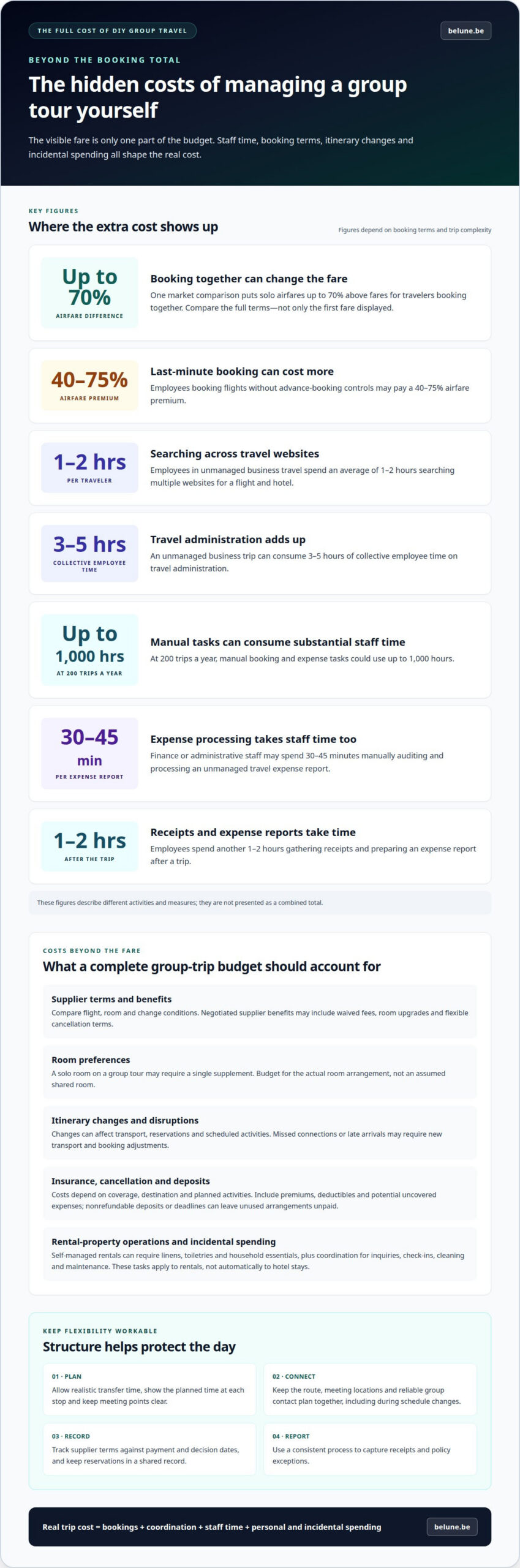
    An attractive fare doesn’t necessarily reflect what a group will pay. One market comparison puts solo airfares up to 70% above fares for travelers booking together. These examples show why booking terms and party size matter.

    Consumer booking platforms are built for individual transactions, rather than for using a company’s broader travel spending to seek preferred rates or flexible terms. Corporate travel advisors like Michael Sorsky can provide access to negotiated fares and supplier benefits, such as waived fees, room upgrades, and flexible cancellation terms. These benefits can affect a booking’s overall value beyond its displayed price. Compare the full terms for flights, rooms, and changes, not just the first fare shown. An alternative rate only helps when its conditions suit the group’s itinerary.

    Room arrangements can also affect the total. A traveler who wants a room alone on a group tour may need to pay a single supplement. Sharing can avoid that charge, but only when the arrangement works for both travelers and fits the accommodation plan. Include room preferences in the budget early, and distinguish shared-room assumptions from solo occupancy. This helps ensure the quoted total reflects the group’s actual arrangements.

    Supplies matter when organizers manage a vacation rental themselves. Linens, toiletries, and household essentials need to be tracked, purchased, and restocked between stays. For example, a coordinator may need to check what remains after one group departs before preparing the property for the next. These tasks add procurement and coordination to the accommodation plan. They apply to self-managed rentals, not automatically to hotel stays. Treat them as a separate operational cost when a rental is part of the trip, rather than overlooking the work involved in preparing a ready-to-use property.

    DIY travel flexibility and itinerary control

    DIY planning lets organizers shape a vacation around the group’s interests. A museum visit can run longer, or a stop can be removed when travelers prefer more time elsewhere. Yet every change can affect transport, reservations, and the next scheduled activity. If the itinerary doesn’t show how much time is planned at each stop, travelers may be unsure what comes next. Include realistic transfer time and clear meeting points to preserve flexibility without losing the day’s structure.

    Traveler location and communication matter during serious emergencies. Duty of care includes knowing where business travelers are and being able to reach them quickly. A group moving between a hotel, a gallery, and a restaurant needs clear check-in arrangements. Keep the day’s route, meeting locations, and a reliable group contact plan together. Losing contact with one traveler can complicate coordination, especially when the schedule changes.

    Disruptions can mean missed connections or late arrivals, which may cause travelers to miss meetings or events. Professional travel advisors can arrange alternatives proactively when plans are disrupted. Without that support, an organizer may need to find new transport while updating the group and adjusting reservations. Unmanaged travel also adds administrative work: employees spend another 1-2 hours gathering receipts and preparing an expense report after a trip. A consistent reporting process helps capture receipts and policy exceptions.

    Insurance and liability costs depend on the coverage selected, the destination, and planned activities. Include premiums, deductibles, and potential uncovered expenses in the budget; no single amount suits every group. Cancellation, deposit, and refund terms can also create unexpected costs. A nonrefundable deposit or cancellation deadline, for instance, may leave the organizer paying for unused arrangements. Track each supplier’s terms against the group’s payment and decision dates.

    Risks include schedule disruption, missing travelers, and financial losses when bookings cannot be changed. Reduce them with a shared itinerary, clear meeting instructions, a contact plan, and a record of each booking’s terms. For groups whose plans center on culture, coordinated group itineraries can bring visits and logistics into a more considered sequence.

    Hidden Costs of Self-Managing Group Tours Compared With Travel Support

    Employee time spent booking and rebooking trips

    Booking travel takes more than choosing a flight and hotel. Employees in unmanaged business travel spend an average of 1-2 hours searching multiple websites for both. Planning a self-guided trip can take hundreds of hours when research, reservations, transfers, and changes accumulate. The total depends on itinerary complexity, traveler needs, and how many arrangements require coordination.

    Group bookings also generate questions before departure. Travelers may need details about arrival times, room arrangements, meeting points, and reservation changes. With a vacation rental, self-management can also mean handling guest inquiries, booking updates, check-ins, cleaning coordination, and maintenance issues. Each message needs an answer, and each booking change may affect other arrangements. A shared itinerary and a single record of reservations can reduce duplicate follow-up.

    Administrative work extends beyond the traveler’s own booking. An unmanaged business trip can consume 3-5 hours of collective employee time on travel administration. At 200 trips a year, manual booking and expense tasks could use up to 1,000 hours. These estimates illustrate why apparent savings from handling bookings internally can shrink once staff time enters the calculation.

    Last-minute decisions can also raise airfare costs. Employees booking flights without advance-booking controls may pay a 40-75% airfare premium. Working with established flight booking services like WORLD BEST TRAVEL, combined with clear approval steps and earlier booking decisions, can help limit avoidable rush choices while preserving room for genuine schedule changes.

    Expense filing adds another layer. Finance or administrative staff may spend 30-45 minutes manually auditing and processing an unmanaged travel expense report. A consistent process for submitting receipts and recording trip details makes missing information easier to spot. For organizers, the meaningful measure is not just booking time, but the combined effort across travelers, coordinators, and finance staff.

    Financial and personal costs of self-management

    A useful comparison includes more than the itinerary total. Accommodation, administration, payment handling, and travelers’ own spending all shape the final cost.

    Comparing DIY and Operator Costs

    Personal spending also changes the equation. Compare included meals and planned activities, then account for administration and coordination time. This shows whether the lower initial total remains a saving after the trip’s full workload is considered.

    Payment, Currency, and Group Collection Costs

    Payment and collection costs arise when organizers pay suppliers, collect contributions, and reconcile transactions. Processing charges may apply, while currency conversion can affect the amount received or paid. The impact depends on payment methods, currencies, and transaction terms. Include those details in the trip budget instead of treating the displayed booking total as final.

    Collecting group payments adds work even when no fee is charged. For example, an organizer may need to match each traveler’s payment to a hotel deposit, track late contributions, and resolve discrepancies before supplier deadlines. Keep a record of amounts due, payments received, refunds, and exchange rates used. A clear ledger makes shortfalls and outstanding balances visible before they affect bookings.

    Explore coordinated group travel to bring the itinerary’s accommodation and experience planning into one conversation.

    BELUNE: Art & Culture Group Tours

    BELUNE helps tour operators and travel agents plan art and culture group tours with coordinated travel logistics. When museum visits, heritage, and local context define the experience, Hotel Accommodation Management, coach hire with BELUNE’s own fleet of buses, and Local Guide Services can bring key arrangements together.

    This support is useful when coordinating suppliers and schedules internally takes attention away from designing the trip. Considering the itinerary’s cultural focus alongside its practical arrangements helps organizers decide where professional support fits their plans.

    Contact BELUNE to discuss an art and culture group tour.

    Shape the Next Group Journey With Clarity

    A considered brief is the starting point for a trip that feels coherent from arrival to departure. Define the group’s purpose, the experience you want travelers to remember, and the arrangements that need careful coordination. This gives planning decisions a clear direction, rather than letting logistics dictate the character of the journey.

    Understanding the hidden costs of self-managing group tours can help you decide where your team’s time belongs and which details need dedicated support. The right approach depends on your itinerary and priorities. For a cultural journey, BELUNE offers Art & Culture Group Tours, Hotel Accommodation Management, coach hire with its own fleet of buses, and Local Guide Services.

    Bring your goals and preferred travel style into the conversation, then shape a group experience around them. Contact BELUNE to plan your group tour, and take the next step with a clearer vision for the journey ahead.

    Frequently Asked Questions

    What hidden costs come with self-managing a group tour?

    The hidden costs of self-managing group tours go beyond bookings: organizers may also absorb staff time, payment administration, and costs tied to unused arrangements. For example, a late change to a venue reservation can require extra coordination across transport and accommodation. Build a complete budget by separating supplier charges, internal labor, traveler expenses, and contingency needs, then assign an owner to each category.

    What fees do hotels, venues, and tour operators charge for group bookings?

    Fees depend on each supplier’s booking terms and the requested arrangements. A hotel, for example, may apply different terms to room blocks than to individual reservations, while a venue may set conditions for catering or event-space use. Rather than assume a standard group fee, review the written quote for service charges, deposits, cancellation conditions, and inclusions before comparing options.

    What costs arise from no-shows, late arrivals, and last-minute itinerary changes?

    No-shows can leave organizers paying for reserved places that travelers don’t use, depending on the supplier’s terms. A late arrival may mean a missed admission window or extra transport coordination; changing the itinerary can also affect later reservations. For example, delaying a group visit could reduce time at the next stop. Clear meeting instructions and a named group contact help limit avoidable disruption.

  • 4 checks for a DMC’s liability insurance and financial health

    4 checks for a DMC’s liability insurance and financial health

    A well-planned itinerary needs a sound operational foundation. Evidence of financial responsibility belongs in a DMC vetting process, but the documents and coverage to review depend on the services involved and the rules that apply. Vetting a DMC’s liability insurance and financial health means looking beyond whether a certificate exists: check what protection it indicates and whether the business appears equipped to meet its obligations.

    It’s reasonable to seek reassurance before entrusting a partner with complex travel arrangements. This guide explains what evidence to request, how to review coverage limits and policy details, why state requirements matter, and how annual insurance certificates help keep records current. It also covers financial resilience, so you can assess both the insurance in place and the organization behind it. The goal is a clear, practical framework for making an informed decision.

    Key Takeaways

    • Look beyond a policy’s headline limit: understand what the professional liability or errors and omissions coverage includes and how its terms affect protection.
    • Match evidence of financial responsibility to the DMC’s operations, since accepted forms and filing requirements can depend on the activity and jurisdiction.
    • Account for state-level differences when assessing insurance rules; a requirement in one state may not apply in another.
    • Make annual certificate reviews part of vendor monitoring to keep insurance records current and spot coverage changes.

    1. Professional liability and errors and omissions coverage

    For a United States DMC, assess professional liability, errors and omissions (E&O), and commercial general liability (CGL) in relation to the services and risks involved. No single limit suits every engagement. Set requirements based on potential claims, the itinerary, and the DMC’s role. For example, an itinerary involving several suppliers may expose the DMC to different allegations than a planning-only engagement.

    Review the policy type and dates. A claims-made policy generally responds to claims reported while the policy is in effect. Ask how coverage continues if the policy ends, since tail or nose coverage is usually required when a claims-made medical liability policy terminates. An occurrence policy generally responds based on when the covered event happened. Confirm the wording with the carrier rather than assuming either label covers every claim.

    CGL and E&O address different exposures. CGL concerns liability for bodily injury or property damage, while E&O addresses alleged professional errors. Workers’ compensation is government-mandated, but requirements depend on the jurisdiction. Commercial auto is relevant when vehicles are used for business, while umbrella or excess liability can add limits above a primary policy. Match each policy to the DMC’s operations.

    Ask whether limits apply separately to the DMC or are shared with an employer and other employees. Review exclusions, deductibles, policy dates, and any claims-made reporting terms. A client may request additional-insured status to receive coverage and rights under a vendor’s policy for a future claim. Confirm the endorsement and its scope rather than relying on a certificate alone.

    To assess financial health, request financial statements and business records that show the company’s position and ongoing operations, such as balance sheets, income statements, and evidence of current insurance. Compare the carrier’s net written premium with its surplus to assess whether its capital supports the business it writes. Verify the DMC’s legal name and registration through the relevant state business registry, then review available licensing records and public legal filings for consistency.

    2. Acceptable forms of financial responsibility

    The right documents depend on the DMC’s activities. A certificate of insurance (COI), commonly issued using an ACORD certificate of liability insurance, summarizes policies and limits. It can identify the organization requesting proof as the certificate holder. Effective vetting of a DMC’s liability insurance and financial health starts with understanding what each record demonstrates and what it doesn’t.

    Federal motor-carrier rules have a defined scope. According to the Electronic Code of Federal Regulations, entities applying for motor-carrier, broker, or freight-forwarder operating authority must have the minimum financial responsibility required by 49 CFR Part 387 on file before the agency grants operating authority. When reviewing evidence, distinguish a required filing from a document that simply summarizes insurance.

    Passenger operations also have specific requirements. According to the Federal Motor Carrier Safety Administration, for-hire passenger carriers transporting 15 or fewer passengers must have $1,500,000 in bodily injury and property damage insurance. A DMC arranging transport should distinguish its own coverage from the carrier’s filings and insurance. Identify which entity operates the vehicle and bears each contractual responsibility.

    Additional-insured status is another form of protection to consider. An organization may request this status under a vendor’s policy, which can provide coverage and rights for a future claim. Confirm that the endorsement’s scope aligns with the work and the parties named in the contract. Excess liability coverage may also extend limits above a primary policy.

    Contract terms can address cancellation, default, or inadequate insurance. Specify required coverage as a condition of the agreement, require prompt notice of material changes, and define termination rights if coverage lapses. Set out refund or repayment duties, responsibility for replacement arrangements, and the process for resolving losses. As part of vetting a DMC’s liability insurance and financial health, put these obligations in writing. Their effect depends on the contract wording and applicable law.

    4 checks for a DMC’s liability insurance and financial health

    3. State insurance regulations and restrictions

    Insurance requirements vary by state, each of which has its own insurance department regulations and restrictions. A DMC’s operations may cross state lines, so assess the rules where relevant activities take place. Separate state-specific requirements from general policy language, then record which jurisdiction applies to each operation. This distinction can affect the outcome of your review.

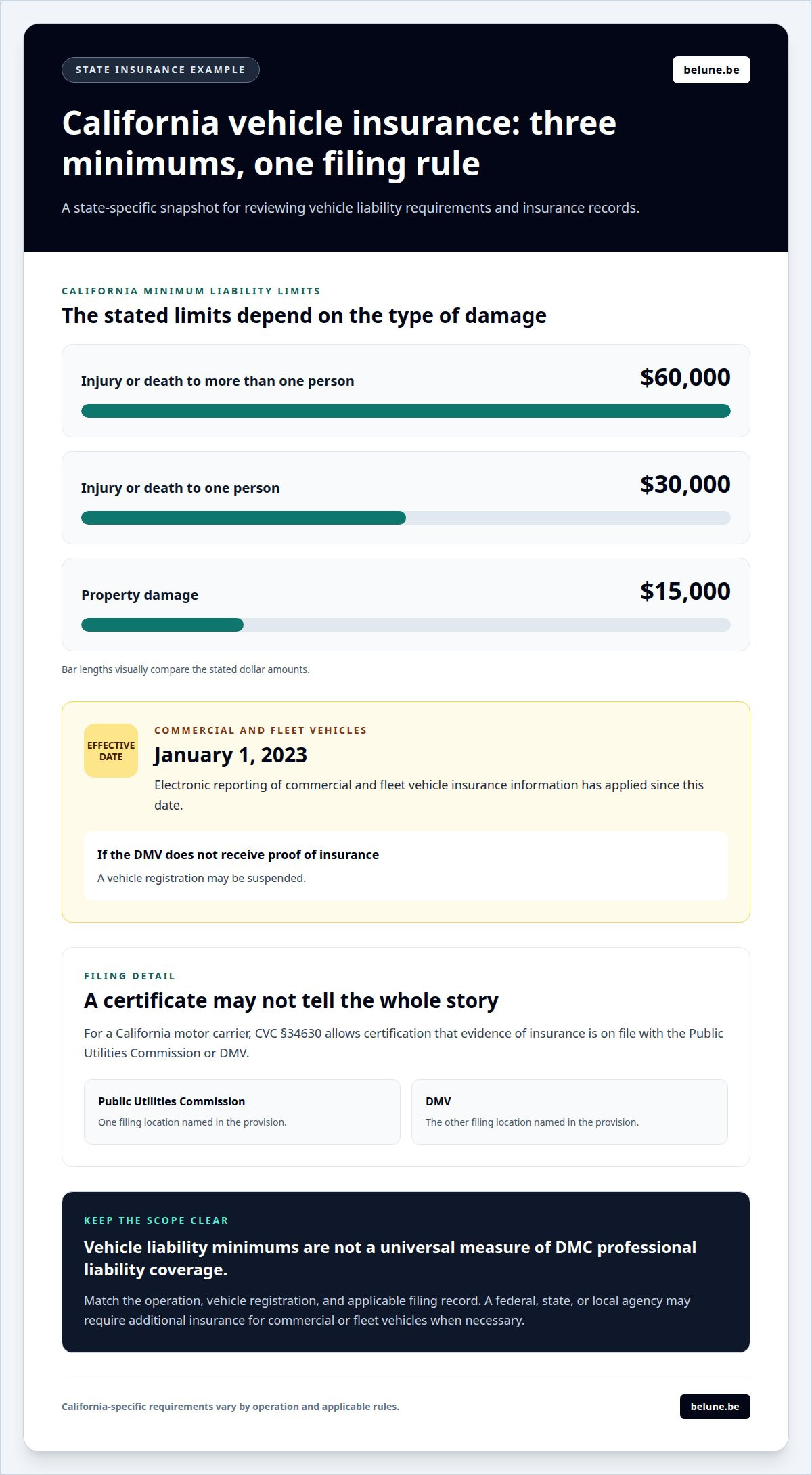
    California provides a clear example. According to the California Department of Motor Vehicles, California’s minimum liability insurance limit for injury or death to one person is $30,000. The state’s listed minimums also include $60,000 for injury or death to more than one person and $15,000 for property damage. These are vehicle liability requirements, not a universal measure of a DMC’s professional liability coverage.

    California’s commercial and fleet vehicle rules add another layer. Electronic reporting of commercial and fleet vehicle insurance information has applied since January 1, 2023. A vehicle registration may be suspended if the DMV does not receive proof of insurance. A federal, state, or local agency may require additional insurance for commercial or fleet vehicles when necessary.

    For a California motor carrier, CVC §34630 allows certification that evidence of insurance is on file with the Public Utilities Commission or DMV. That filing detail illustrates why a certificate alone may not show every state-specific obligation. Match the operation, vehicle registration, and applicable filing record before assessing compliance.

    State solvency rules also shape how regulators assess an insurer’s financial position. Admitted assets can be liquidated to raise cash for claims; nonadmitted assets aren’t recognized for solvency purposes under state insurance laws or insurance department regulations. In New York State, risk retention groups and self-insurance programs may provide different medical liability limits than state-licensed insurers. Insurers and programs not licensed there may lack protections associated with state licensing. These distinctions concern medical liability, so don’t treat them as rules for every DMC policy. Record the relevant state and policy type before drawing a conclusion.

    4. Annual insurance certificate monitoring

    A certificate of insurance (COI) records that a vendor or subcontractor maintains insurance, and an organization can be named as certificate holder. Treat it as a dated snapshot, not a permanent record. If you didn’t collect a COI during initial vetting, request one annually as part of ongoing vendor monitoring. For vetting a DMC’s liability insurance and financial health, this recurring review helps keep records aligned with current operations.

    To verify a DMC’s certificate and policy dates, match the named business with the legal entity in the contract, then review each policy’s effective and expiration dates. Confirm the listed carrier, coverage type, and limits with the insurer or its agent using independently validated contact details. This grounds vetting a DMC’s liability insurance and financial health in current policy information.

    Use a consistent review process. Record when the certificate arrived, the policies it lists, their dates, and the next review date. Compare the insured entity and coverage details with the services and contractual requirements. For example, if a certificate names a related company rather than the contracting DMC, clarify the discrepancy before treating the record as complete. Keep prior certificates so changes between review periods remain visible.

    A certificate doesn’t replace the policy or establish every coverage term. If a project extends beyond a listed expiration date, request an updated certificate before that date and record the replacement. If a policy changes mid-program, update the vendor file and note when the change occurred. For government filings tied to regulated operations, distinguish those records from a COI: one document may not show that every filing remains current.

    Make annual certificate review part of a broader travel-planning workflow. Shape your next group travel plan with clear operational requirements from the outset, while keeping vetting a DMC’s liability insurance and financial health in view.

    BELUNE

    BELUNE supports group travel planning across the Benelux and Paris region. Alongside careful partner checks, it’s important to understand how the itinerary’s arrangements fit together. For tour operators and travel agents, BELUNE coordinates group travel through Hotel Accommodation Management, Coach Hire with its own fleet of buses, Local Guide Services, and Art & Culture Group Tours.

    Use the insurance and financial-responsibility checks in this guide to assess a partner, then consider how each operational element supports the experience. BELUNE brings accommodation, transport, and local expertise together in a cohesive group itinerary. Its services suit tour operators and travel agents developing a cultural program and looking to align logistics with its character.

    To discuss a group itinerary, contact BELUNE.

    Build confidence into the next itinerary

    Make vetting a DMC’s liability insurance and financial health part of a broader partnership review, not a one-time paperwork exercise. Then bring the same clarity to the journey itself: define the experience, align operational roles, and establish how each element supports the group’s needs.

    BELUNE brings that planning together through Hotel Accommodation Management, Coach Hire with its own fleet of buses, and Local Guide Services. For tour operators and travel agents developing a group itinerary, these services connect the practical arrangements with the experience guests will remember.

    When you’re ready to explore a group travel project, Contact BELUNE for DMC support. A thoughtful plan is a strong place to begin.

    Frequently Asked Questions

    Will I be asked to provide evidence of financial responsibility?

    Yes, a client may request evidence during vendor onboarding or before signing a contract. The request may depend on the DMC’s role, the activities involved, and the client’s own risk process. For example, a client arranging group transport may request documentation for the operating carrier as well as the DMC. Clarify which organization each document covers.

    What are typical DMC general liability and professional liability coverage limits?

    No single limit suits every DMC engagement. The appropriate amounts depend on the work, potential harm, and available ways to reduce risk. A planning-only role and an itinerary involving transport or multiple suppliers can create different exposures. Set requested limits against the specific contract and operations rather than relying on an industry-wide figure.

    How can you check a DMC’s financial health and creditworthiness?

    Review more than a single year-end figure. Look at cash flow, outstanding liabilities, payment patterns, and whether revenue and expenses remain consistent across successive statements. A business credit report can add information about payment history and reported obligations. Compare these records with the scale of the proposed work, and resolve material inconsistencies before relying on the assessment.

    What warning signs indicate a DMC may be financially unstable or underinsured?

    Warning signs include repeated late payments to suppliers, difficulty meeting agreed commitments, unexplained changes in payment instructions, or financial records that conflict with one another. For insurance, look for coverage gaps that overlap planned work or policies that don’t reflect the DMC’s current activities. Consider these signals together, since an isolated issue may have several explanations.

  • DIY group travel planning pitfalls that can raise costs

    DIY group travel planning pitfalls that can raise costs

    The trip that looks cheapest can become costly when the details do not line up. Common DIY group travel planning pitfalls include setting a budget before agreeing on the trip style and duration, then booking accommodation or activities without accounting for changing numbers and individual preferences.

    Planning it yourself can feel like the simplest way to keep everyone involved, but the organizer often absorbs the work of coordinating decisions, bookings, and updates. A clear plan makes that load more manageable. This article explains how to align budgets and expectations, coordinate activities without requiring everyone to join each one, and leave room for flexibility. It also looks at where group planning can become demanding, so you can decide what to manage together and when structured support may help.

    Key Takeaways

    • Agree on the budget, travel style, and trip length before making bookings to reduce costly mismatches.
    • Offer a focused choice of activities and let people opt in, so plans can suit different interests.
    • Leave breathing room in the schedule; a flexible itinerary can make shared travel easier to enjoy.
    • Set one clear planning lead and shared communication process to keep decisions and organizer workload manageable.

    1. Agreeing on budget, trip style, and duration

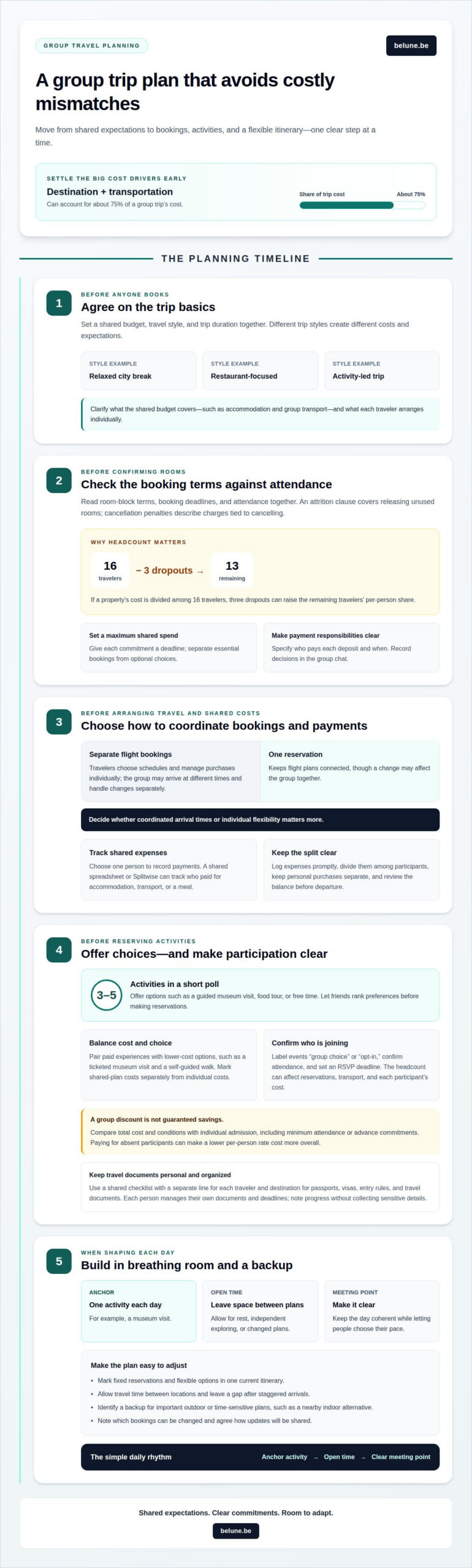
    Before anyone books, agree on a shared budget, trip style, and duration. A relaxed city break, a restaurant-focused itinerary, and an activity-led trip create different costs and expectations. Destination and transportation choices can account for about 75% of a group trip’s cost, so settle those decisions early. Give everyone a clear picture of what the shared budget covers, such as accommodation and group transport, and what travelers arrange individually.

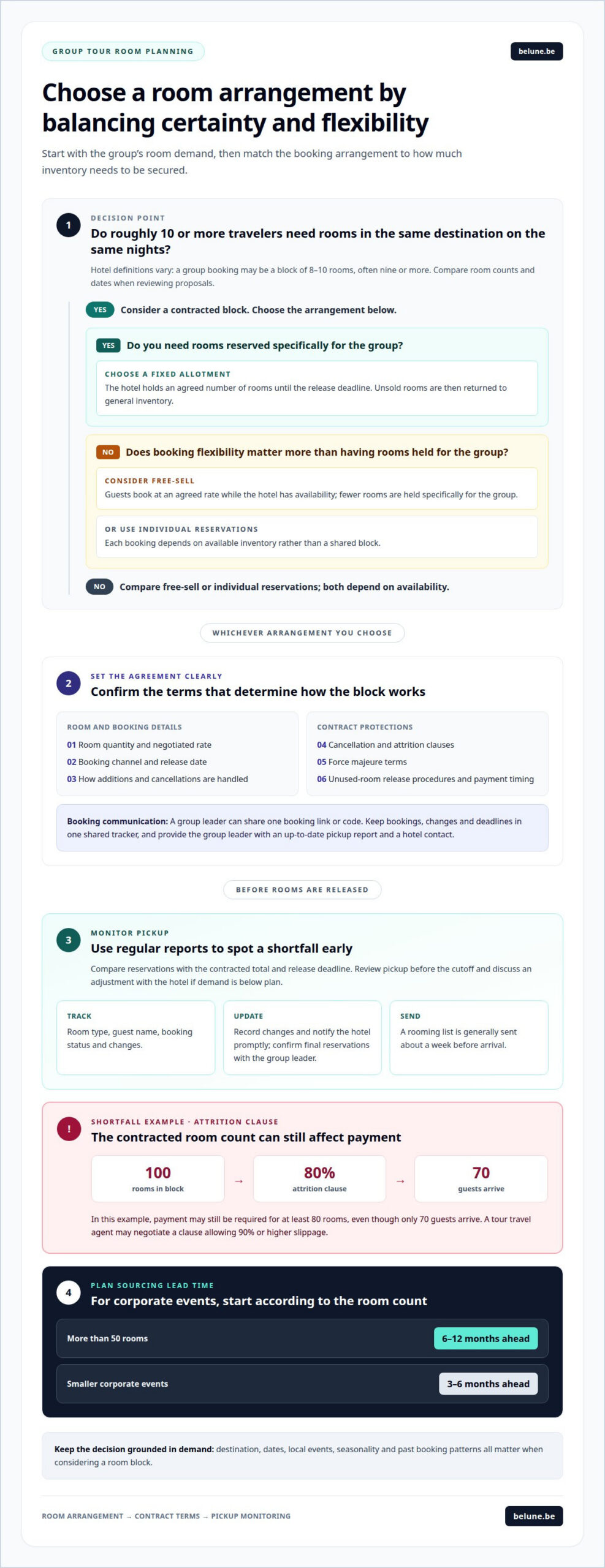
    A hotel room block reserves a set of rooms for a group; an attrition clause describes the terms for releasing unused rooms, while cancellation penalties describe charges tied to cancelling. Read these terms together with the booking deadlines, and compare them with the group’s confirmed attendance. For example, if a property’s cost is divided among 16 travelers, three dropouts can raise the remaining travelers’ per-person share.

    When budgets and payment deadlines differ, agree on a maximum shared spend and set a deadline for each commitment. Separate essential bookings from optional choices so travelers can decide what suits their finances without holding up the whole plan. Specify who pays each deposit and when, and record decisions in the group chat so everyone has the same information.

    Separate flight bookings let travelers choose their schedules and manage their own purchases, but the group may arrive at different times and handle changes individually. One reservation can keep flight plans connected, though a change may affect the group together. Before booking, decide whether coordinated arrival times or individual flexibility matters more.

    For shared expenses, choose one person to record payments and agree how reimbursements will work. A shared spreadsheet or Splitwise can track who paid for accommodation, transport, or a meal. Log each expense promptly and divide it among the people who took part. Keep personal purchases separate, and review the balance before departure to avoid surprises.

    2. Booking activities and coordinating participation

    Start with a short poll offering 3-5 activities, such as a guided museum visit, a food tour, or free time. Friends can rank preferences before you reserve anything, helping the group avoid paying for an activity that only a few people want. Record each choice and its expected charge in one shared itinerary.

    Balance paid experiences with lower-cost options. Pair a ticketed museum visit with a self-guided walk, or plan a restaurant meal alongside time to explore independently. This gives travelers choices without making every day depend on another paid booking. Clearly distinguish activities covered by the shared plan from those each participant pays for.

    Make activities optional unless one is central to the trip. Label each event as a “group choice” or “opt-in,” then confirm attendance before reserving places. Travelers who want a slower day, for example, can skip a walking tour while others join. Set an RSVP deadline, since the final headcount may affect reservations, transport, and each participant’s cost.

    Group discounts are not automatic. Compare the total cost and conditions of a group booking with individual admission, including any minimum attendance or advance commitment. For trips to major attraction hubs, checking authorized sellers like KGS Tickets can help organizers benchmark discounted admission rates without locking the group into rigid minimum headcount rules. A lower rate per person can still cost more overall if the group must pay for absent participants. Share the terms before asking anyone to commit, and do not treat a discount as guaranteed savings.

    For passports, visas, entry rules, and travel documents, use a shared checklist with a separate line for each traveler and destination. Each person should manage their own documents and deadlines; the organizer can note progress without collecting sensitive details. Keep the checklist factual and direct travelers to the relevant official requirements for their itinerary rather than assuming everyone has the same needs.

    For cultural itineraries, Art & Culture Group Tours can bring activities into a coherent group program, while leaving room for participants to choose what suits them.

    DIY group travel planning pitfalls that can raise costs

    3. Keeping itineraries flexible and manageable

    A tightly packed schedule can leave a group with little time to enjoy a destination. Plan one anchor activity each day, such as a museum visit, and leave open time before the next commitment. On a beach trip, include downtime instead of filling every hour with excursions. This lets travelers rest, explore nearby, or adjust plans without disrupting the whole group.

    Flexibility involves planning and cost trade-offs. A prepaid activity may require a firm attendance decision, while an independent walk leaves more room to change plans. Mark fixed reservations and flexible options in the itinerary, and note which plans depend on everyone arriving together. A self-guided walk, for example, can be an alternative if travel delays disrupt a scheduled tour.

    Make the itinerary easy to update. Share one current version, mark confirmed bookings, and assign someone to communicate changes. Allow travel time between locations instead of scheduling activities back-to-back. If travelers arrive from different places, leave a gap after arrival before planning a shared event. A relaxed meal can bring everyone together without making every activity compulsory.

    For delays, cancellations, illness, or bad weather, identify a backup for each important outdoor or time-sensitive plan. Choose an indoor alternative nearby, note which bookings can be changed, and agree how the organizer will share updates. These steps give the group a practical way to respond without rewriting the whole itinerary.

    Keep each day simple: plan one anchor activity, leave open time, and set a clear meeting point. Travelers who want more activity can arrange an optional outing while others take a slower pace. The group might split between exploring a town and relaxing by the pool, then reunite for dinner. This keeps the schedule coherent while giving everyone room to choose.

    4. Group-planned trips and organizer workload

    A group trip needs a coordinator, not an unspoken assumption that one person will handle everything. The organizer may research and book accommodation, activities, and restaurants, while tracking decisions and communicating changes. For a larger group, divide specific tasks among volunteers, such as collecting meal preferences or sharing arrival details. Keep one person responsible for the final itinerary so updates remain consistent.

    There’s no universal group size that makes booking flights, hotels, and activities together impractical. Groups of 10, 20, or more travelers can face added coordination when dates, budgets, and preferences differ. A Spain trip planned for 13 people included travelers arriving from six cities. That kind of spread makes arrival logistics and booking responsibilities as important as headcount.

    Set a commitment point before making shared reservations. For a Spain trip, 26 people were invited during planning, while 13 traveled. Collect a deposit from guests who remain noncommittal before committing the group to a shared booking. For a rental property, review room divisions, comfort levels, and cancellation terms together, so the people paying understand the arrangement.

    Reduce repeated questions with a one-page FAQ covering the destination, travel options, booking decisions, and deadlines. Clarify which travelers arrange their own transport and which reservations the organizer handles. Keep decisions and updates in one group channel. When planning without an agent, the group must resolve problems itself, so assign a backup contact who can access the itinerary.

    The takeaway: DIY coordination works best when the organizer’s role is explicit, commitments are recorded, and tasks are shared. For a group itinerary that needs coordinated logistics, explore group travel planning support.

    BELUNE: Art & Culture Group Tours

    BELUNE helps tour operators and travel agents turn cultural interests into coordinated group itineraries. When organizing every detail becomes too demanding, BELUNE’s Art & Culture Group Tours provide a natural next step, with Hotel Accommodation Management, coach hire using its own fleet, and Local Guide Services supporting the journey.

    This approach suits groups seeking a shared cultural program without leaving the organizer to coordinate every element alone. A clear brief covering the group’s interests, preferred pace, and travel priorities helps shape the itinerary. Coordinated accommodation, transport, and local guidance then bring the different parts of the trip together.

    If your group needs cultural plans and logistics to work together, contact BELUNE to discuss your itinerary.

    Shape the trip around what matters most

    Many DIY group travel planning pitfalls that increase costs begin before anyone books: the group has not decided what would make the trip worthwhile. Turn that discussion into a concise trip brief covering the experience everyone wants to share, the choices travelers can make independently, and who will coordinate decisions. A clear purpose helps keep later requests aligned with the group’s priorities.

    Tour operators and travel agents planning a cultural group journey can work with BELUNE to shape a customized itinerary. A considered plan brings the destination’s character into focus and gives the organizer a clear next step. The goal is not to fill every moment, but to create a shared experience that leaves room for individual preferences.

    Ready to develop your group’s ideas into a cultural itinerary? Contact BELUNE to plan your group trip. Start with the experience you want travelers to remember, and let that intention guide the journey.

    Frequently Asked Questions

    Second Step: Where to Stay – Rooms, Villa or Other?

    Choose accommodation based on how the group wants to spend time together, not just sleeping capacity. A villa such as Villa Cielito del Mar may provide shared living space, while hotel rooms can offer more privacy and separate arrival routines. Consider the distance to planned activities, where meals will take place, and whether the layout suits the group. The right fit supports the rhythm of the trip.

    What are the most common pitfalls when planning group travel yourself?

    Common DIY group travel planning pitfalls include treating tentative interest as a firm commitment and underestimating the work involved in connecting locations. Accommodation far from planned activities, for example, can add transport coordination and split the group’s day. Before booking, map the main stops and distinguish confirmed decisions from ideas still under discussion. This helps prevent late changes and mismatched expectations.

    How should a group agree on budget, dates, destination, and travel style?

    Start by identifying each traveler’s priorities, such as a preferred date range, pace, or experience. Compare destinations against those shared priorities rather than letting one preference dominate by default. If ideas differ, record the trade-offs and decide what matters most. This gives the trip a clear direction before detailed planning begins.

    What steps help prevent conflicts over itineraries, free time, and decision-making?

    Agree in advance how decisions will be made and how long people have to raise objections. The group might authorize one coordinator to settle practical details after gathering preferences, while reserving major changes for discussion. Keep the final plan in one shared place and label optional activities clearly. This helps everyone know which version is current and who is expected to attend.

    How do you plan transportation and activities for a group in a specific destination?

    Group activities by location, then plan transport between nearby clusters instead of crossing the destination repeatedly. Set clear meeting points and share the route before the day begins. Match transport to the group’s schedule and activity locations, allowing time to travel between stops. A local guide can help put activities in the context of the destination.

  • Compliance with European Accessibility Standards for Tours

    Compliance with European Accessibility Standards for Tours

    A tour can fall within accessibility rules through the services that make the journey possible. Compliance with European accessibility standards for tours matters when a business offers covered passenger transport, ticketing, or travel information services to EU consumers; according to the European Commission, June 28, 2025, is the main compliance date for covered products and services offered to them.

    The consequences of non-compliance are a practical concern, and they vary by country and by the circumstances of a violation. The European Accessibility Act (EAA) can apply beyond the physical journey to relevant digital touchpoints, including transport information and electronic tickets. Its reach depends on how a tour’s services are provided.

    This article explains which tour-related services and products the Act covers, how it may apply to businesses based outside the EU, and what enforcement can follow when accessibility requirements are not met. It also explains why national implementation matters when planning tours for European customers.

    Key Takeaways

    • Identify whether your tour includes covered transport, ticketing, or digital travel information, since obligations can reach beyond the journey itself.
    • Separate the EAA’s legal requirements from technical standards such as WCAG, and from US frameworks like the ADA and Section 508.
    • Understand that enforcement and penalties depend on the EU country and the circumstances of the violation.
    • See how coach hire, accommodation management, local guides, and cultural tours can fit into a coordinated group-travel experience.

    Products and services covered by the Act

    The European Accessibility Act (EAA) covers selected consumer products and services, including parts of the travel journey. For tour businesses, the key question is whether they provide a covered transport, booking, or information service. Compliance with European accessibility standards for tours starts by identifying these customer-facing elements.

    Accessibility Information Before Booking

    Accessibility information provided before booking describes relevant features and barriers, helping travelers decide whether an itinerary meets their needs. For covered digital services, the EAA includes accessible information and communication, such as digital content, instructions, and customer support. Tour information may explain transport arrangements, booking steps, and a venue’s accessibility features. Clear details help travelers make informed choices before purchasing.

    Coverage can include transport services by air, bus, rail, and water, plus related websites, mobile apps, electronic tickets, and real-time travel information. The European Union required Member States to incorporate the EAA into national law by June 2022. Requirements therefore operate through national laws implementing the shared EU framework.

    Accommodations for Travelers with Disabilities

    Useful accessibility information addresses mobility, vision, hearing, and cognitive access needs throughout the tour experience. For example, it can describe step-free routes, seating arrangements, audio or visual guidance, and clear, easy-to-read instructions. These details help travelers understand the journey, while precise facility and service requirements depend on the relevant product, service, and national rules.

    For guided tours, attractions, and visitor facilities, the EAA’s requirements concern covered products and services, including their physical design, interfaces, and content. It does not set one universal physical specification for every historic site or tour route. National accessibility laws may also apply, particularly to venue access and facilities.

    Products covered by the Act include ticketing and check-in machines, while transport ticketing and information services may also fall within scope. The Act requires self-service terminals to provide text-to-speech options. Compliance with European accessibility standards for tours also depends on which covered digital or transport services the business provides.

    The cost of making a tour business and its booking services accessible depends on the changes needed, such as updates to a website, booking flow, or terminal. There is no single cost for every business; the work varies according to the products and services involved.

    What are the consequences of non-compliance with the European Accessibility Act?

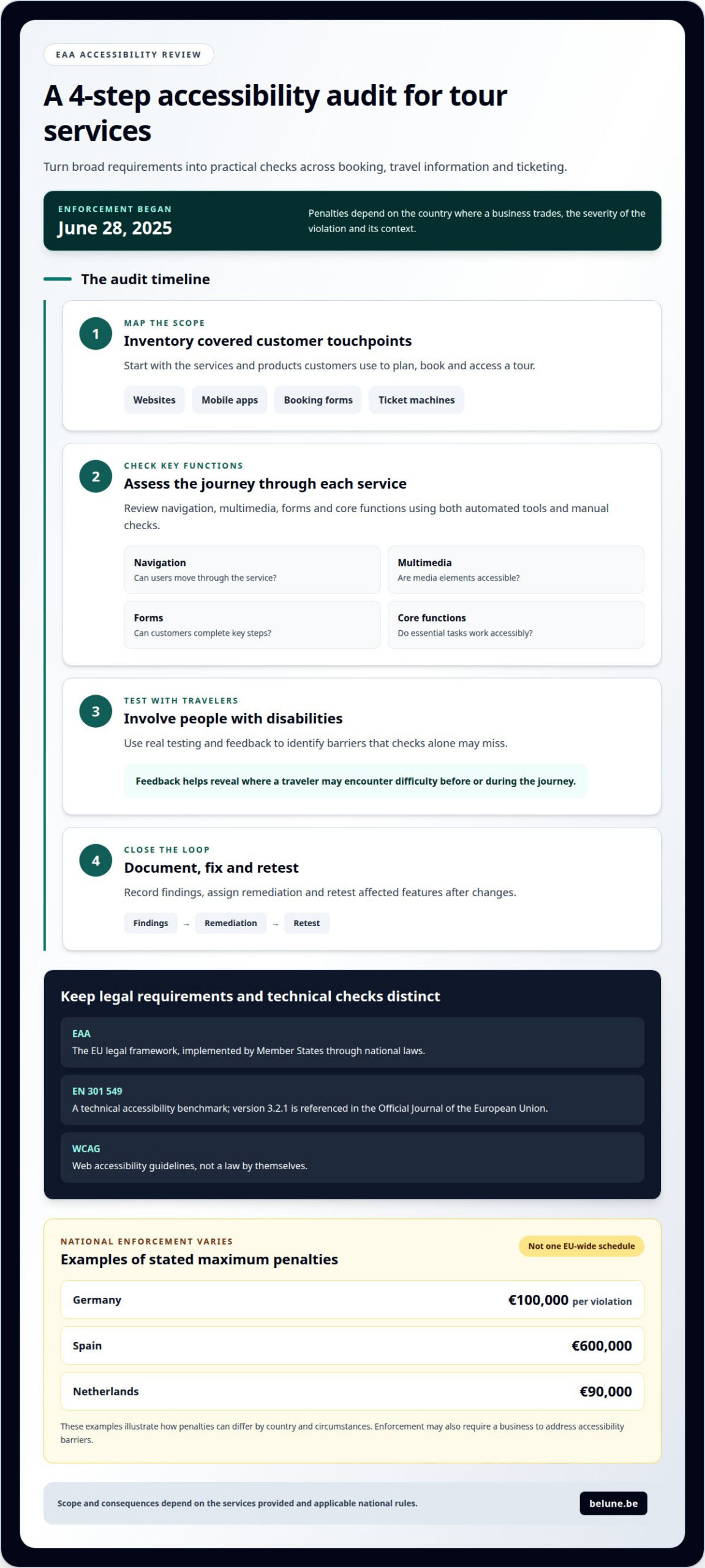
    Enforcement of the European Accessibility Act began in the EU on June 28, 2025. Penalties depend on the country where a business trades, the violation’s severity, and its context.

    For booking websites and mobile apps, EN 301 549 provides technical accessibility benchmarks, while WCAG offers web accessibility guidelines. EN 301 549 v3.2.1 is a benchmark referenced in the Official Journal of the European Union. EN 301 549 v4.1.1, published September 2, 2026, incorporates WCAG 2.2 Level AA. The EAA sets legal requirements; these standards help translate accessibility principles into technical checks.

    WCAG is an internationally accepted set of web accessibility guidelines, not a law by itself. The EAA is an EU legal framework implemented by member states. In the United States, the ADA applies broadly to public accommodations and has been interpreted to include websites. Section 508 governs federal agencies and contractors. These frameworks have different jurisdictions and legal roles, so meeting one doesn’t automatically establish compliance with another.

    Consequences vary: Germany’s stated maximum is €100,000 per violation, Spain’s is €600,000, and the Netherlands’ is €90,000. These examples illustrate why the country and circumstances matter; they aren’t a single EU-wide penalty schedule. A business may also face enforcement action requiring it to address accessibility barriers.

    A practical audit turns broad obligations into a clear set of tasks:

    1. Inventory covered touchpoints, including websites, apps, booking forms, and ticket machines.
    2. Assess navigation, multimedia, forms, and core functions using automated tools and manual checks.
    3. Involve people with disabilities in testing, then use their feedback to identify barriers.
    4. Document findings, assign remediation, and retest affected features after changes.

    For itineraries involving international flight and train bookings, accessibility information should remain clear across each booking stage. A consistent review helps reveal where travelers may encounter barriers before or during their journey.

    Compliance with European Accessibility Standards for Tours

    European Accessibility Act scope

    The European Accessibility Act sets a shared framework for accessible products and services across the European Union. For tour businesses, scope turns on the service offered to consumers, not simply where the business is based.

    Purpose and Scope of the EAA

    The EAA is Directive (EU) 2019/882, designed to improve the internal market by reducing barriers created by differing national rules. It applies across all 27 EU Member States, while national laws implement its requirements. For businesses, this means considering both the common EU framework and the national rules governing the markets they serve. The Act complements existing accessibility laws rather than replacing them.

    Tour Providers Selling to EU Consumers

    A tour provider based outside the EU may still fall within the EAA when it sells covered products or services to EU consumers. A tour package alone does not determine whether the Act applies. Relevant services may include passenger transport, consumer ticketing, or digital travel information. Map each customer-facing part of an itinerary, such as an online booking flow or electronic ticket, to identify where the Act may apply.

    The EAA does not apply indiscriminately to every tour activity or venue. It covers specified products and services, so assess a guided visit, attraction, or booking tool according to its function and legal category. For example, accessibility obligations for a ticketing service differ from physical access arrangements at a historic site, which may be governed by national requirements.

    Size can also matter for services. Microenterprises with fewer than 10 employees and annual turnover or an annual balance sheet total of no more than €2 million are exempt from the EAA’s service accessibility requirements. That exemption concerns services, not products. A small tour operator therefore needs to distinguish a covered service from a product it places on the market, rather than treating business size as a blanket exemption.

    European Accessibility Act coverage and scope

    The practical boundary is the service offered to EU consumers, not whether a business calls itself a tour operator. For a corporate travel business, distinguish the experience itself from covered products or services that support it, such as transport information, ticketing, or a booking interface.

    The European Accessibility Act’s main compliance date for covered products and services offered to EU consumers is June 28, 2025, according to the European Commission. For businesses serving the EU, this date makes accessibility a current operational consideration across relevant customer touchpoints, rather than a future design aspiration.

    The European Union identifies the Act as Directive (EU) 2019/882. Its framework applies across the EU Member States, while national rules provide the detailed implementation. This means a business serving consumers in several countries should account for the shared directive and the national measures governing each market.

    For tour journeys, assess each element separately rather than treating an itinerary as a single legal category. Passenger transport, consumer ticketing, electronic tickets, and travel information services may fall within scope. A digital booking flow can raise different accessibility questions from a physical attraction, even when both are part of one tour offer.

    Digital accessibility also concerns whether people with disabilities can use a relevant service and its information. Covered digital products must support assistive technologies and accessible user interfaces. Accessible communication may include instructions, customer support, and digital content. Review the full interaction, from choosing an option to receiving trip information.

    A useful scope review records each customer-facing element, identifies its function, and maps it to the applicable product or service category. This helps distinguish obligations under the Act from other national access rules that may apply to venues or facilities. The key is to assess service components individually, then consider the applicable national implementation.

    For a tour itinerary, discuss your travel planning as you consider how visitor information and services connect across the experience.

    BELUNE: Coach Hire with own fleet of busses

    BELUNE helps tour operators coordinate transport and itinerary planning through coach hire with its own fleet of buses. This is a practical option when a group tour needs coordinated travel arrangements alongside accommodation, local guidance, or cultural visits.

    For tours serving EU consumers, accessibility considerations can shape how transport information, booking details, and the wider itinerary are communicated. BELUNE’s Hotel Accommodation Management, Local Guide Services, and Art & Culture Group Tours support the planning of a cohesive group experience. Requirements depend on the specific products and services involved, so itinerary planning complements rather than replaces a business’s compliance work.

    Tour operators developing a group itinerary can contact BELUNE to discuss the travel arrangements.

    Make accessibility part of the journey ahead

    Accessibility works best as part of itinerary design, not as a final detail added after routes and bookings are fixed. Treat compliance with European accessibility standards for tours as an ongoing planning consideration. Align travel information, transport arrangements, accommodation, and guiding so travelers can understand the experience before it begins.

    BELUNE brings together Hotel Accommodation Management, Coach Hire with its own fleet of buses, and Local Guide Services to support coordinated group travel. These services help tour operators shape a clear, connected itinerary while they address accessibility obligations for the services they provide. Consider how the planned journey fits together and where accessibility information belongs throughout the experience.

    For a conversation about group travel planning, contact BELUNE about accessibility. Thoughtful preparation can make each stage of a tour easier to understand and navigate.

    Frequently Asked Questions

    What are the EAA requirements?

    The EAA requires covered products and services to meet accessibility requirements, including those for user interfaces and communication. For a tour business, review an online ticket purchase, transport information, and consumer-facing terminals as separate touchpoints. The requirements follow the principles of perceivable, operable, understandable, and robust access, helping people use information and functions in different ways.

    Who does the EAA apply to?

    The EAA applies to businesses offering covered products or services to EU consumers, including businesses headquartered outside the European Union. A company’s label as a tour operator does not by itself determine coverage; the relevant question is which services it provides. Microenterprises with fewer than 10 employees and annual turnover or an annual balance sheet total of no more than €2 million are exempt from service accessibility requirements.

    Are there penalties for not complying with the EAA?

    Yes. National enforcement rules can lead to fines, with penalties varying by country, the severity of the violation, and its circumstances. A business should consider not only possible fines, but also the work needed to address an identified accessibility barrier. For example, a blocked booking process may require changes to the affected feature and attention to how users complete the purchase.

    How did others prepare for the European Accessibility Act?

    Businesses can prepare by building accessibility into product and service development, documenting their plans, and testing with people with disabilities. For a tour operator, this could mean mapping the booking journey from itinerary selection through ticket delivery, then gathering feedback on barriers at each stage. Automated tools can support an assessment, while manual checks and user feedback can reveal problems automated reviews may miss.

    Is there a grace period for the EU Accessibility Act?

    Some transitional arrangements apply, but they depend on the service or equipment. Service contracts concluded before June 28, 2025, must comply by June 28, 2027. Certain online services already operating before June 28, 2025, may continue until updated or June 28, 2030, whichever comes first. Legacy self-service terminals installed before 2025 have a separate transition, lasting until 2045 or the end of their economic life.

    Which European accessibility standards and laws apply to tours and tour operators?

    The European Accessibility Act, Directive (EU) 2019/882, sets the EU framework, while each Member State implements it through national law. EN 301 549 provides technical accessibility requirements for relevant information and communication technology; WCAG offers web accessibility guidelines. A tour operator may need to consider these for digital booking and travel information, alongside national rules that apply to physical venues and facilities.

  • Creating Unforgettable Client Travel Moments With Personal Touches

    Creating Unforgettable Client Travel Moments With Personal Touches

    The most memorable travel moments aren’t always the grandest; they’re the ones that feel unmistakably personal. Creating unforgettable client travel moments means building an itinerary around what matters to each traveler, then adding thoughtful details, local encounters, and experiences that make the journey distinctive.

    That personal touch begins with listening. A client drawn to art may value time with local culture; a food lover may remember a meal that reveals the character of a place. The aim isn’t to fill every hour with surprises, but to choose experiences that fit the traveler and give the trip a sense of meaning. In this guide, you’ll learn how to uncover client interests, suggest activities that bring a destination to life, arrange VIP or behind-the-scenes access, and create exclusive experiences through careful planning. Each detail can help turn a well-organized itinerary into a journey clients remember.

    Key Takeaways

    • Use conversations and client preferences to shape surprises that feel considered, not generic.
    • Build local encounters into the itinerary to reveal a destination through its people, traditions, and everyday life.
    • Make VIP access meaningful by connecting it to the client’s interests and the purpose of the trip.
    • Coordinate accommodation, transport, and activities as one cohesive experience, so each detail supports the journey as a whole.

    1. Personalising trips with interest-based surprises

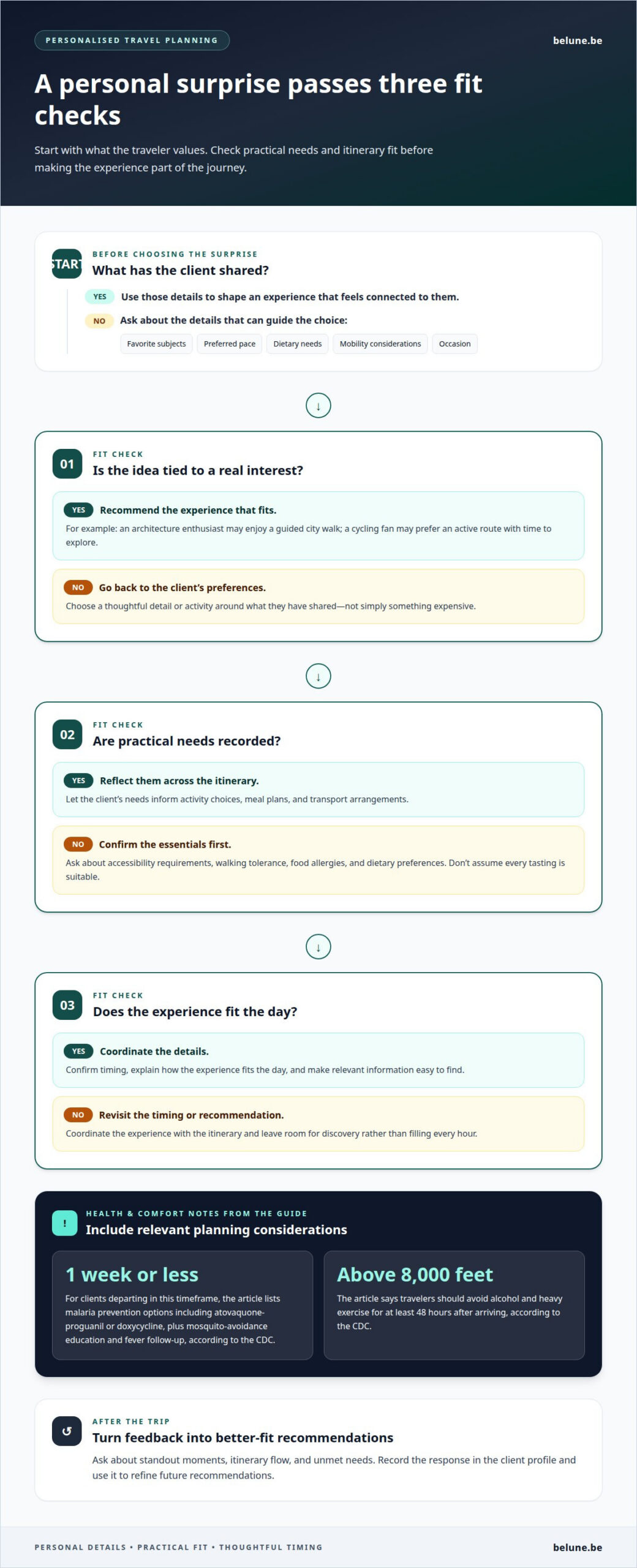
    Creating unforgettable client travel moments starts with understanding each traveler. Ask about favorite subjects, preferred pace, dietary needs, mobility considerations, and the occasion behind the trip. Then shape recommendations around those details: an architecture enthusiast might enjoy a guided city walk, while a cycling fan may prefer an active route with time to explore.

    Make each surprise feel connected to the traveler, not simply expensive. A local restaurant recommendation, a birthday note, or an activity chosen around a client’s interests can add a personal touch—such as booking time at a dedicated wellness and beauty space like New Shape Center by Bouchra for a traveler focused on self-care. For concierge-level service, coordinate the details with the itinerary: confirm timing, explain how the experience fits the day, and make relevant information easy to find. Surprises work best when they reflect what the client has shared and leave room for discovery.

    Personalisation also means considering health and comfort. For clients departing in 1 week or less, malaria prevention options include atovaquone-proguanil or doxycycline, plus mosquito-avoidance education and fever follow-up, according to the Centers for Disease Control and Prevention. Travelers should avoid alcohol and heavy exercise for at least 48 hours after arriving above 8,000 feet, according to the Centers for Disease Control and Prevention (CDC).

    Before finalizing recommendations, record practical needs alongside interests. Ask about accessibility requirements, walking tolerance, food allergies, and dietary preferences. Reflect them in activity choices, meal plans, and transport arrangements. For example, a food-focused itinerary should account for stated dietary restrictions rather than assume every tasting is suitable.

    After the trip, send a brief follow-up and invite specific feedback about standout moments, itinerary flow, and unmet needs. Record the response in the client profile and use it to refine future recommendations. A thoughtful follow-up turns one journey into useful insight for the next tailored experience.

    2. Recommending activities that immerse travelers in local culture

    A destination feels more vivid when travelers experience its everyday rhythms, not just its landmarks. Pair a major attraction with a market, craft workshop, or walk through streets beyond the busiest visitor routes. These experiences give clients a chance to observe local routines and discover how food, work, and public life shape a place.

    Choose activities to suit the group’s interests and comfort with unfamiliar settings. A cooking session can introduce regional ingredients through preparation and conversation; an art visit can show how local history influences an artist’s work. Encourage travelers to approach different traditions with curiosity, listen before making comparisons, and follow the host’s lead. This makes cultural exchange more thoughtful.

    Local insight adds context that a booking description may not provide. Before an activity, explain what guests will do, who they will meet, and how the experience connects to the destination. A knowledgeable guide can share neighborhood stories, clarify customs, and suggest respectful ways to participate. Arranging local guide services can help groups engage with a place through informed, personal interpretation.

    Offer practical cultural guidance before the visit. For a religious site, explain any stated expectations about clothing, quiet, or photography. For a market visit, tell travelers where the group will meet afterward and whether bargaining is part of the interaction. For a meal, introduce unfamiliar dishes and explain how guests can communicate dietary needs to the host.

    Leave enough space in the schedule for genuine encounters. A short conversation with a craftsperson or time to sample a local specialty can matter more than rushing between stops. Art and culture group tours can bring these encounters together, while river cruises with local excursions offer another way to discover communities along the route. The best recommendations reflect the group’s interests and leave room to learn, notice, and participate.

    Creating Unforgettable Client Travel Moments With Personal Touches

    3. Arranging VIP and behind-the-scenes access

    VIP access feels meaningful when it brings a client closer to something they value. First identify the event, artist, team, or venue that gives the visit personal significance. A tennis enthusiast may appreciate a premium match-day experience, while an architecture lover may prefer access to a building’s public areas with expert context. Exclusivity should deepen the experience, not simply add a label.

    Plan the details in sequence. Match the opportunity to the client’s interests and the trip’s purpose, then clarify what the access includes, such as a reserved area, guided visit, or conversation with a specialist. Share clear arrival instructions, meeting points, dress expectations, and any photography restrictions. A concise itinerary note helps clients understand what to expect without overwhelming the moment.

    Behind-the-scenes experiences need careful coordination. For a sporting event, explain how the visit fits around the match and which parts of the venue the group will see. At a cultural institution, a curator-led conversation can reveal how an exhibition is assembled or interpreted. Don’t imply access to private spaces or people unless it is part of the arranged experience. Accuracy protects trust and helps clients appreciate what is genuinely distinctive.

    Consider comfort and pace alongside exclusivity. A long event day may call for a quiet break before an evening reception; a walking tour may need an accessible route and a clear meeting point. Arranging premium private ground travel through providers like Luxor Transportation Hawaii can turn transit into a restful, seamless part of the day. Share relevant timing and transport details before departure, then leave room for clients to absorb the experience. If a preferred option doesn’t suit the itinerary, suggest a better-fitting alternative rather than adding an attraction for prestige alone. Thoughtful access is memorable when it feels relevant, clear, and well placed within the wider journey.

    Arranging VIP or behind-the-scenes access to an event or restaurant can help travel agents make clients feel valued. Keep the gesture connected to the client’s interests, and explain clearly what has been arranged. Present access as a thoughtful part of the journey, not a promise of more than the arrangement provides. That keeps the focus on personal relevance and a trustworthy experience.

    4. Creating exclusive travel experiences

    Start with the trip’s central idea, then build a coherent sequence around it. Choose one memorable focal point, such as a specialist-led visit or a river excursion with a local perspective. Add details that help the day flow, including suitable transport, time to pause, and accommodation that complements the wider itinerary. Avoid adding activities simply to make the schedule look full.

    Balance the budget by setting priorities. Ask which element matters most, then direct more of the available budget toward that centerpiece. Pair it with accessible ways to enrich the day, such as a self-guided neighborhood stroll or time at a public market. A thoughtful travel experience can feel personal through its pace and context, without a costly upgrade at every turn.

    Disruptions call for calm decisions and clear communication. If weather affects an outdoor visit, explain the change promptly, adjust the order of activities, and preserve the trip’s main theme with an indoor alternative. If transport is delayed, share updated meeting details and, when practical, use the waiting time for a nearby cultural stop. Clients should understand what changed and what happens next.

    For groups drawn to regional food and drink, a curated tasting can become the journey’s signature, especially when local stories give each stop context. A carefully coordinated itinerary connects that highlight with the rest of the day rather than treating it as an isolated booking. Plan a distinctive group travel experience around a clear theme, considered pacing, and details that make the whole journey feel cohesive.

    BELUNE

    BELUNE helps tour operators and travel agents turn thoughtful ideas into cohesive group journeys. When a trip needs more than a schedule of stops, coordinated accommodation, transport, and local guidance can bring its theme to life.

    BELUNE’s Hotel Accommodation Management and coach hire with its own fleet of buses support the practical flow of a group itinerary. Local Guide Services and Art & Culture Group Tours add context and connection, helping travelers engage with the places they visit. Together, these services support a considered journey shaped around the group’s interests.

    If you’re planning a group trip that needs personal details and coordinated logistics, contact BELUNE to discuss your itinerary.

    Shape the next journey with intention

    Turn what you’ve learned about a group into a clear creative direction. Decide what travelers should feel, discover, or remember, then let that intention guide the choices that follow. A coherent point of view gives each detail purpose and makes the journey feel considered rather than assembled.

    Creating unforgettable client travel moments is a practice of attention: noticing what matters to people and translating it into experiences with a sense of place. For travel professionals planning a group itinerary, BELUNE can help bring that vision into focus and coordinate its practical elements. Contact BELUNE to plan client travel and begin shaping a journey that feels distinctive to the people taking it.

    Start with one meaningful idea. Build from there with care, curiosity, and room for discovery.

    Frequently Asked Questions

    What makes a client travel experience unforgettable?

    A travel experience becomes unforgettable when its details connect to the client’s purpose rather than forming a collection of unrelated highlights. A reunion trip, for instance, might center on a shared interest that gives the group a natural way to spend time together. Smooth transitions between activities matter too: a well-paced day lets travelers enjoy each moment instead of rushing to the next stop.

    How can travel advisors personalize trips for clients?

    Personalize the journey by shaping its overall rhythm as well as its activities. A client seeking restoration may value unstructured time between planned events, while a group celebrating a milestone may prefer shared experiences that bring everyone together. Present a few coherent itinerary options, explain the character of each, and adapt the chosen plan as the client clarifies what feels right.

    What questions should you ask clients to understand their travel preferences?

    Ask questions that reveal priorities without turning planning into an interview. What would make the trip feel worthwhile? Which past journey did the traveler enjoy most, and why? Do they prefer a clear schedule or flexible days? Ask what they want to avoid, such as early starts or crowded settings. The answers help distinguish essential preferences from optional details.

  • Managing Hotel Allocations for Group Tours to Track Room Pickup

    Managing Hotel Allocations for Group Tours to Track Room Pickup

    A room block can look secure on paper and still leave a tour exposed if bookings lag behind the allotment. Managing hotel allocations for group tours starts with a practical threshold: consider a contracted block when roughly ten or more people need rooms in the same market on the same nights. The right arrangement then depends on how rooms are held, when unsold rooms are released, and how closely pickup is monitored.

    It’s easy to focus on the number of rooms reserved, but the terms behind that number matter just as much. A fixed allotment holds rooms until a release deadline, while a free-sell arrangement lets guests book at an agreed rate as long as the hotel has availability.

    This guide explains how these options work, how to track bookings against a block, and what to do when pickup falls short. It also shows how accommodation planning connects with transport, meals, activities, and the wider rhythm of a group itinerary.

    Key Takeaways

    • Choose between a fixed room block and a free-sell arrangement based on how much inventory you need secured and how much booking flexibility matters.
    • Build contingency plans around group needs, arrival timing, contract terms, and a clear process for overflow accommodation.
    • Use regular pickup reports to spot booking gaps early, then act before the room-release deadline.
    • Coordinate accommodation with transport, meals, activities, and tickets so the group itinerary works as one connected plan.

    1. Group booking definitions and room allotment types

    Hotels commonly treat a block of 8-10 rooms as a group booking, often defining it as nine or more rooms. For tour planning, consider a contracted block when roughly ten or more travelers need rooms in the same destination on the same nights. Since hotel definitions vary, compare room counts and dates when reviewing proposals. Managing hotel allocations for group tours begins with matching the arrangement to the group’s actual travel plans.

    How do hotel room blocks and allocations work for group tours? A hotel reserves an agreed number of rooms until a release deadline, then returns unsold rooms to general inventory. With free-sell, guests book at a negotiated rate while rooms remain available, so fewer rooms are held specifically for the group. Individual bookings rely on available inventory rather than a shared block.

    How should operators compare these options? Weigh room certainty against booking flexibility: a fixed block suits a tour that needs reserved capacity, while free-sell or individual reservations depend on availability. Confirm the room quantity, negotiated rate, booking channel, and release date in the agreement. A group leader can share one booking link or code to give travelers a direct route to reservations.

    Keep communication clear throughout the booking process. Give the group leader an up-to-date pickup report and a hotel contact, then record bookings, changes, and deadlines in one shared tracker. A rooming list connects each traveler with their room and sharing arrangements. Update the hotel as names and reservations change. This makes managing hotel allocations for group tours a coordinated process rather than a collection of separate bookings.

    Corporate lead times depend on the event’s room count. For corporate events requiring more than 50 rooms, start hotel sourcing six to twelve months ahead; for smaller corporate events, begin three to six months in advance. Early coordination gives the group leader time to circulate booking details, monitor reservations, and resolve gaps before the release date.

    2. Operational challenges and contingency planning

    Group arrivals can bring several demands at once: room assignments, luggage, transport timing, and event schedules. Send the hotel a concise operations brief with the itinerary, arrival window, rooming list, and tour planner’s contact details. If a coach arrives in stages, agreed arrival updates help the front desk prepare for staggered check-in.

    Accommodation planning starts with travelers’ needs, not just room totals. Gather accessibility and mobility requirements before assigning rooms, then share relevant details with the hotel. Confirm how late arrivals, room changes, and missed connections will be handled. A written overflow plan should identify backup accommodation and explain who coordinates a move if the original hotel cannot host every guest.

    For a conference or banquet, align the event schedule with hotel operations. Share meal times, room setup requirements, and transitions between sessions and dining. If guests return from an outing shortly before dinner, allow enough time for their arrival. Clear timings help the hotel coordinate staff and reduce clashes between group activities and event service.

    Plan check-in as a clear sequence. Give the hotel the latest rooming list, arrange advance key preparation where available, and agree on baggage handling from coach to rooms. Decide whether guests will check in individually or through a group process, such as a web portal or hotel app. Make the group’s arrival visible to hotel staff so reception can prepare for the tour rather than react to a queue.

    Contingency planning also belongs in the group contract. Review cancellation, attrition, and force majeure clauses, and agree on release procedures for unused rooms. For a tour combining a conference, cultural visits, and transfers, coordinated group accommodation can keep hotel logistics aligned with the wider itinerary.

    Managing Hotel Allocations for Group Tours to Track Room Pickup

    3. Tracking room pickup and managing shortfalls

    Track pickup with regular reports showing how many rooms are booked against each block. Compare reservations with the contracted total and release deadline, then flag a slow booking pace early. For managing hotel allocations for group tours, use reservation software or a shared tracker to record room type, guest name, booking status, and changes. Consistent fields make reports useful to both the tour operator and hotel.

    Agree on the room release policy in the contract, including when unused rooms return to general inventory. For fixed event dates, the hotel can set unbooked rooms to release automatically before arrival. Tour operators should review pickup before that cutoff and discuss an adjustment if demand is below plan. A rooming list is generally sent about a week before arrival.

    Attrition terms shape the cost of a shortfall. For example, an 80% attrition clause on a 100-room block can require payment for at least 80 rooms, even if only 70 guests arrive. A tour travel agent may negotiate a clause allowing 90% or higher slippage. Clarify how additions, cancellations, and payment timing work before signing.

    How do tour operators handle rooming changes, cancellations, and no-shows? Update the rooming list and notify the hotel promptly, record each change, and follow the contract’s cancellation and release terms. Confirm final reservations with the group leader so the hotel has an accurate picture of who is arriving.

    What accessibility, bed-type, and special-request details should tours plan for? Record mobility needs, accessible-room requests, twin or double bed preferences, and other relevant requirements beside each reservation. Share these details with the hotel early, then reconcile them against the rooming list before arrival. This precision helps tailor hotel allocations to the group’s needs.

    4. Combining accommodation, activities, transfers, meals, and tickets

    Build an itinerary that connects each hotel night with the day’s transport, activities, meals, and tickets. For specialized sports travel where event admission and lodging must align seamlessly, providers like fotballturer.no show how bundling accommodations with match tickets simplifies logistics. For example, schedule a city tour to finish with enough time for the group to reach dinner before its reservation. A detailed transfer schedule can reveal tight connections between a hotel, a museum visit, and an evening event.

    Keep one group budget covering hotels, coach transfers, activities, meals, and tickets. Record the cost of each component, then set the selling price for the complete trip. This view helps planners understand how a change, such as adding a meal or moving a hotel night, affects the overall budget. It also makes the itinerary easier to coordinate with each partner.

    Accommodation details support practical duty-of-care planning. Collect only the information needed to arrange the stay, such as accessibility requirements or a relevant dietary request, and share it with the appropriate hotel contact. Keep room assignments and special requests current in the group record. For corporate travel, limit access to personal details to the people coordinating reservations and guest support.

    A hotel isn’t the only accommodation format to consider. A rented home or apartment may suit a smaller group when shared space fits the trip’s budget and helps the group spend time together. Compare the lodging format with the itinerary: a hotel may suit a schedule with frequent arrivals and departures, while an apartment can provide a shared base between planned activities.

    Check that amenities, meal arrangements, and ticket timings work together before confirming the itinerary. If a transfer changes, review the hotel arrival, dinner booking, and activity entry time as one connected plan. Plan your group’s accommodation and itinerary as a coordinated experience.

    BELUNE: Hotel Accommodation Management

    BELUNE provides Hotel Accommodation Management for tour operators coordinating group stays. We align hotel arrangements with the itinerary, connecting room planning to the group’s schedule and travel needs.

    This is a natural next step when room blocks, pickup changes, or hotel logistics need to work alongside the rest of a tour. For a cultural itinerary, accommodation can be coordinated with Art & Culture Group Tours, Coach Hire with our own fleet of buses, and Local Guide Services. Each element has a distinct role, yet together they help shape a smoother journey from arrival to departure.

    Contact BELUNE to discuss Hotel Accommodation Management for your group tour.

    Shape the journey around the stay

    Turn the room plan into a considered travel experience. A well-coordinated stay gives each part of the itinerary a clear place to begin, while leaving room for the character of the destination to come through. That’s the wider value of managing hotel allocations for group tours: accommodation supports the experience rather than sitting apart from it.

    BELUNE brings Hotel Accommodation Management together with Coach Hire using its own fleet of buses and Local Guide Services. For tour operators shaping a group itinerary, accommodation, transfers, and local guidance can be planned as connected parts of the journey. The right balance depends on the destination, the group’s priorities, and the experience you want to create.

    Share your tour concept and start shaping its accommodation plan with BELUNE. Contact BELUNE to plan your tour. A thoughtful framework is the first step toward a journey with a clear sense of place.

    Frequently Asked Questions

    How many rooms should tour operators reserve and how are rooming lists managed?

    Calculate the room count from traveler numbers, occupancy preferences, and any single-room requests. Then match each reservation to a guest, room type, and sharing arrangement in a master list. For example, two travelers together may share a twin or double room, while a solo traveler may need a separate room. Keep one current version for the hotel and tour team, and record changes clearly.

    What are typical hotel group rates, deposits, and attrition penalties in the United States?

    There is no single typical rate, deposit, or attrition penalty for United States group bookings. Terms depend on the destination, dates, room demand, and negotiated block size. A proposal should distinguish the group rate from any deposit schedule and state how unused rooms affect payment. Compare the full contract terms, not just the nightly rate, before accepting an offer.

    What contract terms should be negotiated for group hotel allocations?

    Negotiate clear terms for room quantities, room categories, rates, booking procedures, changes, cancellations, release deadlines, and payment. The contract should explain how additions are handled and whether cancellations carry penalties. Tour operators can also seek terms allowing room changes without penalty and payment after the stay. Specify who can approve updates, so the hotel and organizer follow the same process.

    When are hotel room blocks released and what are cutoff dates?

    Room blocks are released on the cutoff date set in the hotel contract, not on one universal industry date. The deadline determines when unbooked rooms return to the hotel’s general inventory. For a tour with uneven booking activity, agree on a release date that leaves time to review pickup and adjust the block. Record the deadline in the planning calendar and share it with the group leader.

    What systems or software help manage hotel allocations and rooming lists?

    Use reservation software that organizes room assignments, occupancy, and room-sharing details in one record. Useful functions include sharing rooming lists with relevant team members, searching past and future reservations, and exporting supplier-ready lists. A dedicated group code or rate code can also let travelers book independently through the hotel’s booking channel while keeping their reservations associated with the group.

  • Benelux vs Germany WWII History Tours: Choose Your Sites

    Benelux vs Germany WWII History Tours: Choose Your Sites

    The best WWII tour is not necessarily the one with the most famous city names. For Benelux vs Germany for WWII history tours, choose Belgium’s Ardennes to follow the Battle of the Bulge through its battlefields and memorials; choose Germany if Berlin, Nuremberg, and Dachau are central to the history you want to explore. Each destination offers a distinct perspective on the war.

    It is easy to see why the choice can feel difficult: both routes connect significant places with stories of conflict, occupation, and remembrance. The key difference is the focus, from a campaign fought across the Ardennes to sites that illuminate Germany’s wartime history and its consequences.

    This guide compares Belgian Battle of the Bulge sites with WWII destinations in Berlin, Nuremberg, and Dachau. You’ll see what each itinerary brings into focus, how to consider combining sites, and which route may best suit your group’s interests and travel plans.

    Key Takeaways

    • Choose Belgium’s Ardennes for a tour centered on the Battle of the Bulge; choose Germany to explore sites connected with the Nazi regime, wartime politics, and remembrance.
    • Berlin, Nuremberg, and Dachau offer distinct perspectives, so select destinations based on the history you most want to understand.
    • In Belgium, the Netherlands, and Luxembourg, shape your route around the specific battlefields, museums, memorials, and cemeteries that matter to your group.
    • For an English-language group tour, plan the guide service and transport alongside the itinerary, and book timing around your preferred sites and travel arrangements.

    WWII sites in Germany, including Berlin, Nuremberg, and Dachau

    Germany suits visitors tracing Nazi rule, wartime decision-making, persecution, and remembrance. Berlin, Nuremberg, and Dachau each illuminate a different part of that history. In Berlin, sites connected with the regime and the war place political history within the city. Nuremberg brings visitors to places associated with Nazi rallies and the postwar trials. Dachau’s memorial site focuses on the former concentration camp and the people imprisoned there.

    These destinations create a city-based itinerary, while the Ardennes offers a battlefield landscape. Berlin and Nuremberg are connected by high-speed train; the journey takes 2 ¾ hours. Dachau adds a concentration camp memorial to a Germany-focused route, rather than another battlefield stop. In Poland, Auschwitz-Birkenau offers a different lens on Nazi persecution and the Holocaust, so combining Germany and Poland shifts the tour toward a broader account of occupation and mass murder.

    For a campaign-focused experience, Bastogne and nearby sites in Belgium follow the Battle of the Bulge. The Bastogne perimeter covered sixteen miles, and the 101st Airborne Division was surrounded there by December 21, 1944. The NUTS! Cellar recalls General McAuliffe’s response to the German surrender demand on December 22. These places connect military decisions with the terrain where American soldiers fought.

    Further west, Dunkirk marks Operation Dynamo, which evacuated over 338,000 British and French soldiers between May 26 and June 4, 1940. At Raversyde in Belgium, a preserved Atlantic Wall section includes more than 60 bunkers and two miles of trenches. Together, these sites show how World War II’s Western Front crossed Belgium, France, Luxembourg, the Netherlands, and Germany.

    At memorials and concentration camp sites, treat graves, exhibits, and commemorative spaces with care. Follow visitor instructions, maintain a respectful tone, and avoid behavior that disrupts remembrance. Choose the route according to your focus: Germany and Poland for dictatorship and persecution, or Belgium and France for battlefield history, evacuation, and military defenses.

    What are the best WWII history tours in Belgium, the Netherlands, and Luxembourg?

    A focused Benelux itinerary can connect battlefields, museums, cemeteries, and sites of occupation. In Belgium, Bastogne works well as an anchor for Battle of the Bulge history. Allow at least two hours for the Battle of the Bulge Museum, then include the Mardasson Memorial, a 15-minute drive away. This pairing brings the campaign’s military story together with a place of remembrance, without making every stop another museum visit.

    Belgium also offers a broader view of wartime life. In Brussels, the Royal Museum of the Armed Forces and Military History presents 12 centuries of military history, adding context beyond the Battle of the Bulge. For a Netherlands-focused route, Amsterdam’s Anne Frank House connects the story of Nazi occupation with the experience of one family. Anne Frank and her family lived in hiding in the secret annex for two years. That stop shifts attention from battlefield movements to persecution and civilian life.

    Luxembourg adds both battlefield context and remembrance. At the Luxembourg American Cemetery, 5,076 American service members are buried, including General George S. Patton. The WWII museum in Diekirch complements the cemetery with a closer look at the Battle of the Bulge; visitors can spend several hours there. Together, Diekirch and the cemetery form a meaningful Luxembourg day, while Bastogne pairs naturally with nearby Belgian sites.

    Choose your route by theme rather than by country count. For campaign history, prioritize Bastogne and Diekirch. For occupation and civilian experience, add Amsterdam. For a group journey linking museums, memorials, and cultural stops, Benelux heritage travel planning can help shape the itinerary around its central theme.

    Benelux vs Germany WWII History Tours: Choose Your Sites

    Which WWII sites are included in Benelux versus Germany tours?

    Choosing Benelux vs Germany for WWII history tours starts with the story your group wants to follow. Benelux routes often connect Western Front battlefields, military cemeteries, and memorials. Germany-focused itineraries commonly center on Berlin, Nuremberg, and Dachau, exploring Nazi rule, wartime politics, and persecution. The difference is not simply how many places you visit, but the historical perspective that gives those visits meaning.

    In Belgium, Henri-Chapelle American Cemetery and Memorial links the Ardennes campaign with the U.S. advance into Germany. According to the American Battle Monuments Commission, it covers 57 acres and holds 7,987 American military dead, most of whom lost their lives during that advance. Near Bastogne, the Mardasson Memorial honors almost 77,000 American soldiers killed or wounded during the Battle of the Bulge. Recogne German war cemetery offers another perspective, with almost 7,000 soldiers buried there.

    Other Belgian sites broaden a battlefield itinerary. Wereth commemorates 11 American Black soldiers captured and murdered there. Bastogne Peace Wood contains more than 4,000 memorial trees honoring American soldiers and units who fought in the campaign. These locations let a route move from military events toward individual loss and collective remembrance.

    Germany’s sites form a different historical sequence. Berlin frames the regime’s capital, Nuremberg connects Nazi rallies with the postwar trials, and Dachau focuses on the concentration camp and its prisoners. When choosing Benelux vs Germany for WWII history tours, consider whether your group wants to explore battlefield terrain or sites examining dictatorship and persecution.

    A combined route can connect both perspectives through the story of the U.S. advance into Germany. Begin with Belgian cemeteries and memorials to establish the campaign context, then continue to German sites that deepen the account of the regime and its consequences. This creates a thematic journey rather than a checklist of locations.

    English WWII tours: booking and availability

    English-language WWII tours depend on the guide, itinerary, and transport plan. A group visiting Bastogne, for example, benefits from explanations that connect the battlefield, memorials, and museum into one account. In Berlin, Nuremberg, or Dachau, the schedule also needs to leave time for visits and interpretation. Tour language is therefore a planning decision, not just a label.

    The coordination required depends on the route. A single-city visit to Berlin involves different logistics from a multi-country journey linking Belgium, Luxembourg, and Germany. Additional stops mean more transport legs, hotel nights, and guide arrangements to coordinate. For remote Ardennes sites, plan transport alongside museum visits. For groups travelling internationally, flight and train bookings also shape arrival and departure plans.

    Start with the route, then settle the practical details in sequence:

    • Choose the focus: set priorities such as Bastogne’s battlefields, Berlin’s wartime history, or Dachau’s memorial site.
    • Set the language plan: align guide-led visits and the group’s preferred language across each destination.
    • Map the connections: account for travel between cities and sites. Berlin to Nuremberg takes 2 ¾ hours by high-speed train.
    • Coordinate the stay: match accommodation and arrival times to the route, especially when crossing borders.

    Ready to shape an English-language group itinerary around your chosen WWII sites? Plan your WWII group journey with the route, travel connections, and accommodation considered together.

    BELUNE

    BELUNE helps tour operators and travel agents turn a choice of WWII sites into a coherent group itinerary. Whether your focus is the Battle of the Bulge in Belgium or memorials and museums in Germany, the route can be tailored to your group’s historical interests and travel plans.

    For journeys across the Benelux region, BELUNE coordinates hotel accommodation management, coach hire with its own fleet of buses, and local guide services. Art and culture group tours can add context to a wider itinerary. The goal is a cohesive plan that connects the places your group wants to visit with the transport, accommodation, and guidance needed for the journey.

    Contact BELUNE to discuss your WWII group tour and the sites you want to include.

    Shape the journey around the story you want to follow

    Choosing Benelux versus Germany for WWII history tours is ultimately a decision about perspective. Before setting dates, decide what you want your group to take away: a deeper understanding of a particular campaign, a thoughtful visit to sites of remembrance, or a route connecting several dimensions of wartime history. That focus can guide the pace, the stops, and time for reflection.

    For a group itinerary, the next step is to turn that focus into a practical plan. BELUNE can coordinate the route and travel arrangements so the experience serves the story rather than feeling like a checklist of locations.

    Contact BELUNE to plan your tour and begin shaping a meaningful journey for your group.

    Frequently Asked Questions

    What are the best WWII history tours in Germany?

    Germany tours work best when their stops follow a clear historical thread. A Berlin and Nuremberg itinerary can examine Nazi rule and political spectacle, while adding Dachau shifts attention to persecution and imprisonment. For a group, decide whether the priority is political history, memorial visits, or both, then shape the route around that focus rather than rushing between places.

    How do Benelux and Germany WWII tours compare in historical focus and visitor experience?

    Benelux routes often take visitors through battlefields, cemeteries, and memorial landscapes; Germany routes connect urban sites with the history of Nazi rule and persecution. That difference shapes the experience: in the Ardennes, the terrain plays a central role, while Berlin or Dachau invites closer attention to political history and remembrance. Choose according to the questions your group wants to explore.

    How many days are needed for a WWII history tour of Benelux or Germany?

    The time needed depends on how many destinations your route connects and how deeply you want to explore each one. A focused visit to one city cluster involves less travel between sites than a cross-border itinerary linking Belgium, Luxembourg, and Germany. Schedule priority visits first, then allow for travel and reflection instead of treating every stop as a brief arrival.

    What are the best WWII museums, battlefields, and memorials in Germany?

    Berlin, Nuremberg, and Dachau make a strong starting set because each represents a distinct dimension of WWII history. Use Berlin to frame the regime’s capital, Nuremberg to examine Nazi rallies and postwar trials, and Dachau to explore the history of a concentration camp. A balanced itinerary pairs interpretive sites with time for quiet reflection, especially at memorials.

    Which destination is better for a first-time WWII history tour, Benelux or Germany?

    Neither destination is universally better for a first visit; the right choice depends on your main interest. Choose Benelux if battlefield landscapes and campaign memorials are your priority. Choose Germany to explore Nazi governance, political history, and concentration camp remembrance. If your group has varied interests, select one central theme and build the itinerary around it rather than trying to cover every aspect of the war.

  • Navigating Last-Minute Supplier Cancellations: Your Next Steps

    Navigating Last-Minute Supplier Cancellations: Your Next Steps

    A supplier cancellation is a disruption, not yet an event failure. Navigating last-minute cancellations from suppliers starts with a focused triage of what’s affected, what must be protected, and what can change; use the first 60 minutes to get the cancellation in writing, review the agreement, and identify a workable backup. A clear response creates room to act before the change ripples through the event.

    It’s natural to feel pressure when a key service suddenly falls through. But rushed decisions can add costs and strain operations. A calm, clear response helps protect the trip’s essential experience and keeps everyone aligned.

    This guide explains what to do first, how to adjust the itinerary and communicate changes, and which cancellation, substitution, refund, and force majeure terms to review. It also covers practical ways to limit financial and operational disruption, from activating backup plans to updating shared travel information. Not every cancellation has a perfect fix, but deliberate decisions can keep the trip moving.

    Key Takeaways

    • Use the first 60 minutes to establish what’s affected, get the cancellation in writing, and identify the event’s most urgent needs.
    • Ask planners and other event vendors about suitable replacements, while using backup contacts to keep the search focused.
    • Rework the event flow and share clear updates with affected stakeholders so teams can adapt without losing sight of essential details.
    • Review cancellation, substitution, refund, and force majeure terms, then document decisions and use the event debrief to strengthen future contingency plans.

    1. Last-Minute Cancellations: What are Your Next Steps?

    In the first 60 minutes, establish what the cancellation affects and what must stay intact. Confirm the supplier’s message in writing, then identify dependencies: a catering delay may affect meal service, room access, staffing, and the event schedule. Separate essential services from details that can change. This gives the team a clear brief for replacement options rather than prompting disconnected decisions. A disciplined approach to navigating last-minute cancellations from suppliers keeps attention on immediate impacts and practical next steps.

    To find a replacement, start with the tour operator’s existing contacts and local partners. Give each lead the same concise brief: travel dates, destination, required service, logistical needs, and decision deadline. Ask whether they can meet the group’s essential requirements, rather than reproduce every original detail. A suitable replacement preserves the trip’s core experience while leaving room to adjust the itinerary.

    Before confirming a substitute, ask what operational changes their service requires. Will the replacement need different access, equipment, setup time, staffing, or coordination with catering? Ask what they can deliver, what must change, and which other vendors need the update. Record the answers in the event plan. These details reveal whether the proposed fix works across the event, rather than solving one supplier gap while creating another.

    Prioritize commitments by urgency, impact, and dependencies. Tell affected clients directly what has changed, the revised timing, and when they’ll receive another update. Explain which parts of the itinerary remain intact and which need adjustment. Notify other partners of confirmed changes, such as a revised pickup time or activity plan, so they can adapt their arrangements.

    A broad network of local partners makes future replacements easier to arrange. Build relationships before a trip through respectful, regular communication, and keep alternative contacts by service category. After a cancellation, acknowledge the message promptly and request the details you need, including any recommendations. Consistent communication helps everyone understand the group’s priorities and coordinate a workable response.

    2. Adjusting the event schedule and communicating changes

    Once you know which service is affected, map its place in the itinerary. A change to an activity may shift transfers, meals, or the timing of the next stop. Mark fixed commitments first, such as accommodation arrangements or a scheduled event, then move flexible elements around them. This protects the trip’s essential rhythm and makes practical adjustments clear to the whole team.

    Give one person authority to approve itinerary changes and assign specific decisions to other team members. For example, a tour coordinator can manage revised transport arrangements while the lead planner approves changes to the schedule. A shared messaging group can carry concise updates, but keep the master itinerary in one shared document. Record each change, who owns it, and any action required, so the team isn’t working from conflicting messages.

    Tell affected clients and partners as soon as a change is settled. Explain what changed, what remains on schedule, and what the group should do next. If an activity is delayed, for example, clarify how that affects the next transfer or stop. Keep the wording calm and factual. Avoid sharing unconfirmed details, and send another update if the plan changes again.

    Guest cancellations also call for operational updates. Send vendors the revised guest count, relevant timing, and any adjustment they need to make. A catering team may need the new count; the venue team may need updated seating arrangements. Treat the seating plan as a live document and keep digital check-ins aligned with its latest version. For groups attending a fixed-date match, sport event tours can offer a useful planning context: preserve essential event timing while adapting the surrounding itinerary.

    Navigating Last-Minute Supplier Cancellations: Your Next Steps

    3. Discussing cancellation policies before signing a contract

    Before signing, read the cancellation policy alongside the service description and payment schedule. Identify what happens if you cancel, if a supplier cancels, or if circumstances outside either party’s control disrupt the trip. These are distinct situations, and one clause may not cover them all. Ask how notice must be given, whether replacement assistance is required, and what reimbursement applies if a supplier fails to deliver.

    Payment terms deserve close attention. One photographer’s event contract requires a 50% retainer to reserve the date; another makes the remaining half due 60 days before the event. These examples show why timing and refund language matter. An agreement may make a retainer non-refundable, address later payments separately, or release a client from a final payment that hasn’t been processed. Read each term as written, rather than assuming one payment rule applies to every situation.

    Look for cancellation notice periods, non-performance penalties, and a clear process for finding a replacement. A substitution clause may describe backup arrangements or allow changes to services such as transport or activities. Ask what happens if the replacement differs from the original arrangement, or if staffing issues affect delivery. The contract should explain how changes are handled and whether you can request another alternative.

    Review force majeure language carefully. Such a clause may excuse contractual duties when an event outside the parties’ control occurs; its wording determines which circumstances and duties it covers. A default clause may describe failure to provide services and set out reimbursement or refund terms. Also note any provision stating that unused services or travel costs aren’t reimbursable.

    Contract laws vary by state, so couples should consult a lawyer licensed in the state where the wedding will take place. A contracts lawyer can explain how the agreement’s notice, refund, and non-performance terms apply to that situation. Before signing, ask for unclear cancellation procedures or replacement commitments to be stated in writing. Specific language makes each party’s responsibilities easier to understand if plans change.

    4. Financial and operational effects of event cancellations

    An unexpected cancellation can affect more than the missing service. A replacement may come with premium last-minute rates, while itinerary changes can add staffing, transport, or accommodation costs. Map each consequence to the affected budget item and operational task. This shows which commitments can be adjusted and where a decision could create further disruption.

    Document the cancellation and related costs in one shared record. Save the supplier’s written notice, relevant contract terms, replacement quotes, receipts, and revised invoices. Note when each change was agreed, which service it covers, and how it affects the itinerary. Shared cloud documents help coordinators and on-the-ground teams use current information instead of outdated copies.

    Keep the record practical. For example, if a supplier withdraws and a replacement changes transfer timing, log the revised schedule, any additional staffing needs, and client-approved budget adjustments. Separate confirmed expenses from proposed costs. This creates a clear account of the decision and helps the team explain its financial impact without relying on scattered messages.

    After the trip, hold a debrief with each team involved. Invite candid feedback from planning, operations, and on-the-ground staff about what worked, where information arrived late, and which contingency steps failed. Use those observations to update supplier contacts, backup arrangements, and communication templates. A debrief turns a difficult situation into specific improvements for the next trip.

    Casual events can allow more flexibility than tightly timed programs. If a date cancellation leaves a gap, consider promoting the newly available date, booking a smaller job, or using the time to regroup. The right choice depends on existing commitments and the event’s purpose. For a planned gathering that still needs coordinated arrangements, explore tailored event logistics support as you shape the revised plan.

    BELUNE

    BELUNE helps tour operators and travel agents keep group itineraries coherent when a supplier cancellation disrupts planned logistics. If accommodation, transport, local guidance, or cultural activities need to be coordinated around revised plans, its Hotel Accommodation Management, coach hire with its own fleet of buses, Local Guide Services, and Art & Culture Group Tours can form part of a customized itinerary. The right support depends on which arrangements are affected and how the group’s schedule needs to change.

    Bring BELUNE into the planning process when a group trip across the Benelux region or Paris needs a coordinated adjustment. Share the affected arrangements and revised priorities so the itinerary can be shaped around what still works. Contact BELUNE to discuss your group’s plans.

    Build resilience into the next itinerary

    A supplier cancellation can reveal where a travel plan depends too heavily on one connection. Use that insight to build a more resilient itinerary: clarify who can approve changes, keep operational information accessible, and leave room to adapt without losing the group’s purpose. These steps make navigating last-minute cancellations from suppliers a deliberate part of planning, rather than a disruption handled in isolation.

    For tour operators and travel agents coordinating group travel, BELUNE can help bring the wider arrangements into focus as plans evolve. Contact BELUNE to discuss your event and explore how a tailored itinerary can support your next group journey. A thoughtful plan leaves space for change while keeping the experience moving forward.

    Frequently Asked Questions

    Last-Minute Cancellations: What are Your Next Steps?

    Start by separating essential outcomes from details that can change. Identify who can approve a substitute, who will update the itinerary, and which decisions need client approval. For example, protect essential transport or a scheduled group activity before refining optional elements. This structure keeps a disruption from becoming a series of unrelated changes and gives the team a clear way forward.

    Turning cancellations into future bookings, is it possible?

    Yes, a cancelled date can create an opportunity to promote that date, accept a smaller booking, or use the time to regroup. The best option depends on existing commitments and the work already prepared. If the original trip can’t proceed, consider whether a revised format or future date still serves the client’s purpose. Keep any new booking separate from unresolved terms or payments connected to the cancelled arrangement.

    What should you do immediately when a supplier cancels at the last minute?

    Assign one person to own the response and record decisions as they happen. That person can note who has been informed, what remains unresolved, and which choices need approval. When navigating last-minute cancellations from suppliers, a simple decision log helps prevent duplicate calls or conflicting instructions, especially when several teams are working on the trip and the schedule is changing.

    How can you find and qualify a replacement supplier quickly?

    Use recommendations from the tour operator and partners already involved, then compare each lead with the trip’s essential requirements. For a replacement activity provider, for instance, establish whether the proposed service fits the group’s schedule, transport arrangements, and accommodation plans. Confirm responsibilities and any changes the substitute requires before revising the itinerary. A suitable match is one the wider operation can accommodate.

    What contract clauses cover supplier cancellations, notice, and liability?

    Look for cancellation notice terms, non-performance provisions, replacement assistance, and refund or reimbursement language. A force majeure clause may address duties affected by events outside the parties’ control, while a default clause may describe failure to provide services. Read each clause in context: the agreement’s wording determines how it treats notice, substitute services, and resulting costs. Contract laws vary by state.

    Can you recover deposits, extra costs, or damages after a supplier cancellation?

    Recovery depends largely on the contract’s deposit, refund, and reimbursement terms. A supplier may return a deposit even when it was described as non-refundable, but that isn’t automatic. Separate amounts already paid from new expenses for replacement services, and keep relevant invoices and written communications together. The agreement’s wording, including any terms for unused services or travel costs, shapes what may be recoverable.

  • Bad weather backup plans for Benelux cycling tours: when to shelter, reroute or add time

    Bad weather backup plans for Benelux cycling tours: when to shelter, reroute or add time

    Rain should change the plan, not dictate the day. Effective bad weather backup plans for Benelux cycling tours combine rain radar and precipitation probabilities to time shelter stops, route checks for flooding or diversions, and extra time for slower riding or weather delays. If heavy rain makes it difficult for drivers to see cyclists, get off the road. If conditions remain safe, adjust the day’s distance rather than treating rain alone as a reason to abandon the tour.

    A changing forecast can unsettle even a carefully planned itinerary. The aim isn’t to ride through every shower, but to make clear decisions that protect safety and preserve the experience. This guide explains when to pause, when to reroute and how to leave more room in the schedule.

    Learn how to combine rain radar with seven-day forecasts, check routes after overnight rain, use long-term weather averages as a planning guide and allow for a slower pace in adverse conditions. The result is a more flexible tour, with practical options to shelter, shorten a stage or take a weather day.

    Key Takeaways

    • Use radar and precipitation probabilities together to choose a safer window for shelter, lunch or a rest day.
    • After overnight rain, review the route for flooding and diversions before setting out, and adjust the day’s plan if needed.
    • Use long-term weather averages to shape expectations, but consider record temperatures too, especially when camping.
    • Build weather days and extra travel time into the itinerary so headwinds or a slower pace don’t force rushed decisions.

    1. Rain radar for choosing when to shelter or rest

    Along Benelux routes, use a weather app or national meteorological service to check forecasts, rain radar and storm alerts for your location. While travelling, review the seven-day forecast, then compare radar movement with precipitation probabilities before deciding when to shelter, eat lunch or rest.

    Use radar as a timing tool, not a promise that the road will stay clear. If rain is approaching, choose a sheltered stop before exposed roads or a long stretch without places to pause. A brief shower may be worth waiting out; persistent rain may call for a shorter stage or rest day. If rain becomes so heavy that drivers can’t see cyclists, get off the road. Strong storms may mean taking more breaks or ending the ride early.

    Dress for the temperature as well as the rain. In warm, wet weather, avoid excessive layers and choose synthetic materials over cotton or wool. In mild rain, keep your hands and feet dry, drink regularly and maintain a steady pace. In cold rain, use shoe covers, rain tights, full-finger gloves and a vented rain jacket. A helmet cover can add protection, while opening the jacket on climbs can help limit sweat.

    Prepare the bicycle and essentials before setting out. Pack dry socks and a warm spare layer for stops, and keep your phone in a waterproof bag. Bright clothing or lights improve visibility in rain; ride gently on descents and around curves. Snow or rain alone doesn’t automatically rule out cycling: use the forecast and road conditions to decide whether it’s safe to ride. A rain jacket, dry clothing and a flexible schedule are useful on any travel day.

    2. Research routes and check for flooding or diversions

    After overnight rain, inspect the day’s route before setting out. Check for flood warnings, closures and diversions, then compare the route with a paper map to find alternatives that avoid low-lying paths or exposed roads. Accommodation staff may also know about local delays or flooded sections. Short-term forecasts can show whether conditions are improving or worsening along the route.

    For thunderstorms, strong winds or flooding, adjust the itinerary instead of forcing the planned route. Avoid flooded sections, and stop riding if a strong sidewind pushes you towards traffic or off the road. Lightning, hail and dangerous flood conditions can make cycling unsafe. A shorter stage, sheltered stop or indoor visit may be a better choice than riding into a hazard.

    Train rules and charges for bicycles vary by operator and service across Belgium, the Netherlands and Luxembourg. Before relying on a train, check the current bicycle-carriage conditions for your journey, including any booking requirements, restrictions or fees.

    Access for bicycles on buses, trams and ferries also depends on the operator and vehicle. Don’t assume a bicycle can board in bad weather; check the service’s carriage conditions before relying on it for a reroute.

    Route-planning tools vary in what they show. Use a cycling planner for bike routes and a separate map or transit planner for public transport, indoor stops and repair shops. Confirm the alternative route suits your bicycle and the day’s conditions. For a coordinated Benelux cycling tour, route changes can be considered alongside the wider itinerary.

    Before departure, inspect the bicycle’s tyres, brakes, chain and lights, and wear a helmet. After a wet ride, check the tyres for debris or damage, rinse grit from the drivetrain, then clean and lubricate the chain. These simple checks can reveal problems before the next day’s ride.

    Bad weather backup plans for Benelux cycling tours: when to shelter, reroute or add time

    3. Using long-term weather averages for tour planning

    Start with weather averages gathered over decades for the towns and landscapes along your Benelux route. They reveal seasonal patterns that can help you choose clothing and set realistic expectations for rain, temperature and daylight. They aren’t a day-by-day forecast. Compare averages for each overnight stop, since coastal and inland stages can face different conditions. Then use the current forecast closer to departure to guide daily decisions. A mild average doesn’t rule out a cold shower or wet afternoon.

    When planning to camp, consider average and record temperatures together. Averages help you prepare for typical conditions, while records show how much temperatures have varied. This matters when choosing a sleeping setup, jacket and waterproof layers. Pack gloves and dry clothing so a temperature change doesn’t leave you uncomfortable after riding. Plan overnight stops where you can rest and dry wet gear, rather than assuming every day will suit camping.

    Plan each day around available daylight, not distance alone. It’s generally light enough to see about 30 minutes before sunrise and after sunset, but that doesn’t make every stretch comfortable or safe to ride. Set a realistic arrival time and leave room for breaks, slower progress or a route change. A stage that ends near accommodation gives you more options than one that relies on reaching a remote stop late.

    Include a rest day or weather day in the itinerary, especially if the route has little flexibility. If the forecast turns poor, move a riding stage, pause in town or use the day to recover. Completing a ride before noon can help avoid winds that commonly pick up later. Treat this as an option, not a guarantee: check the day’s conditions and adapt the schedule accordingly.

    4. Building time buffers into tour plans for unpredictable weather

    A weather buffer is planned flexibility, not unused time. Headwinds can make the same distance take longer and feel harder, while rain can slow riding and add clothing changes or shelter stops. Build bad weather backup plans for Benelux cycling tours around the day’s destination, expected riding time, route exposure and arrival window. Leave room for slower progress instead of scheduling every hour around ideal conditions. The right amount of flexibility depends on the terrain, forecast, temperature and how easily the route can be shortened.

    Build flexibility into the parts of the route where it can make a difference. Allow more room for a headwind across open countryside than on a sheltered urban stretch. If rain is forecast, identify a town where the group can pause, dry clothes or end the stage early. Keep lights ready in case a delay pushes arrival towards dusk, and avoid making a distant overnight stop the only workable destination.

    Rest days and weather days can serve different purposes. A rest day supports recovery; a weather day gives the itinerary room to shift when conditions disrupt riding. For a Patagonia cycling tour in spring 2017, Martin Moschek planned two extra days as a weather buffer. That example shows the principle, not a universal formula: route length, terrain, accommodation sequence and forecast uncertainty all affect how much time makes sense.

    Build the buffer into the schedule before departure, then decide how to use it as conditions develop. Move a stage, shorten the day or pause when unsafe weather makes continuing unwise. Groups travelling to a fixed event or timed connection have less flexibility than those with adaptable overnight stops, so protect those commitments first. Effective bad weather backup plans for Benelux cycling tours also account for the group’s priorities and practical travel arrangements. If your group needs an itinerary designed with weather flexibility in mind, plan a tailored cycling tour around its route and accommodation needs. A little room in the schedule helps the adventure stay composed when the forecast changes.

    BELUNE: Cycling Tours

    BELUNE organizes customized cycling tours for groups travelling through the Benelux, bringing route planning and travel logistics into one itinerary. For tour operators and travel agents, that can mean considering where a weather delay could affect the day’s ride, overnight stay or onward transfer.

    If rain or flooding calls for a change, BELUNE can support a revised group itinerary with accommodation management and coach hire using its own fleet of buses. Local guide services bring regional knowledge to the journey. These services can help shape a cycling tour with room for route alternatives, rest periods or a different daily rhythm.

    Share your group’s cycling tour plans with BELUNE to discuss an itinerary tailored to your travel needs.

    Make room for a more adaptable journey

    A cycling itinerary is more than a line between destinations. It’s a sequence of choices shaped by the group, the landscape and the rhythm of each day. Build bad weather backup plans for Benelux cycling tours into the design from the outset, so changing conditions lead to considered adjustments rather than rushed decisions. For tour operators and travel agents, practical flexibility helps keep the journey’s character intact.

    BELUNE can help develop a customized group cycling itinerary and coordinate the travel arrangements that support it. Bring your route ideas, group priorities and preferred travel dates to the conversation, and explore how they can come together in a coherent plan. Contact BELUNE about your cycling tour to discuss the next step. With thoughtful planning behind it, a change of weather can become a reason to adjust the pace, not lose sight of the journey.

    Frequently Asked Questions

    Plan B: What should I do in bad weather?

    Choose whether to wait, reroute or end the ride based on what conditions make safe. If the weather is expected to pass, pause somewhere sheltered and reassess before setting off. If a route segment is unsafe, take a pre-planned alternative that still leads to your overnight stop. If no safe option remains, stop riding and reorganize the day rather than treating the original schedule as fixed.

    What happens if it rains during my bike tour?

    Light rain may not require ending the ride, but wet roads call for careful handling. Avoid sudden braking, sharp turns and close following, especially where puddles may hide debris. If visibility drops or conditions become hazardous, stop somewhere safe and decide whether to wait or change plans. After the ride, let wet clothes dry before packing them with dry layers.

    What happens if a bike ride is canceled due to weather?

    A canceled ride can become an opportunity to reshape the day around an indoor activity. Consider a museum visit, cultural experience, artisan tour or wine tasting, depending on the route and opening times. If the itinerary includes several overnight stops, rearrange the order of activities rather than adding a long transfer. Keep the next cycling stage flexible until conditions improve.

    How often do rain, wind and storms affect cycling conditions in the Benelux?

    Weather’s effect varies with the season, location and timing, so there’s no single frequency that applies to every Benelux route. A shower may affect only one stretch, while wind can increase the effort across a longer stage. Check conditions for the places you’ll pass through, not just the day’s starting point, and let the forecast guide your riding decision.

    Which indoor attractions and museums near popular Benelux cycling routes make good rainy-day backups?

    Museums and cultural venues can make useful alternatives, as can artisan visits, wine tastings and other indoor experiences. Choose an option near the planned route or overnight stop, so a rainy-day change doesn’t create a demanding transfer. Check opening times and whether the visit suits the group before rearranging the day. This keeps the detour purposeful, rather than simply filling time.

    Which bike-friendly hotels, hostels and campsites offer flexible cancellation or shelter for wet-weather stops?

    Look for accommodation near your route with a sheltered place to wait or dry off, and cancellation terms that suit a weather-sensitive itinerary. Policies and facilities vary, so compare the written terms before booking. At campsites, consider whether there’s an indoor communal space; at hotels or hostels, check whether arrival and cancellation conditions give your group room to adapt its plans.