Tag: Travel Professional Guide

  • 2026 Professional Trappist Brewery Tour Belgium for Groups

    2026 Professional Trappist Brewery Tour Belgium for Groups

    The world’s most prestigious beers aren’t found in high-volume retail centers; they’re crafted in the silence of Belgian abbeys, where production follows the rhythm of prayer rather than the demands of the market. For travel professionals, organizing a sophisticated trappist brewery tour belgium for groups in 2026 requires more than just a passion for ale. It demands a deep respect for monastic boundaries and a mastery of logistical precision. You likely already know that securing a group tasting at sites like Westvleteren or Chimay is a complex undertaking that often leaves organizers hitting dead ends.

    This article provides the blueprint for executing a seamless, high-end pilgrimage through Belgium’s brewing heartland. You’ll discover how to navigate the strict booking windows for the 2026 open days at Orval and Westmalle while ensuring your guests enjoy the comfort of professional coach transport and luxury rural lodging. We’ll outline the exact steps to guarantee exclusive access and manage the intricate timing required to move a group between remote monasteries without sacrificing the serenity of the experience. From technical transit details to the nuances of monastic etiquette, we’ve refined the process into an art form.

    Key Takeaways

    • Understand the rigorous “Authentic Trappist Product” criteria to ensure your itinerary reflects the true spiritual and artisanal heritage of Belgian monastic brewing.
    • Master the distinction between closed brewing facilities and accessible visitor centers to curate a successful trappist brewery tour belgium for groups without logistical friction.
    • Identify the critical role of private coach hire for navigating the narrow, rural roads of Flanders and Wallonia while maintaining a sophisticated, timely schedule.
    • Elevate the travel experience by integrating regional gastronomic pairings and nearby cultural landmarks, from Cistercian architecture to historical battlefields.
    • Learn how a specialized DMC partner manages complex group bookings and provides guaranteed access to exclusive tasting rooms for professional travel operators.

    The Allure of the Belgian Trappist Brewery Tour for Groups in 2026

    2026 represents a pivotal moment for professional travel. Groups no longer seek mere consumption; they demand provenance. A trappist brewery tour belgium for groups offers exactly this. It’s a journey through the silent corridors of history, spanning the linguistic divide from the lush forests of Wallonia to the windswept fields of Flanders. These aren’t just breweries. They’re living Cistercian monuments where time moves at a different pace. For the sophisticated traveler, the appeal lies in this rare access to a world that remains largely hidden behind abbey walls.

    To better understand this concept, watch this helpful video:

    What Makes a Beer ‘Trappist’?

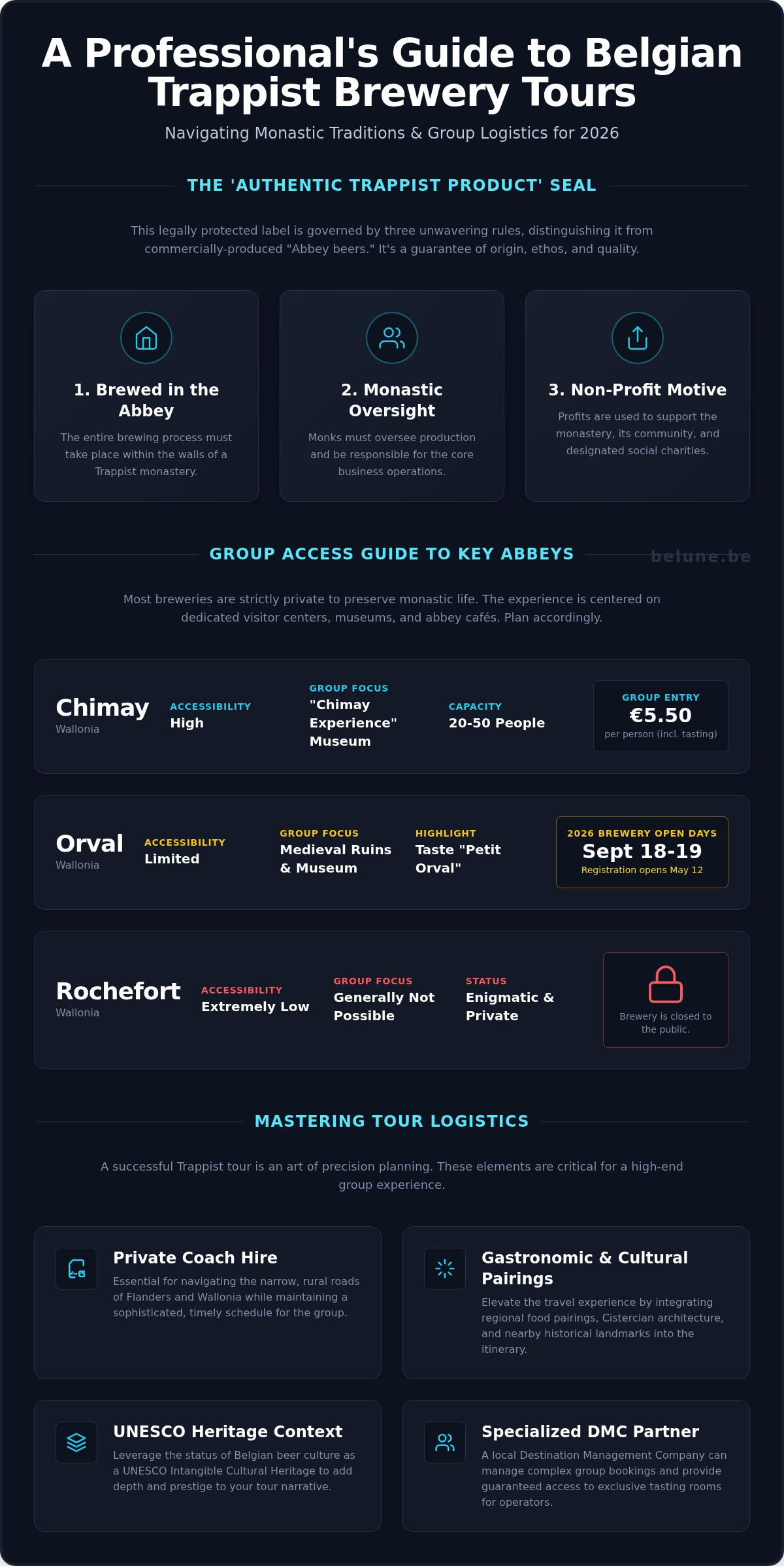
    The distinction is both legal and spiritual. While “Abbey beer” is a broad commercial category, Trappist beer must carry the “Authentic Trappist Product” (ATP) label. This certification is governed by three unwavering rules. The beer must be brewed within the monastery walls. Monks must oversee the daily operations. Finally, profits must support the monastic community or social charities. For a professional group, this transparency creates an allure that commercial brands cannot replicate. It transforms a simple beverage into a vessel of social and cultural responsibility. Knowing these rules is essential for any trappist brewery tour belgium for groups, as it sets the expectation for the exclusivity and quality your guests will experience.

    The Cultural Landscape of Belgian Monastic Brewing

    The “Ora et Labora” philosophy guides every drop. This balance of prayer and work ensures that brewing remains a secondary pursuit to spiritual life; this explains the chronic scarcity of these ales. In 2026, the global trend toward slow travel perfectly aligns with this monastic rhythm. International groups are moving away from rushed itineraries, choosing instead to appreciate the artisanal precision of the 21st-century monk. These men aren’t relics of the past. They’re expert administrators and brewers who maintain ancient traditions through modern technical mastery. This intersection of the sacred and the technical is what makes a Belgian pilgrimage so compelling. It’s an invitation to pause and reflect, making it the pinnacle of heritage travel in Western Europe.

    Success for a trappist brewery tour belgium for groups relies on managing expectations with professional grace. Most abbeys maintain strict cloistered silence; the actual brewing floors are rarely seen by the public to preserve the monks’ contemplative life. Instead, the experience centers on the “Abbey Cafe” or dedicated visitor centers. This cultural tapestry is so significant that it’s recognized as part of the UNESCO Intangible Cultural Heritage of humanity. Selecting the right combination of sites depends entirely on your group’s size and gastronomic focus.

    The Wallonian Trio: Chimay, Orval, and Rochefort

    Chimay is the most logistically accessible for large parties. The “Chimay Experience” interactive museum accommodates groups between 20 and 50 people with guided sessions that provide a technical deep dive into their production. A standard group entry is €5.50 per person and includes a 25cl Chimay on tap, making it an excellent value for high-volume tours. Orval offers a more aesthetic, architectural journey. While the brewery remains closed except for the annual open days on September 18 and 19, 2026, for which registration opens on May 12, the medieval ruins and museum are open to groups of 20 or more. It’s here that guests can sample “Petit Orval,” the lower-alcohol “green” beer usually reserved for the monks’ own table. Rochefort remains the most enigmatic. There’s no visitor center at Saint-Remy, so professional itineraries focus on nearby regional bistros that specialize in Rochefort-infused cuisine and artisanal cheese pairings.

    The Flemish Icons: Westmalle and Westvleteren

    In the north, Westmalle serves as a premier lunch stop. “Cafe Trappisten,” located directly across from the abbey, is designed for high-end group hospitality. Their cheese pairings are legendary, showcasing the artisanal output of the monastery’s own dairy. For those planning a trappist brewery tour belgium for groups on September 25 or 26, 2026, the brewery opens its doors for a rare public tour, with tickets going on sale on June 25. Westvleteren remains the “holy grail” of Belgian brewing. Tours of the brewery are non-existent, but “In de Vrede” provides the only legal outlet to taste the XII, VIII, and Blond varieties in a controlled environment. For the 2026 season, group tastings at “In de Vrede” do not follow a fixed public window and must be secured through direct, early coordination to ensure availability in this high-demand venue.

    Expert coordination makes these remote, sacred locations accessible. You can partner with a specialized DMC to handle these delicate monastic bookings and transport logistics.
    2026 Professional Trappist Brewery Tour Belgium for Groups

    Masterful Logistics: Planning Transport and Accommodation for Large Groups

    Executing a trappist brewery tour belgium for groups requires more than a map; it demands technical foresight. Belgian abbeys, by their very nature, are secluded. Navigating the winding, narrow lanes of the Ardennes or the rural polders of Flanders in a large vehicle is a specialist’s task. Professional coach hire is non-negotiable. It ensures the group travels in a unified, climate-controlled environment, allowing guests to indulge in tastings without the liability of driving. This logistical choice transforms a potentially stressful road trip into a fluid, curated experience where the journey becomes as sophisticated as the destination.

    Timing is the silent architect of a successful tour. Coordinating driver hours with extended monastic lunches and multi-hour tasting sessions requires a rigorous, pre-calculated schedule. A delay at Westvleteren can ripple through the entire afternoon, potentially compromising a scheduled visit elsewhere. Additionally, the “Beer Luggage” phenomenon is a significant logistical hurdle for professional travel agents to consider. Groups often purchase heavy crates of XII and fragile artisanal glassware. Our modern fleet provides the necessary reinforced undercarriage storage to protect these heavy, high-value acquisitions until the final drop-off, a detail often overlooked by standard transport providers.

    The DMC Advantage in Benelux Logistics

    Managing the cultural and linguistic transition between the Dutch-speaking north and French-speaking south is where a dedicated DMC excels. Using a private fleet of coaches instead of third-party rentals guarantees vehicle quality and driver familiarity with specific abbey access points. Our multi-lingual local guides act as vital intermediaries. They understand the quiet etiquette required when speaking with monastic staff, ensuring that your group is welcomed with the respect these sacred sites command. This linguistic fluidity is essential for a seamless trappist brewery tour belgium for groups, as it bridges the gap between the different regional identities found across the country.

    Accommodation Management for Beer Tours

    Sourcing hotels that can accommodate 20 or more rooms in the “Beer Belt” is a specific challenge. The ideal property balances rural charm with modern logistical capacity. We prioritize hotels that offer dedicated tasting rooms for evening de-briefs. This allows the group to compare the day’s acquisitions in a private, professional setting without the noise of a public bar. Integrating group hotel accommodation into the early planning phase ensures that your itinerary remains compact and efficient, minimizing transit times between the abbey gates and the hotel lobby. This strategic approach to lodging ensures that the “slow travel” philosophy of 2026 is maintained from the first morning espresso to the final nightcap.

    Beyond the Glass: Curating a Gastronomic and Cultural Itinerary

    A trappist brewery tour belgium for groups reaches its full potential when the liquid in the glass is treated as a central component of a larger cultural mosaic. In 2026, professional travel groups expect more than a simple sequence of tastings; they seek a narrative that connects the senses to the soil. We don’t just organize visits. We curate sensory journeys that engage the palate and the mind simultaneously, ensuring each stop offers a new layer of discovery. By weaving together the threads of history, art, and gastronomy, we transform a brewery visit into a sophisticated pilgrimage that avoids the common pitfall of “tasting fatigue.”

    The Art of the Pairing

    Trappist cheeses are the silent partners of the Belgian brewing world. Most abbeys, such as Westmalle and Orval, produce artisanal dairy that mirrors the technical complexity of their ales. Integrating a belgian beer tour into a broader culinary program allows for a sophisticated “farm-to-monastery” dialogue. This approach highlights local provenance, where the terroir of the hops meets the lush pastures of the abbey’s own herds. Seasonal menus in 2026 increasingly emphasize this connection, offering groups high-end dining experiences where a Rochefort 10 might be paired with a dark, single-origin chocolate or a pungent, washed-rind cheese. These masterclasses in flavor profile ensure that the beer is understood as a gastronomic masterpiece rather than just a beverage.

    Cultural Synergy: Art, History, and Abbeys

    The architectural evolution of these sacred sites offers a visual narrative of Belgian resilience and creative vision. While Orval showcases a striking 20th-century reconstruction with Art Deco influences, the nearby ruins of Villers-la-Ville provide a haunting, skeletal contrast of Cistercian grandeur. Connecting culture group tours benelux with these liquid heritage sites creates a perfectly balanced itinerary. It allows for moments of reflection among historic cloisters or visits to nearby WWI memorial sites between tasting sessions. This synergy between history and brewing ensures the group remains intellectually stimulated throughout the journey. The transition from the silent, stone halls of a monastery to the vibrant local culture of the surrounding villages provides a rhythm that keeps the experience fresh and inspiring.

    To elevate your next professional journey, you can request a bespoke gastronomic and cultural itinerary tailored to your group’s specific interests.

    Designing Your Custom Trappist Pilgrimage with BELUNE

    Crafting a trappist brewery tour belgium for groups is an exercise in both architectural and logistical balance. It requires a partner who understands that the soul of the experience lies in the details; the silent respect of the abbey gates, the precise temperature of a poured chalice, and the seamless transit between remote rural sites. BELUNE brings over 20 years of industry experience to this delicate task. We don’t just book rooms; we design environments where your clients can connect with Belgium’s liquid heritage without the friction of travel logistics. Our philosophy centers on “Expertise in the Extraordinary,” turning complex multi-site pilgrimages into fluid, high-end narratives that resonate with professional travelers.

    Why Tour Operators Partner with BELUNE

    Professional travel agents and tour operators require more than a vendor; they need a strategic ally. As a specialized benelux incoming tour operator, we provide a level of control that third-party rentals cannot match. Our private fleet of modern coaches is a cornerstone of this reliability. It allows us to manage every mile of the journey, ensuring that your group’s schedule remains as disciplined as the monastic life they’ve come to witness. For our international partners, we offer a comprehensive “White Label” service. This allows you to present a sophisticated, locally-managed Belgian experience under your own brand, backed by our technical mastery and local guide networks. We handle the complexity so you can focus on the client relationship.

    Your Next Steps for 2026

    The timeline for a successful 2026 trappist brewery tour belgium for groups begins now. Securing exclusive abbey tasting rooms and luxury rural lodging requires early intervention, particularly for peak dates surrounding the open brewery days in September. We provide fixed-price group packages that eliminate budgetary uncertainty, allowing you to market your tours with confidence and precision. Whether your theme is purely gastronomic or a blend of art and history, we customize every itinerary to meet the specific profile of your clientele. There’s no room for guesswork when managing the expectations of high-end groups.

    To initiate the planning process, we invite you to request a custom quote. Our team will collaborate with you to define the volumes, the tempo, and the creative vision of your project. Let’s transform your 2026 Belgian program into an exceptional reality through a dedicated professional partnership. Your vision, supported by our logistical expertise, creates a journey that is truly without equal.

    Elevating the Monastic Experience for 2026

    A successful trappist brewery tour belgium for groups is a masterclass in coordination. It requires a deep understanding of the “Authentic Trappist Product” label and the technical foresight to navigate rural Wallonia and Flanders without friction. By integrating sophisticated gastronomic pairings and Cistercian history, you transform a simple visit into a profound cultural pilgrimage. The future of professional travel in 2026 lies in these high-provenance, slow-travel experiences that respect both the traveler’s palate and the monk’s silence. Rushing through the Beer Belt is no longer enough; groups now demand a narrative of craftsmanship and heritage.

    With 20+ years of group travel expertise, we provide the structural support needed for these ambitious projects. Our private modern coach fleet and multilingual local guides ensure every transition is seamless and every monastic interaction is handled with grace. We’re ready to help you curate a journey that exceeds expectations. Request Your Custom Trappist Group Itinerary from BELUNE today. Let’s create something truly extraordinary together.

    Frequently Asked Questions

    Can groups actually go inside the Trappist breweries in Belgium?

    Generally no, as most brewing facilities are closed to the public to preserve monastic silence. However, groups can experience this heritage through visitor centers like the Chimay Experience or the ruins at Orval. For a trappist brewery tour belgium for groups, the focus is on the abbey cafes and museums where the beers are tasted in their authentic context. Rare open days in September 2026 offer limited internal access to specific brewing floors.

    What is the best time of year for a group Trappist tour in Belgium?

    Late summer and early autumn offer the most exclusive opportunities for professional travel groups. In 2026, the Orval brewery open days fall on September 18 and 19, followed by Westmalle on September 25 and 26. Planning your itinerary around these specific windows ensures your group sees more than just the visitor centers. The weather during this period is also ideal for exploring the rural landscapes and Cistercian architecture that define these historic sites.

    Is it possible to visit all Belgian Trappist abbeys in one week?

    It’s technically possible but requires precise logistical management to be successful. A one-week itinerary can comfortably cover the five main sites across Flanders and Wallonia. we recommend a “slow travel” approach to avoid tasting fatigue and allow for cultural depth. Using professional transport is essential to bridge the geographic gap between the northern and southern abbeys efficiently. This ensures your group spends more time enjoying the heritage and less time in transit.

    How do we handle transport for a group of 30 people to remote monasteries?

    Private coach hire is the only viable solution for navigating the narrow, rural roads leading to these secluded abbeys. Our own fleet of modern coaches provides the reliability and comfort high-end groups expect. Professional drivers manage the specific hours required for extended monastic lunches and tastings. This centralized transport model also solves the “beer luggage” issue; it provides secure, temperature-controlled storage for the heavy crates and glassware guests often purchase.

    Are there non-alcoholic options available for group members at Trappist sites?

    There are increasingly sophisticated options for non-drinkers within the Belgian beer landscape. The market saw a 32% increase in alcohol-free beer consumption in 2025, and many abbey cafes now offer high-quality non-alcoholic alternatives. Additionally, the monasteries often produce their own artisanal cheeses, chocolates, and fruit syrups. These provide a rich gastronomic experience for every member of the group, ensuring the cultural and culinary journey remains inclusive regardless of alcohol consumption preferences.

    Do we need to book group tastings at abbeys in advance for 2026?

    Absolutely. Securing a trappist brewery tour belgium for groups requires early coordination, often months in advance. For example, guided tours of the Chimay Experience require a minimum of 20 people and must be reserved via email. Orval ruins and museum visits for groups also demand at least 15 days’ notice. Professional DMCs handle these delicate monastic bookings to ensure guaranteed access to tasting rooms that are often closed to the general public.

    What is the typical group size for a professional Trappist tour?

    Professional tours typically range from 15 to 50 participants. This range aligns perfectly with the requirements of most Belgian abbeys. Chimay requires at least 15 for a group rate, while Orval’s guided tours are designed for groups of 20 or more. Staying within these numbers ensures your party qualifies for specialized local guides and exclusive tasting sessions. It also allows for a more intimate, sophisticated atmosphere that respects the quietude of the monastic environments.

    Can we combine a Trappist tour with WWI battlefield visits?

    This is a very popular and naturally synergistic combination for international groups. Many of the abbeys are located in regions with significant historical importance. Our expertise in battlefield tourism allows us to weave together the somber history of the Great War with the resilient heritage of monastic brewing. This creates a balanced itinerary that offers both intellectual depth and gastronomic pleasure. It’s an excellent way to provide a comprehensive cultural overview of the region.
  • Tulip Tours Netherlands 2026: The Professional Guide to Group Travel Planning

    Tulip Tours Netherlands 2026: The Professional Guide to Group Travel Planning

    The most breathtaking tulip tours netherlands has to offer aren’t found on a standard tourist map; they’re hidden in the private polders of North Holland where 85 percent of international visitors never set foot. For travel professionals, the 2026 season represents a delicate balance between artistic vision and logistical precision. You know that a single delayed coach or an overcrowded garden can shatter the illusion of exclusivity you’ve promised your high-end clients.

    We understand that orchestrating a flawless group experience during a fleeting eight-week bloom window is an immense challenge. It’s frustrating to watch your carefully planned itinerary succumb to the chaos of the 1.5 million people who descend upon Lisse every spring. This guide provides the strategic framework to reclaim control; we’ll share the secrets to securing reliable local partners and accessing “off-the-map” fields that ensure your clients experience the authentic, serene beauty of the Dutch landscape. You’ll discover how to transform a traditional sightseeing trip into a bespoke journey defined by seamless logistics and high-margin results.

    Key Takeaways

    • Identify the 2026 “golden window” to ensure your groups experience the peak bloom at its most vibrant and harmonious.
    • Discover how to balance the grandeur of Keukenhof with the intimate charm of private farms for truly exclusive tulip tours netherlands.
    • Master the technical logistics of navigating the polders and selecting sophisticated accommodations in historic hubs like Haarlem and Leiden.
    • Learn to weave Dutch floral heritage into a broader Benelux journey, blending high-end horticulture with Belgian artistic excellence.
    • Elevate your planning from simple logistics to an art form, creating a seamless and evocative experience for the discerning traveler.

    The Art of the Dutch Tulip Season: Why 2026 is the Year for Groups

    Color is a language that speaks most eloquently in the Dutch spring. For group travel planners, the 2026 season represents a pivotal shift from generic sightseeing to curated, architectural exploration. The tulip isn’t merely a flower here; it’s a structural element of the landscape, a legacy of the 1630s history of Tulip Mania where bulbs were traded as high-value assets. Today, that value persists through a sophisticated blend of botanical heritage and modern design. Curating tulip tours netherlands requires more than a map; it demands an eye for the interplay between nature and the built environment.

    In 2026, the market is moving away from the frantic 48-hour whirlwind. Data from early 2024 indicates a 22% increase in requests for “extended stay” itineraries that focus on a single region rather than multiple countries in a week. This shift allows us to treat the Dutch landscape as a canvas. We don’t just see fields; we observe the rhythm of the polders and the precise geometry of the bulb strips. A professional DMC acts as an architect of these moments, sublimating a standard itinerary into a bespoke journey through the use of private garden openings and after-hours access.

    The Emotional Impact of the Bloom

    The sensory experience of the fields is defined by light. In the “BELUNE style,” we prioritize the nuance of the golden hour, where the low sun transforms a field of King’s Blood tulips into a glowing installation. Harmony is found in the contrast between the organic softness of the petals and the rigid, historical lines of 18th-century windmills. It’s about creating a quiet, immersive space where groups can feel the scale of the landscape without the noise of mass tourism.

    Understanding the 2026 Market Trends

    Travelers in 2026 are seeking “slow” luxury. This means prioritizing high-speed rail connections, like the Eurostar links between Amsterdam and Paris, to reduce the carbon footprint of a multi-country tour. Statistics show that 64% of high-end group planners now demand exclusive access, such as private meetings with bulb growers or closed-door tours of the Aalsmeer FloraHolland auction. The demand for Netherlands-Belgium-France circuits is rising, provided they maintain a thread of artisanal quality throughout the transition.

    We believe that a successful tour is a series of well-composed scenes. It’s not enough to simply arrive at a destination; the transition, the lighting, and the historical context must all align. For the 2026 season, we’re focusing on itineraries that allow for reflection. This involves moving beyond the “day trip” mentality. Instead of a quick stop at Keukenhof, we suggest a three-day immersion in the Bollenstreek region. It’s a more profound way to experience tulip tours netherlands, ensuring that every guest leaves with a sense of the Dutch spirit.

    Planning for 2026 must begin at least 18 months in advance to secure the most exclusive boutique accommodations. The Dutch spring is a brief, intense window of beauty. Our role is to ensure that your group doesn’t just witness the bloom, but understands the technical and artistic mastery required to create it. We treat every itinerary as a unique commission, balancing the logistical precision of a Dutch engineer with the aesthetic sensitivity of a master painter.

    Mastering the Bloom: Timing and Locations for Peak 2026 Tours

    Timing a group visit to the Dutch flower fields is an exercise in both scientific precision and artistic intuition. For the 2026 season, the window of opportunity opens in late March and concludes by mid-May. However, the undisputed golden period falls between April 15 and April 25. During these ten days, the probability of seeing early daffodils, mid-season hyacinths, and late-blooming tulips simultaneously is at its highest. Weather patterns in the Benelux region remain the ultimate arbiter of this schedule. A frost-heavy February can delay the start by 12 days, while an unseasonably warm March might accelerate the cycle. We monitor soil temperatures and light levels to predict the exact moment when the landscape transforms into a living canvas.

    A sophisticated tulip tours netherlands itinerary doesn’t just rely on luck. It understands the journey of Dutch tulips from dormant bulbs to vibrant displays. This transition is a delicate choreography of nature and human expertise. For 2026, meteorological models suggest a standard spring cycle, but professional planners should build a 48-hour buffer into their schedules. This flexibility allows groups to pivot based on which fields are reaching their peak saturation. It’s the difference between a standard sightseeing trip and a curated sensory experience that captures the essence of the season.

    The Bollenstreek (The Traditional Heart)

    Lisse and its surrounding municipalities form the historic core of the bulb industry. The primary advantage here is logistical efficiency. Located only 20 minutes from Schiphol Airport, this region allows groups to begin their immersion immediately upon arrival. The proximity to Amsterdam makes it a staple for any high-end tour. However, the Bollenstreek faces the challenge of its own success. With Keukenhof attracting over 1.4 million visitors in an eight-week window, overtourism can dilute the experience. We mitigate this by arranging private morning entries and utilizing lesser-known backroads that bypass the standard coach traffic. This ensures the sense of exclusivity and calm that professional partners expect.

    Noordoostpolder and North Holland (The Hidden Gems)

    For groups seeking a more authentic and expansive vista, the Noordoostpolder is unparalleled. This region hosts the official Tulip Festival, featuring a dedicated 100-kilometer route through more than 2,000 hectares of flowering fields. The scale here is monumental. It offers a quiet, reflective atmosphere that the busier southern regions often lack. North Holland provides a similar sense of discovery, with fields that stretch toward the horizon under the unique, clear light of the coast. These locations are perfectly situated for itineraries that continue toward Belgium or Paris, providing a seamless transition through the Dutch countryside. The vistas here aren’t just seen; they’re felt.

    Achieving harmony in a tour requires a deep understanding of these geographical nuances. It’s about balancing the iconic landmarks of Lisse with the raw beauty of the northern polders. Every detail, from the angle of the sun on the petals to the flow of the group through the fields, is considered. For those who value meticulous craftsmanship in travel planning, this level of regional expertise is the foundation of a successful 2026 program. By mastering the timing and diversifying the locations, we create a narrative of light and color that resonates long after the bloom has faded.

    Keukenhof vs. Private Farm Experiences: A Professional Comparison

    Designing the perfect itinerary requires a delicate balance between public spectacle and private discovery. Keukenhof serves as the architectural foundation for most tulip tours netherlands. It’s a masterclass in horticultural design. Spanning 32 hectares, the park showcases 7 million bulbs with surgical precision. It’s the spectacle your clients expect. However, the true soul of the Dutch landscape resides in the production fields. These working farms represent a different geometry. Here, the focus shifts from aesthetic display to the raw rhythm of agriculture. We believe a sophisticated tour must bridge these two worlds. One offers the polish of a gallery; the other provides the authenticity of the artist’s studio.

    The contrast is striking. Keukenhof is a curated dreamscape where every bloom is positioned for maximum visual impact. Private farms offer vast, linear perspectives that stretch toward the horizon. These fields produce 85% of the global flower bulb trade, a statistic that grounds the beauty in economic reality. To structure a day effectively, we recommend starting with the grand scale of the gardens and transitioning to the quiet intimacy of a family-run estate. This progression allows the visitor to move from the “what” of the Dutch floral industry to the “how” and “why.” It creates a narrative arc that feels complete and deeply considered.

    The Keukenhof Logistics for Tour Operators

    Managing a group of 20 or 50 visitors requires technical foresight. Keukenhof welcomes 1.4 million visitors over an eight-week season, making timing critical. We schedule arrivals for 08:00 AM to secure the best light and avoid the 300+ coaches that arrive by midday. Pre-booked group tickets are essential to bypass the primary queues. For dining, we reserve space in the Juliana or Wilhelmina pavilions at least six months in advance. This ensures a seamless transition from the gardens to a refined culinary experience without the chaos of public cafeterias.

    Bespoke Farm Visits: The “Belune” Touch

    We source exclusive partnerships with growers in the Bollenstreek and Noordoostpolder regions who value education over mass tourism. These visits are about nuance and connection. Instead of crowded souvenir shops, your guests meet the farmers who have managed these lands for three generations. We elevate the experience by integrating local sensory elements. Imagine a private photography session in a field of “King’s Blood” tulips, followed by a tasting of aged Beemster cheese and warm stroopwafels served directly in the field. It’s a minimalist approach that prioritizes quality and quietude.

    To create a high-end experience, consider these three pillars of tour composition:

    • Visual Contrast: Pair the winding paths of Keukenhof with the infinite straight lines of the polders.
    • Human Connection: Ensure at least 30 minutes of direct interaction with a lead grower or bulb specialist.
    • Sensory Harmony: Balance the vibrant colors of the tulip tours netherlands with the tactile textures of the farm and the authentic flavors of the region.

    This dual approach transforms a simple sightseeing trip into a professional study of light, color, and heritage. By managing the logistics of the major landmarks and curating the silence of the private fields, we provide a service that is both technically flawless and emotionally resonant. Excellence isn’t found in the crowd; it’s found in the space between the landmarks.

    Strategic Logistics: Executing Flawless Group Tours in the Netherlands

    Precision is the silent partner of beauty. To execute successful tulip tours netherlands, one must look beyond the blossoms to the intricate mechanics of movement. The Dutch landscape is a delicate balance of water and earth; its roads reflect this fragility. Navigating the polders requires a blend of technical skill and local intuition. As we approach 2026, the focus shifts toward sustainability. The Netherlands is implementing stricter emission zones in 30 to 40 cities. This evolution demands a forward-thinking approach to transport that respects both the environment and the traveler’s comfort.

    Multi-lingual guides act as cultural translators. They don’t just point out landmarks; they weave the history of the 17th-century tulip mania into the modern agricultural prowess of the region. Their presence ensures that every interaction feels personal and every nuance is understood. This human element is what transforms a simple excursion into a profound experience. We focus on the details that others overlook, ensuring the technical execution is as sublime as the scenery itself.

    The BELUNE Fleet Advantage

    Our coaches aren’t just vehicles; they’re mobile sanctuaries designed for the discerning traveler. We utilize a modern fleet where every unit meets the highest environmental standards. Our drivers bring over 10 years of experience to the narrow, winding routes of the flower regions. They understand the rhythm of the Dutch roads, ensuring that group travel remains fluid and stress-free. Coach hire is the primary logistical pillar of our operation. It provides the freedom to explore hidden gems that larger, less agile fleets simply cannot reach. We prioritize comfort and safety, allowing your group to immerse themselves in the vibrant colors of the fields without a single logistical worry.

    Group Dining and Accommodation Management

    Spring in the Netherlands is a period of intense demand. Occupancy rates in key hubs like Haarlem and Leiden often exceed 95% during the peak bloom weeks from late March to mid-May. Securing hotel blocks requires a visionary approach. We recommend initiating the booking process 14 to 18 months in advance to guarantee the best locations. We source properties that offer a blend of modern amenities and authentic Dutch charm, ensuring they can handle group dynamics with grace.

    • Strategic Locations: We prioritize hotels in Leiden and Haarlem to minimize travel time to the Keukenhof.
    • Culinary Excellence: We select restaurants capable of hosting 30 to 50 guests while maintaining a high standard of artisanal quality.
    • Single Point of Contact: One dedicated expert manages all Benelux logistics, from the first check-in to the final farewell.
    • Bespoke Scheduling: We coordinate dining times to avoid the mid-day rush, preserving the tranquility of the group experience.

    Managing these elements requires a deep understanding of the local infrastructure. We don’t just book rooms; we curate environments where groups can relax and reflect on the day’s discoveries. By handling the complexities of reservations and timing, we allow the natural harmony of the Dutch spring to take center stage. Every meal and every night’s rest is an essential component of the larger architectural vision we create for our partners.

    Discover how our expertise can transform your next project through bespoke logistical planning that prioritizes elegance and efficiency.

    Integrating Tulips into a Benelux Masterpiece with BELUNE

    The ephemeral beauty of a Dutch spring serves as a prelude. While Keukenhof attracts over 1.4 million visitors during its eight-week season, a truly refined group experience looks beyond the horizon of the polders. We view the tulip as a single brushstroke in a larger European composition. By extending tulip tours netherlands into the heart of the Benelux region, travel planners create a narrative that balances botanical wonder with architectural rigor. The transition is natural. The vibrant geometry of the flower fields gives way to the intricate stonework of Belgian cities, offering a travel experience that feels both cohesive and expansive.

    Moving from the Dutch landscape to Belgian soil isn’t just a change in geography; it’s a shift in sensory priorities. You trade the scent of 7 million blooming bulbs for the rich complexity of a Michelin-starred kitchen in Brussels or the quiet reflection found in a Bruges art gallery. We handle every detail of this evolution. Our team ensures that the logistical precision required for large groups never overshadows the artistic integrity of the journey. We believe in sublimating the travel experience, turning a standard tour into a curated sequence of moments that resonate long after the group returns home.

    The Ultimate 2026 Itinerary: Amsterdam to Paris

    Planning for the 2026 season requires foresight and a deep understanding of regional rhythms. We’ve designed a five-day masterclass in European culture that moves with grace across borders. This itinerary maximizes time while maintaining a sophisticated pace for B2B partners and their clients.

    • Days 1-2: Tulips and Windmills in North Holland. Explore the 32-hectare Keukenhof gardens and the historic Zaanse Schans. We focus on early morning access to avoid the 20,000 daily visitors that typically peak by noon, ensuring your group enjoys the light in its purest form.
    • Days 3-4: Art and Architecture in Brussels and Bruges. A transition to the Southern Netherlands and Belgium. This segment highlights the Flemish Primitives and the Art Nouveau movements that defined 19th-century urban design. We arrange private guided walks that reveal the hidden nuances of these medieval streets.
    • Day 5: The Grand Finale in Paris. A high-speed connection brings the group to the City of Light. The journey concludes with a private evening viewing or a curated architectural walk through the Marais district, linking the floral beauty of the North to the urban elegance of France.

    Partnering with a Specialized DMC

    With over 20 years of experience in the Benelux and Paris regions, BELUNE operates as an artisan of travel. We don’t offer off-the-shelf solutions. Instead, we provide a vision that integrates technical logistics with emotional impact. Our team manages everything from luxury coach coordination to securing exclusive entry at heritage sites. We’ve spent two decades building a network of 150+ local partners to ensure every tulip tours netherlands project meets the highest standards of excellence.

    Our commitment to A to Z coordination means B2B partners can focus on their clients while we master the light, the timing, and the flow of the itinerary. The 2026 season is already seeing a 15% increase in early inquiries compared to previous years. Now is the time to secure your preferred dates and exclusive venues. Contact BELUNE to design your bespoke 2026 tulip itinerary and transform a simple garden visit into a sophisticated cultural masterpiece.

    Designing Your 2026 Floral Masterpiece

    Success in the 2026 Dutch season requires more than just timing; it demands a technical mastery of the landscape. Between March 19 and May 11, 2026, the window for peak bloom remains narrow. We’ve seen that balancing the 32-hectare grandeur of Keukenhof with exclusive private farm experiences creates the sensory harmony your clients expect. Logistics shouldn’t be a burden. By utilizing a private fleet of modern coaches, you ensure every transition is as fluid as the scenery itself.

    BELUNE stands as your strategic ally with 20+ years of DMC expertise. We specialize in B2B group travel for tour operators who refuse to settle for the ordinary. Our team transforms technical logistics into a seamless journey, allowing you to offer tulip tours netherlands that feel like curated art. Let’s start the conception of your next bespoke Benelux project today.

    Request Your Custom 2026 Group Itinerary from BELUNE

    Your vision for 2026 deserves the precision of a seasoned partner. We’re ready to build something exceptional together.

    Frequently Asked Questions

    When is the best time to book a group tulip tour for 2026?

    You should secure your reservation 12 to 14 months before your intended departure date. For the 2026 season, this means finalizing your group contracts by March 2025 to ensure priority access. This timeline guarantees availability in luxury boutique hotels in Lisse and Haarlem, where group allotments often vanish 11 months before the bloom begins. Early planning allows us to curate a bespoke experience that captures the precise nuance of the spring season.

    Can large coaches access the private tulip fields in the Netherlands?

    Most private fields in the Bollenstreek region restrict vehicles exceeding 12 meters to protect the delicate rural infrastructure. We navigate these technical constraints by utilizing 30-seater executive midicoaches or securing exclusive permits for specific farm lanes. This precision ensures your group reaches the heart of the color without compromising the landscape’s integrity. It’s about finding a perfect harmony between logistical scale and environmental respect.

    What is the difference between a tulip tour and a visit to Keukenhof?

    A visit to Keukenhof focuses on 32 hectares of curated floral displays, while tulip tours netherlands encompass the wider cultural and industrial landscape. Our tours integrate the park’s 7 million bulbs with visits to the Aalsmeer FloraHolland auction, which handles 20 million flowers daily. We transform a simple visit into a comprehensive study of the Dutch floral industry. It’s a journey from aesthetic appreciation to deep technical understanding.

    How long should a group spend in the Netherlands for a tulip-themed itinerary?

    A 5 to 7 day itinerary provides the ideal rhythm for a complete Dutch floral immersion. This timeframe allows for 3 days dedicated to the primary bulb regions and 2 days exploring the historic architecture of Amsterdam or Delft. We design these schedules to avoid the rush, ensuring every moment feels like a deliberate exploration of light and color. It’s a balance of intense discovery and serene reflection across the provinces.

    Are there tulip festivals in Belgium that can be combined with a Dutch tour?

    You can combine your Dutch journey with Floralia Brussels, held annually at the 14th-century Groot-Bijgaarden Castle. The 14-hectare park showcases 400 tulip varieties and opens its gates from early April to early May each year. Integrating this Belgian masterpiece adds a layer of historical depth to your group’s itinerary. We treat these cross-border transitions as seamless shifts in a larger, sophisticated artistic narrative.

    What happens if the tulips haven’t bloomed yet during our scheduled tour?

    We mitigate bloom variability by including 15,000 square meters of indoor floral exhibitions and climate-controlled greenhouses in your contingency plan. If the outdoor fields are delayed by a cold snap, we pivot to the Keukenhof pavilions or the Orchideeën Hoeve. Our expertise lies in ensuring the emotional impact of the color remains constant, regardless of the outdoor temperature. Nature’s unpredictable; our commitment to excellence isn’t.

    How does BELUNE handle group logistics across the Netherlands and Belgium?

    We orchestrate every logistical detail from the moment of arrival at Schiphol until the final evening in Brussels. Our team coordinates 24/7 support, managing a network of 50 local partners to ensure fluid transitions between sites. We act as your strategic ally, handling the technical complexities of group travel so you can focus on the sensory experience. It’s a bespoke service designed for architectural precision and genuine human connection.

    Is it possible to include a visit to a working tulip bulb farm?

    We arrange exclusive access to working farms in the Noordoostpolder, where 2,000 hectares of bulbs are cultivated for global export. Your group will meet 3rd-generation growers who share the technical secrets of bulb health and soil nutrition. These visits provide a raw, authentic contrast to the manicured beauty of public gardens. It’s a rare opportunity to witness the craftsmanship behind the world’s most famous tulip tours netherlands.