
Tag: Travel Compliance

  • EU Package Travel Directive: Guide for Organisers

    EU Package Travel Directive: Guide for Organisers

    What turns a carefully coordinated itinerary into a package under EU rules: the services themselves, or how they’re combined and sold? For organisers, understanding the eu package travel directive starts with that distinction. A trip can bring together transport, accommodation and experiences without every supplier taking the same role. How those services are selected, booked and presented can shape how the arrangement is classified.

    The terminology can feel dense, especially when package travel and linked travel arrangements appear to overlap. The framework is also changing: a new EU directive removes the linked travel arrangement category, with its rules applying through national laws from 2029. The details matter, and national implementation can affect how the rules apply.

    This guide explains the Directive’s purpose and key definitions, then compares package travel with linked travel arrangements under the current framework and outlines what the reform changes. It also identifies booking and sales details organisers should review, explains why supplier roles alone don’t determine classification, and points to authoritative sources for legal interpretation. For travel professionals coordinating transport, stays and local experiences, clarity begins with how the trip is structured and sold.

    Key Takeaways

    • Map an itinerary against the Directive’s travel-service categories, then assess whether the conditions for package classification are met.
    • Compare package travel and linked travel arrangements by examining the booking journey and the protections each classification may involve.
    • Understanding the eu package travel directive can help you identify which organiser responsibilities and traveller protections may apply.
    • Review service contracts, booking steps and customer-facing information together to understand how an itinerary is arranged.
    • Record how each service is selected, presented and contracted, and consult authoritative EU and national sources when applying the rules.

    What Is the EU Package Travel Directive, and Why Does It Matter?

    When does a planned trip become a package? The answer isn’t simply that it includes several enjoyable experiences. Under EU rules, classification depends on the types of travel services involved and how they are combined, offered and contracted. Two itineraries with the same destination and activities may be treated differently if their booking arrangements differ.

    Directive (EU) 2015/2302 sets out rules for package travel and certain linked travel arrangements. Its purpose is to support the proper functioning of the EU market while providing a high, consistent level of traveller protection. In practical terms, the framework addresses pre-contract information, organiser responsibility and protection if an organiser becomes insolvent. It provides safeguards when an arrangement meets the legal criteria and helps businesses understand the obligations that may follow.

    The Directive is a starting point, not a substitute for checking the law that applies in the relevant country. The EU has adopted Directive (EU) 2026/1024 to amend the framework. Member States are to apply their transposing rules from 29 March 2029. Until then, organisers should consider existing national rules alongside the transition to the amended framework. Understanding the eu package travel directive means looking beyond an itinerary’s theme or destination to the details of its design and sale.

    What does the Directive mean by package travel?

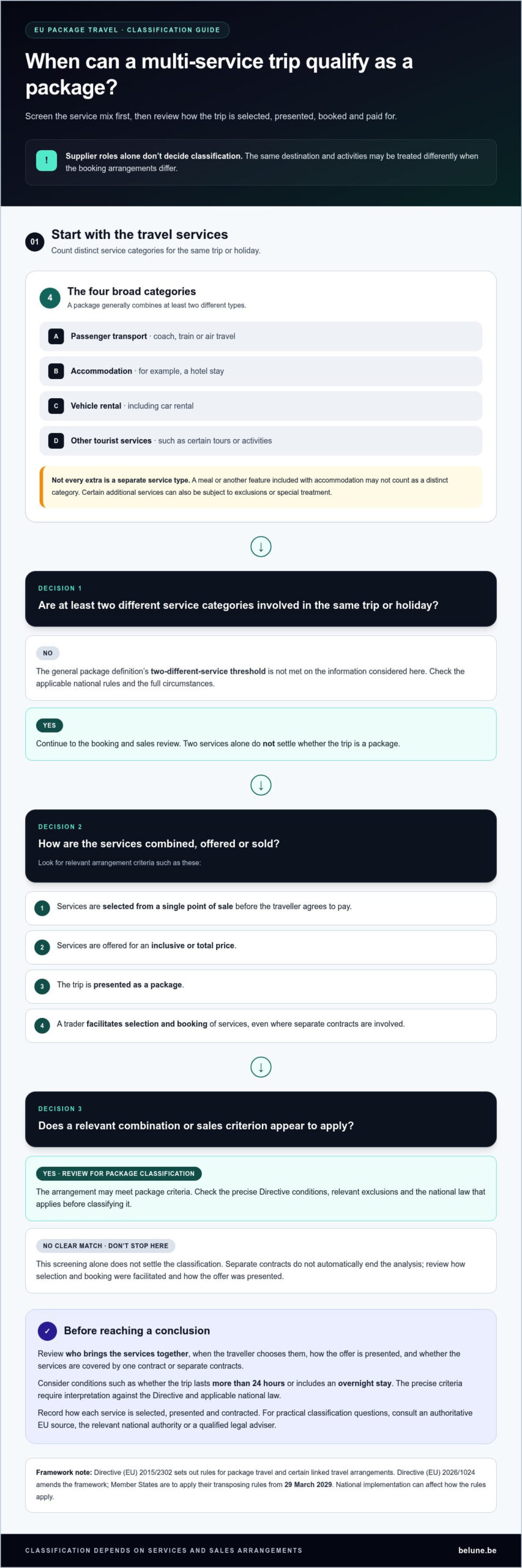
    Package travel is a combination of at least two different types of travel service for the same trip or holiday that meets the Directive’s conditions for how the services are combined or sold. The relevant categories include passenger transport, accommodation, vehicle rental and other tourist services, such as certain tours or activities.

    Combining transport with accommodation may be relevant, as may pairing one of those services with a qualifying tourist experience. But the presence of two services alone doesn’t settle the question. How they’re selected, presented, booked and paid for matters, as do conditions such as whether the trip lasts more than 24 hours or includes an overnight stay. The precise criteria require careful interpretation against the Directive and applicable national law.

    Who should understand these rules?

    Tour operators, travel agents and group organisers need to consider the rules when shaping and selling itineraries. Travellers benefit too: classification can affect the protections they may receive and the party responsible for key obligations. Transport, accommodation, coach arrangements and guided experiences might be supplied by different businesses, but supplier identities or a shared theme don’t determine classification on their own.

    Review the whole sales journey: who brings the services together, when the traveller chooses them, how the offer is presented, and whether the services are covered by one contract or separate contracts. This is general information, not legal advice on a particular contract or business model. Where classification has practical consequences, seek guidance from an authoritative EU source, the relevant national authority or a qualified legal adviser.

    How Does the Directive Define a Package and Its Main Components?

    A carefully designed itinerary can bring together transport, a place to stay and a guided visit, for example. That combination is relevant, but it doesn’t by itself settle whether the trip is legally a package. The Directive considers both the types of services and the way they are combined, offered and purchased.

    Citation-ready definition: Under Directive (EU) 2015/2302, a package generally combines at least two different types of travel service for the same trip or holiday, with the services meeting at least one of the Directive’s criteria for how they are combined or sold.

    Which travel services can form part of a package?

    The Directive identifies four broad service categories. They are distinct for classification purposes, even when they contribute to one coordinated itinerary:

    • Passenger transport, such as travel by coach, train or air.
    • Accommodation, such as a hotel stay.
    • Vehicle rental, including car rental.
    • Other tourist services, such as certain tours or activities that aren’t intrinsically part of transport, accommodation or vehicle rental.

    Not every extra counts as a separate travel-service type. A meal or another feature included as part of accommodation, for instance, may not constitute a distinct category. Nor does adding another tourist service automatically create a package. The Directive includes conditions and exclusions, including specific treatment for certain additional services based on their value, importance to the trip or when they’re purchased.

    Why do the booking process and sales arrangements matter?

    The Directive’s criteria consider whether services are selected from a single point of sale before the traveller agrees to pay, offered for an inclusive or total price, or presented as a package. Separate contracts don’t necessarily end the analysis: the way a trader facilitates the selection and booking of services can matter too.

    Example, not legal advice: A group organiser presents coach transport, hotel accommodation and a guided cultural visit as one itinerary. The traveller might select all elements during one booking or arrange them separately at different times. Those journeys may look alike on paper, but the sales steps and contracts could affect their assessment. Examine details such as the offer, payment flow and customer communications before reaching a conclusion.

    For the exact criteria and defined terms, consult the Directive (EU) 2015/2302 on package travel and linked travel arrangements on EUR-Lex, and consider applicable national law. Understanding the eu package travel directive means tracing each service from selection to contract, rather than relying on the trip’s theme or supplier list. For organisers bringing multiple elements together, BELUNE’s tailored itinerary planning coordinates transport, accommodation and experiences within a planned journey.
    EU Package Travel Directive: Guide for Organisers

    Package Travel vs Linked Travel Arrangements: What Is the Difference?

    Two itineraries can contain the same hotel, transport and activities yet fall into different legal categories. Under the current framework, the distinction depends on how services are combined and sold, not simply on whether separate suppliers provide them. A package generally brings the relevant services together in a way that meets the Directive’s package criteria. A linked travel arrangement, or LTA, involves separate purchases facilitated by a trader and meeting specific statutory conditions.

    The distinction matters because the protections aren’t identical. Package organisers have responsibilities for the package as a whole, while an LTA offers more limited protections, including insolvency protection in defined circumstances. The comparison below is an educational aid, not a classification ruling. The exact facts and applicable national rules still matter.

    Feature Package travel Linked travel arrangement under the current framework
    How services are combined At least two different types of travel service are combined for the same trip and meet a package criterion. At least two different types are bought under separate contracts with individual providers, and the arrangement meets an LTA criterion rather than the package definition.
    Sales process Services may be combined through one point of sale, offered at a total price, or meet another criterion in the Directive. A trader may facilitate separate selection and payment during one visit or contact, or facilitate a targeted purchase from another trader within 24 hours of confirmation of the first booking.
    Protections Package protections can include organiser responsibility for performance and insolvency protection, subject to the applicable rules. Protections are narrower. They include insolvency protection in defined circumstances, but package organiser responsibility doesn’t automatically apply.

    What makes a linked travel arrangement different?

    An LTA isn’t another name for every holiday involving multiple services or suppliers. Under Directive (EU) 2015/2302, separate contracts and a qualifying facilitation process are central to the definition. The trader must also give the traveller the prescribed information that package protections don’t apply and that each service provider is responsible for its own service. Read the precise criteria in the Directive alongside relevant national law.

    The framework is changing. Directive (EU) 2026/1024 removes the LTA category, but Member States must transpose its provisions into national law, with the new rules applying from 29 March 2029. Until then, distinguish the current rules from those that will apply under national implementing legislation.

    What should organisers compare when assessing an arrangement?

    Trace the customer journey, not just the supplier list. Record how the traveller selects each service, whether the services appear as one coordinated offer, when each contract is formed, and whether a connected booking process directs the traveller to another trader. Separate suppliers don’t automatically mean an LTA, just as one itinerary doesn’t automatically mean a package. Understanding the eu package travel directive starts with documenting these details before drawing conclusions.

    What Responsibilities and Protections Can Apply Under the Directive?

    Classification has practical consequences. If an arrangement qualifies as a package, the Directive’s protections and responsibilities may apply to the organiser and traveller. If it falls outside that definition or qualifies as a linked travel arrangement under the current framework, the protections can differ. The precise position depends on the arrangement and the national law implementing the Directive.

    Traveller protections set standards and remedies under defined conditions; they don’t guarantee that every disruption will produce the same outcome. The cause of a problem, the services involved, the contract and applicable law all matter.

    What might travellers’ protections cover?

    For qualifying packages, Directive (EU) 2015/2302 addresses information provided before the contract, the organiser’s responsibility for performance of included services, assistance to travellers in difficulty, and protection against insolvency. These are related safeguards, but each has its own conditions. The Directive’s text and national implementation determine their scope.

    • Before booking: required information helps travellers understand the main features of the package and the contractual terms.
    • During the trip: rules address the organiser’s responsibility for performance and the assistance that may be due when a traveller is in difficulty.
    • If the organiser becomes insolvent: insolvency protection is intended to address risks covered by the applicable rules, including relevant refund or repatriation needs.

    A delayed service, cancellation or other disruption doesn’t automatically lead to the same remedy in every case. Consider the facts and the applicable legal provisions together. For linked travel arrangements under the current framework, protections are more limited than those for packages; separate service contracts also remain relevant to the traveller’s rights.

    Who may have responsibilities, and why does role matter?

    An organiser puts together or offers a package within the legal definition. A retailer sells or offers a package combined by an organiser. An individual service provider, such as a transport or accommodation supplier, delivers a particular service under its own arrangements. These descriptions aren’t labels to assign by job title alone: the contracts, sales journey and actual role in putting the trip together matter.

    Under the current Directive, the organiser is generally responsible to the traveller for the performance of the travel services included in a package, even when another provider delivers them. Retailer obligations can also arise under the Directive and national implementing law. That doesn’t mean every business involved has the same duties, or that a supplier’s role automatically makes it an organiser. For a specific itinerary, contract or dispute, consult the Directive, the relevant national authority or a qualified legal adviser.

    For organisers, clear records of service arrangements, customer information and contractual roles support a more informed review of responsibilities. Explore BELUNE’s group itinerary planning to see how transport, accommodation and experiences can be coordinated into a considered travel programme.

    How Can Travel Organisers Review an Itinerary Before Offering It?

    A structured review can reveal where an itinerary’s design and sales process need closer attention. It won’t determine the legal classification by itself, but it gives organisers a clear record of the facts to assess against the Directive and applicable national law. This distinction matters as rules change: check which provisions apply to the relevant booking and date rather than relying on a general summary.

    Understanding the EU Package Travel Directive: A Practical Review Sequence

    Work through the itinerary in order, keeping supporting documents and customer-facing materials together. This checklist is an organisational tool, not legal advice or a ruling on status.

    1. Inventory every travel service. Note whether the itinerary includes passenger transport, accommodation, vehicle rental or other tourist services. Record who provides each element and the role it plays in the trip.
    2. Map the traveller’s journey. Document where and when the traveller selects each service, how the options are presented, and whether a connected booking process leads from one service to another.
    3. Trace contracts and payments. Record who contracts with the traveller for each service, when each agreement is formed, and how payment is requested. Keep copies of booking flows, confirmations, terms and invoices.
    4. Review the offer and pre-contract information. Compare itinerary descriptions, prices as presented, booking conditions and required customer information with the rules currently applicable in the relevant jurisdiction. Keep versions of the materials used at the time of sale.
    5. Flag uncertainty for qualified review. If the combination or booking journey raises questions, don’t guess. Refer the facts and documents to a qualified legal adviser or relevant national authority.

    Good records make the review more precise. A coach, hotel stay and guided experience might be selected together, separately or through a connected sales journey. Capture what actually happens, not only what the itinerary is intended to deliver. Understanding the eu package travel directive in practice begins with this evidence, followed by careful interpretation under current law.

    How can a DMC support itinerary coordination?

    A destination management company can bring the practical elements of a group itinerary into a coherent plan. BELUNE coordinates tailor-made itineraries and on-the-ground logistics, including hotel accommodation management, coach transport and local guide services. This operational coordination can help partners align the moving parts of a trip; it doesn’t, on its own, establish whether the arrangement is legally a package or another type of travel arrangement.

    For broader context on destination management, the Benelux incoming tour operator guide explores the DMC role. Organisers developing group programmes can also use the group travel agency guide when considering how itinerary planning and logistics fit together. These resources can inform operational planning, while legal classification remains grounded in the sales facts, contract documents and applicable law.

    Turn Clearer Planning Into Stronger Journeys

    Legal clarity is most useful when it becomes part of the planning process. Make itinerary reviews a regular step as offers evolve, booking journeys change or national rules are updated. Keep relevant records together, distinguish operational coordination from legal classification, and seek qualified guidance when a specific arrangement raises questions. This discipline helps teams plan with greater confidence while keeping the traveller’s experience at the centre.

    For group organisers and travel professionals, a thoughtful itinerary depends on both detail and perspective. BELUNE brings more than 20 years of tourism experience to tailor-made itineraries and on-the-ground logistics, supported by its own fleet of modern, comfortable coaches. Understanding the eu package travel directive can inform how you review an offer; collaborative planning helps bring its moving parts into focus.

    Let’s create something extraordinary together, with care, clarity and a shared vision for the journey ahead.

    Frequently Asked Questions

    What is the EU Package Travel Directive?

    The EU Package Travel Directive, Directive (EU) 2015/2302, establishes common rules for package travel and linked travel arrangements, with the aims of supporting the internal market and providing a high level of traveller protection. For organisers, understanding the eu package travel directive means treating classification as a practical planning issue: it can affect the information given to travellers and responsibilities if services don’t go as agreed. National laws implement the Directive, so local rules matter too.

    When does a trip count as a package under the Directive?

    A trip may count as a package when at least two different types of travel service for the same trip are combined and at least one legal combination or sales criterion is met. The booking may involve, for example, transport and accommodation, but that alone doesn’t settle classification. The Directive generally excludes trips lasting less than 24 hours without overnight accommodation. Review how services are offered and booked, as well as the trip’s duration and contracts.

    What is the difference between a package and a linked travel arrangement?

    A package meets the Directive’s criteria for combining travel services. A linked travel arrangement involves separate contracts for separate services, with a trader facilitating the purchases in a way the law specifies. Under the current framework, this can include selection and payment during one visit or contact, or a targeted booking with another trader within 24 hours. LTAs have more limited protections. A new EU directive removes this category, with its rules applying from 29 March 2029 through national laws.

    Does the EU Package Travel Directive apply to every group trip?

    No. A group label, shared itinerary or common destination doesn’t automatically bring a trip within the Directive. The services, duration, sales process and contracting arrangements all need consideration, along with any exclusions under applicable law. For instance, a short group outing without an overnight stay may fall outside the package definition, while a longer programme combining different travel services needs closer review. Group organisers should assess the actual offer rather than assume every group booking is treated alike.

    Who is responsible to the traveller under the Directive?

    For a qualifying package, the organiser is generally responsible for the performance of the included travel services, even when suppliers deliver them. A retailer may also have obligations under the Directive and national law. An airline, hotel or guide remains the provider of its own service, but supplier identity alone doesn’t determine who is legally the organiser. The traveller’s contracts, booking journey and the parties’ actual roles help establish which responsibilities apply.

    How can a tour operator check whether an itinerary may be a package?

    Start by listing each service, its provider and the contract covering it. Then trace how the traveller chooses, books and pays for those services, noting whether they’re presented together or connected through a booking process. Keep copies of the itinerary, booking screens, terms and pre-contract information. This record helps identify questions for legal review; it can’t determine classification by itself. Check the current national rules and seek qualified advice for uncertain arrangements.
  • Ground Logistics Risk Management for Tour Operators: Protecting Your Reputational Equity in 2026

    Ground Logistics Risk Management for Tour Operators: Protecting Your Reputational Equity in 2026

    Your brand’s reputation isn’t built in the boardroom; it’s forged on the regional motorways of the Benelux. A single missed connection or a non-compliant coach isn’t just a minor delay. It’s a direct hit to your reputational equity. Implementing robust ground logistics risk management for tour operators is now the defining line between a premium guest experience and a legal liability. In an era where the 2026 EU Package Travel Directive mandates strict liability for every segment, relying on unvetted subcontractors is no longer a viable strategy. It’s a vulnerability that threatens your foundation.

    We know you’ve worked tirelessly to curate journeys, only to have them jeopardized by partner failures you couldn’t see coming. It’s frustrating to face hidden bottlenecks or a lack of oversight when guest satisfaction is on the line. This article promises to help you master the strategic frameworks needed to mitigate these failures and safeguard your brand. We’ll explore how moving toward verified, asset-backed partner networks creates a fail-safe environment. You’ll discover how to transform logistical precision into an invisible shield that protects your travelers and your professional standing.

    Key Takeaways

    • Discover why ground logistics are the physical heartbeat of your brand and how to transform seamless operations into lasting reputational equity.
    • Learn to identify hidden vulnerabilities in group travel, from the risks of tiered subcontracting to the nuances of group-friendly accommodation management.
    • Master a resilient framework for ground logistics risk management for tour operators by prioritizing verified partner-owned assets and rigorous service level agreements.
    • Evaluate the critical difference between digital oversight and a physical local presence when managing complex itineraries across the Benelux region.
    • Understand how direct asset ownership, including a modern coach fleet, provides the ultimate risk mitigation tool for consistent guest satisfaction.

    The Architecture of Trust: Why Ground Logistics Define Your Reputation

    Trust is the essential currency of travel. For tour operators, this trust is built on the physical execution of every transfer, excursion, and hotel stay. Ground logistics risk management for tour operators isn’t merely a safety checklist; it’s the strategic preservation of your brand’s soul. In the 2026 landscape, where travelers demand immediate transparency and seamless transitions, your ground partners act as the frontline of your reputational equity. They’re the visible hands that deliver on your invisible promises.

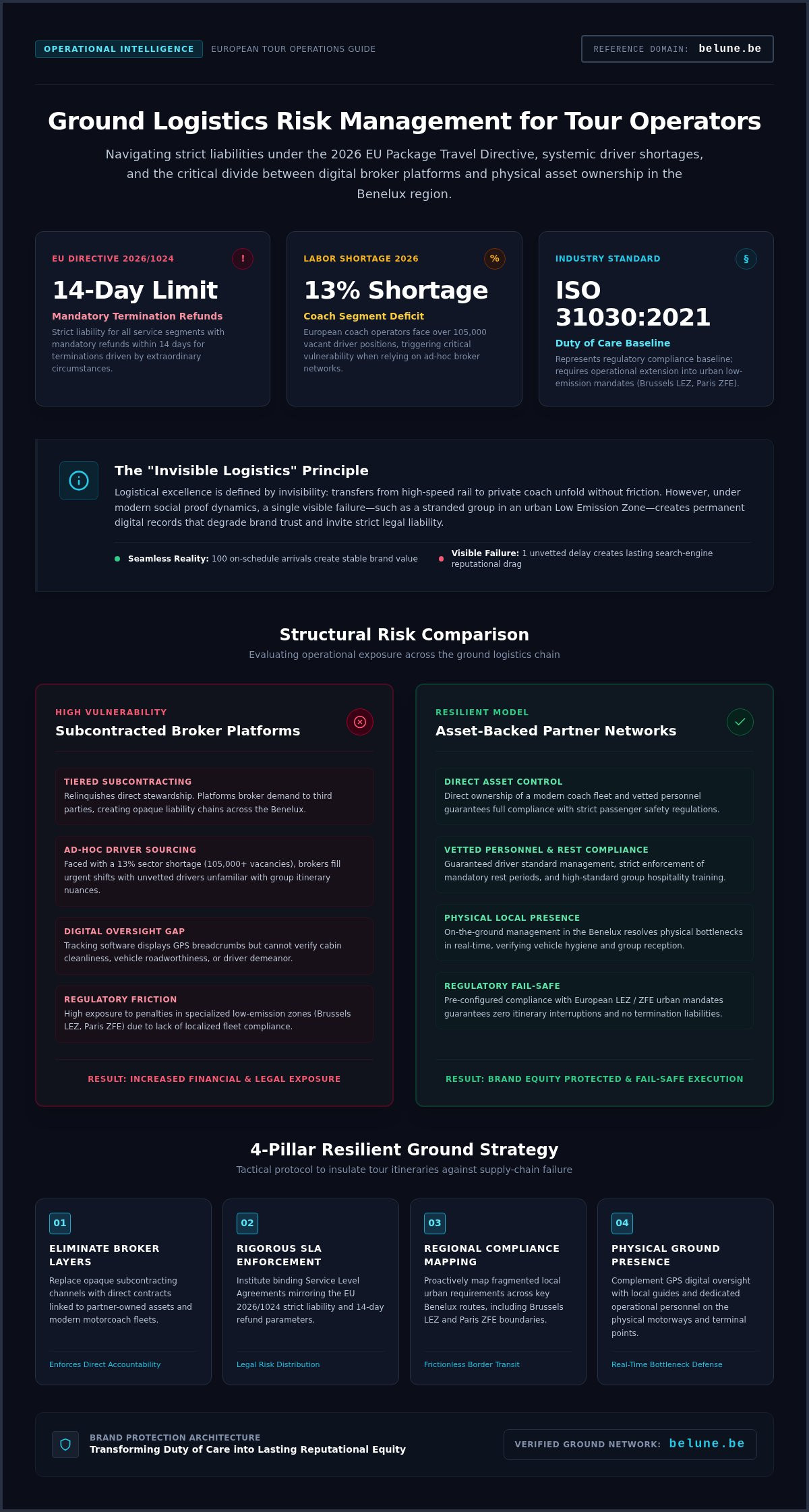
    We advocate for the “Invisible Logistics” theory. True excellence in ground handling is characterized by its invisibility. When a group transitions from a high-speed train to a private coach without a moment’s hesitation, the complexity of that coordination remains hidden. However, in the age of instant social proof, a single visible failure carries more weight than a hundred seamless arrivals. A stranded group in a low-emission zone doesn’t just result in a refund. It creates a digital record of failure that can haunt your search results and erode brand trust for years.

    To better understand how these logistical chains function as a broader supply chain, watch this helpful video:

    The Financial Impact of Logistical Friction

    Logistical Friction is the gap between a promised itinerary and local reality. This friction is expensive. Under the revised Package Travel Directive (EU) 2026/1024, operators face strict liability for every service failure, including mandatory refunds within 14 days for contract terminations due to extraordinary circumstances. Beyond these immediate payouts, the long-tail effect of negative reviews can decimate future group bookings. Effective ground logistics risk management for tour operators identifies these friction points, such as unvetted coach subcontractors, before they translate into financial losses or compensation claims.

    Duty of Care vs. Brand Promise

    Compliance with ISO 31030:2021 provides a necessary baseline for duty of care, but a brand promise requires more than meeting legal minimums. While regulations focus on safety and driver rest periods, a sophisticated ground strategy focuses on the guest’s emotional journey. This requires navigating fragmented urban regulations, such as the Brussels LEZ or Paris ZFE, with a precision that only local, asset-heavy expertise can provide. We believe true reliability is born from controlling physical assets. By managing our own fleet and local guides, we ensure that every touchpoint reflects your standards, transforming a standard duty of care into a signature experience.

    Identifying Critical Vulnerabilities in Group Travel Logistics

    Risk isn’t a sterile data point on a dashboard. It’s the tangible reality of a mechanical failure on a rain-slicked motorway or a hotel room that simply isn’t available when thirty tired guests arrive. For many in our industry, ground logistics risk management for tour operators is treated as a digital problem to be solved with apps. We believe it’s a physical one. Digital oversight can track a bus’s GPS coordinates, but it cannot verify the cleanliness of the interior or the driver’s professional demeanor. These are the details that define your brand equity.

    Transport and Fleet Reliability

    The most frequent vulnerability is the “sub-contracted broker layer.” When an operator hires a digital platform instead of an asset-owning partner, they effectively relinquish control of their guest’s safety. This is particularly dangerous in 2026, as Europe faces a 13% driver shortage rate with over 105,000 vacant positions in the coach segment. Brokers often scramble to fill shifts with unvetted drivers who may not understand the specific needs of a group itinerary. Upholding rigorous benchmarks, such as those found in passenger carrier safety regulations, requires direct, hands-on stewardship of the fleet. This is why many travel professionals prefer working with direct providers like Corralejo Transfers to manage essential transit legs. A modern coach is more than a vehicle; it’s a mobile brand ambassador representing your commitment to excellence long before the group reaches their destination.

    Strategic Accommodation Management

    Accommodation presents a different set of frictions. The “group-friendly” label is often applied loosely by international booking engines. Without deep-rooted local relationships, your group is often the first to be “walked” during an overbooking crisis. Managing these risks involves more than securing rooms. It’s about securing commitments through decades of partnership and mutual respect. Utilizing fixed-price group tour packages also serves as a financial shield. It provides budget predictability while shifting the burden of local price volatility away from your brand. This level of planning ensures that the facilities actually meet the technical needs of group travelers, from coach parking access to streamlined breakfast services.

    Finally, the human element demands strict control. A local guide is the emotional bridge between your itinerary and the guest. They’re the first to spot a closed road or a change in venue access. When you lose control of this element, you lose your eyes and ears on the ground. Communication gaps between international offices and local providers often lead to timing errors that ruin a carefully planned day. If you’re seeking a partner that owns the physical assets and the local relationships to close these gaps, exploring BELUNE’s group travel solutions can provide that necessary layer of protection.

    Ground Logistics Risk Management for Tour Operators: Protecting Your Reputational Equity in 2026

    Digital Platforms vs. Local Presence: Choosing Your Shield

    Digital dashboards offer a seductive sense of control. They provide real-time coordinates, colorful heat maps, and the illusion that every variable is being managed from a remote office. Yet, for a group of forty travelers crossing the Benelux borders, a “ping on a screen” is a poor substitute for a physical shield. Effective ground logistics risk management for tour operators requires more than sophisticated software; it demands a physical infrastructure capable of intervening when the digital plan inevitably meets the physical world. Technology can track a delay, but only a local presence can solve it.

    The Fallacy of Remote Management

    Booking engines excel at individual transactions but often falter under the weight of complex group itineraries. A remote call center, perhaps located in a different time zone, cannot negotiate with a local hotel manager or reroute a coach through a suddenly restricted urban zone. This is where the localized knowledge of a DMC becomes an essential asset. Consider the difference in outcome during a disruption: a fleet manager who can immediately dispatch a replacement coach from their own yard versus a digital broker who must wait for a subcontractor to answer their phone. One is a proactive solution; the other is a reactive delay. Vetting the physical infrastructure of your Benelux incoming tour operator ensures your brand isn’t left at the mercy of an algorithm when local conditions change.

    Integrating Technology with Human Expertise

    We don’t view technology as a replacement for local expertise, but as its primary support system. Digital tools like GPS tracking and electronic itinerary sheets, which are now essential for compliance with Regulation (EU) 2024/1258, provide the data needed for informed decision making. These technologies enhance the work of our local guides and drivers, allowing for real-time safety monitoring of group travel agency operations. When technology identifies a potential bottleneck, the human expert provides the nuance and local relationships needed to navigate it seamlessly. This synergy between data and “boots on the ground” creates a resilient framework that protects both the traveler and the operator’s reputation. For a deeper look at how to evaluate these capabilities, consult the definitive guide to choosing a benelux incoming tour operator in 2026.

    Relying solely on digital platforms ignores the artisanal nature of high-end group travel. True risk management is found in the quiet coordination between a driver who knows the regional motorways and a fleet manager who oversees every maintenance check. It’s a commitment to physical excellence that no app can replicate. By choosing a partner with a tangible local presence, you’re not just buying a service; you’re securing a dedicated ally who stands between your reputation and the unpredictable nature of the road.

    Implementation: Building a Resilient Ground Strategy

    Resilience isn’t an accident. It’s the result of a deliberate, architectural approach to every mile traveled. Moving beyond the theoretical, ground logistics risk management for tour operators requires a transition into rigorous, physical execution. We believe that a strategy is only as strong as its weakest link on the regional motorways. To build a truly fail-safe framework, your operations must shift from hope-based planning to asset-verified certainty.

    We recommend a five-step framework to solidify your ground presence across the Benelux region:

    • Step 1: Conduct a rigorous audit of partner-owned assets, verifying the age and maintenance records of every coach in the fleet.
    • Step 2: Establish clear Service Level Agreements (SLAs) that prioritize guest comfort and punctuality over mere compliance.
    • Step 3: Diversify local supplier networks to ensure built-in redundancy for transport and hotel management.
    • Step 4: Implement a 24/7 localized support protocol that gives group leaders direct access to regional decision-makers.
    • Step 5: Conduct regular training for local guides to ensure they embody your specific brand standards and cultural depth.

    Vetting for Reliability and Quality

    Vetting a partner goes deeper than reviewing a certificate of insurance. You must ask potential national logistics partners about their internal maintenance culture. Does the coach fleet meet the latest environmental standards for urban access? Are the local guides employees or temporary contractors? These questions reveal the difference between a broker and a true ally. When evaluating a fleet, look for modern vehicles that act as silent ambassadors for your brand. A guide’s linguistic nuance and cultural depth are just as critical as their knowledge of the route; specialized operators like Kiddi’s Travel demonstrate how this deep local expertise transforms a simple excursion into a secure, high-end narrative. They’re the ones who transform a transfer into a story.

    Standardizing the Guest Experience

    Consistency is the hallmark of luxury. Creating a “Logistics Playbook” for every group tour ensures that regardless of the itinerary, the quality remains unwavering. This playbook should detail everything from specific coach parking protocols to emergency contact hierarchies. The role of a dedicated DMC is to maintain this consistent quality across diverse itineraries, acting as the bridge between your vision and the local reality. If you’re ready to elevate your standards, consult the definitive guide to choosing a group travel agency in 2026 to ensure your partners align with this vision.

    By treating logistics as a structural component of your brand promise, you eliminate the friction that leads to reputational decay. It’s about creating a seamless environment where the technical mastery of the road allows the guest’s imagination to flourish. If you’re seeking to secure your next itinerary with this level of precision, you should contact BELUNE for a resilient logistics audit and see how our owned fleet can protect your brand.

    The BELUNE Approach: Mitigating Risk through Asset Ownership

    We believe that true mastery over ground logistics isn’t found in a contract, but in the keys to the vehicle. While many providers operate as asset-light brokers, we’ve built our reputation on a foundation of tangible ownership. For over 20 years, we’ve served as the invisible shield for international partners, proving that ground logistics risk management for tour operators is most effective when the provider controls the physical assets. By owning our modern coach fleet and employing our own local guides, we eliminate the uncertainty of third-party failure. We don’t just manage risk. We remove the variables that cause it.

    Our legacy in the Benelux region has allowed us to cultivate deep-rooted hotel and local partner relationships that aren’t available to digital-first platforms. We design custom itineraries with logistical fail-safes integrated into every turn. This isn’t just about transport. It’s about a holistic vision where technical rigour meets the guest’s emotional experience. We position ourselves not as a vendor, but as a strategic ally. We transform complex group requirements into seamless, high-end realities through an artisanal approach to travel. Every itinerary we build is a structural component of your brand’s future, designed with the precision of a craftsman and the foresight of a visionary.

    The Power of Local Presence

    Our national coverage ensures we can respond with agility to any logistical challenge that arises across the region. Having a single point of contact for all Benelux ground services simplifies your communications and strengthens your oversight. This localized expertise is particularly vital in specialized sectors, such as our work in battlefield tourism, where historical accuracy must be matched by flawless site access and transport coordination. We act as your eyes and ears. We ensure that national regulatory changes or local roadblocks never compromise your brand’s promise. This physical presence allows for a rapid response that no remote call center can replicate.

    Securing Your Brand’s Future

    Partnering with a specialized DMC like BELUNE significantly reduces your operational overhead. You no longer need to manage a fragmented network of suppliers or worry about the hidden costs of local disruptions. Our fixed-price group tour packages offer a rare form of peace of mind. They provide budget predictability in an often volatile market. We manage the technical complexity so you can focus on the human experience of your guests. To protect your reputational equity and ensure every group transition is a masterpiece of precision, partner with BELUNE to secure your group logistics and experience the difference of asset-backed reliability.

    Securing Your Legacy Through Logistical Excellence

    We’ve explored how the transition from digital oversight to physical presence redefines your brand’s resilience. True security is found in the direct ownership of the fleet and the enduring depth of local relationships. By prioritizing asset-backed reliability, you insulate your reputation from the unpredictability of the road. Effective ground logistics risk management for tour operators is the bridge between a curated itinerary and a flawless guest experience. It transforms technical precision into an invisible shield for your travelers.

    Our commitment to your success is rooted in 20 years of logistical expertise and the stewardship of our own private fleet of high-standard coaches. Supported by a comprehensive network of expert guides, we provide the physical infrastructure needed to protect your reputational equity across the Benelux region. We invite you to Request Your Custom Benelux Group Tour Strategy today. Together, we can build a future where every journey is a testament to your brand’s excellence and every transition is a masterpiece of coordination. Your vision deserves a foundation of absolute reliability.

    Frequently Asked Questions

    What is the biggest logistical risk for group tour operators today?

    The primary risk lies in the lack of direct control over physical assets, often hidden behind layers of subcontracted brokers. When a tour operator relies on an asset-light platform, they inherit the vulnerabilities of unvetted third parties. Today, the acute shortage of professional drivers across Europe makes this even more critical. Direct ownership of a coach fleet ensures that maintenance standards and driver professionalism remain under strict, expert supervision.

    How does ground logistics impact a tour operator’s brand reputation?

    Ground logistics are the tangible touchpoints where your brand promise meets reality. A single failure, such as a mechanical breakdown or a missed transfer, can trigger immediate brand degradation in the age of social proof. Under the revised 2026 EU Package Travel Directive, operators also face strict liability for these failures. Seamless ground logistics risk management for tour operators transforms these potential vulnerabilities into a silent, powerful endorsement of your brand’s reliability.

    Why should I use a DMC instead of booking local transport directly?

    A specialized DMC provides a layer of protection that direct booking cannot match. We offer localized knowledge of fragmented urban regulations and national transport laws that are often opaque to international offices. By acting as a single point of contact, a DMC manages the complex coordination of coaches, hotels, and guides. This integrated approach ensures that every segment of the journey aligns with your high-end standards and regulatory requirements.

    What should be included in a logistics risk management plan for tours?

    A comprehensive plan must prioritize physical asset audits and clear Service Level Agreements. It should include 24/7 localized support protocols, driver rest-period compliance, and a vetted network of local guides. Redundancy is also essential; your plan should outline immediate substitution procedures for transport or accommodation disruptions. Integrating ground logistics risk management for tour operators into your core strategy ensures that crisis management is proactive rather than reactive.

    How can I verify the safety standards of a foreign coach fleet?

    Verifying safety standards requires a rigorous review of maintenance records and the average age of the fleet. You should ensure the operator complies with Regulation (EU) 2024/1258 regarding driver breaks and rest periods. It’s also vital to confirm that vehicles meet the latest Euro standards required for access to national low-emission zones. Direct partnership with an asset-owning DMC allows for transparent, real-time verification of these critical safety benchmarks.

    What role do local guides play in risk mitigation?

    Local guides serve as your primary eyes and ears, providing real-time intelligence that no digital platform can replicate. They’re trained to navigate local disruptions, from unannounced road closures to changes in venue access. Their cultural depth and linguistic expertise also mitigate the risk of miscommunication with local suppliers. A professional guide doesn’t just present an itinerary; they actively manage the environment to ensure the guest’s safety and satisfaction.

    Can technology replace the need for local ground presence?

    Technology is a powerful tool for monitoring, but it cannot replace the nuance of a physical local presence. GPS tracking and digital journey sheets provide essential data for compliance and safety, yet they lack the ability to intervene during a physical disruption. A “ping on a screen” can identify a delay, but only a local fleet manager can dispatch a replacement vehicle. Human expertise remains the essential component of high-end group logistics.

    How does a fixed-price group tour package help with risk management?

    Fixed-price packages act as a financial shield against local price volatility and unexpected operational costs. By securing a comprehensive rate for logistics, accommodation, and activities, you gain budget predictability for your group itineraries. This approach shifts the burden of managing local currency fluctuations or sudden vendor price increases to the DMC. It allows you to focus on the guest experience while we handle the technical and financial complexities of the road.

  • Benelux Group Travel Risk Management: A Masterclass in Duty of Care for 2026

    Benelux Group Travel Risk Management: A Masterclass in Duty of Care for 2026

    Could a single oversight in digital border compliance dismantle a prestige group experience before it even begins? You likely recognize that in Belgium, the Netherlands, and Luxembourg, true luxury is defined by seamlessness. However, the regulatory landscape for 2026 has become increasingly intricate. With the Netherlands raising VAT on accommodation to 21% and Belgium increasing tourism service VAT to 12% in March 2026, the financial and logistical stakes have never been higher. Mastering benelux group travel risk management is no longer just a legal checkbox. It’s the invisible, sophisticated architecture of your duty of care.

    This masterclass reveals how to weave safety and compliance into your high-end offerings without sacrificing the guest’s sense of wonder. We’ll explore the impact of the April 2026 Entry/Exit System (EES) launch and the official €20 ETIAS authorization fee. You’ll also learn how to align with ISO 31030 standards while vetting local partners who handle emergencies with quiet, expert precision. From coach safety to digital security, discover how to transform risk mitigation into a mark of excellence for your 2026 tours.

    Key Takeaways

    • Redefine duty of care as a holistic framework where security and prestige coexist to protect both your guests and your brand’s reputation.
    • Identify the critical safety benchmarks for modern coach fleets and accommodation to ensure logistical continuity across every border.
    • Master the nuances of benelux group travel risk management by leveraging local intelligence to navigate crowd dynamics at exclusive heritage sites and festivals.
    • Implement a strategic two-step assessment process to vet tier-one suppliers against the rigorous safety standards required for 2026.
    • Discover how a visionary partner can handle the technical complexities of risk, transforming potential disruptions into a seamless, high-end narrative.

    The Evolution of Duty of Care: Benelux Group Travel Risk Management in 2026

    True expertise in benelux group travel risk management transcends the simple avoidance of crisis. It’s a holistic craft that weaves safety, quality, and logistical continuity into a single, invisible fabric. While Belgium, the Netherlands, and Luxembourg enjoy a reputation for stability, this perceived safety can be a trap for the unprepared. In 2026, the landscape has shifted. By applying foundational Risk Management Principles, we ensure that every logistical thread remains taut and reliable, even when regional regulations diverge.

    The industry benchmark for 2026 is the ISO 31030 standard. This framework moves us toward “silent security,” a concept where risks are mitigated so deeply within the planning phase that the guest never feels the weight of oversight. It’s about the nuance of the experience. We anticipate the friction before it occurs, ensuring the aesthetic of the tour remains unblemished by the mechanics of safety.

    To better understand the strategic depth of these concepts, watch this helpful video:

    Understanding the Modern Duty of Care

    The duty of care in 2026 is both a legal mandate and a moral promise. As of April 2026, the implementation of the EU Entry/Exit System (EES) has made digital compliance a primary safety concern. Tour operators now face heightened expectations to protect groups not just from physical harm, but from digital and administrative disruptions. When the Netherlands increased VAT on short-stay accommodation to 21% in 2026, it added a layer of financial risk that requires precise management. This is where the vision of a benelux incoming tour operator becomes indispensable. We bridge the gap between international standards and local realities, ensuring your benelux group travel risk management policy is as resilient as it’s refined.

    Risk as a Component of Luxury and Quality

    We view risk management as a tool to sublimate the guest experience. By removing friction, we create space for harmony. A successful tour isn’t just one that avoids accidents; it’s one where the transition from a Brussels hotel to an Amsterdam canal cruise feels effortless despite the 33.5% total tax burden now facing visitors in the Dutch capital. Active on-the-ground management has replaced basic insurance as the gold standard. We don’t just react to emergencies; we design environments where they’re unlikely to occur. This proactive stance is the signature of a partner who values excellence over mere compliance.

    The Core Pillars of Risk Mitigation: Transport, Accommodation, and Logistics

    Sophisticated risk mitigation isn’t a performance. It’s a quiet, rigorous discipline. In the Benelux region, where the border between Belgium and the Netherlands might be a simple line on a city street, benelux group travel risk management demands a unified technical approach. We focus on the specific details that define quality: the safety of the vehicle, the security of the room, and the agility of the plan. This isn’t about armored convoys. It’s about the precision of the invisible architecture that supports every prestigious journey.

    Coach Safety and EU Regulatory Compliance

    Safety starts with the fleet. In 2026, we don’t settle for standard transport. Every vehicle must be a masterpiece of modern engineering, equipped with Advanced Emergency Braking Systems (AEBS) and Electronic Stability Programs (ESP). Driver compliance is equally vital to the tour’s harmony. Strict adherence to EU Regulation (EC) No 561/2006 regarding driving hours and rest periods ensures your group is always in capable, well-rested hands. We avoid the risks of third-party brokers by prioritizing partners with their own meticulously maintained fleets. This technical rigour is the only way to guarantee total quality control across every kilometer.

    Vetting Group-Friendly Accommodations

    A five-star rating is only a surface-level indicator. True duty of care involves a technical audit of group hotel accommodation against the ISO 31030:2021 Standard. We evaluate more than just aesthetics. Our vetting process includes a review of evacuation accessibility, fire safety protocols, and secure luggage handling systems. We also manage group check-ins to minimize public exposure, ensuring the group’s presence remains discreet and protected. These details transform a hotel stay into a secure sanctuary, allowing the guest to focus on the experience rather than their safety.

    Real-time intelligence serves as the ultimate safeguard for logistical continuity. Our local guides act as visionary advisors on the ground. They manage crowd flow at heritage sites like Brussels’ Grand Place or the Rijksmuseum with a nuanced touch. They anticipate potential delays and pivot the itinerary before the guest ever notices a change. This level of preparation is what allows a tour to breathe and remain effortless. If you’re looking to elevate your regional operations, partnering with a specialist ensures these high-end standards are met with every single departure.

    Global security protocols often feel like a heavy, ill-fitting coat. They provide broad coverage but lack the mobility required for the intricate streets of Ghent or the crowded squares of Luxembourg City. While a U.S. State Department Travel Advisory provides a necessary macro-view of regional safety, it cannot replace the granular intelligence of a local partner. In the context of benelux group travel risk management, expertise is found in the nuances. It’s the ability to navigate three languages and three distinct sets of local police protocols without a moment’s hesitation.

    Our multi-lingual guides are the primary sensors in our risk framework. They don’t just translate words; they interpret the environment. By understanding the cultural landscape, they can de-escalate potential friction before it impacts the guest experience. This is the difference between a reactive security guard and a visionary local guide. We believe that true safety should be felt, not seen, through the harmonious flow of the tour.

    Managing Large-Scale Events and Festivals

    Consider the complexity of the Belgian Grand Prix at Francorchamps or the major music festivals that define the Benelux summer. With over 50,000 attendees in concentrated areas, the primary risk isn’t security in the traditional sense. It’s the logistical pressure on group movement and emergency access. Our protocols prioritize pre-arranged assembly zones and encrypted communication channels that remain stable even when local cellular networks are overwhelmed. We don’t just follow the crowd. We orchestrate the group’s path through it with technical precision.

    Heritage and Battlefield Tourism Safety

    Sites like flanders fields demand a specific emotional and physical sensitivity. For many, these are pilgrimages. This adds a layer of psychological duty of care. We coordinate closely with local authorities at national memorials to ensure groups, particularly those with elderly participants, have prioritized, safe access. Whether it’s a specialized themed group travel benelux itinerary or a somber remembrance tour, we balance the technical requirements of safety with the profound respect these locations deserve. Meticulous planning ensures that the somber beauty of the site remains the focus, protected by a silent, robust safety framework.

    A Strategic Framework for Tour Operators: Building a 2026 Risk Policy

    Constructing a resilient strategy for benelux group travel risk management in 2026 is an exercise in technical foresight. It’s the difference between a tour that merely exists and one that thrives under pressure. A high-end policy doesn’t just list rules; it creates a safety net that is both invisible and unbreakable. We approach this through a five-step framework designed to maintain the harmony of the guest experience while fulfilling every legal and moral duty of care.

    • Step 1: Conduct a destination-specific risk assessment for each itinerary to identify regional vulnerabilities.
    • Step 2: Vet all tier-one suppliers, including transport, hotels, and restaurants, against rigorous safety benchmarks.
    • Step 3: Establish a 24/7 emergency response protocol that provides immediate, local on-the-ground support.
    • Step 4: Train group leaders and guides on incident management and discreet communication strategies.
    • Step 5: Review and refine the policy quarterly based on real-time feedback and evolving global standards.

    The Destination-Specific Risk Assessment

    A static plan is a liability. We analyze every transport route and venue capacity with surgical precision. This involves identifying logistical bottlenecks, such as the high-traffic entry points at Schiphol or the narrow, historic corridors of Bruges, which could increase group vulnerability. In 2026, a dynamic risk assessment is a living protocol that synthesizes real-time logistical data with regional regulatory shifts to protect group continuity. By anticipating these pressures, we ensure the group remains in a state of effortless flow, regardless of external circumstances.

    Supplier Vetting and Quality Assurance

    Digital questionnaires are insufficient for a masterclass in safety. Physical site inspections remain the gold standard. We evaluate our partners not just for their aesthetic appeal, but for their technical reliability. This is particularly vital for culture group tours benelux, where we often collaborate with artisanal partners in historic buildings. We ensure that every gastronomy partner meets the highest food safety and allergen standards, especially as Belgium’s 12% VAT increase on tourism services in March 2026 places new administrative pressures on local providers. Our role is to ensure these shifts never compromise the quality or safety of the guest’s plate.

    To ensure your next departure meets these exacting standards, you can request a technical audit of your 2026 itinerary from our specialist team.

    BELUNE: Elevating Group Experiences Through Sophisticated Risk Integration

    At BELUNE, we believe that the most profound security is that which remains invisible. We manage the shadow work. The intricate, technical layers of benelux group travel risk management are handled with a visionary’s eye, allowing the beauty of the journey to take center stage. With over 20 years of expertise spanning the Benelux region and Paris, we’ve refined the art of the A to Z accompaniment. This commitment ensures that tour operators can step away from the heavy mechanics of compliance and return to the heart of their mission: the client experience.

    Our fleet is a physical manifestation of this philosophy. It’s not merely transport; it’s a sanctuary of modern technology and artisanal care. Each vehicle is maintained with a technical rigor that mirrors our commitment to architectural precision. We don’t just move people. We protect the narrative of their journey. By operating our own fleet, we eliminate the variables of third-party providers, ensuring that the safety and comfort of your group are never left to chance.

    An Artisan’s Approach to Group Safety

    We blend technical rigor with artistic itinerary design to create something truly unique. Our multi-lingual guides are more than experts; they’re the frontline of your brand’s reputation. They possess the nuanced sensitivity to read a group’s needs and the authority to act with quiet precision when the environment shifts. We don’t believe in generic safety blankets. Instead, we build custom risk protocols that fit the specific profile of your group. Whether they’re seeking the quiet contemplation of a heritage site or the vibrant energy of a contemporary festival, our approach is always sur-mesure.

    Partner with Expertise

    Choosing BELUNE is a choice for serenity. We position ourselves as strategic allies in the realization of exceptional architectural and cultural projects. Our commitment extends beyond the road to the transformation of every space and experience through light, safety, and precision. We handle the complexities of 2026, from evolving digital border systems to regional tax shifts, with a steady hand. This partnership is rooted in trust and a shared pursuit of excellence. It’s time to elevate your standards and provide your guests with the secure, prestigious experience they deserve. Connect with BELUNE to secure your next Benelux group itinerary and discover the power of sophisticated risk integration.

    Mastering the Art of the Uninterrupted Experience

    The landscape of 2026 demands more than just awareness. It requires a visionary approach where technical precision meets artistic execution. You’ve seen how the integration of ISO 31030 standards and a deep understanding of regional VAT shifts can transform potential disruptions into a seamless narrative. Excellence in benelux group travel risk management is the invisible foundation of every prestigious tour. It’s the silent promise that allows your guests to immerse themselves in the beauty of Flanders or the historic squares of Luxembourg without a single logistical shadow.

    With 20 years of logistical expertise, we stand as your strategic ally in this evolving environment. Our private fleet of modern, safety-vetted coaches and our specialized multi-lingual guides ensure that every detail is mastered with artisanal care. We don’t just plan tours; we craft secure environments where harmony and safety prevail. This is the art of sublimating the guest experience through meticulous, technical care.

    Design your secure and sophisticated Benelux itinerary with BELUNE. Let’s create something extraordinary together.

    Frequently Asked Questions

    What are the primary travel risks for groups in the Benelux region in 2026?

    The primary risks in 2026 center on digital border compliance and significant tax shifts across the region. With the EU Entry/Exit System fully operational as of April 2026, administrative delays are a constant threat to logistical flow. Additionally, the Netherlands’ 21% VAT on accommodation and Belgium’s 12% rate for tourism services require precise financial and logistical planning to avoid sudden disruptions.

    How does ISO 31030 affect my group travel risk management policy?

    ISO 31030 serves as the definitive global benchmark, shifting the focus from reactive assistance to proactive, documented mitigation. By aligning your benelux group travel risk management policy with these standards, you ensure that every itinerary is backed by rigorous risk assessments and technical supplier vetting. It’s a commitment to professional excellence that protects both your guests and your brand’s reputation.

    Why is a local DMC better than a global security firm for group tours?

    Local DMCs provide granular intelligence and linguistic agility that global security firms often lack. We navigate the specific cultural nuances of three distinct nations and their local police protocols with a precision that global providers can’t match. This local expertise allows us to anticipate friction in historic city centers or at large-scale festivals before it ever impacts the guest experience.

    What safety features should I look for when hiring a coach in Belgium or the Netherlands?

    You should prioritize vehicles equipped with Advanced Emergency Braking Systems (AEBS) and Electronic Stability Programs (ESP). Beyond the technical specifications, it’s vital to verify that operators strictly follow EU Regulation (EC) No 561/2006 regarding driver rest periods. A safe journey is built on a combination of modern engineering and the well-being of the professionals behind the wheel.

    How do you manage medical emergencies for large groups in rural areas like the Ardennes?

    Managing emergencies in rural areas requires pre-mapped access to regional medical centers and 24/7 on-site support. We coordinate with local emergency services well before the group arrives, ensuring that even in remote heritage sites, help is accessible within minutes. This level of preparation is essential for maintaining the serenity and harmony of the tour, regardless of the location.

    What is the ‘Duty of Care’ for a tour operator according to current EU standards?

    Duty of care is the legal and moral obligation to ensure the safety and well-being of guests throughout their journey. By 2026 standards, this includes proactive risk assessment, digital security, and administrative compliance with new EU border systems. It’s a comprehensive promise that your organization has taken every reasonable step to prevent foreseeable harm and ensure a seamless experience.

    Can risk management be integrated into a high-end, luxury tour without feeling intrusive?

    Yes, risk management is most effective when it’s integrated as “silent security” during the planning phase. By handling the complexities of transport safety and venue vetting behind the scenes, we create a secure environment that feels entirely natural to the guest. The goal is to sublimate the experience, ensuring that safety protocols never disrupt the artistic flow or aesthetic of the itinerary.

    How does BELUNE vet its hotel and restaurant partners for safety and quality?

    BELUNE employs a rigorous vetting process that prioritizes physical site inspections over simple digital questionnaires. We evaluate hotel and restaurant partners against high safety benchmarks, focusing on fire safety, secure group access, and food hygiene standards. This artisanal attention to detail ensures that every partner in our network reflects the high-end quality and security our clients expect.