Keeping every tour-planning task in-house doesn’t automatically reduce costs. In-house tour planning vs outsourcing to a DMC is a decision about where expertise, coordination and responsibility sit. A DMC can manage local logistics while your team retains control of the programme’s goals and key decisions. The right balance depends on the tour’s scope and the work your team would otherwise handle.
It’s reasonable to want a well-managed budget and a clear view of what guests will experience. This comparison explains how in-house teams, DMCs, full-service agencies and event platforms differ in cost drivers, specialist expertise, workload and client oversight. You’ll also learn how to assess the operational value of each model and when a blended partnership can preserve your team’s direction while easing the demands of planning group travel.
Key Takeaways
- Compare the full cost of planning, including staff time, coordination and the expertise needed to deliver the programme.
- Choose a delivery model by matching its strengths to your itinerary, logistics and level of internal involvement.
- Keep client oversight by defining which programme decisions stay with your team and which tasks are coordinated externally.
- For battlefield tours, consider how accommodation management, coach hire and local guides can bring the programme together.
Assessing provider expertise and communication
A destination management company (DMC) coordinates local elements of a tour, such as ground transport, off-site venues and local vendor relationships. It can link itinerary planning with destination knowledge while your team retains agreed decision-making authority. For example, a DMC or an established local tour operator like Marrakech Excursion Shop can bring together a city visit, transfers and local experiences.
Assess specialist expertise against the scale and character of your programme. For a group of 1,000 people, seek a DMC with experience producing events for groups of that size. If a candidate typically produces events for 200 guests or fewer, consider whether its experience fits your needs. Ask how long it has operated, which services it handles directly, and where vendors are involved.
Clear communication makes responsibilities visible. Share the programme’s goals, audience, schedule and decision boundaries in a common brief. Then agree who approves itinerary changes, communicates with vendors and handles guest-facing issues. This creates a clearer distinction between specialist delivery and client oversight. Consistent attention to the guest experience can also help build brand trust and encourage future participation.
| Option | Expertise | Communication and oversight |
|---|---|---|
| In-house team | Strong internal brand knowledge | Direct control; internal capacity carries coordination |
| DMC | Destination and local vendor knowledge | Shared brief; agree retained decisions |
| Agency or event platform | May focus on broad planning or digital coordination | Define handoffs and client approvals |
Assess evidence, not presentation alone: distinguish original event photographs from stock images, and read testimonials or reviews on Google, Facebook or Yelp. Ask for an example of a programme similar in destination, audience and complexity. The decision about in-house tour planning versus outsourcing to a DMC should reflect the expertise required and the oversight your team wants to retain. Choose the model whose relevant experience and communication approach fit those needs.
Comparing full-service agencies, in-house teams, DMCs, and event platforms
Each model allocates planning expertise, vendor coordination and decision-making differently. Compare what each can handle with the control your team needs to retain.
In-House Planning and DMC Outsourcing
In-house planning keeps the programme close to your brand vision and gives your team direct control over decisions. A DMC contributes destination knowledge and can coordinate local transport, venues and vendors. To plan a tour, the DMC needs the group’s goals, destination, schedule, audience and service priorities. Your team can then agree on approvals and responsibilities before operations begin. Risks include missed handoffs, unclear ownership and changes reaching vendors late. Clear agreements define who manages each task.
Full-Service DMCs and Middlemen
A full-service DMC can bring connected local arrangements into one coordinated programme. A middleman may instead pass requirements between the client and separate vendors, creating additional handoffs. Clarify which services the partner coordinates directly and which it sources elsewhere. For example, a tour combining local guides, transport and an experience needs clear ownership of timing and communication. Bizzabo’s 2026 State of Events Benchmark Report found that 40% of event organizers planned to host more events in 2026, making defined workflows useful as programmes expand.
In-House and Outsourced Service Handling
In-house contact handling keeps guest communication within the team, while outsourced handling adds external capacity and specialist skills. The choice depends on contact complexity, brand knowledge and how closely staff must coordinate with planners. Outsourced DPO services can give an organization access to dedicated privacy expertise; an internal arrangement keeps the role closer to daily operations. For either service, define escalation routes, information access and responsibility for responses. Those boundaries reduce confusion without removing client oversight.
| Model | Best suited to |
|---|---|
| In-house team | Direct brand control and internal coordination |
| Full-service DMC | Connected local tour logistics |
| Middleman | Vendor introductions and separate handoffs |
| Event platform | Digital planning and event administration |
For a programme centred on local experiences, explore regional group-tour planning as a way to align logistics with the guest experience.
Comparing operational value and programme cost
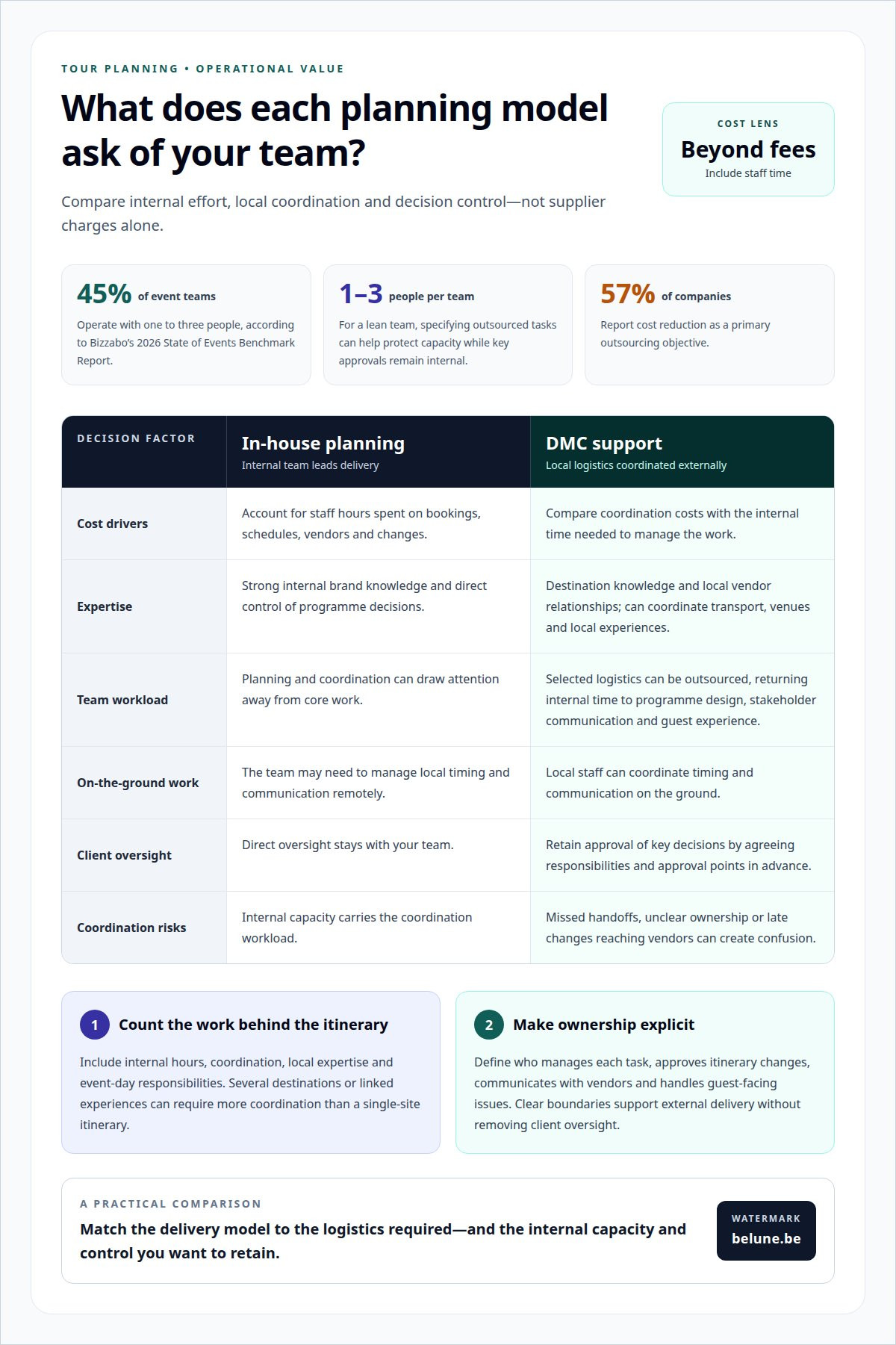
Programme costs reflect more than supplier charges. Compare the internal hours, coordination, local expertise and event-day responsibilities required by each model.
Operational Efficiency and Internal Team Focus
In-house planning gives your team direct oversight, but coordination can draw attention from core work. Outsourcing selected logistics can return internal time to programme design, stakeholder communication and guest experience. Bizzabo’s 2026 State of Events Benchmark Report says 45% of event teams operate with one to three people. For a lean team, defining outsourced tasks in the contract can protect capacity without surrendering approval of key decisions.
Cost reduction is reported as a primary outsourcing objective by 57% of companies. For group travel, compare the cost of coordination with the internal hours needed to handle bookings, schedules, vendors and changes. A programme with several destinations or linked experiences can require more coordination than a single-site itinerary.
Local Staff and Event-Day Operations
Local staff can coordinate timing and communication on the ground, while an internal team may have to manage those details remotely. Consider a group travelling from a hotel to a cultural visit: transport timing, guide coordination and guest updates all affect the day’s flow. A partner with local knowledge can connect these moving parts, while the client team retains decisions about tone, priorities and programme changes.
Before operations begin, assign a contact to each workstream and define how changes are communicated to the relevant vendors. This can reduce duplicated messages between internal planners and local teams.
Group Travel Operational Overhead
Group travel overhead often lies in the connections between services. Accommodation, transport, guides and activities each require timing, communication and coordination. Managing them separately can increase internal workload; coordinating them as one programme makes responsibilities easier to track. The right balance depends on itinerary complexity, vendor relationships and the level of oversight your team wants to retain.
Compare the full operational picture, not just the contract total. Include internal planning time, handoffs, event-day coordination and the work needed when plans change. A concise responsibility map can show which tasks stay in-house and where local support adds capacity.
In-house production compared with outsourcing
Tour planning rarely sits entirely inside or outside one organization. Companies rarely practice 100% in-house production, so the practical decision is which responsibilities an employee should retain and which a partner can deliver. An internal planner may shape the guest experience and protect brand priorities, while external specialists coordinate destination logistics. This division can preserve a clear creative vision without making the internal team responsible for every operational detail.
Consider a multi-stop cultural itinerary. An in-house team may lead the concept, guest communications and approvals, but still need to coordinate accommodation, transport, guides and activity vendors. For instance, when arranging cross-regional routes, utilizing specialized transport booking platforms like Saparis Station ensures complex travel legs are handled reliably without burdening internal staff. Hiring an employee for each specialist task can add permanent capacity, even if those skills aren’t needed for every programme. Outsourcing can bring the required capabilities into a project. Compare the work involved, not just the number of suppliers.
Outsourcing can also become a strategic relationship rather than a one-off transaction. 80% of companies were highly satisfied with their outsourcing relationships, and 65% planned to use outsourcing partners as strategic players by 2026. Those figures point to the value of clear collaboration, not a reason to transfer every decision. Keep programme goals and approval authority with the internal team; assign delivery responsibilities through an agreed workflow.
Flexibility matters when tour demand changes. A typical outsourcing contract allows scaling up or down with notice periods of 30-90 days. By contrast, an in-house team’s capacity is shaped by its employees, hiring decisions and competing work. For each programme, map recurring tasks, specialist requirements, decision ownership and the notice needed for changes. The strongest model is often selective: retain the work that defines the guest experience, and outsource tasks that require destination-specific coordination.
For a group itinerary with external logistics, discuss a tailored tour plan that keeps your team’s priorities at the centre.
BELUNE: Battlefield Tourism
BELUNE coordinates battlefield tourism for tour operators and travel agents planning group programmes. This is a natural fit when historical sites, transport, accommodation and local interpretation need to work together, while your team retains its programme vision.
For a battlefield itinerary, Hotel Accommodation Management and Coach Hire with own fleet of busses can provide the practical framework. Local Guide Services add destination context to visits, connecting each site with the wider story. A shared brief can set out the group’s aims, schedule, priorities and the decisions your team wants to retain.
Planning a battlefield group tour and looking for professional coordination? Contact BELUNE to discuss your programme.
Shape the Next Programme Around Your Priorities
Choosing between in-house tour planning and outsourcing to a DMC comes down to where your team can contribute most. Start with the experience you want guests to remember, then decide which planning responsibilities should stay within your organization and which would benefit from dedicated coordination. A clearly defined partnership can preserve your direction while ensuring operational details receive the attention they need.
For a group programme, BELUNE can bring Hotel Accommodation Management, Coach Hire with its own fleet of buses, and Local Guide Services into the planning process. Together, these services connect a tour’s practical framework with its destination and guest experience. Your team remains central to the programme’s purpose and priorities.
Ready to explore how that collaboration could work for your group? Discuss your tour plans with BELUNE and take the next step toward a programme shaped around your goals.
Frequently Asked Questions
Can a DMC partnership reduce internal workload without reducing client oversight?
Yes. Keep strategic approvals and guest-facing priorities with your team, while assigning defined delivery tasks to the DMC. For example, your team can approve an itinerary change before the DMC coordinates it with local suppliers. A responsibility matrix can show who proposes, approves and communicates each change, preserving visibility without requiring your staff to manage every operational exchange.
What Counts as Operational Overhead in a DMC Partnership?
Operational overhead includes the coordination around the itinerary, not just the services guests experience. It can include briefing suppliers, managing schedule changes, keeping approval records and updating internal stakeholders. If a group’s arrival time changes, for example, someone needs to notify the affected transport and accommodation contacts. Mapping these tasks reveals how much internal work remains after outsourcing.
What belongs in a useful DMC brief?
A useful brief explains the group’s purpose, audience, travel dates, destination preferences, desired experience and practical constraints. Include the services required, preferred communication route, decision-makers and approval process. For example, a cultural group may prioritize guided interpretation and time for independent visits. Clear priorities help the DMC shape proposals around the intended experience instead of making assumptions about what matters most.
What are the pros and cons of planning tours in-house versus outsourcing to a DMC?
In-house planning gives your team direct control over decisions and a close connection to internal culture, but requires staff capacity and destination-specific coordination. Outsourcing can add local expertise and reduce some execution work, while requiring clear communication and defined responsibilities. The choice between in-house tour planning and outsourcing to a DMC depends on your team’s existing capabilities and where specialist coordination would add value.
How do DMC fees and pricing models compare with in-house tour planning costs?
In-house costs include employee time, hiring and the ongoing capacity needed to coordinate programmes. DMC proposals may cover a group itinerary, per-person arrangements or planning and logistics services. Compare the scope of each, including accommodation management, coach transport, guidance and activities. BELUNE provides pricing after receiving a quote request, based on the requested programme.
How do you evaluate and choose a reliable DMC?
Assess whether the DMC has relevant destination and programme experience, then consider how clearly it explains responsibilities and supplier coordination. Review testimonials and event examples to see whether its work matches the group experience you need. A history-focused itinerary, for instance, calls for a different mix of expertise than a gastronomy programme. Agree on communication, approvals and task ownership before planning moves forward.