
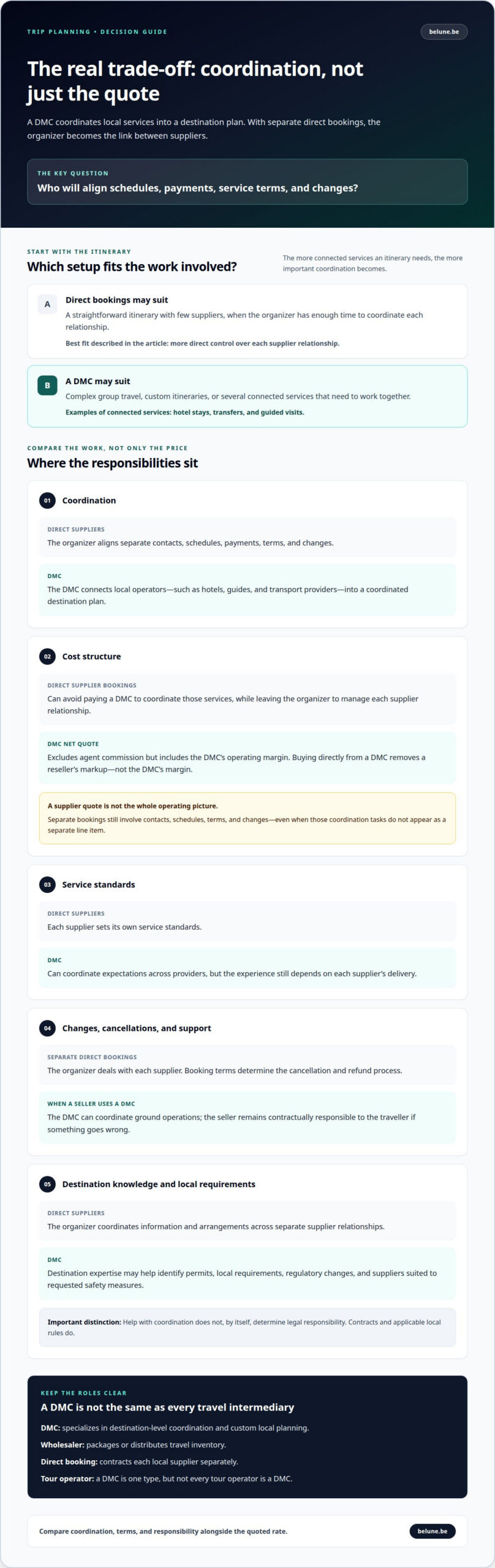
Booking directly with local suppliers can remove an intermediary, but it does not automatically make a trip easier to manage. A DMC brings local services together in a coordinated destination plan; when you book each supplier separately, your team must align schedules, payments, cancellation terms, and service standards. Comparing a DMC with booking directly with local suppliers involves more than the quoted rate. It also means considering who coordinates delivery and how responsibilities are handled when plans change.
It is reasonable to focus on cost: a DMC adds coordination services, while direct bookings may seem more straightforward. The value depends on what that coordination covers, which supplier relationships are involved, and how much time your team can spend managing the details.
This article explains what a DMC does, how its costs and coordination compare with direct bookings, and how responsibilities are allocated if something goes wrong. You will have a clearer basis for choosing the approach that fits your itinerary, group, and capacity to manage the arrangements.
Key Takeaways
- Compare the full coordination involved, not just supplier quotes: separate bookings leave schedules, payments and service terms to manage across providers.
- Understand how a DMC’s operating margin differs from a reseller markup, and why direct booking doesn’t necessarily remove every layer of cost.
- See how destination knowledge can support planning for local requirements, permits and safety, while responsibility may still depend on who sells the trip.
- Learn when a DMC’s joined-up approach can suit a group itinerary, and how transport, accommodation, travel bookings and local guidance can fit together.
DMCs compared with direct booking and generalist agencies
A DMC coordinates destination services, while direct booking makes the travel organizer the link between separate suppliers. The right approach depends on how much custom planning and coordination the itinerary requires.
DMCs, wholesalers, and direct suppliers
A DMC connects local operators, such as hotels, guides, and transport providers, to build a coordinated destination plan. A wholesaler packages or distributes travel inventory, while direct booking means contracting each local supplier separately. For an incentive trip with hotel stays, transfers, and guided visits, the distinction determines who aligns schedules and service details. A DMC adds coordination; direct arrangements give the organizer more control over each supplier relationship.
DMCs and other travel intermediaries
A DMC specializes in a destination, while tour operators, travel agents, wholesalers, and online travel agencies (OTAs) play different roles in selling or arranging travel. A DMC is a type of tour operator, but not every tour operator is a DMC. Larger tour operators may sell itineraries across many destinations; a DMC focuses on local delivery and custom planning. This distinction helps agencies decide whether they need broad product access or destination-level coordination.
Locally owned and national DMCs
A locally owned DMC may bring close knowledge of its destination, while a national DMC may have resources across a wider market. The practical difference matters when an itinerary needs local insight or in-person support. A national company may not have staff in the city hosting an event, while a locally based team can offer destination-specific knowledge. Match the structure to the trip’s footprint and support needs, not simply the company’s reach.
When direct booking may suit
Booking directly can suit a straightforward itinerary with few suppliers and enough time for separate coordination. It may also avoid the cost of hiring a DMC to coordinate services when the organizer contracts each hotel, guide, and vehicle directly. A DMC may be more suitable for complex group travel, custom itineraries, or multiple connected services. Direct suppliers set their own service standards; a DMC can coordinate expectations across providers, but the quality of the experience still depends on each supplier’s delivery.
Net rates, operating margins, and reseller markups
A DMC’s net quote excludes agent commission but includes the DMC’s operating margin. This matters when an agency compares a supplier quote with a packaged itinerary. Buying directly from a DMC removes a reseller’s markup, not the DMC’s margin. By contrast, contracting local hotels, guides, and transport providers separately avoids paying a DMC to coordinate those services, but leaves the organizer to manage each relationship.
Local ground operators deliver the services behind an itinerary, from activities and transfers to hotel stays. DMCs use supplier relationships to tailor these components and may sometimes secure discounted rates. However, a lower individual supplier quote does not show the full operating picture: the organizer still handles separate contacts, schedules, terms, and changes. For a corporate programme with several venues and transfers, coordination belongs in the cost comparison, even when it does not appear as a separate line item.
A DMC can also work alongside a tour operator rather than replace it. The tour operator can provide a ready-made package, while the DMC arranges a custom local extension or special programme. This structure can keep the broader itinerary intact while adding destination-specific activities. It also creates distinct roles: the DMC manages local delivery, and the tour operator remains the seller responsible to the traveller under its contract.
For cancellations and refunds, the applicable booking terms determine the process. With separate direct bookings, the organizer deals with each supplier; when a seller uses a DMC, the DMC can coordinate ground operations, but the seller remains contractually responsible to the traveller if something goes wrong. Customer support therefore depends on the seller’s arrangements and the relevant supplier terms, not simply on who coordinates the transfer. For itineraries that rely on local expertise, destination-specific guide services can be part of the ground plan.
How do DMCs and local operators handle insurance, permits, safety, and liability?
Destination expertise helps identify local requirements, but coordination and legal responsibility are separate matters. A DMC may assist with permits and safety planning; the contract and applicable local rules determine each party’s responsibilities.
Regional knowledge matters because requirements can differ between destinations. In Thailand, the Tourism Business and Guide Act requires tour operators to hold a tourism business licence. In Vietnam, a locally registered company serving foreign visitors needs an international travel service business licence, which carries a bonded deposit. These examples show why arrangements in one market cannot automatically be applied elsewhere, and why specialized operators like Historic War Tours depend on strict regional compliance and coordination when managing group travel across Southeast Asia.
A DMC may help clients plan for permits, understand local regulatory changes, and draw on established vendor relationships. For an event with guided experiences, destination-specific knowledge can help identify local requirements and suppliers suited to requested safety measures. Direct booking puts the organizer in contact with each operator, but also means coordinating information and arrangements across separate relationships.
Safety remains connected to the service being delivered. Event planners can use a DMC to identify local recommendations and locate vendors that implement requested safety measures. Local guides and operators contribute practical knowledge of the experience and its setting. Neither coordination nor local familiarity alone establishes that every provider has identical insurance, permits, or liability terms.
Payment protection and booking terms depend on the booking contract and seller, not simply on whether a DMC is involved. With direct bookings, each supplier’s terms apply to its service; a DMC can coordinate local delivery, while the seller remains contractually responsible to the traveller if something goes wrong. The distinction matters: operational coordination does not automatically transfer contractual liability or provide the same payment protections across separate bookings.
For clients planning several regional experiences, the practical value lies in connecting destination knowledge with clear roles. A DMC can support local compliance planning and safety coordination, while each agreement defines the responsibilities attached to the services arranged.
What a destination management company does
A destination management company is an in-destination travel business with in-depth knowledge of the country, region, or locality it represents. It uses that knowledge to make arrangements with local guides, accommodation providers, and transport operators. Destination management is not simply about selling separate services. It is about shaping how those services work together for a group or event.
For a group arriving by train, a DMC can coordinate station transfers, accommodation, and a guided local experience. It can arrange one part of a trip or develop a customized tour across the destination. Local supplier relationships help connect each element to the itinerary, while destination knowledge helps identify experiences suited to the place and the group’s brief.
That work can extend beyond leisure travel. For an in-person corporate event, a DMC can source, contact, book, and manage local vendors onsite. It can help optimize logistics and plan for permits, while clarifying what an all-inclusive offer covers. Itemized service descriptions also help clients understand the arrangements and prepare a more precise estimate.
A DMC’s role may include preparing contingency plans and identifying local contacts to address problems. On-the-ground support can help travelers resolve issues during a trip, while local expertise can inform seasonal timing and destination events. The scope depends on the brief: dates, event goals, technical needs, and requests such as VIP transportation all shape the plan. When managing executive retreats or incentive programmes, firms like Aura Events rely on this level of comprehensive coordination to ensure high-end group experiences run smoothly.
The key difference from booking suppliers independently is the integrated view. A direct booking secures an individual service; destination management connects services to the wider itinerary. For example, accommodation and local excursions can be planned as complementary parts of a group visit rather than isolated reservations. In short, use a DMC when local knowledge and coordinated arrangements are central to the experience.
Planning a group itinerary with coordinated stays? Explore hotel accommodation management as part of your destination arrangements.
BELUNE: Coach Hire with own fleet of busses
BELUNE helps tour operators and travel agents coordinate group journeys when separate bookings make an itinerary complex. Coach hire with BELUNE’s own fleet of buses provides a transport option for connecting hotels, local visits, and group activities.
BELUNE also offers international flight and train bookings, hotel accommodation management, and local guide services. These elements can be arranged around the group’s route and destination programme, bringing travel logistics and on-the-ground experiences into a coherent plan.
Planning group travel that needs coordinated transport and local arrangements? Contact BELUNE to discuss your plans.
Shape the Next Journey Around Your Group
The choice between a DMC and booking directly with local suppliers becomes clearer when you start with the journey itself. Define the experience you want guests to have, then consider how transport, accommodation, and local activities should connect. A well-planned itinerary starts with those priorities, not a list of isolated bookings.
For tour operators and travel agents planning group travel, BELUNE offers hotel accommodation management, coach hire with its own fleet of buses, and local guide services. These services can support a programme shaped around the group’s route and destination interests, providing a practical starting point for planning.
Bring the proposed itinerary, travel dates, and group priorities into the conversation. Contact BELUNE to plan your group trip and take the next step toward a journey designed with purpose.
Frequently Asked Questions
What is a destination management company (DMC) and what services does it provide?
A destination management company focuses on a particular destination and uses local knowledge to plan and arrange services. Depending on the brief, this may mean arranging a guided cultural visit, booking accommodation, or organizing ground transport. For an event, its role can also include sourcing local venues and vendors. The scope can range from one trip component to a customized programme.
Can you use both?
Yes. A tour operator can provide the main package while a DMC arranges a custom extension or special local programme. The choice between using a DMC and booking directly with local suppliers can also vary by itinerary component. For example, an organizer might book a straightforward service directly and use a DMC for a locally planned heritage visit. This blended approach lets the organizer choose support based on the complexity of each part.
Does a DMC ever sell to travellers directly?
Yes. DMCs may work directly with travellers, sell trips through travel agencies or tour operators, or use both models. Their sales approach varies, so the term “DMC” alone doesn’t show who can book with a particular business. BELUNE focuses on group travel for tour operators and travel agents, rather than individual B2C travel bookings. That distinction helps clarify whether its model fits your role as a buyer.
How do single-DMC and multiple-operator costs compare, including fees and markups?
A single DMC quote may include the DMC’s operating margin, while a reseller may add a separate markup. Comparing a DMC with booking directly with local suppliers means weighing the coordination cost against the work of managing separate bookings and terms. Compare the full itinerary scope, included arrangements, and each seller’s charges rather than judging by one headline total. A net quote excludes agent commission, but still includes the DMC’s margin.
What are the advantages of using one DMC for an entire trip or event?
A single DMC can provide a consistent local planning contact, especially when a programme includes several experiences or event vendors. It can advise on seasonal timing and local events that may affect the schedule, then shape arrangements around the event’s goals and requests. This is useful when the programme needs a coherent destination perspective rather than separate services planned without a shared local brief.
What does DMC stand for in travel?
DMC stands for “destination management company.” In travel, the term describes a business with in-depth knowledge of a particular destination and the local services available there. That destination focus distinguishes a DMC from businesses whose main role is selling travel across a broad range of markets. The acronym identifies a type of company, not a guarantee that every DMC offers the same services or booking model.