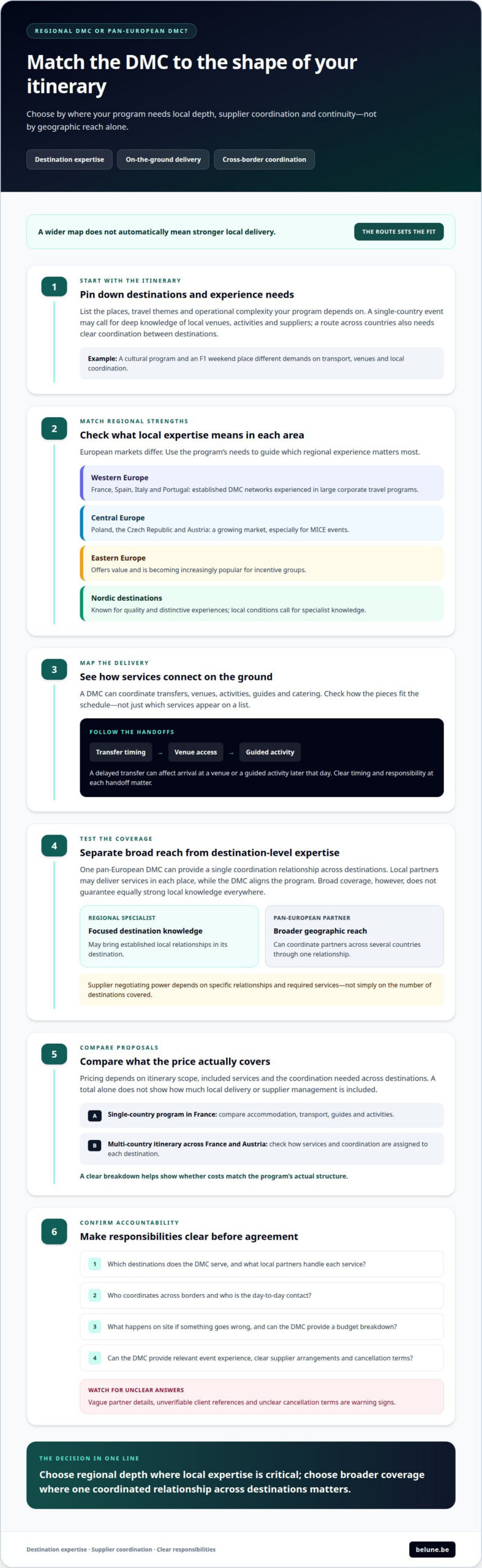
A wider map doesn’t automatically mean stronger local delivery. In the regional DMC vs pan-European DMC decision, the right fit depends on the shape of your tour program: a regional partner can bring concentrated destination knowledge and supplier coordination, while a pan-European partner can offer broader geographic reach through one relationship. Neither model is inherently better; the difference is where your itinerary needs depth, continuity and local expertise.
It makes sense to look for a partner who can simplify logistics without flattening the character of each place. The key is matching the DMC’s network to the destinations, travel themes and operational complexity your program demands. This comparison explains how European markets differ, what DMC services and supplier coordination involve, and when a focused regional specialist may serve a multi-destination itinerary better than broad coverage. You’ll have a clearer basis for choosing a partner whose reach and local insight align with the experience you want to create.
Key Takeaways
- Match a DMC’s destination expertise to the places and travel themes your program depends on, rather than choosing by geographic reach alone.
- Understand how accommodation, transport, guides and activities fit together to see where supplier coordination can shape the guest experience.
- Distinguish a DMC’s tailored, on-the-ground role from the tour operator’s role in selling packaged holidays to travelers.
- Compare proposals by the services and coordination they cover, so you can assess their value against your itinerary’s needs.
DMC market differences across European regions
A DMC’s strengths vary by destination, so geographic reach alone does not reveal where its local expertise is strongest. Regional focus matters when a program depends on a country’s suppliers, culture or operating conditions.
Western Europe, including France, Spain, Italy and Portugal, has established DMC networks experienced in large corporate travel programmes. Central Europe, including Poland, the Czech Republic and Austria, has grown strongly, especially for MICE events. Eastern Europe offers value and is becoming increasingly popular for incentive groups. Nordic destinations offer quality and distinctive experiences, while local conditions call for specialist knowledge.
For a single-country event, a regional DMC can offer focused destination knowledge and established local relationships. That expertise can help shape a program around the country’s venues, activities and travel themes.
Regional and Pan-European Pricing
Pricing depends on the itinerary’s scope, included services and the coordination needed across destinations. A total alone does not show how much local delivery or supplier management the proposal covers.
For a single-country program in France, compare proposals by checking what they include for accommodation, transport, guides and activities. For a multi-country itinerary across France and Austria, examine how each proposal assigns services and coordination to each destination. A clear breakdown helps show whether the costs match the program’s actual structure.
Local Knowledge and European Coverage
Local knowledge means practical familiarity with a destination’s suppliers, activities and operating conditions. European coverage describes where a DMC can coordinate delivery. Both matter when a route crosses regions with different strengths, such as an Austria event followed by a Nordic experience.
Ask which destinations the DMC serves, what local partners handle each service and who coordinates the itinerary across borders. Request examples of relevant event experience, and clarify who your day-to-day contact will be. These questions help reveal whether broad coverage includes destination-level expertise or relies on a network of partners.
DMC services and supplier coordination
A DMC coordinates on-the-ground services such as transfers, venues, activities, guides and catering. For a program spanning Paris and Vienna, that means aligning transport timings with venue access and scheduled experiences. The regional DMC vs pan European DMC decision affects how these services are coordinated across destinations.
Supplier access can reflect a DMC’s local relationships and geographic scope. A regional specialist may have established connections in its destination, while a pan-European DMC can coordinate partners across several countries. Negotiating power depends on the specific supplier relationships and services required, not simply on the number of destinations covered.
For a multi-country event, one pan-European DMC can provide a single coordination relationship across destinations. This can simplify communication when a schedule links a meeting in France with an event in Austria. Local partners may deliver services in each place, while the DMC aligns transfers, venues and activities within one program.
Using one DMC across several countries can also create coordination risks. Broad coverage does not guarantee equally strong local knowledge in every destination, and unclear supplier arrangements can blur responsibilities. Vague answers about partners, unverifiable client references and unclear cancellation terms are warning signs.
Supplier coordination connects each service to the itinerary. A delayed transfer, for example, can affect arrival at a venue or a guided activity later that day. When transport, catering and a local guide are involved, clear timing and responsibility at each handoff matter. Choose a regional DMC vs pan European DMC based on where the itinerary needs the deepest coordination.
Before an agreement, establish who your daily contact will be, what happens if something goes wrong on site, and whether the DMC can provide a budget breakdown. These points clarify communication, response ownership and how costs relate to services. Relevant event experience matters too: an F1 weekend and a cultural program place different demands on transport, venues and local coordination.
Destination management company roles
A destination management company (DMC) plans and coordinates services on the ground. It can connect transfers, venues, activities, guides and catering into a tailored program. For example, a cultural itinerary in Paris might pair a venue visit with local guiding and scheduled transport. The DMC’s role is to make these separate elements work as one coherent destination experience.
A DMC serves a different purpose from a tour operator. Tour operators sell pre-packaged holidays to consumers; DMCs work business-to-business with companies, agencies and professional conference organisers. An agency might commission a tailor-made program in Italy, while the DMC coordinates the local services that bring it to life. The distinction is that one party sells the holiday, while the other organizes its delivery at the destination.
A DMC’s work starts with the program brief. It translates the intended experience into services and coordinates the local elements around the schedule. If a group moves from a venue to an activity, the transfer and timing need to fit the itinerary. A guide-led visit must also align with the group’s route and planned stops. This gives the professional buyer a destination-level partner instead of a set of separate service arrangements.
- Program design: Shape activities and local experiences around the group’s purpose, such as art, culture or a conference.
- Service coordination: Bring together transport, venues, guides and catering where the itinerary requires them.
- Delivery planning: Align each service with the route and sequence, such as a transfer before a scheduled venue visit.
For a multi-destination program, coordination can extend across more than one local market. A pan-European arrangement may connect delivery in France and Austria through one professional relationship, while regional DMCs focus on their destination. The useful distinction is the scope of coordination, not the label alone. Agencies and conference organisers can define the services they need, then assess whether a destination specialist or broader coverage fits the program.
How do regional and pan-European DMCs compare on pricing and fees?
There is no reliable rule that a regional DMC costs less than a pan-European one. Price depends on the destinations, services, itinerary complexity and supplier coordination, and is provided after a quote request. The regional DMC vs pan European DMC distinction describes scope, not a fixed pricing formula.
A single-country program may involve fewer handoffs between destinations than a multi-country route. But fewer destinations do not automatically mean a simpler or less costly program. Several venues, specialist activities or a demanding schedule can require substantial coordination within one country. Compare the services and work covered by each proposal rather than assuming geographic scope predicts the total.
A broader proposal may coordinate services across several markets, while a regional proposal may focus on one destination. Neither structure alone determines the final amount. For a route through France and Austria, consider how each proposal accounts for local suppliers, transport, activities and coordination at both stops. This shows what the quoted scope supports.
Make a like-for-like comparison. If one proposal includes venue coordination while another covers transport and activities, their totals reflect different scopes. Request a breakdown linking costs to services and coordination responsibilities. That makes differences easier to understand than comparing headline totals alone. The regional DMC vs pan European DMC choice is most useful when you compare equivalent itinerary components.
- Destination scope: Identify every country and location included in the itinerary.
- Service coverage: Compare accommodation, transport, venues, guides and activities in each proposal.
- Coordination: See how local partners and cross-destination planning are represented.
- Terms: Review cancellation terms alongside the services and responsibilities described.
For a single-country cultural tour, a focused regional scope may suit the brief. For a route crossing borders, assess how each proposal coordinates delivery at every stop. The best fit is the scope that matches the experience and operational support the itinerary needs.
To discuss a tailored group program, discuss your tour program with BELUNE.
BELUNE
BELUNE helps tour operators and travel agents shape group programs when destination expertise and coordinated local services matter. For itineraries across the Benelux region and Paris, its work can bring accommodation management, coach transport, local guides and art and culture tours into a tailored travel experience. This regional focus can suit programs built around several destinations within its area, rather than a route requiring delivery across Europe.
The right choice depends on your itinerary’s geography and character. If your program needs regional knowledge and coordinated arrangements on the ground, BELUNE can help bring its moving parts together. Share your destination plans and the experience you want to create.
Contact BELUNE to discuss your tour program.
Shape the next journey around its sense of place
The regional DMC vs pan European DMC choice is ultimately about fit: which partner can bring the route’s intended character into the details of the experience? When planning a program, consider not only where guests will travel, but how each transition supports the journey’s story, pace and purpose. A well-matched partner can help turn operational components into a coherent experience.
For tour operators planning group travel, BELUNE can bring hotel accommodation management, coach hire with its own fleet of buses and local guide services into the program. These services can support an itinerary where transport, stays and destination interpretation need to work together. Start with your route and the experience you want guests to remember.
Discuss your tour program with BELUNE, and take the next step toward a journey shaped with intention.
Frequently Asked Questions
What is a regional DMC and what is a pan-European DMC?
A regional DMC organizes tailored, on-the-ground programs within a focused destination area; a pan-European DMC coordinates across a broader set of European destinations. Both typically work with professional buyers, including travel agencies and companies. The regional DMC vs pan European DMC choice describes geographic scope, not a different kind of guest experience or a fixed package format.
How does a DMC’s destination footprint shape its local expertise?
A DMC’s footprint indicates where its destination knowledge and working relationships are concentrated. For a specialist theme such as battlefield tourism, familiarity with relevant sites can shape the itinerary’s interpretation and pace. On a broader route, local expertise at each stop helps give destinations their own character, rather than making the journey feel like a series of transfers.
How do DMCs manage logistics, communication, and coordination across multiple European countries?
DMCs coordinate itineraries by aligning local services with the group’s movements and planned activities. A change to a venue schedule, for example, may affect transport timing and the guide’s arrival. Clear communication helps the organizer understand who is responsible for updates and decisions at each destination, especially when local partners deliver different parts of the program.
What should planners consider when choosing a destination management partner?
Start with the itinerary’s purpose, route and required services, then compare those needs with each partner’s destination experience. A regional DMC vs pan European DMC assessment can clarify whether focused knowledge in one market or coordinated coverage across several better serves the program. Consider how the proposed scope supports the theme, schedule and guest experience from arrival through departure.