A room block can look secure on paper and still leave a tour exposed if bookings lag behind the allotment. Managing hotel allocations for group tours starts with a practical threshold: consider a contracted block when roughly ten or more people need rooms in the same market on the same nights. The right arrangement then depends on how rooms are held, when unsold rooms are released, and how closely pickup is monitored.
It’s easy to focus on the number of rooms reserved, but the terms behind that number matter just as much. A fixed allotment holds rooms until a release deadline, while a free-sell arrangement lets guests book at an agreed rate as long as the hotel has availability.
This guide explains how these options work, how to track bookings against a block, and what to do when pickup falls short. It also shows how accommodation planning connects with transport, meals, activities, and the wider rhythm of a group itinerary.
Key Takeaways
- Choose between a fixed room block and a free-sell arrangement based on how much inventory you need secured and how much booking flexibility matters.
- Build contingency plans around group needs, arrival timing, contract terms, and a clear process for overflow accommodation.
- Use regular pickup reports to spot booking gaps early, then act before the room-release deadline.
- Coordinate accommodation with transport, meals, activities, and tickets so the group itinerary works as one connected plan.
1. Group booking definitions and room allotment types
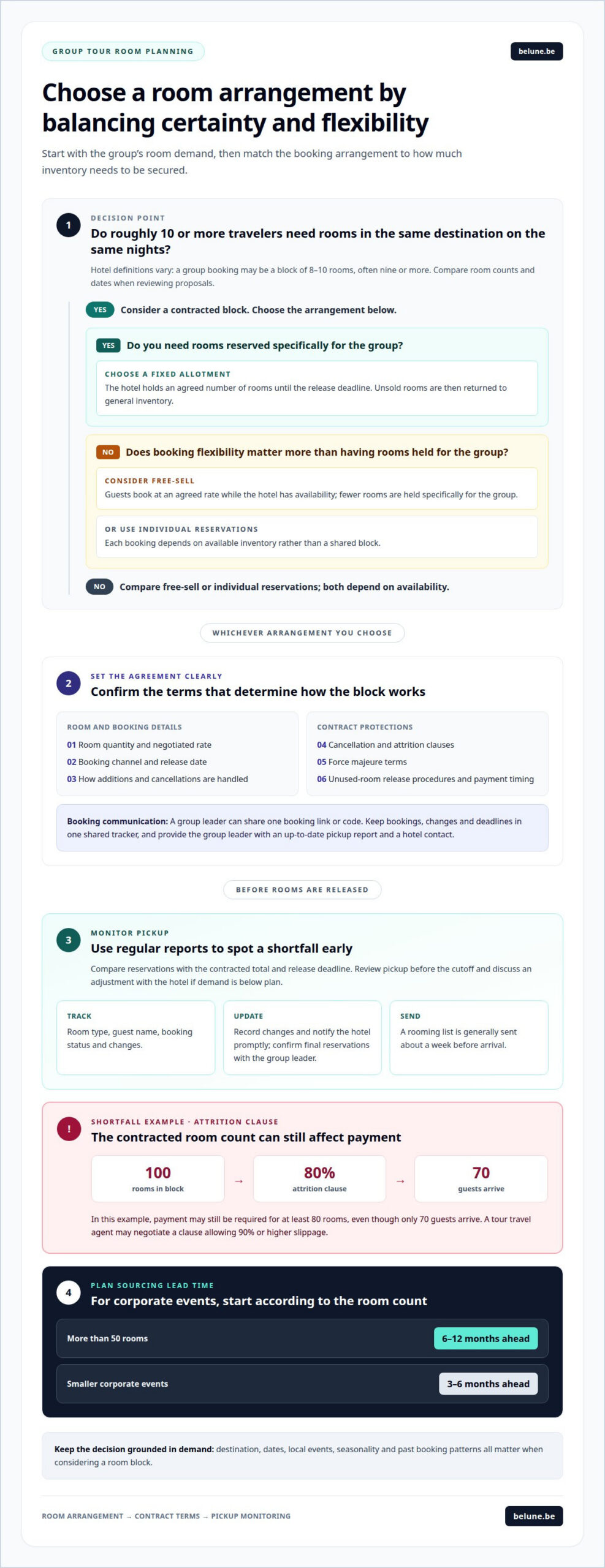
Hotels commonly treat a block of 8-10 rooms as a group booking, often defining it as nine or more rooms. For tour planning, consider a contracted block when roughly ten or more travelers need rooms in the same destination on the same nights. Since hotel definitions vary, compare room counts and dates when reviewing proposals. Managing hotel allocations for group tours begins with matching the arrangement to the group’s actual travel plans.
How do hotel room blocks and allocations work for group tours? A hotel reserves an agreed number of rooms until a release deadline, then returns unsold rooms to general inventory. With free-sell, guests book at a negotiated rate while rooms remain available, so fewer rooms are held specifically for the group. Individual bookings rely on available inventory rather than a shared block.
How should operators compare these options? Weigh room certainty against booking flexibility: a fixed block suits a tour that needs reserved capacity, while free-sell or individual reservations depend on availability. Confirm the room quantity, negotiated rate, booking channel, and release date in the agreement. A group leader can share one booking link or code to give travelers a direct route to reservations.
Keep communication clear throughout the booking process. Give the group leader an up-to-date pickup report and a hotel contact, then record bookings, changes, and deadlines in one shared tracker. A rooming list connects each traveler with their room and sharing arrangements. Update the hotel as names and reservations change. This makes managing hotel allocations for group tours a coordinated process rather than a collection of separate bookings.
Corporate lead times depend on the event’s room count. For corporate events requiring more than 50 rooms, start hotel sourcing six to twelve months ahead; for smaller corporate events, begin three to six months in advance. Early coordination gives the group leader time to circulate booking details, monitor reservations, and resolve gaps before the release date.
2. Operational challenges and contingency planning
Group arrivals can bring several demands at once: room assignments, luggage, transport timing, and event schedules. Send the hotel a concise operations brief with the itinerary, arrival window, rooming list, and tour planner’s contact details. If a coach arrives in stages, agreed arrival updates help the front desk prepare for staggered check-in.
Accommodation planning starts with travelers’ needs, not just room totals. Gather accessibility and mobility requirements before assigning rooms, then share relevant details with the hotel. Confirm how late arrivals, room changes, and missed connections will be handled. A written overflow plan should identify backup accommodation and explain who coordinates a move if the original hotel cannot host every guest.
For a conference or banquet, align the event schedule with hotel operations. Share meal times, room setup requirements, and transitions between sessions and dining. If guests return from an outing shortly before dinner, allow enough time for their arrival. Clear timings help the hotel coordinate staff and reduce clashes between group activities and event service.
Plan check-in as a clear sequence. Give the hotel the latest rooming list, arrange advance key preparation where available, and agree on baggage handling from coach to rooms. Decide whether guests will check in individually or through a group process, such as a web portal or hotel app. Make the group’s arrival visible to hotel staff so reception can prepare for the tour rather than react to a queue.
Contingency planning also belongs in the group contract. Review cancellation, attrition, and force majeure clauses, and agree on release procedures for unused rooms. For a tour combining a conference, cultural visits, and transfers, coordinated group accommodation can keep hotel logistics aligned with the wider itinerary.
3. Tracking room pickup and managing shortfalls
Track pickup with regular reports showing how many rooms are booked against each block. Compare reservations with the contracted total and release deadline, then flag a slow booking pace early. For managing hotel allocations for group tours, use reservation software or a shared tracker to record room type, guest name, booking status, and changes. Consistent fields make reports useful to both the tour operator and hotel.
Agree on the room release policy in the contract, including when unused rooms return to general inventory. For fixed event dates, the hotel can set unbooked rooms to release automatically before arrival. Tour operators should review pickup before that cutoff and discuss an adjustment if demand is below plan. A rooming list is generally sent about a week before arrival.
Attrition terms shape the cost of a shortfall. For example, an 80% attrition clause on a 100-room block can require payment for at least 80 rooms, even if only 70 guests arrive. A tour travel agent may negotiate a clause allowing 90% or higher slippage. Clarify how additions, cancellations, and payment timing work before signing.
How do tour operators handle rooming changes, cancellations, and no-shows? Update the rooming list and notify the hotel promptly, record each change, and follow the contract’s cancellation and release terms. Confirm final reservations with the group leader so the hotel has an accurate picture of who is arriving.
What accessibility, bed-type, and special-request details should tours plan for? Record mobility needs, accessible-room requests, twin or double bed preferences, and other relevant requirements beside each reservation. Share these details with the hotel early, then reconcile them against the rooming list before arrival. This precision helps tailor hotel allocations to the group’s needs.
4. Combining accommodation, activities, transfers, meals, and tickets
Build an itinerary that connects each hotel night with the day’s transport, activities, meals, and tickets. For specialized sports travel where event admission and lodging must align seamlessly, providers like fotballturer.no show how bundling accommodations with match tickets simplifies logistics. For example, schedule a city tour to finish with enough time for the group to reach dinner before its reservation. A detailed transfer schedule can reveal tight connections between a hotel, a museum visit, and an evening event.
Keep one group budget covering hotels, coach transfers, activities, meals, and tickets. Record the cost of each component, then set the selling price for the complete trip. This view helps planners understand how a change, such as adding a meal or moving a hotel night, affects the overall budget. It also makes the itinerary easier to coordinate with each partner.
Accommodation details support practical duty-of-care planning. Collect only the information needed to arrange the stay, such as accessibility requirements or a relevant dietary request, and share it with the appropriate hotel contact. Keep room assignments and special requests current in the group record. For corporate travel, limit access to personal details to the people coordinating reservations and guest support.
A hotel isn’t the only accommodation format to consider. A rented home or apartment may suit a smaller group when shared space fits the trip’s budget and helps the group spend time together. Compare the lodging format with the itinerary: a hotel may suit a schedule with frequent arrivals and departures, while an apartment can provide a shared base between planned activities.
Check that amenities, meal arrangements, and ticket timings work together before confirming the itinerary. If a transfer changes, review the hotel arrival, dinner booking, and activity entry time as one connected plan. Plan your group’s accommodation and itinerary as a coordinated experience.
BELUNE: Hotel Accommodation Management
BELUNE provides Hotel Accommodation Management for tour operators coordinating group stays. We align hotel arrangements with the itinerary, connecting room planning to the group’s schedule and travel needs.
This is a natural next step when room blocks, pickup changes, or hotel logistics need to work alongside the rest of a tour. For a cultural itinerary, accommodation can be coordinated with Art & Culture Group Tours, Coach Hire with our own fleet of buses, and Local Guide Services. Each element has a distinct role, yet together they help shape a smoother journey from arrival to departure.
Contact BELUNE to discuss Hotel Accommodation Management for your group tour.
Shape the journey around the stay
Turn the room plan into a considered travel experience. A well-coordinated stay gives each part of the itinerary a clear place to begin, while leaving room for the character of the destination to come through. That’s the wider value of managing hotel allocations for group tours: accommodation supports the experience rather than sitting apart from it.
BELUNE brings Hotel Accommodation Management together with Coach Hire using its own fleet of buses and Local Guide Services. For tour operators shaping a group itinerary, accommodation, transfers, and local guidance can be planned as connected parts of the journey. The right balance depends on the destination, the group’s priorities, and the experience you want to create.
Share your tour concept and start shaping its accommodation plan with BELUNE. Contact BELUNE to plan your tour. A thoughtful framework is the first step toward a journey with a clear sense of place.
Frequently Asked Questions
How many rooms should tour operators reserve and how are rooming lists managed?
Calculate the room count from traveler numbers, occupancy preferences, and any single-room requests. Then match each reservation to a guest, room type, and sharing arrangement in a master list. For example, two travelers together may share a twin or double room, while a solo traveler may need a separate room. Keep one current version for the hotel and tour team, and record changes clearly.
What are typical hotel group rates, deposits, and attrition penalties in the United States?
There is no single typical rate, deposit, or attrition penalty for United States group bookings. Terms depend on the destination, dates, room demand, and negotiated block size. A proposal should distinguish the group rate from any deposit schedule and state how unused rooms affect payment. Compare the full contract terms, not just the nightly rate, before accepting an offer.
What contract terms should be negotiated for group hotel allocations?
Negotiate clear terms for room quantities, room categories, rates, booking procedures, changes, cancellations, release deadlines, and payment. The contract should explain how additions are handled and whether cancellations carry penalties. Tour operators can also seek terms allowing room changes without penalty and payment after the stay. Specify who can approve updates, so the hotel and organizer follow the same process.
When are hotel room blocks released and what are cutoff dates?
Room blocks are released on the cutoff date set in the hotel contract, not on one universal industry date. The deadline determines when unbooked rooms return to the hotel’s general inventory. For a tour with uneven booking activity, agree on a release date that leaves time to review pickup and adjust the block. Record the deadline in the planning calendar and share it with the group leader.
What systems or software help manage hotel allocations and rooming lists?
Use reservation software that organizes room assignments, occupancy, and room-sharing details in one record. Useful functions include sharing rooming lists with relevant team members, searching past and future reservations, and exporting supplier-ready lists. A dedicated group code or rate code can also let travelers book independently through the hotel’s booking channel while keeping their reservations associated with the group.