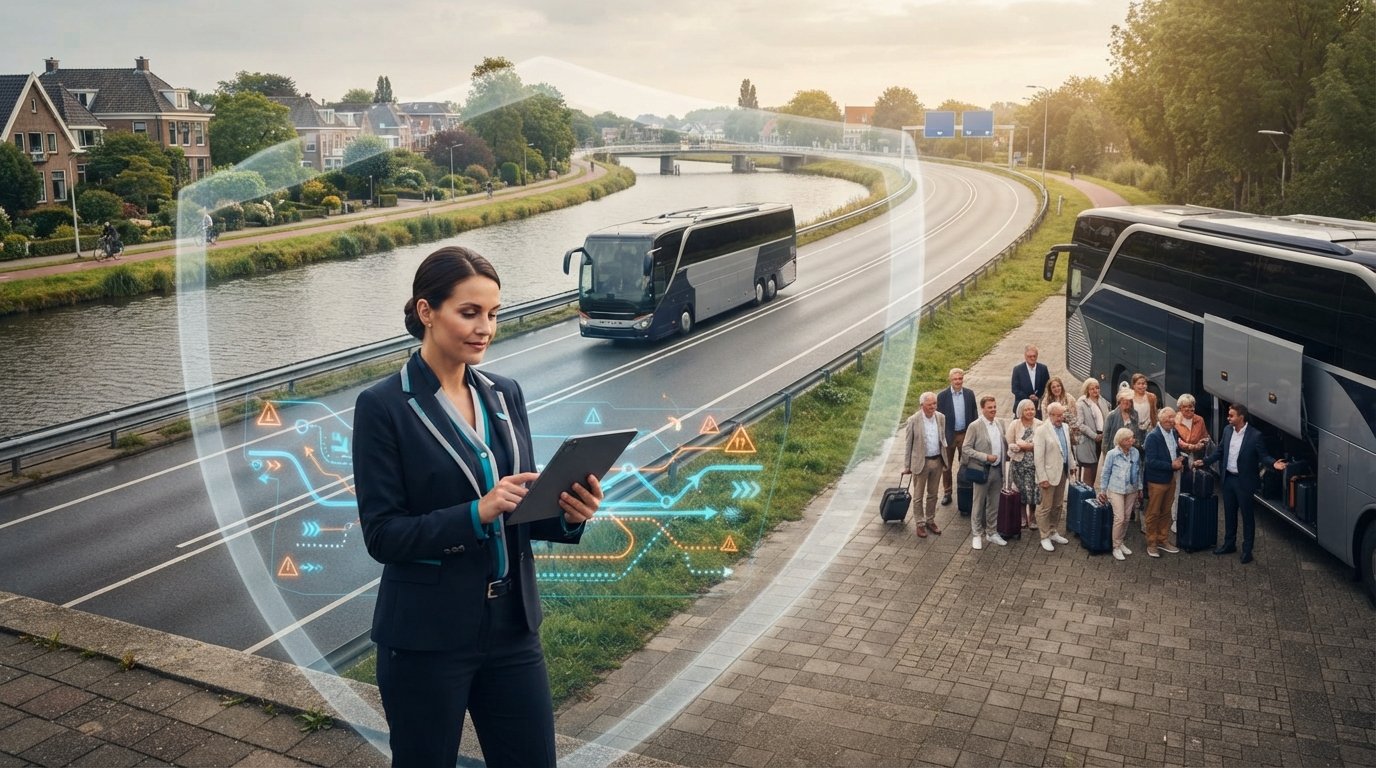
Your brand’s reputation isn’t built in the boardroom; it’s forged on the regional motorways of the Benelux. A single missed connection or a non-compliant coach isn’t just a minor delay. It’s a direct hit to your reputational equity. Implementing robust ground logistics risk management for tour operators is now the defining line between a premium guest experience and a legal liability. In an era where the 2026 EU Package Travel Directive mandates strict liability for every segment, relying on unvetted subcontractors is no longer a viable strategy. It’s a vulnerability that threatens your foundation.
We know you’ve worked tirelessly to curate journeys, only to have them jeopardized by partner failures you couldn’t see coming. It’s frustrating to face hidden bottlenecks or a lack of oversight when guest satisfaction is on the line. This article promises to help you master the strategic frameworks needed to mitigate these failures and safeguard your brand. We’ll explore how moving toward verified, asset-backed partner networks creates a fail-safe environment. You’ll discover how to transform logistical precision into an invisible shield that protects your travelers and your professional standing.
Key Takeaways
- Discover why ground logistics are the physical heartbeat of your brand and how to transform seamless operations into lasting reputational equity.
- Learn to identify hidden vulnerabilities in group travel, from the risks of tiered subcontracting to the nuances of group-friendly accommodation management.
- Master a resilient framework for ground logistics risk management for tour operators by prioritizing verified partner-owned assets and rigorous service level agreements.
- Evaluate the critical difference between digital oversight and a physical local presence when managing complex itineraries across the Benelux region.
- Understand how direct asset ownership, including a modern coach fleet, provides the ultimate risk mitigation tool for consistent guest satisfaction.
The Architecture of Trust: Why Ground Logistics Define Your Reputation
Trust is the essential currency of travel. For tour operators, this trust is built on the physical execution of every transfer, excursion, and hotel stay. Ground logistics risk management for tour operators isn’t merely a safety checklist; it’s the strategic preservation of your brand’s soul. In the 2026 landscape, where travelers demand immediate transparency and seamless transitions, your ground partners act as the frontline of your reputational equity. They’re the visible hands that deliver on your invisible promises.
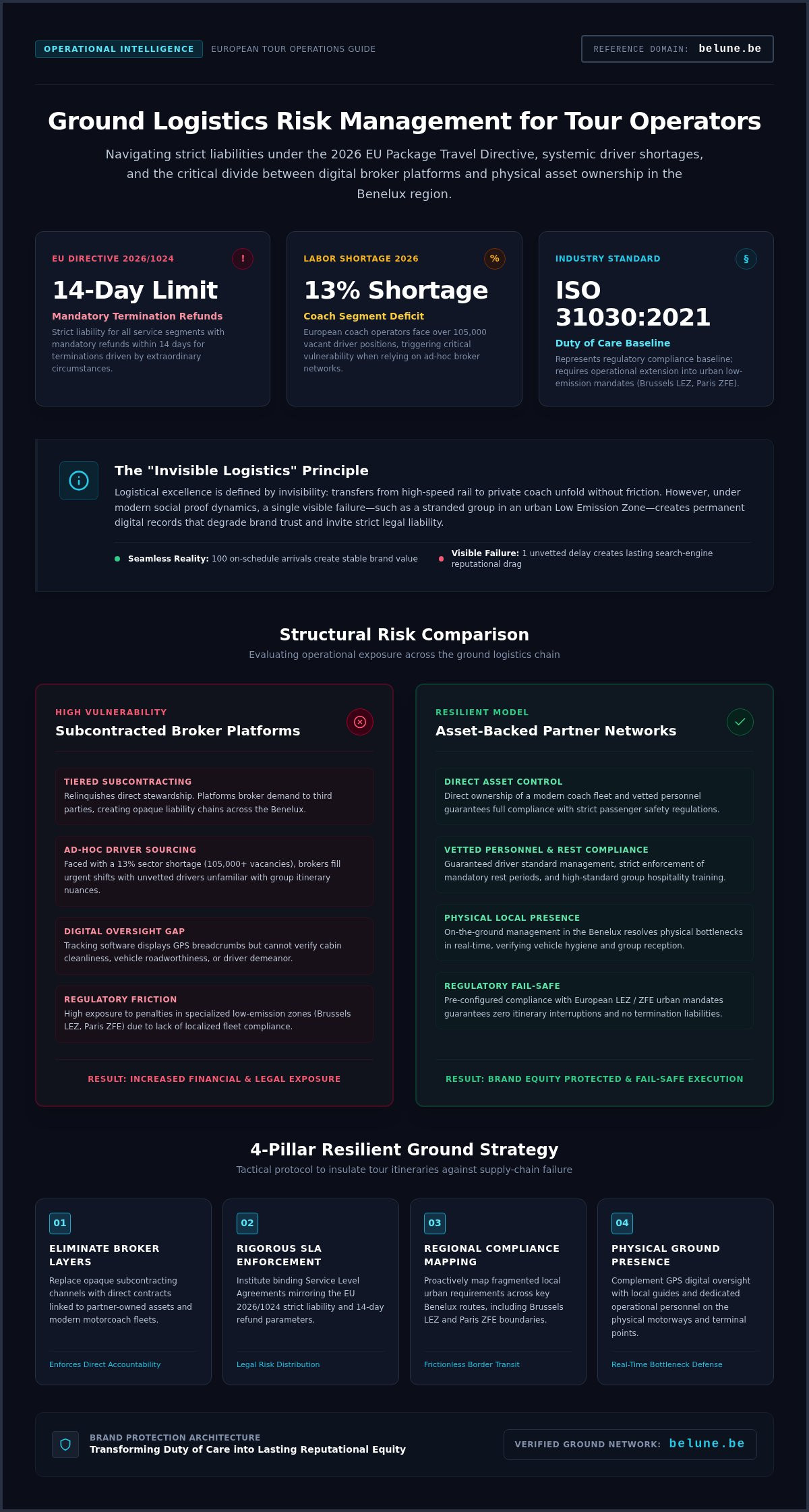
We advocate for the “Invisible Logistics” theory. True excellence in ground handling is characterized by its invisibility. When a group transitions from a high-speed train to a private coach without a moment’s hesitation, the complexity of that coordination remains hidden. However, in the age of instant social proof, a single visible failure carries more weight than a hundred seamless arrivals. A stranded group in a low-emission zone doesn’t just result in a refund. It creates a digital record of failure that can haunt your search results and erode brand trust for years.
To better understand how these logistical chains function as a broader supply chain, watch this helpful video:
The Financial Impact of Logistical Friction
Logistical Friction is the gap between a promised itinerary and local reality. This friction is expensive. Under the revised Package Travel Directive (EU) 2026/1024, operators face strict liability for every service failure, including mandatory refunds within 14 days for contract terminations due to extraordinary circumstances. Beyond these immediate payouts, the long-tail effect of negative reviews can decimate future group bookings. Effective ground logistics risk management for tour operators identifies these friction points, such as unvetted coach subcontractors, before they translate into financial losses or compensation claims.
Duty of Care vs. Brand Promise
Compliance with ISO 31030:2021 provides a necessary baseline for duty of care, but a brand promise requires more than meeting legal minimums. While regulations focus on safety and driver rest periods, a sophisticated ground strategy focuses on the guest’s emotional journey. This requires navigating fragmented urban regulations, such as the Brussels LEZ or Paris ZFE, with a precision that only local, asset-heavy expertise can provide. We believe true reliability is born from controlling physical assets. By managing our own fleet and local guides, we ensure that every touchpoint reflects your standards, transforming a standard duty of care into a signature experience.
Identifying Critical Vulnerabilities in Group Travel Logistics
Risk isn’t a sterile data point on a dashboard. It’s the tangible reality of a mechanical failure on a rain-slicked motorway or a hotel room that simply isn’t available when thirty tired guests arrive. For many in our industry, ground logistics risk management for tour operators is treated as a digital problem to be solved with apps. We believe it’s a physical one. Digital oversight can track a bus’s GPS coordinates, but it cannot verify the cleanliness of the interior or the driver’s professional demeanor. These are the details that define your brand equity.
Transport and Fleet Reliability
The most frequent vulnerability is the “sub-contracted broker layer.” When an operator hires a digital platform instead of an asset-owning partner, they effectively relinquish control of their guest’s safety. This is particularly dangerous in 2026, as Europe faces a 13% driver shortage rate with over 105,000 vacant positions in the coach segment. Brokers often scramble to fill shifts with unvetted drivers who may not understand the specific needs of a group itinerary. Upholding rigorous benchmarks, such as those found in passenger carrier safety regulations, requires direct, hands-on stewardship of the fleet. This is why many travel professionals prefer working with direct providers like Corralejo Transfers to manage essential transit legs. A modern coach is more than a vehicle; it’s a mobile brand ambassador representing your commitment to excellence long before the group reaches their destination.
Strategic Accommodation Management
Accommodation presents a different set of frictions. The “group-friendly” label is often applied loosely by international booking engines. Without deep-rooted local relationships, your group is often the first to be “walked” during an overbooking crisis. Managing these risks involves more than securing rooms. It’s about securing commitments through decades of partnership and mutual respect. Utilizing fixed-price group tour packages also serves as a financial shield. It provides budget predictability while shifting the burden of local price volatility away from your brand. This level of planning ensures that the facilities actually meet the technical needs of group travelers, from coach parking access to streamlined breakfast services.
Finally, the human element demands strict control. A local guide is the emotional bridge between your itinerary and the guest. They’re the first to spot a closed road or a change in venue access. When you lose control of this element, you lose your eyes and ears on the ground. Communication gaps between international offices and local providers often lead to timing errors that ruin a carefully planned day. If you’re seeking a partner that owns the physical assets and the local relationships to close these gaps, exploring BELUNE’s group travel solutions can provide that necessary layer of protection.
Digital Platforms vs. Local Presence: Choosing Your Shield
Digital dashboards offer a seductive sense of control. They provide real-time coordinates, colorful heat maps, and the illusion that every variable is being managed from a remote office. Yet, for a group of forty travelers crossing the Benelux borders, a “ping on a screen” is a poor substitute for a physical shield. Effective ground logistics risk management for tour operators requires more than sophisticated software; it demands a physical infrastructure capable of intervening when the digital plan inevitably meets the physical world. Technology can track a delay, but only a local presence can solve it.
The Fallacy of Remote Management
Booking engines excel at individual transactions but often falter under the weight of complex group itineraries. A remote call center, perhaps located in a different time zone, cannot negotiate with a local hotel manager or reroute a coach through a suddenly restricted urban zone. This is where the localized knowledge of a DMC becomes an essential asset. Consider the difference in outcome during a disruption: a fleet manager who can immediately dispatch a replacement coach from their own yard versus a digital broker who must wait for a subcontractor to answer their phone. One is a proactive solution; the other is a reactive delay. Vetting the physical infrastructure of your Benelux incoming tour operator ensures your brand isn’t left at the mercy of an algorithm when local conditions change.
Integrating Technology with Human Expertise
We don’t view technology as a replacement for local expertise, but as its primary support system. Digital tools like GPS tracking and electronic itinerary sheets, which are now essential for compliance with Regulation (EU) 2024/1258, provide the data needed for informed decision making. These technologies enhance the work of our local guides and drivers, allowing for real-time safety monitoring of group travel agency operations. When technology identifies a potential bottleneck, the human expert provides the nuance and local relationships needed to navigate it seamlessly. This synergy between data and “boots on the ground” creates a resilient framework that protects both the traveler and the operator’s reputation. For a deeper look at how to evaluate these capabilities, consult the definitive guide to choosing a benelux incoming tour operator in 2026.
Relying solely on digital platforms ignores the artisanal nature of high-end group travel. True risk management is found in the quiet coordination between a driver who knows the regional motorways and a fleet manager who oversees every maintenance check. It’s a commitment to physical excellence that no app can replicate. By choosing a partner with a tangible local presence, you’re not just buying a service; you’re securing a dedicated ally who stands between your reputation and the unpredictable nature of the road.
Implementation: Building a Resilient Ground Strategy
Resilience isn’t an accident. It’s the result of a deliberate, architectural approach to every mile traveled. Moving beyond the theoretical, ground logistics risk management for tour operators requires a transition into rigorous, physical execution. We believe that a strategy is only as strong as its weakest link on the regional motorways. To build a truly fail-safe framework, your operations must shift from hope-based planning to asset-verified certainty.
We recommend a five-step framework to solidify your ground presence across the Benelux region:
- Step 1: Conduct a rigorous audit of partner-owned assets, verifying the age and maintenance records of every coach in the fleet.
- Step 2: Establish clear Service Level Agreements (SLAs) that prioritize guest comfort and punctuality over mere compliance.
- Step 3: Diversify local supplier networks to ensure built-in redundancy for transport and hotel management.
- Step 4: Implement a 24/7 localized support protocol that gives group leaders direct access to regional decision-makers.
- Step 5: Conduct regular training for local guides to ensure they embody your specific brand standards and cultural depth.
Vetting for Reliability and Quality
Vetting a partner goes deeper than reviewing a certificate of insurance. You must ask potential national logistics partners about their internal maintenance culture. Does the coach fleet meet the latest environmental standards for urban access? Are the local guides employees or temporary contractors? These questions reveal the difference between a broker and a true ally. When evaluating a fleet, look for modern vehicles that act as silent ambassadors for your brand. A guide’s linguistic nuance and cultural depth are just as critical as their knowledge of the route. They’re the ones who transform a transfer into a story.
Standardizing the Guest Experience
Consistency is the hallmark of luxury. Creating a “Logistics Playbook” for every group tour ensures that regardless of the itinerary, the quality remains unwavering. This playbook should detail everything from specific coach parking protocols to emergency contact hierarchies. The role of a dedicated DMC is to maintain this consistent quality across diverse itineraries, acting as the bridge between your vision and the local reality. If you’re ready to elevate your standards, consult the definitive guide to choosing a group travel agency in 2026 to ensure your partners align with this vision.
By treating logistics as a structural component of your brand promise, you eliminate the friction that leads to reputational decay. It’s about creating a seamless environment where the technical mastery of the road allows the guest’s imagination to flourish. If you’re seeking to secure your next itinerary with this level of precision, you should contact BELUNE for a resilient logistics audit and see how our owned fleet can protect your brand.
The BELUNE Approach: Mitigating Risk through Asset Ownership
We believe that true mastery over ground logistics isn’t found in a contract, but in the keys to the vehicle. While many providers operate as asset-light brokers, we’ve built our reputation on a foundation of tangible ownership. For over 20 years, we’ve served as the invisible shield for international partners, proving that ground logistics risk management for tour operators is most effective when the provider controls the physical assets. By owning our modern coach fleet and employing our own local guides, we eliminate the uncertainty of third-party failure. We don’t just manage risk. We remove the variables that cause it.
Our legacy in the Benelux region has allowed us to cultivate deep-rooted hotel and local partner relationships that aren’t available to digital-first platforms. We design custom itineraries with logistical fail-safes integrated into every turn. This isn’t just about transport. It’s about a holistic vision where technical rigour meets the guest’s emotional experience. We position ourselves not as a vendor, but as a strategic ally. We transform complex group requirements into seamless, high-end realities through an artisanal approach to travel. Every itinerary we build is a structural component of your brand’s future, designed with the precision of a craftsman and the foresight of a visionary.
The Power of Local Presence
Our national coverage ensures we can respond with agility to any logistical challenge that arises across the region. Having a single point of contact for all Benelux ground services simplifies your communications and strengthens your oversight. This localized expertise is particularly vital in specialized sectors, such as our work in battlefield tourism, where historical accuracy must be matched by flawless site access and transport coordination. We act as your eyes and ears. We ensure that national regulatory changes or local roadblocks never compromise your brand’s promise. This physical presence allows for a rapid response that no remote call center can replicate.
Securing Your Brand’s Future
Partnering with a specialized DMC like BELUNE significantly reduces your operational overhead. You no longer need to manage a fragmented network of suppliers or worry about the hidden costs of local disruptions. Our fixed-price group tour packages offer a rare form of peace of mind. They provide budget predictability in an often volatile market. We manage the technical complexity so you can focus on the human experience of your guests. To protect your reputational equity and ensure every group transition is a masterpiece of precision, partner with BELUNE to secure your group logistics and experience the difference of asset-backed reliability.
Securing Your Legacy Through Logistical Excellence
We’ve explored how the transition from digital oversight to physical presence redefines your brand’s resilience. True security is found in the direct ownership of the fleet and the enduring depth of local relationships. By prioritizing asset-backed reliability, you insulate your reputation from the unpredictability of the road. Effective ground logistics risk management for tour operators is the bridge between a curated itinerary and a flawless guest experience. It transforms technical precision into an invisible shield for your travelers.
Our commitment to your success is rooted in 20 years of logistical expertise and the stewardship of our own private fleet of high-standard coaches. Supported by a comprehensive network of expert guides, we provide the physical infrastructure needed to protect your reputational equity across the Benelux region. We invite you to Request Your Custom Benelux Group Tour Strategy today. Together, we can build a future where every journey is a testament to your brand’s excellence and every transition is a masterpiece of coordination. Your vision deserves a foundation of absolute reliability.
Frequently Asked Questions
What is the biggest logistical risk for group tour operators today?
The primary risk lies in the lack of direct control over physical assets, often hidden behind layers of subcontracted brokers. When a tour operator relies on an asset-light platform, they inherit the vulnerabilities of unvetted third parties. Today, the acute shortage of professional drivers across Europe makes this even more critical. Direct ownership of a coach fleet ensures that maintenance standards and driver professionalism remain under strict, expert supervision.
How does ground logistics impact a tour operator’s brand reputation?
Ground logistics are the tangible touchpoints where your brand promise meets reality. A single failure, such as a mechanical breakdown or a missed transfer, can trigger immediate brand degradation in the age of social proof. Under the revised 2026 EU Package Travel Directive, operators also face strict liability for these failures. Seamless ground logistics risk management for tour operators transforms these potential vulnerabilities into a silent, powerful endorsement of your brand’s reliability.
Why should I use a DMC instead of booking local transport directly?
A specialized DMC provides a layer of protection that direct booking cannot match. We offer localized knowledge of fragmented urban regulations and national transport laws that are often opaque to international offices. By acting as a single point of contact, a DMC manages the complex coordination of coaches, hotels, and guides. This integrated approach ensures that every segment of the journey aligns with your high-end standards and regulatory requirements.
What should be included in a logistics risk management plan for tours?
A comprehensive plan must prioritize physical asset audits and clear Service Level Agreements. It should include 24/7 localized support protocols, driver rest-period compliance, and a vetted network of local guides. Redundancy is also essential; your plan should outline immediate substitution procedures for transport or accommodation disruptions. Integrating ground logistics risk management for tour operators into your core strategy ensures that crisis management is proactive rather than reactive.
How can I verify the safety standards of a foreign coach fleet?
Verifying safety standards requires a rigorous review of maintenance records and the average age of the fleet. You should ensure the operator complies with Regulation (EU) 2024/1258 regarding driver breaks and rest periods. It’s also vital to confirm that vehicles meet the latest Euro standards required for access to national low-emission zones. Direct partnership with an asset-owning DMC allows for transparent, real-time verification of these critical safety benchmarks.
What role do local guides play in risk mitigation?
Local guides serve as your primary eyes and ears, providing real-time intelligence that no digital platform can replicate. They’re trained to navigate local disruptions, from unannounced road closures to changes in venue access. Their cultural depth and linguistic expertise also mitigate the risk of miscommunication with local suppliers. A professional guide doesn’t just present an itinerary; they actively manage the environment to ensure the guest’s safety and satisfaction.
Can technology replace the need for local ground presence?
Technology is a powerful tool for monitoring, but it cannot replace the nuance of a physical local presence. GPS tracking and digital journey sheets provide essential data for compliance and safety, yet they lack the ability to intervene during a physical disruption. A “ping on a screen” can identify a delay, but only a local fleet manager can dispatch a replacement vehicle. Human expertise remains the essential component of high-end group logistics.
How does a fixed-price group tour package help with risk management?
Fixed-price packages act as a financial shield against local price volatility and unexpected operational costs. By securing a comprehensive rate for logistics, accommodation, and activities, you gain budget predictability for your group itineraries. This approach shifts the burden of managing local currency fluctuations or sudden vendor price increases to the DMC. It allows you to focus on the guest experience while we handle the technical and financial complexities of the road.