
A well-planned itinerary needs a sound operational foundation. Evidence of financial responsibility belongs in a DMC vetting process, but the documents and coverage to review depend on the services involved and the rules that apply. Vetting a DMC’s liability insurance and financial health means looking beyond whether a certificate exists: check what protection it indicates and whether the business appears equipped to meet its obligations.
It’s reasonable to seek reassurance before entrusting a partner with complex travel arrangements. This guide explains what evidence to request, how to review coverage limits and policy details, why state requirements matter, and how annual insurance certificates help keep records current. It also covers financial resilience, so you can assess both the insurance in place and the organization behind it. The goal is a clear, practical framework for making an informed decision.
Key Takeaways
- Look beyond a policy’s headline limit: understand what the professional liability or errors and omissions coverage includes and how its terms affect protection.
- Match evidence of financial responsibility to the DMC’s operations, since accepted forms and filing requirements can depend on the activity and jurisdiction.
- Account for state-level differences when assessing insurance rules; a requirement in one state may not apply in another.
- Make annual certificate reviews part of vendor monitoring to keep insurance records current and spot coverage changes.
1. Professional liability and errors and omissions coverage
For a United States DMC, assess professional liability, errors and omissions (E&O), and commercial general liability (CGL) in relation to the services and risks involved. No single limit suits every engagement. Set requirements based on potential claims, the itinerary, and the DMC’s role. For example, an itinerary involving several suppliers may expose the DMC to different allegations than a planning-only engagement.
Review the policy type and dates. A claims-made policy generally responds to claims reported while the policy is in effect. Ask how coverage continues if the policy ends, since tail or nose coverage is usually required when a claims-made medical liability policy terminates. An occurrence policy generally responds based on when the covered event happened. Confirm the wording with the carrier rather than assuming either label covers every claim.
CGL and E&O address different exposures. CGL concerns liability for bodily injury or property damage, while E&O addresses alleged professional errors. Workers’ compensation is government-mandated, but requirements depend on the jurisdiction. Commercial auto is relevant when vehicles are used for business, while umbrella or excess liability can add limits above a primary policy. Match each policy to the DMC’s operations.
Ask whether limits apply separately to the DMC or are shared with an employer and other employees. Review exclusions, deductibles, policy dates, and any claims-made reporting terms. A client may request additional-insured status to receive coverage and rights under a vendor’s policy for a future claim. Confirm the endorsement and its scope rather than relying on a certificate alone.
To assess financial health, request financial statements and business records that show the company’s position and ongoing operations, such as balance sheets, income statements, and evidence of current insurance. Compare the carrier’s net written premium with its surplus to assess whether its capital supports the business it writes. Verify the DMC’s legal name and registration through the relevant state business registry, then review available licensing records and public legal filings for consistency.
2. Acceptable forms of financial responsibility
The right documents depend on the DMC’s activities. A certificate of insurance (COI), commonly issued using an ACORD certificate of liability insurance, summarizes policies and limits. It can identify the organization requesting proof as the certificate holder. Effective vetting of a DMC’s liability insurance and financial health starts with understanding what each record demonstrates and what it doesn’t.
Federal motor-carrier rules have a defined scope. According to the Electronic Code of Federal Regulations, entities applying for motor-carrier, broker, or freight-forwarder operating authority must have the minimum financial responsibility required by 49 CFR Part 387 on file before the agency grants operating authority. When reviewing evidence, distinguish a required filing from a document that simply summarizes insurance.
Passenger operations also have specific requirements. According to the Federal Motor Carrier Safety Administration, for-hire passenger carriers transporting 15 or fewer passengers must have $1,500,000 in bodily injury and property damage insurance. A DMC arranging transport should distinguish its own coverage from the carrier’s filings and insurance. Identify which entity operates the vehicle and bears each contractual responsibility.
Additional-insured status is another form of protection to consider. An organization may request this status under a vendor’s policy, which can provide coverage and rights for a future claim. Confirm that the endorsement’s scope aligns with the work and the parties named in the contract. Excess liability coverage may also extend limits above a primary policy.
Contract terms can address cancellation, default, or inadequate insurance. Specify required coverage as a condition of the agreement, require prompt notice of material changes, and define termination rights if coverage lapses. Set out refund or repayment duties, responsibility for replacement arrangements, and the process for resolving losses. As part of vetting a DMC’s liability insurance and financial health, put these obligations in writing. Their effect depends on the contract wording and applicable law.
3. State insurance regulations and restrictions
Insurance requirements vary by state, each of which has its own insurance department regulations and restrictions. A DMC’s operations may cross state lines, so assess the rules where relevant activities take place. Separate state-specific requirements from general policy language, then record which jurisdiction applies to each operation. This distinction can affect the outcome of your review.
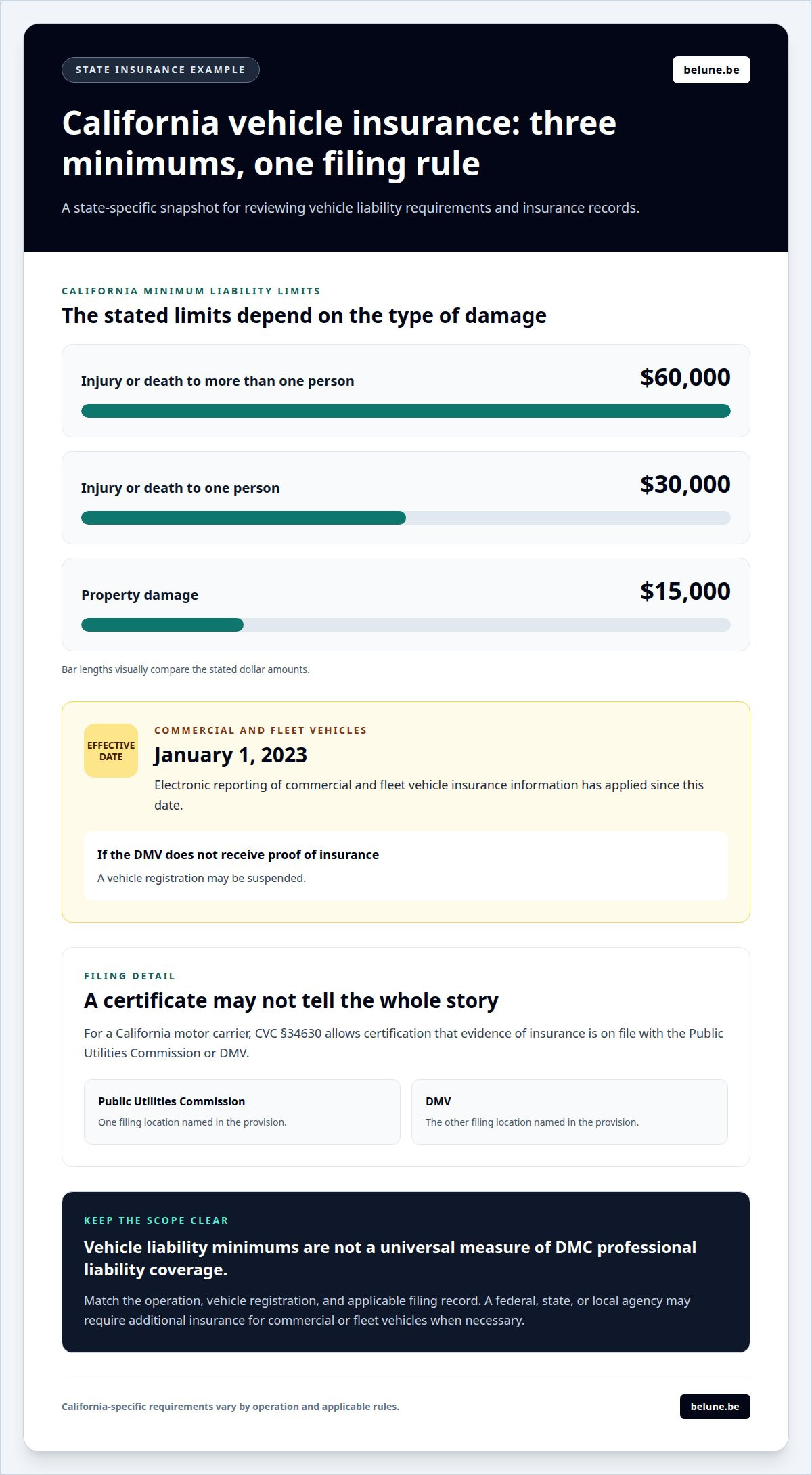
California provides a clear example. According to the California Department of Motor Vehicles, California’s minimum liability insurance limit for injury or death to one person is $30,000. The state’s listed minimums also include $60,000 for injury or death to more than one person and $15,000 for property damage. These are vehicle liability requirements, not a universal measure of a DMC’s professional liability coverage.
California’s commercial and fleet vehicle rules add another layer. Electronic reporting of commercial and fleet vehicle insurance information has applied since January 1, 2023. A vehicle registration may be suspended if the DMV does not receive proof of insurance. A federal, state, or local agency may require additional insurance for commercial or fleet vehicles when necessary.
For a California motor carrier, CVC §34630 allows certification that evidence of insurance is on file with the Public Utilities Commission or DMV. That filing detail illustrates why a certificate alone may not show every state-specific obligation. Match the operation, vehicle registration, and applicable filing record before assessing compliance.
State solvency rules also shape how regulators assess an insurer’s financial position. Admitted assets can be liquidated to raise cash for claims; nonadmitted assets aren’t recognized for solvency purposes under state insurance laws or insurance department regulations. In New York State, risk retention groups and self-insurance programs may provide different medical liability limits than state-licensed insurers. Insurers and programs not licensed there may lack protections associated with state licensing. These distinctions concern medical liability, so don’t treat them as rules for every DMC policy. Record the relevant state and policy type before drawing a conclusion.
4. Annual insurance certificate monitoring
A certificate of insurance (COI) records that a vendor or subcontractor maintains insurance, and an organization can be named as certificate holder. Treat it as a dated snapshot, not a permanent record. If you didn’t collect a COI during initial vetting, request one annually as part of ongoing vendor monitoring. For vetting a DMC’s liability insurance and financial health, this recurring review helps keep records aligned with current operations.
To verify a DMC’s certificate and policy dates, match the named business with the legal entity in the contract, then review each policy’s effective and expiration dates. Confirm the listed carrier, coverage type, and limits with the insurer or its agent using independently validated contact details. This grounds vetting a DMC’s liability insurance and financial health in current policy information.
Use a consistent review process. Record when the certificate arrived, the policies it lists, their dates, and the next review date. Compare the insured entity and coverage details with the services and contractual requirements. For example, if a certificate names a related company rather than the contracting DMC, clarify the discrepancy before treating the record as complete. Keep prior certificates so changes between review periods remain visible.
A certificate doesn’t replace the policy or establish every coverage term. If a project extends beyond a listed expiration date, request an updated certificate before that date and record the replacement. If a policy changes mid-program, update the vendor file and note when the change occurred. For government filings tied to regulated operations, distinguish those records from a COI: one document may not show that every filing remains current.
Make annual certificate review part of a broader travel-planning workflow. Shape your next group travel plan with clear operational requirements from the outset, while keeping vetting a DMC’s liability insurance and financial health in view.
BELUNE
BELUNE supports group travel planning across the Benelux and Paris region. Alongside careful partner checks, it’s important to understand how the itinerary’s arrangements fit together. For tour operators and travel agents, BELUNE coordinates group travel through Hotel Accommodation Management, Coach Hire with its own fleet of buses, Local Guide Services, and Art & Culture Group Tours.
Use the insurance and financial-responsibility checks in this guide to assess a partner, then consider how each operational element supports the experience. BELUNE brings accommodation, transport, and local expertise together in a cohesive group itinerary. Its services suit tour operators and travel agents developing a cultural program and looking to align logistics with its character.
To discuss a group itinerary, contact BELUNE.
Build confidence into the next itinerary
Make vetting a DMC’s liability insurance and financial health part of a broader partnership review, not a one-time paperwork exercise. Then bring the same clarity to the journey itself: define the experience, align operational roles, and establish how each element supports the group’s needs.
BELUNE brings that planning together through Hotel Accommodation Management, Coach Hire with its own fleet of buses, and Local Guide Services. For tour operators and travel agents developing a group itinerary, these services connect the practical arrangements with the experience guests will remember.
When you’re ready to explore a group travel project, Contact BELUNE for DMC support. A thoughtful plan is a strong place to begin.
Frequently Asked Questions
Will I be asked to provide evidence of financial responsibility?
Yes, a client may request evidence during vendor onboarding or before signing a contract. The request may depend on the DMC’s role, the activities involved, and the client’s own risk process. For example, a client arranging group transport may request documentation for the operating carrier as well as the DMC. Clarify which organization each document covers.
What are typical DMC general liability and professional liability coverage limits?
No single limit suits every DMC engagement. The appropriate amounts depend on the work, potential harm, and available ways to reduce risk. A planning-only role and an itinerary involving transport or multiple suppliers can create different exposures. Set requested limits against the specific contract and operations rather than relying on an industry-wide figure.
How can you check a DMC’s financial health and creditworthiness?
Review more than a single year-end figure. Look at cash flow, outstanding liabilities, payment patterns, and whether revenue and expenses remain consistent across successive statements. A business credit report can add information about payment history and reported obligations. Compare these records with the scale of the proposed work, and resolve material inconsistencies before relying on the assessment.
What warning signs indicate a DMC may be financially unstable or underinsured?
Warning signs include repeated late payments to suppliers, difficulty meeting agreed commitments, unexplained changes in payment instructions, or financial records that conflict with one another. For insurance, look for coverage gaps that overlap planned work or policies that don’t reflect the DMC’s current activities. Consider these signals together, since an isolated issue may have several explanations.