
A tourist tax can increase a group’s travel costs without necessarily easing pressure on a crowded destination. Understanding EU-wide tourist tax implications for groups starts with a key distinction: visitor charges are set locally, while VAT follows a shared EU framework with country-specific rates.
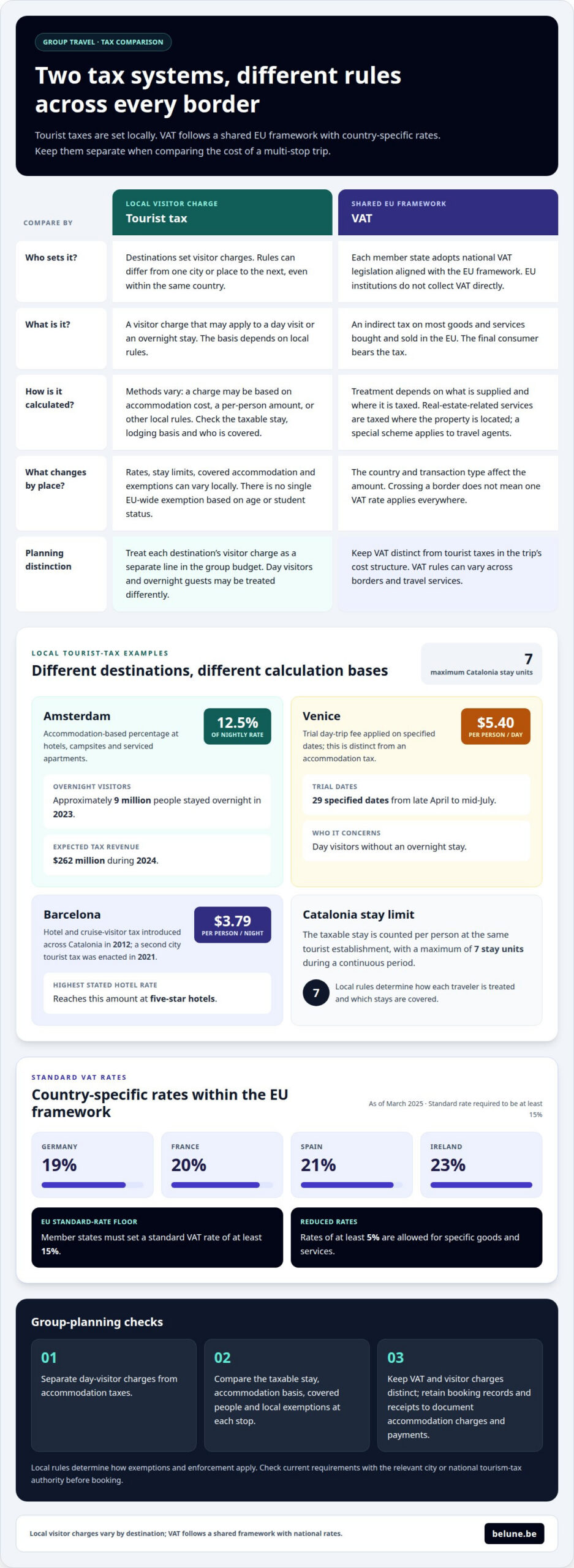
It’s easy to assume that crossing a border means carrying one consistent set of tax rules. In practice, a destination may charge visitors in a different way from the next, and VAT rates vary too. As of March 2025, standard VAT rates were 19% in Germany, 20% in France, and 21% in Spain.
This guide explains how tourist taxes relate to efforts to manage overcrowding, what the EU VAT framework means for cross-border group travel, and why the details matter when planning accommodation and an itinerary. It clarifies where charges come from, how they can affect a group’s budget, and what to consider as a trip moves between destinations.
Key Takeaways
- Tourist taxes are set by destinations and can differ in how they’re charged, so account for each stop separately when shaping a group itinerary.
- Visitor charges may help fund destination management, but their effect on overcrowding and a destination’s competitiveness depends on more than the tax alone.
- Separate tourist taxes from VAT in your planning: they are distinct charges, and VAT treatment can vary across borders and types of travel services.
- Compare how each destination calculates its visitor charge, including the taxable stay, accommodation basis, and who in the group is covered.
A look at Europe’s tourist taxes, have they helped curb overcrowding?
Tourist taxes can raise revenue and influence visitor choices, but they do not guarantee less overcrowding. Across Europe, local charges may treat day visitors and overnight guests differently, and the combined costs can affect a destination’s competitiveness.
Day and Overnight Visitor Taxes
Day-visitor charges apply to visits without an overnight stay; accommodation taxes relate to lodging. Venice’s trial day-trip fee was $5.40 per person per day on 29 specified dates from late April to mid-July. Barcelona’s hotel and cruise-visitor tax was introduced across Catalonia in 2012, with a second city tourist tax enacted in 2021. Groups should distinguish these charges by visit type. Rules apply to tour groups and school trips according to the relevant local basis.
Accommodation-Based Tax Differences
Accommodation-based taxes may use different calculation methods or covered lodging types, so hotel, hostel, rental, and campsite stays can’t be assumed to follow identical rules. Amsterdam charges 12.5% of the nightly accommodation rate at hotels, campsites, and serviced apartments. Exemptions for children, students, seniors, or other travelers depend on local rules, rather than a single EU-wide exemption. Organizers can retain booking records and receipts to document accommodation charges and payments.
Traveler Exemptions
Tax exemptions are determined locally; a traveler’s age or student status alone does not establish an EU-wide exemption. For groups, the number of taxable people and covered nights can affect the total, while local rules determine how each traveler is treated. Incorrect collection or payment may have local enforcement consequences, but the process depends on the destination. Check current requirements with the relevant city or national tourism-tax authority before booking.
Rates, Stay Limits, and Budget Comparisons
Rates and stay limits vary by destination, so compare accommodation totals after applicable visitor charges, not room prices alone. Barcelona’s hotel tourist tax reaches $3.79 per person per night at five-star hotels. In Catalonia, according to Agència Tributària de Catalunya, the taxable stay is counted per person at the same tourist establishment, with a maximum of 7 stay units during a continuous period. Tourist taxes may add to a group’s cost burden; qualified domestic minimum top-up taxes belong to the corporate global minimum-tax system, not visitor charges.
EU VAT framework
Value added tax, or VAT, is an indirect tax on most goods and services bought and sold in the EU. The final consumer bears the tax, while each member state adopts national VAT legislation aligned with the shared EU framework. EU institutions do not collect VAT directly. For group travel, this distinction matters: VAT is a consumption tax, not the same as a destination’s tourist tax.
Council Directive 2006/112/EC of 28 November 2006 sets out the common EU VAT system. The framework requires member states to set a standard rate of at least 15%, while allowing reduced rates of at least 5% for specific goods and services. As of March 2025, standard rates were 19% in Germany, 20% in France, and 21% in Spain. The country and type of transaction therefore affect the VAT amount.
VAT treatment also depends on what is supplied and where the supply is taxed. EU rules define a service as anything that is not a good, and tax real-estate-related services where the property is located. A special VAT scheme applies to travel agents, among other transactions. For cross-border itineraries, the relevant scheme and place of supply can shape how transactions are treated. Crossing a border does not mean one rate applies everywhere.
Digital transactions have also prompted changes. New EU VAT rules for cross-border business-to-consumer e-commerce have applied since 1 July 2021. The European Commission proposed measures to modernise, simplify, and strengthen the system on 8 December 2022. The VAT in the Digital Age package was adopted in March 2025, with a phased rollout from 1st January 2027. For practical cross-border group travel planning, keep VAT and local visitor charges distinct in the trip’s cost structure.
A general estimate puts VAT at 20-30% of government revenue in EU countries. Goods exported from the EU and services sold to customers outside the EU are normally not subject to VAT, while most imports into the EU are subject to VAT.
The EU VAT system’s Sixth Directive was issued in 1977 to harmonize member states’ national VAT systems and provide a uniform basis of assessment. The EU VAT Directive provides for a minimum VAT rate limit, and 5% is described as the generally intended minimum rate throughout Europe. As of March 2025, Ireland’s standard VAT rate was 23%.
Which EU countries and cities charge tourist taxes to visitors?
Tourist taxes vary across European destinations; no single charge applies uniformly throughout the EU. A group crossing borders may encounter different rules in each city, even within one country. Amsterdam, for example, calculates its tourist tax as a percentage of accommodation cost, while other destinations use different methods. Treating a route as one tax zone can obscure differences in the trip’s total cost.
Amsterdam charges 12.5% of the nightly accommodation rate at hotels, campsites, and serviced apartments. The city expected $262 million in tourist-tax revenue during 2024. These figures show why a city-level charge deserves a separate line in a group budget.
Visitor numbers also provide context, though they don’t prove a tax has reduced crowding. Approximately 9 million people visited Amsterdam for an overnight stay in 2023. Comparing that figure with the city’s expected tax revenue can illustrate the scale of overnight tourism and the funds associated with it, but revenue alone doesn’t establish how the money is spent or whether visitor pressure has eased.
For group travel, identify each destination where accommodation or visitor charges may apply, and keep the relevant city and lodging details distinct. Under Amsterdam’s percentage-based model, the accommodation cost affects the tax amount; a destination using another method may produce a different comparison. When reviewing stays across several cities, the lowest listed room price may not mean the lowest total once local charges are included. National borders alone do not determine which local taxes apply: the destination and type of visit matter.
How EU Tourist Taxes are Calculated
Tourist taxes use different calculation methods: a charge per person, a charge linked to nights, a percentage of accommodation cost, or a day-visit fee. The destination’s method determines which details shape the group total, such as the number of taxable travelers, length of stay, or accommodation cost. There is no single Europe-wide calculation.
Amsterdam uses a percentage model, charging 12.5% of the nightly accommodation rate at hotels, campsites, and serviced apartments. As the room rate changes, the tax amount changes with it. For a group comparing stays, this means evaluating the accommodation charge alongside the room price, rather than treating the tax as an identical fixed amount for every booking.
Other systems count people and stay units. In Catalonia, the taxable stay is counted per person at the same tourist establishment, with a maximum of 7 stay units during a continuous period, according to Agència Tributària de Catalunya. This measure makes the traveler count, establishment, and continuous stay relevant to understanding the taxable period. It also shows why organizers should distinguish separate establishments and destinations in their calculations.
A day-visitor fee follows a different basis from an overnight charge. Venice’s day-trip entry fee was $5.40 per person per day on 29 specified dates from late April to mid-July. For a group, that structure makes the applicable visit date and number of visitors central to estimating the charge. It should not be confused with a tax calculated from accommodation costs or overnight stays.
For a practical comparison, separate each destination’s calculation method, taxable people, relevant nights or visit days, and accommodation basis. Keep the figures grouped by stop, especially when an itinerary crosses borders and changes lodging. For multi-stop group travel, coordinate accommodation planning around each destination’s charging method.
BELUNE: Art & Culture Group Tours
BELUNE organizes Art & Culture Group Tours for travel professionals planning group itineraries across European destinations. When a route combines different cities and accommodation arrangements, Hotel Accommodation Management, Coach Hire with its own fleet of buses, and Local Guide Services bring key travel elements together.
This coordination helps tour operators and travel agents plan the practical structure of a cultural journey and account for destination-specific visitor charges in their budgets. BELUNE organizes the group experience and its logistics, while local rules determine applicable taxes and tax liability.
For an art and culture group itinerary, contact BELUNE to discuss your plans.
Shape a More Considered Group Journey
Understanding EU-wide tourist tax implications for groups gives planners a stronger basis for shaping a journey, not just estimating its costs. The next step is to bring destination choices, accommodation decisions, and the type of experience together in one coherent itinerary. This makes it easier to weigh practical arrangements alongside the cultural moments travelers will remember.
For tour operators and travel agents, thoughtful planning means treating each stop as part of a connected experience. A well-planned route can balance major destinations with quieter places while keeping the group’s logistics in view. BELUNE can help develop the journey through coordinated group travel planning, shaped around the itinerary’s purpose.
Start a conversation about the route, the group, and the experience you want to create. Contact BELUNE about group travel, and take the next step toward a considered European itinerary.
Frequently Asked Questions
Who collects and pays tourist taxes, and when are they charged?
Travelers usually bear the tourist tax, while local rules determine who collects it and when payment is due. For organizers, understanding EU-wide tourist tax implications for groups starts with distinguishing charges tied to an overnight booking from those linked to a day visit. It also helps separate visitor charges from VAT when reviewing trip records and organizing payment documents.
What penalties apply if tourist taxes are not collected or paid correctly?
Incorrect collection or payment may have local enforcement consequences, with the applicable process determined by the destination.