A supplier without an eco-certificate doesn’t automatically settle whether a responsible tourism operator in Benelux can be certified. The answer depends on the certification’s scope and the operator’s environmental practices across its operations and supply chain. ISO 14001 is an audited certification standard relevant to sustainable tourism operations, according to the International Organization for Standardization.
It’s sensible to look beyond a tour operator’s own policies: accommodation, transport and local activities all shape a trip’s wider impact. Responsible tourism considers how travel supports host communities and respects local culture, as well as how it reduces environmental effects.
This guide explains how supplier practices relate to eco-certification, what responsible tourism can mean for communities, and how to find Belgian agencies. It also outlines what to look for in a group-travel partner, from local guiding and cultural experiences to the practical coordination that brings an itinerary together.
Key Takeaways
- Assess certification by its scope and the operator’s management of supplier practices, not by a single supplier’s status alone.
- Use practical questions about transport, accommodation, local guides, and community engagement to evaluate a group itinerary.
- Look beyond environmental measures: responsible tourism can also support local businesses, cultural heritage, and meaningful community connections.
- Use Belgian agency directory details to narrow your search, then match the operator’s group-travel services to the experience you want to create.
Can a tour operator be eco-certified if some suppliers are not?
Possibly, depending on the certification’s scope and audit criteria. A supplier’s practices still matter when they shape the destination experience or the operator’s environmental impact.
Certification Frameworks and Bodies
Start by distinguishing a management framework from a certificate. A framework guides how an organisation sets objectives, monitors operations, and improves its processes. Certification indicates that an independent assessment has examined practices within a defined scope. ISO 14001 is an audited certification standard relevant to sustainable tourism operations, according to the International Organization for Standardization. ISO 20121 is identified as a standard for sustainable venues and meetings. These standards address different operational contexts, so buyers should look at what an audit covers, rather than treating every certificate as interchangeable. A certificate for a venue, for example, does not automatically assess every tour supplier.
Supplier and Accommodation Sustainability
Suppliers influence a trip through accommodation, transport, food, activities and local guiding. Operators can assess these partners using clear selection criteria, documented environmental practices and regular communication about performance. For accommodation, consider resource use, waste handling and how the property engages with its destination. A supplier without a certificate may still follow responsible practices, but those practices need credible evidence. Buyers can ask how the operator accounts for supplier impacts in its sustainability management and responds when a partner falls short.
European sustainable-tourism directories can help buyers identify potential partners, but an entry is a starting point, not an audit result. One directory describes 74 companies across 24 countries as committed to sustainable and responsible tourism. Its listings may help tour operators and travel agents map the market, then compare each company’s services, destinations, and stated sustainability approach. Directory presence alone does not establish that every supplier used by a listed operator is certified.
When choosing sustainable tourism services, connect claims with operational evidence. Ask how the operator selects accommodation and transport, which parts of its business a certification covers, and how it assesses supplier practices. A responsible tourism operator in Benelux should explain how its policies and audits relate to the partners shaping each itinerary. This makes certification useful without assuming every supplier holds the same credential.
How many responsible tourism agencies are there based in Belgium?
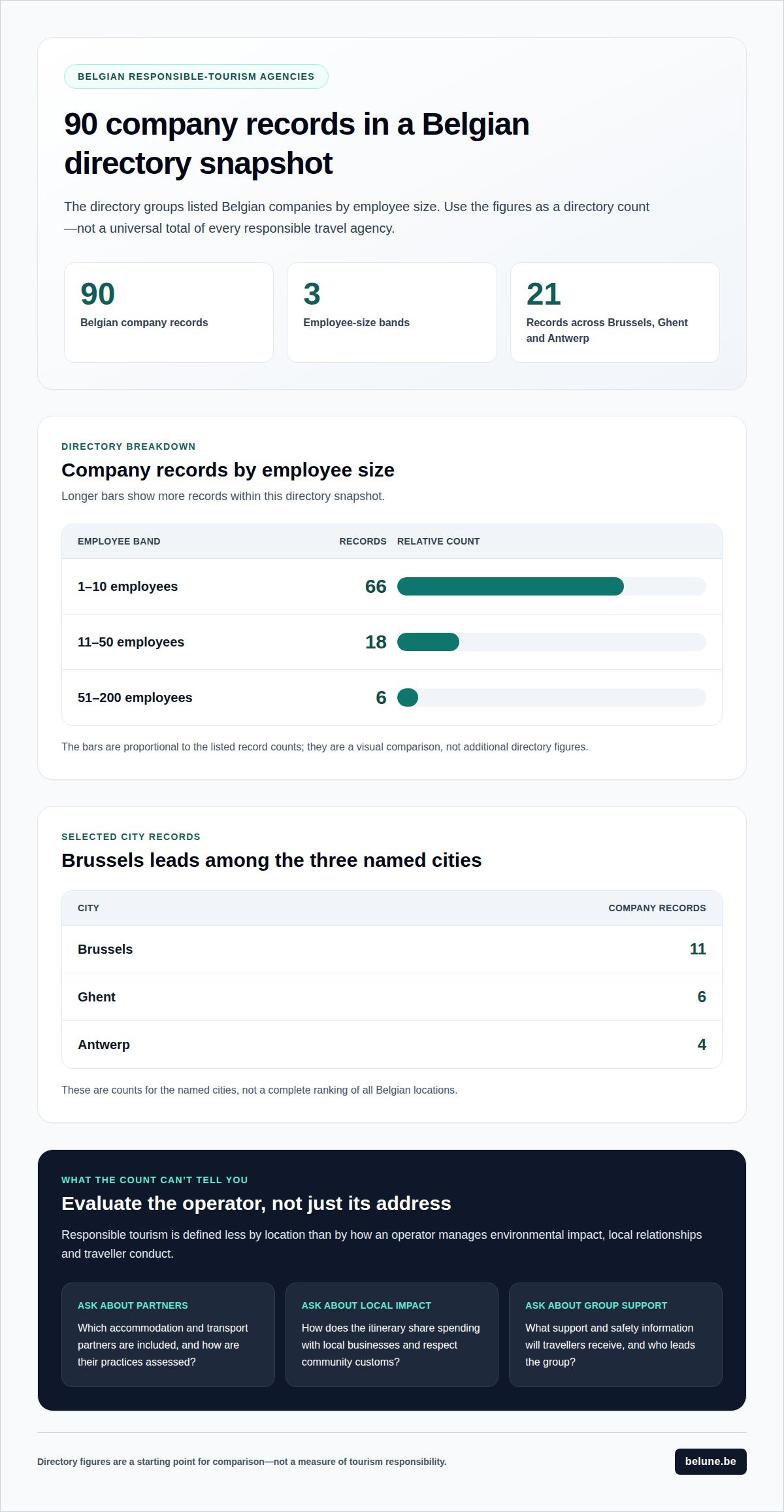
A directory snapshot dated September 21, 2026, recorded 90 Belgian companies across three employee-size bands: 66 with 1-10 employees, 18 with 11-50, and 6 with 51-200. It’s a useful directory count, not a universal total of every responsible travel agency.
Brussels had 11 company records, Ghent had 6, and Antwerp had 4. A responsible tourism operator in Benelux is defined less by its address than by how it manages environmental impact, local relationships, and traveller conduct.
Booking protections depend on the country, the seller and how the trip is packaged. Before committing, read the written terms for cancellations, inclusions, complaint handling and any stated financial protection.
For group travel, ask specific questions before selection:
- Which accommodation and transport partners are included, and how are their practices assessed?
- How does the itinerary share spending with local businesses and respect community customs?
- What support and safety information will travellers receive, and who leads the group?
Green Key certificates are valid for one year. Green Key, EU Ecolabel, Travelife and GSTC can help frame a sustainability discussion, but their names alone don’t explain what an operator’s audit or assessment covers. Ask which entity and activities a credential applies to, and how supplier practices relate to the itinerary.
Responsible travel also considers timing. Visiting a popular destination during a quieter season may ease pressure on busy sites and help spread visitor spending. Ask how the operator plans seasonal visits and group movements, and what guidance it gives on site etiquette and conduct before departure. These details help travellers respect residents, heritage and shared spaces.
For a group itinerary shaped around local culture and considered logistics, explore Belgian group travel planning.
Responsible tourism principles and community benefits
Responsible tourism connects each journey with the people who live in its destination. Its value depends on how partners share decisions, income and responsibility.
Responsible Tourism Principles
Look for practices that respect local culture, limit avoidable pressure and create meaningful community participation. For example, a guided visit can include local interpretation, appropriate group behaviour and opportunities for residents to lead the story. These choices affect more than the visitor experience: they influence whose knowledge is valued and whether tourism supports community priorities. Consider how benefits and disruptions are distributed, rather than treating visitor numbers as the only measure of success. When comparing itineraries, focus on specific choices the operator can explain.
Community Initiatives
Trip for a Trip and Planeterra are names readers may encounter when exploring community-focused travel initiatives. Assess each initiative by identifying its local partners, the role residents play and how visitor participation connects with community goals. Focus on the relationships behind the name. For example, in a locally led experience, consider whether community members shape the content and benefit from their contribution. A program’s title alone doesn’t explain its impact.
Local Community Impact
Tourism can bring customers to local businesses and create opportunities for guides, artisans and cultural organisations. It can also add pressure to busy public spaces or turn daily traditions into performances for visitors. The impact depends on itinerary design, group behaviour, timing and how spending reaches local partners. A local guide, for instance, can provide context and help visitors understand appropriate conduct at a heritage site. Consider whether community voices inform the experience and whether residents retain space to live, work and share culture on their own terms.
For a practical review, trace an itinerary from arrival to departure. Note who leads each experience, where visitor spending goes and how the journey respects local customs. This simple route map makes community impact easier to discuss with travel partners, without reducing responsibility to a slogan or a single activity.
Belgian responsible-tourism agency directory
A useful directory combines a geographic starting point with enough detail to distinguish agencies, networks, and other tourism organisations. One sustainable-tourism directory describes 74 companies across 24 countries. Treat its entries as discovery leads, not as a uniform ranking or a guarantee that every listed organisation holds the same credentials.
In Belgium, identify an organisation’s location and role to narrow your search. A directory entry may represent a tour operator, a destination management company, a trade association or another tourism business. These roles are not interchangeable. An operator plans or delivers trips, while a professional network connects organisations across the sector. Identify the role first, then match it to your group’s needs.
A Brussels-based industry network can be a useful discovery lead, but it should not be treated as a count of Belgian responsible-tourism agencies. ETOA describes itself as a member-driven community of over 1,100 organisations. This makes it a useful example of a Brussels-based industry network, not a count of Belgian responsible-tourism agencies. Directory categories matter: contact records and agency listings measure different things.
Use a consistent selection process for each promising entry:
- Read the organisation’s description and identify whether it serves groups, trade partners, or individual travellers.
- Match its stated destinations and services to your itinerary, such as heritage visits or locally led experiences.
- Look for specific sustainability practices and community partnerships, rather than relying on a directory label alone.
- Review how guides, transport, accommodation, and local activities fit into the proposed journey.
This approach turns a broad directory into a shortlist that fits your travel brief. A group focused on cultural heritage, for example, needs relevant destination expertise and guiding, while a trade buyer may need coordinated ground services. Compare organisations by function and evidence, not contact volume or location alone. A directory can help you find candidates; their actual role and itinerary fit determine whether they belong on your shortlist.
BELUNE: Battlefield Tourism
BELUNE helps tour operators and travel agents plan group battlefield itineraries across the Benelux region. Choose BELUNE when your journey calls for historical context, local guidance and coordinated group logistics.
BELUNE’s Local Guide Services bring destination knowledge to battlefield visits, while Hotel Accommodation Management and coach hire with its own fleet support travel between stops. Art & Culture Group Tours can add wider historical and cultural context. Together, these services help create a considered group journey rather than a series of disconnected visits.
Planning a battlefield group tour? Contact BELUNE to discuss your itinerary.
Shape your next group journey with care
Turn responsible travel priorities into a workable itinerary. Decide what the group should learn, how it should engage with local places and which practical details need coordination. A responsible tourism operator in Benelux can bring those choices together in a considered journey.
For group travel, BELUNE brings together Hotel Accommodation Management, coach hire with its own fleet of buses and Local Guide Services. These services support itineraries where travel between places and the context provided by guides matter as much as the destination itself.
Share your group’s interests and the experience you want to create. Contact BELUNE about responsible tourism to discuss the next step for your itinerary. With a clear purpose and thoughtful planning, your journey can become more meaningful for everyone involved.
Frequently Asked Questions
How do I get contact information for these companies?
Use the contact channel published in the agency’s own directory profile or company materials. For group travel planning with BELUNE, you can email info@belune.eu or call +32 56 505 986. When making an enquiry, include your group’s purpose, preferred destinations, and the services you need. That context helps frame a useful discussion about the itinerary.
How do you assess claims without a certification?
Ask for specific examples that connect a sustainability claim to daily operations. Request the supplier-selection criteria, the partners involved and how the operator records its environmental or community practices. Then compare the explanation with the itinerary. A claim about supporting local businesses is clearer when the program identifies who provides each experience or service.
Is an eco-certified travel partner automatically sustainable across every service?
No. A certificate applies to a defined organisation, activity or site, so it doesn’t automatically assess every service. For example, a credential associated with accommodation doesn’t by itself describe the operator’s transport arrangements or guided activities. Read the certificate’s scope alongside the itinerary, and check that the named entity matches the partner delivering each service.
What certifications should I look for when choosing travel partners in Belgium?
Consider Green Key, EU Ecolabel, Travelife, GSTC, and ISO 14001 among the names relevant to your review. Don’t compare labels by name alone. Identify the organisation assessed, the service or site covered, and the assessment criteria. For a group itinerary, this helps distinguish a credential relating to a hotel from one relating to another travel partner.
Which tour operators in Belgium, the Netherlands, and Luxembourg have recognized sustainability certifications?
A directory entry alone doesn’t establish that an operator is certified. Treat a company as certified only when its current certificate or the issuer’s record names the same legal entity and covers the relevant service. This distinction matters when a tour operator works with separate accommodation, transport and activity partners. Match each credential to the business responsible for that part of your itinerary.
What sustainability certifications are relevant to Benelux tour operators, such as Travelife or GSTC?
Travelife and GSTC are names to include in a sustainability review, alongside standards such as ISO 14001 where applicable. Their relevance depends on the service and the entity being assessed. For a tour program, create a simple record of each partner, its credential, the covered activity, and the evidence provided. This makes gaps and overlaps easier to understand during planning.