Tag: DMC Vetting

  • 4 checks for a DMC’s liability insurance and financial health

    4 checks for a DMC’s liability insurance and financial health

    A well-planned itinerary needs a sound operational foundation. Evidence of financial responsibility belongs in a DMC vetting process, but the documents and coverage to review depend on the services involved and the rules that apply. Vetting a DMC’s liability insurance and financial health means looking beyond whether a certificate exists: check what protection it indicates and whether the business appears equipped to meet its obligations.

    It’s reasonable to seek reassurance before entrusting a partner with complex travel arrangements. This guide explains what evidence to request, how to review coverage limits and policy details, why state requirements matter, and how annual insurance certificates help keep records current. It also covers financial resilience, so you can assess both the insurance in place and the organization behind it. The goal is a clear, practical framework for making an informed decision.

    Key Takeaways

    • Look beyond a policy’s headline limit: understand what the professional liability or errors and omissions coverage includes and how its terms affect protection.
    • Match evidence of financial responsibility to the DMC’s operations, since accepted forms and filing requirements can depend on the activity and jurisdiction.
    • Account for state-level differences when assessing insurance rules; a requirement in one state may not apply in another.
    • Make annual certificate reviews part of vendor monitoring to keep insurance records current and spot coverage changes.

    1. Professional liability and errors and omissions coverage

    For a United States DMC, assess professional liability, errors and omissions (E&O), and commercial general liability (CGL) in relation to the services and risks involved. No single limit suits every engagement. Set requirements based on potential claims, the itinerary, and the DMC’s role. For example, an itinerary involving several suppliers may expose the DMC to different allegations than a planning-only engagement.

    Review the policy type and dates. A claims-made policy generally responds to claims reported while the policy is in effect. Ask how coverage continues if the policy ends, since tail or nose coverage is usually required when a claims-made medical liability policy terminates. An occurrence policy generally responds based on when the covered event happened. Confirm the wording with the carrier rather than assuming either label covers every claim.

    CGL and E&O address different exposures. CGL concerns liability for bodily injury or property damage, while E&O addresses alleged professional errors. Workers’ compensation is government-mandated, but requirements depend on the jurisdiction. Commercial auto is relevant when vehicles are used for business, while umbrella or excess liability can add limits above a primary policy. Match each policy to the DMC’s operations.

    Ask whether limits apply separately to the DMC or are shared with an employer and other employees. Review exclusions, deductibles, policy dates, and any claims-made reporting terms. A client may request additional-insured status to receive coverage and rights under a vendor’s policy for a future claim. Confirm the endorsement and its scope rather than relying on a certificate alone.

    To assess financial health, request financial statements and business records that show the company’s position and ongoing operations, such as balance sheets, income statements, and evidence of current insurance. Compare the carrier’s net written premium with its surplus to assess whether its capital supports the business it writes. Verify the DMC’s legal name and registration through the relevant state business registry, then review available licensing records and public legal filings for consistency.

    2. Acceptable forms of financial responsibility

    The right documents depend on the DMC’s activities. A certificate of insurance (COI), commonly issued using an ACORD certificate of liability insurance, summarizes policies and limits. It can identify the organization requesting proof as the certificate holder. Effective vetting of a DMC’s liability insurance and financial health starts with understanding what each record demonstrates and what it doesn’t.

    Federal motor-carrier rules have a defined scope. According to the Electronic Code of Federal Regulations, entities applying for motor-carrier, broker, or freight-forwarder operating authority must have the minimum financial responsibility required by 49 CFR Part 387 on file before the agency grants operating authority. When reviewing evidence, distinguish a required filing from a document that simply summarizes insurance.

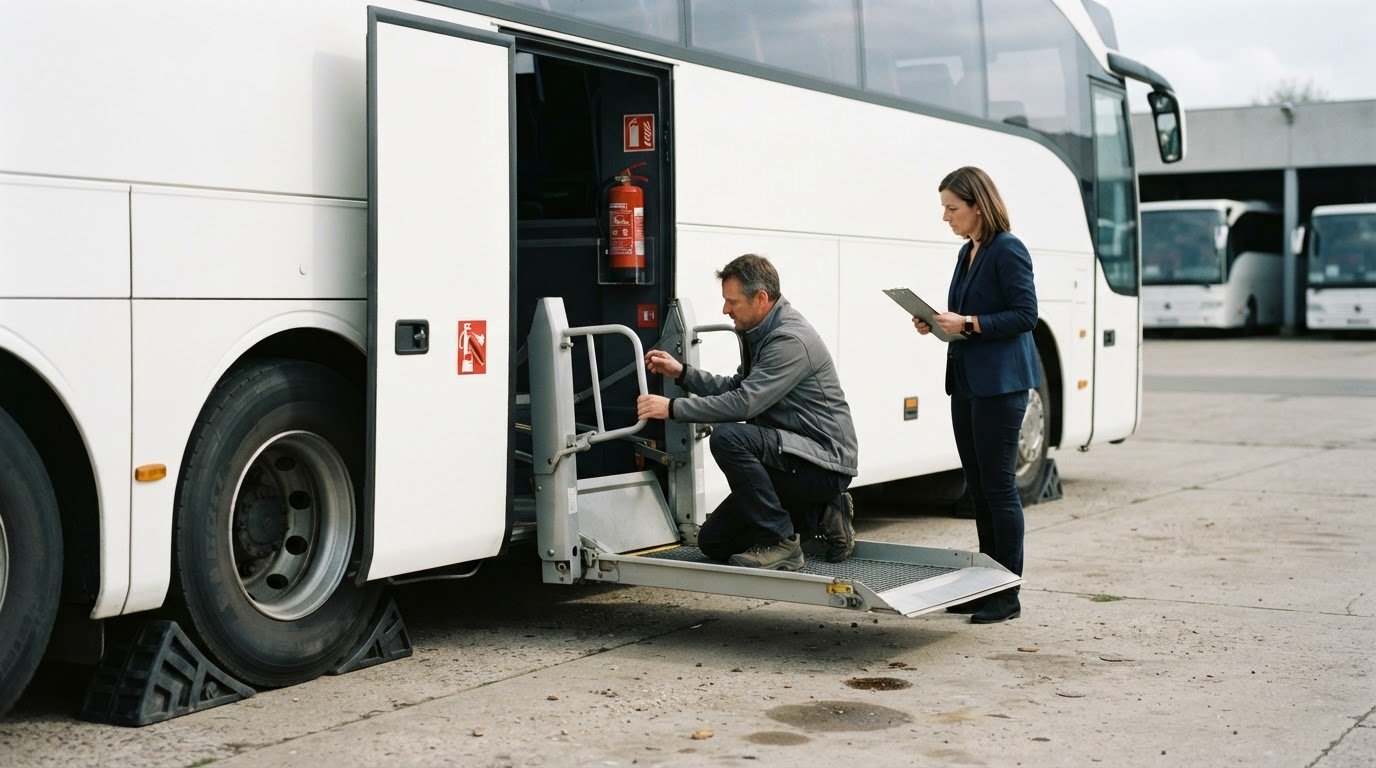
    Passenger operations also have specific requirements. According to the Federal Motor Carrier Safety Administration, for-hire passenger carriers transporting 15 or fewer passengers must have $1,500,000 in bodily injury and property damage insurance. A DMC arranging transport should distinguish its own coverage from the carrier’s filings and insurance. Identify which entity operates the vehicle and bears each contractual responsibility.

    Additional-insured status is another form of protection to consider. An organization may request this status under a vendor’s policy, which can provide coverage and rights for a future claim. Confirm that the endorsement’s scope aligns with the work and the parties named in the contract. Excess liability coverage may also extend limits above a primary policy.

    Contract terms can address cancellation, default, or inadequate insurance. Specify required coverage as a condition of the agreement, require prompt notice of material changes, and define termination rights if coverage lapses. Set out refund or repayment duties, responsibility for replacement arrangements, and the process for resolving losses. As part of vetting a DMC’s liability insurance and financial health, put these obligations in writing. Their effect depends on the contract wording and applicable law.
    4 checks for a DMC’s liability insurance and financial health

    3. State insurance regulations and restrictions

    Insurance requirements vary by state, each of which has its own insurance department regulations and restrictions. A DMC’s operations may cross state lines, so assess the rules where relevant activities take place. Separate state-specific requirements from general policy language, then record which jurisdiction applies to each operation. This distinction can affect the outcome of your review.

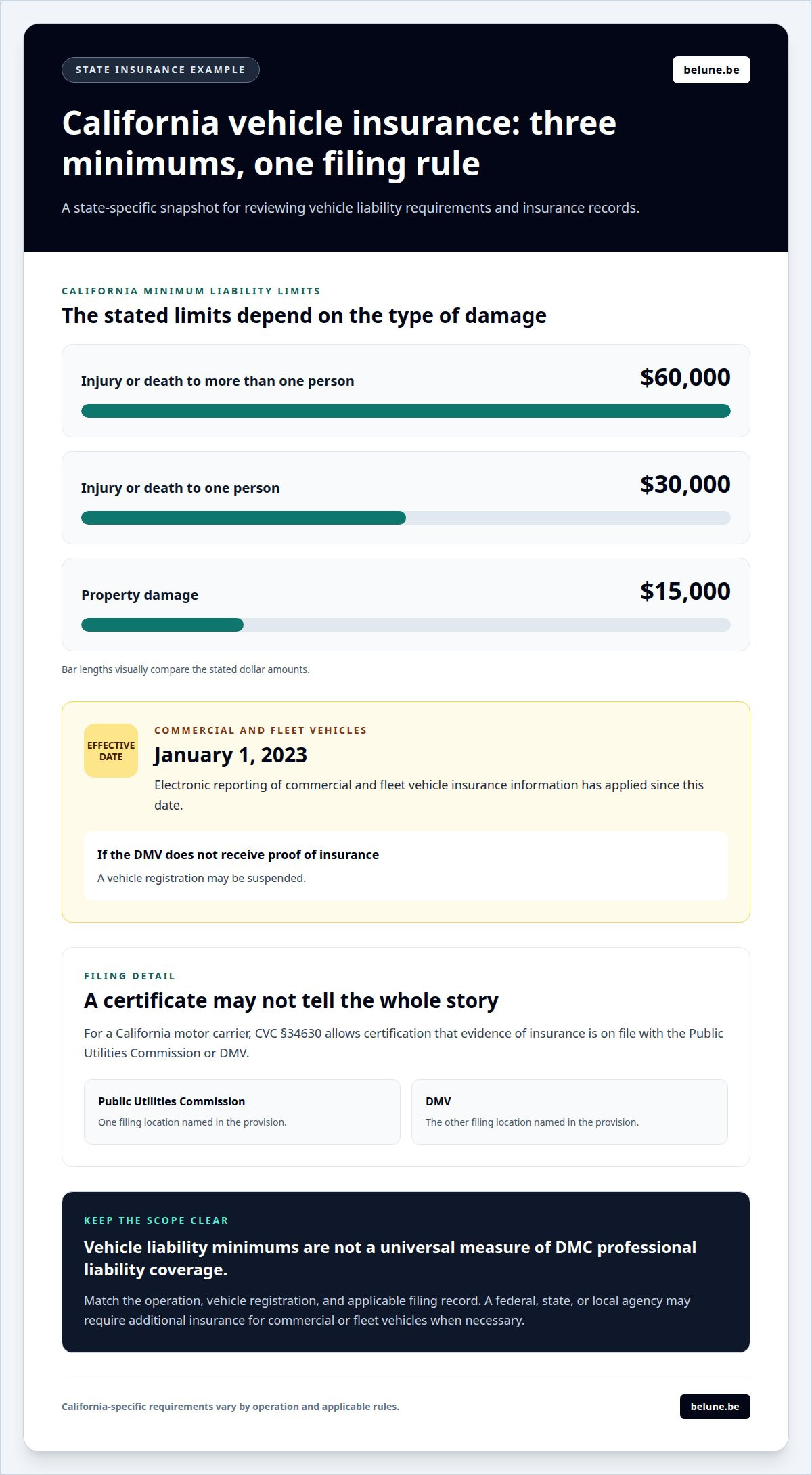
    California provides a clear example. According to the California Department of Motor Vehicles, California’s minimum liability insurance limit for injury or death to one person is $30,000. The state’s listed minimums also include $60,000 for injury or death to more than one person and $15,000 for property damage. These are vehicle liability requirements, not a universal measure of a DMC’s professional liability coverage.

    California’s commercial and fleet vehicle rules add another layer. Electronic reporting of commercial and fleet vehicle insurance information has applied since January 1, 2023. A vehicle registration may be suspended if the DMV does not receive proof of insurance. A federal, state, or local agency may require additional insurance for commercial or fleet vehicles when necessary.

    For a California motor carrier, CVC §34630 allows certification that evidence of insurance is on file with the Public Utilities Commission or DMV. That filing detail illustrates why a certificate alone may not show every state-specific obligation. Match the operation, vehicle registration, and applicable filing record before assessing compliance.

    State solvency rules also shape how regulators assess an insurer’s financial position. Admitted assets can be liquidated to raise cash for claims; nonadmitted assets aren’t recognized for solvency purposes under state insurance laws or insurance department regulations. In New York State, risk retention groups and self-insurance programs may provide different medical liability limits than state-licensed insurers. Insurers and programs not licensed there may lack protections associated with state licensing. These distinctions concern medical liability, so don’t treat them as rules for every DMC policy. Record the relevant state and policy type before drawing a conclusion.

    4. Annual insurance certificate monitoring

    A certificate of insurance (COI) records that a vendor or subcontractor maintains insurance, and an organization can be named as certificate holder. Treat it as a dated snapshot, not a permanent record. If you didn’t collect a COI during initial vetting, request one annually as part of ongoing vendor monitoring. For vetting a DMC’s liability insurance and financial health, this recurring review helps keep records aligned with current operations.

    To verify a DMC’s certificate and policy dates, match the named business with the legal entity in the contract, then review each policy’s effective and expiration dates. Confirm the listed carrier, coverage type, and limits with the insurer or its agent using independently validated contact details. This grounds vetting a DMC’s liability insurance and financial health in current policy information.

    Use a consistent review process. Record when the certificate arrived, the policies it lists, their dates, and the next review date. Compare the insured entity and coverage details with the services and contractual requirements. For example, if a certificate names a related company rather than the contracting DMC, clarify the discrepancy before treating the record as complete. Keep prior certificates so changes between review periods remain visible.

    A certificate doesn’t replace the policy or establish every coverage term. If a project extends beyond a listed expiration date, request an updated certificate before that date and record the replacement. If a policy changes mid-program, update the vendor file and note when the change occurred. For government filings tied to regulated operations, distinguish those records from a COI: one document may not show that every filing remains current.

    Make annual certificate review part of a broader travel-planning workflow. Shape your next group travel plan with clear operational requirements from the outset, while keeping vetting a DMC’s liability insurance and financial health in view.

    BELUNE

    BELUNE supports group travel planning across the Benelux and Paris region. Alongside careful partner checks, it’s important to understand how the itinerary’s arrangements fit together. For tour operators and travel agents, BELUNE coordinates group travel through Hotel Accommodation Management, Coach Hire with its own fleet of buses, Local Guide Services, and Art & Culture Group Tours.

    Use the insurance and financial-responsibility checks in this guide to assess a partner, then consider how each operational element supports the experience. BELUNE brings accommodation, transport, and local expertise together in a cohesive group itinerary. Its services suit tour operators and travel agents developing a cultural program and looking to align logistics with its character.

    To discuss a group itinerary, contact BELUNE.

    Build confidence into the next itinerary

    Make vetting a DMC’s liability insurance and financial health part of a broader partnership review, not a one-time paperwork exercise. Then bring the same clarity to the journey itself: define the experience, align operational roles, and establish how each element supports the group’s needs.

    BELUNE brings that planning together through Hotel Accommodation Management, Coach Hire with its own fleet of buses, and Local Guide Services. For tour operators and travel agents developing a group itinerary, these services connect the practical arrangements with the experience guests will remember.

    When you’re ready to explore a group travel project, Contact BELUNE for DMC support. A thoughtful plan is a strong place to begin.

    Frequently Asked Questions

    Will I be asked to provide evidence of financial responsibility?

    Yes, a client may request evidence during vendor onboarding or before signing a contract. The request may depend on the DMC’s role, the activities involved, and the client’s own risk process. For example, a client arranging group transport may request documentation for the operating carrier as well as the DMC. Clarify which organization each document covers.

    What are typical DMC general liability and professional liability coverage limits?

    No single limit suits every DMC engagement. The appropriate amounts depend on the work, potential harm, and available ways to reduce risk. A planning-only role and an itinerary involving transport or multiple suppliers can create different exposures. Set requested limits against the specific contract and operations rather than relying on an industry-wide figure.

    How can you check a DMC’s financial health and creditworthiness?

    Review more than a single year-end figure. Look at cash flow, outstanding liabilities, payment patterns, and whether revenue and expenses remain consistent across successive statements. A business credit report can add information about payment history and reported obligations. Compare these records with the scale of the proposed work, and resolve material inconsistencies before relying on the assessment.

    What warning signs indicate a DMC may be financially unstable or underinsured?

    Warning signs include repeated late payments to suppliers, difficulty meeting agreed commitments, unexplained changes in payment instructions, or financial records that conflict with one another. For insurance, look for coverage gaps that overlap planned work or policies that don’t reflect the DMC’s current activities. Consider these signals together, since an isolated issue may have several explanations.
  • The Definitive Guide to Finding a Reliable DMC Partner in the Benelux for 2026

    The Definitive Guide to Finding a Reliable DMC Partner in the Benelux for 2026

    What if the true measure of a luxury journey isn’t the distance covered, but the seamless harmony of every transition? In the intricate corridors of Belgium, the Netherlands, and Luxembourg, a single logistical shadow can dim the entire experience for your most discerning clients. You understand that excellence isn’t accidental. It’s designed. Securing a reliable dmc partner benelux for your 2026 season means moving beyond simple bookings toward a vision of travel that feels both effortless and profound.

    Data from the 2024 European Travel Commission suggests that 38% of luxury travelers now prioritize “flawless execution” over the destination itself. We agree that your professional reputation shouldn’t rest on the inconsistent quality of outsourced guides or the sudden sting of hidden transport fees. This guide outlines the essential criteria for selecting a high-end partner who combines architectural logistical precision with a poetic, bespoke touch for curation. You’ll discover how to achieve fixed-price certainty for B2B packages while gaining whispered access to the most exclusive, high-quality local experiences across the region.

    Key Takeaways

    • Master the art of vetting potential allies by prioritizing direct asset ownership and long-term hotel partnerships for flawless logistical execution.
    • Uncover the essential criteria needed to secure a reliable dmc partner benelux capable of harmonizing complex cross-border nuances with high-end travel curation.
    • Explore why deep thematic expertise and emotional sensitivity are non-negotiable when designing specialized itineraries like historical remembrance tours.
    • Utilize a strategic reliability checklist to look beyond marketing surfaces and verify the stability provided by two decades of regional industry experience.
    • Learn how to elevate group travel from mere coordination to a curated journey that reflects a vision of sophistication, precision, and sensory harmony.

    What Defines a Reliable DMC Partner in the Benelux Region?

    Travel in 2026 demands more than logistical precision; it requires a vision that transforms a simple journey into a curated narrative. The modern Destination Management Company acts as an architect of these experiences. They bridge the gap between local authenticity and global standards. Finding a reliable dmc partner benelux means identifying a collaborator who views logistics as a canvas for storytelling. The role has shifted fundamentally from mere itinerary planning to comprehensive experience management. It’s no longer enough to book a hotel or a bus. Partners now expect a seamless fusion of cultural expertise, technical rigour, and artistic flair.

    The Benelux region presents a unique set of challenges that only a seasoned expert can master. While Belgium, the Netherlands, and Luxembourg share a close geographical bond, their cultural nuances and regulatory frameworks remain distinct. A 150-kilometer drive can transition you from the avant-garde design hubs of Eindhoven to the medieval charm of Bruges or the financial heart of Luxembourg City. This cross-border complexity requires a partner who understands the subtle shifts in etiquette, language, and local legislation. Reliability has become the primary currency. International tour operators don’t just buy services; they invest in the peace of mind that every detail is managed with an artisan’s touch.

    The Evolving Expectations of B2B Travel Partners

    B2B partners in the 2026 landscape seek radical transparency. The days of hidden fees or vague “to be confirmed” statuses are over. Modern travel agents demand fixed pricing models and real-time accountability. A reliable dmc partner benelux mitigates risks by providing robust contingency plans for a post-2025 environment where agility is essential. We’ve seen a 25% increase in requests for all-inclusive group packages that prioritize sustainability and ethical sourcing. Success is measured by the ability to provide on-the-ground support that feels invisible yet omnipresent, ensuring every guest feels the heartbeat of the destination without the friction of travel logistics.

    Benelux: A Gateway to Western European Heritage

    The synergy between the three Benelux nations creates a powerful logistical advantage. Their proximity allows for diverse itineraries that remain comfortable and unhurried. A single partner for the entire region ensures a consistent narrative quality. It’s about creating harmony between the Dutch canals and the Belgian Ardennes. Many sophisticated itineraries now include Paris as a strategic extension; the high-speed rail link connects Brussels to the French capital in just 82 minutes. This proximity allows for a broader European story. A single, expert point of contact ensures that the transition between these iconic heritage sites remains fluid, maintaining the emotional resonance of the journey from start to finish.

    The 3 Pillars of Logistical Reliability for Group Travel

    Logistical excellence in the Benelux isn’t a result of luck; it’s the outcome of controlled variables and technical precision. When you seek a reliable dmc partner benelux, you’re looking for a firm that treats travel logistics as a master craft rather than a mere commodity. This reliability rests on three distinct pillars that transform a standard itinerary into a seamless, sophisticated journey through the heart of Europe.

    The Power of a Private Coach Fleet

    Ownership defines control. In the high-demand environment of 2026, relying on third-party transport brokers introduces unnecessary risks to your group’s schedule. A partner with a private, modern fleet eliminates the middleman, ensuring every vehicle meets rigorous standards of cleanliness and safety. Sustainability is the new benchmark. We utilize coaches that meet the latest zero-emission or Euro 6 standards, essential for navigating the strict low-emission zones in cities like Ghent, Amsterdam, and Brussels. Precision is found in the details; managing driver rest periods according to EU Regulation 561/2006 is handled with surgical accuracy to ensure multi-country transit remains fluid and legally compliant.

    Mastering Group Accommodation and Logistics

    Securing the right bed is only half the battle. The art lies in sourcing hotels that truly understand the complex choreography of large groups. A premier benelux incoming tour operator maintains long-term, direct relationships with properties to secure preferential rates and guaranteed blocks. It’s about the nuance of the arrival experience. We prioritize hotels that offer dedicated check-in areas and pre-arranged luggage porterage. These small, technical choices eliminate the 40-minute lobby wait that often dampens a guest’s first impression. Every touchpoint is designed to be friction-free, allowing the beauty of the destination to remain the central focus.

    Multilingual Expertise and Local Nuance

    The guide is the living face of your brand. In the linguistically diverse landscape of the Benelux, where Dutch, French, German, and English intertwine, multi-lingual capability isn’t a luxury, it’s a necessity. We move beyond the standard “guide” to provide cultural storytellers. These are specialists who can speak with authority on specific themes, from the technical mastery of Flemish Primitives to the modern culinary innovations in Luxembourg. They don’t just recite dates; they provide context and harmony to the traveler’s experience.

    Reliability also means being present when the unexpected occurs. 24/7 on-the-ground support is our non-negotiable standard for every B2B partnership. If a flight is delayed at Schiphol or a sudden weather event shifts a schedule in the Ardennes, our team responds in real-time. This level of technical oversight ensures your reputation as a provider remains untarnished. If you’re ready to bring this level of precision to your next tour, you can explore our bespoke partnership options today.

    Specialized Expertise: Why Niche Knowledge Builds Trust

    Generic travel planning is a significant reputational hazard for international agencies. When a DMC treats a solemn remembrance tour with the same “copy-paste” template as a standard corporate retreat, the emotional weight of the journey evaporates. Niche knowledge isn’t a luxury; it’s the foundation of professional trust. Finding a reliable dmc partner benelux means looking for a team that understands the technical and sensory nuances of the region. We don’t just book rooms. We design narratives that resonate through deep thematic roots.

    Battlefield Pilgrimages: A Case for Deep Experience

    Coordinating visits to WWI and WWII sites across Flanders and Wallonia requires more than a map. It demands a profound understanding of the silence these landscapes command. Our team leverages 20+ years of experience to handle the complex logistics of flanders fields, ensuring groups experience a seamless and respectful pilgrimage. This involves more than transport; it’s about securing specialist guides who can translate history into emotion while managing the specific needs of sensitive group demographics.

    Curating Art and Cultural Masterclasses

    The Benelux is a living canvas of Dutch Masters and Art Nouveau architecture. To truly “sublime” these spaces, a DMC must provide exclusive access that transcends the standard ticket booth. We curate culture group tours benelux that offer private viewings of architectural gems and masterclasses with renowned curators. This level of intimacy with heritage transforms a simple visit into a profound cultural encounter, positioning you as a visionary partner in the eyes of your B2B clients.

    Gastronomy and Culinary Storytelling

    Authenticity is often sacrificed in the tourist traps of major cities. We move beyond simple meals to offer genuine culinary storytelling. This requires managing the intricate logistics of private brewery visits where brewmasters share their heritage, or chocolate workshops led by award-winning artisans in Brussels. As a reliable dmc partner benelux, we ensure every tasting reflects a perfect harmony of local flavors. We vet every supplier through a rigorous quality process, ensuring that fine dining for groups maintains the same excellence as a private table for two.

    Evaluating Your Partner: A Reliability Checklist for 2026

    True reliability is felt, not just read. While a polished website provides a first impression, a reliable dmc partner benelux reveals its depth through the nuances of its operations. For 2026, the criteria for excellence have shifted toward resilience and precise execution. A partner with a legacy of 20 or more years doesn’t just offer history; they offer a proven ability to maintain harmony during global shifts. This longevity acts as a safety net, ensuring they possess the deep-rooted connections needed to solve problems before they reach the traveler.

    Financial structures define the health of your collaboration. Choosing between fixed-price and variable-price models is a strategic decision that impacts your bottom line. Fixed pricing acts as a shield for your margins, ensuring that unforeseen fluctuations in 2026 don’t erode your profitability. This transparency allows for a seamless “A to Z” accompaniment. We believe the DMC should act as an artisan of the journey, guiding every detail from the initial concept to the final departure with a responsiveness that feels both personal and professional.

    Vetting Operational Capabilities

    Direct control over assets ensures a higher level of precision. Ask if the DMC owns their transport fleet or relies on third parties. For groups exceeding 50 passengers, the complexity of logistics requires a visionary approach. Request case studies from 2024 or 2025 that detail how they managed high-capacity movements in dense urban centers like Brussels, Amsterdam, or Luxembourg City. Verified testimonials from B2B agents provide the social proof needed to confirm their technical mastery and their ability to handle the pressure of large-scale events.

    Financial and Professional Transparency

    Clarity in fee structures prevents the friction of hidden costs. An all-inclusive bundling approach simplifies the sales process for the end consumer, presenting a unified vision of quality that’s easy to communicate. It’s vital to ensure your partner carries comprehensive professional liability insurance specific to the Benelux region. This isn’t a mere formality; it’s the foundation of a secure, high-end partnership. Professionalism is found in these technical details, ensuring every itinerary is crafted with both artistry and rigor. We value this transparency as it builds a bridge of trust between the creator and the client.

    Discover how a visionary approach to partnership can transform your Benelux offerings for 2026.

    BELUNE: Your Strategic Ally for Exceptional Benelux Journeys

    Precision is our signature. At BELUNE, we view the curation of travel not merely as a logistical task, but as an architectural exercise in light, space, and emotion. With a legacy spanning 20 years, we’ve spent two decades refining the delicate balance between heritage and innovation. We operate as “artisans of the shadow,” a dedicated B2B force that works tirelessly behind the scenes to ensure your brand remains the focal point of every journey. Our philosophy is rooted in sophistication; we believe that every itinerary should be a masterpiece of timing and atmosphere.

    Choosing a reliable dmc partner benelux for your 2026 programs requires an ally that understands the nuance of the region. We don’t just provide services; we offer a vision. Our team approaches every project with a commitment to B2B excellence, acting as a seamless extension of your own office. This collaborative “nous” (we) approach ensures that your specific standards are met with a level of rigor that only twenty years of local mastery can provide.

    The BELUNE Difference: Owned Fleet and Expert Curation

    Control is the foundation of quality. Unlike agencies that outsource their primary touchpoints, we maintain our own fleet of private coaches. This synergy between our expert tour designers and our physical transport infrastructure allows for a level of precision that’s rare in the industry. Whether navigating the historic centers of Belgium, the polders of the Netherlands, the valleys of Luxembourg, or the refined landscapes of Northern France, our mastery of these territories is absolute. We’ve spent 7,300 days perfecting these routes to ensure your clients experience nothing but harmony.

    • Direct Oversight: Our owned fleet means we control the environment, the timing, and the safety standards without intermediaries.
    • Regional Mastery: We focus exclusively on the Benelux and France, ensuring deep local connections and “insider” access.
    • The “Nous” Mentality: You aren’t hiring a vendor; you’re gaining a strategic partner that thinks and acts as part of your team.

    Request Your Custom Itinerary

    Transformation begins with a conversation. We take your initial request and apply a layer of “sublime” design, turning a standard group tour into an evocative experience that reflects your client’s unique identity. The process is deeply collaborative. We listen to your goals for 2026 and co-create bespoke itineraries that emphasize the architectural beauty and cultural depth of our home regions. It’s time to move beyond the expected and embrace a partnership built on transparency and artistic rigour.

    Ready to elevate your European portfolio? Partner with BELUNE for your next Benelux group tour and discover how our 20 years of expertise can transform your 2026 itineraries into something truly exceptional.

    Elevating Your Benelux Vision for 2026

    Securing a reliable dmc partner benelux for your 2026 programs requires a blend of logistical rigor and cultural storytelling. Success rests on technical precision, niche expertise, and seamless execution. You’ve seen how specialized knowledge in WWI and WWII battlefield tours transforms an itinerary into a profound human experience. It’s about crafting an atmosphere where history and modernity find a perfect harmony.

    Belune brings over 20 years of specialized industry experience to your side. We operate a private fleet of modern, high-comfort coaches to ensure every mile reflects the excellence your clients expect. This foundation allows us to focus on the nuances that matter, from cultural heritage to precise group timing. We don’t just provide services; we’re your strategic ally in Europe. Together, we’ll transform logistics into an exceptional narrative for your guests.

    Request your bespoke Benelux group tour itinerary today and let’s begin designing a journey that resonates. Your vision deserves a partner who values precision as much as inspiration.

    Frequently Asked Questions

    What exactly does a DMC in the Benelux handle for B2B partners?

    A DMC in the Benelux manages every architectural layer of a journey, from securing luxury hotel blocks to coordinating complex transport logistics. We act as your local architect on the ground in Belgium, the Netherlands, and Luxembourg. Our team handles venue sourcing, multilingual guide coordination, and technical site visits for 2026 events. This comprehensive oversight ensures your vision remains intact from the first draft to the final departure.

    Why is it more reliable to use a DMC that owns its own coach fleet?

    Choosing a reliable dmc partner benelux that operates its own coach fleet provides absolute control over the guest experience. We eliminate the unpredictability of third-party subcontractors by maintaining a dedicated fleet of 20 modern, Euro 6 compliant vehicles. This direct ownership allows us to guarantee 100% punctuality and pristine vehicle aesthetics. It transforms transport from a simple utility into a seamless extension of your brand high standards.

    Can a Benelux DMC also handle group tours extending into Paris or Northern France?

    We frequently design seamless itineraries that bridge the Benelux with Paris and the Hauts-de-France region. The high-speed rail connections and motorway networks allow for efficient 3 hour transfers between Brussels and the French capital. This cross-border fluidity is essential for operators seeking a holistic European narrative. We maintain established partnerships with Parisian venues to ensure the same level of sophistication across every border crossing.

    How does BELUNE ensure the quality of its local guides across different countries?

    BELUNE selects guides through a rigorous 5 stage vetting process that prioritizes deep historical knowledge and emotional intelligence. Every guide we collaborate with possesses at least 10 years of field experience and holds official national certifications. We treat storytelling as a craft. By matching specific guide personalities to your group profile, we create an atmosphere where local culture becomes a vivid, lived experience rather than a list of dates.

    What is the typical lead time for planning a custom group itinerary in the Benelux?

    Planning a custom group itinerary for 2026 requires a lead time of 9 to 12 months to secure the most exclusive venues. While we can execute projects on shorter notice, this 365 day window allows for the meticulous refinement of every detail. Early engagement ensures availability during peak seasons in cities like Amsterdam or Bruges. It gives us the space to craft a truly bespoke journey that reflects your unique objectives.

    Does BELUNE offer fixed-price group travel packages for tour operators?

    We don’t offer rigid, off-the-shelf packages because excellence requires a personalized approach. Every itinerary is a unique creation, built from the ground up to meet your specific requirements. This artisanal method ensures that 100% of the program aligns with your client expectations. We focus on bespoke design, where each element is chosen for its ability to contribute to a harmonious and high-end travel experience.

    How does a DMC manage the different languages and regulations across Belgium, the Netherlands, and Luxembourg?

    Our team navigates the cultural and regulatory nuances of the region through a deep-rooted local presence. We manage the transition between the three official languages of Belgium and the distinct legal frameworks of the Netherlands and Luxembourg. This expertise includes mastering the 2026 transport regulations and city-specific access permits. We act as a single point of contact, distilling complex regional variations into one clear, professional stream of communication.

    What happens if there is a logistical issue during the tour?

    We provide a 24/7 emergency response protocol that guarantees a solution within 30 minutes of any logistical alert. Our team remains active in the shadows, monitoring every movement to resolve potential friction before it reaches the guest. Whether it’s a sudden road closure or a last-minute schedule change, we handle it with silent efficiency. This commitment to proactive management offers you the serenity to focus on your clients while we master the technical details.