The best WWII tour is not necessarily the one with the most famous city names. For Benelux vs Germany for WWII history tours, choose Belgium’s Ardennes to follow the Battle of the Bulge through its battlefields and memorials; choose Germany if Berlin, Nuremberg, and Dachau are central to the history you want to explore. Each destination offers a distinct perspective on the war.
It is easy to see why the choice can feel difficult: both routes connect significant places with stories of conflict, occupation, and remembrance. The key difference is the focus, from a campaign fought across the Ardennes to sites that illuminate Germany’s wartime history and its consequences.
This guide compares Belgian Battle of the Bulge sites with WWII destinations in Berlin, Nuremberg, and Dachau. You’ll see what each itinerary brings into focus, how to consider combining sites, and which route may best suit your group’s interests and travel plans.
Key Takeaways
- Choose Belgium’s Ardennes for a tour centered on the Battle of the Bulge; choose Germany to explore sites connected with the Nazi regime, wartime politics, and remembrance.
- Berlin, Nuremberg, and Dachau offer distinct perspectives, so select destinations based on the history you most want to understand.
- In Belgium, the Netherlands, and Luxembourg, shape your route around the specific battlefields, museums, memorials, and cemeteries that matter to your group.
- For an English-language group tour, plan the guide service and transport alongside the itinerary, and book timing around your preferred sites and travel arrangements.
WWII sites in Germany, including Berlin, Nuremberg, and Dachau
Germany suits visitors tracing Nazi rule, wartime decision-making, persecution, and remembrance. Berlin, Nuremberg, and Dachau each illuminate a different part of that history. In Berlin, sites connected with the regime and the war place political history within the city. Nuremberg brings visitors to places associated with Nazi rallies and the postwar trials. Dachau’s memorial site focuses on the former concentration camp and the people imprisoned there.
These destinations create a city-based itinerary, while the Ardennes offers a battlefield landscape. Berlin and Nuremberg are connected by high-speed train; the journey takes 2 ¾ hours. Dachau adds a concentration camp memorial to a Germany-focused route, rather than another battlefield stop. In Poland, Auschwitz-Birkenau offers a different lens on Nazi persecution and the Holocaust, so combining Germany and Poland shifts the tour toward a broader account of occupation and mass murder.
For a campaign-focused experience, Bastogne and nearby sites in Belgium follow the Battle of the Bulge. The Bastogne perimeter covered sixteen miles, and the 101st Airborne Division was surrounded there by December 21, 1944. The NUTS! Cellar recalls General McAuliffe’s response to the German surrender demand on December 22. These places connect military decisions with the terrain where American soldiers fought.
Further west, Dunkirk marks Operation Dynamo, which evacuated over 338,000 British and French soldiers between May 26 and June 4, 1940. At Raversyde in Belgium, a preserved Atlantic Wall section includes more than 60 bunkers and two miles of trenches. Together, these sites show how World War II’s Western Front crossed Belgium, France, Luxembourg, the Netherlands, and Germany.
At memorials and concentration camp sites, treat graves, exhibits, and commemorative spaces with care. Follow visitor instructions, maintain a respectful tone, and avoid behavior that disrupts remembrance. Choose the route according to your focus: Germany and Poland for dictatorship and persecution, or Belgium and France for battlefield history, evacuation, and military defenses.
What are the best WWII history tours in Belgium, the Netherlands, and Luxembourg?
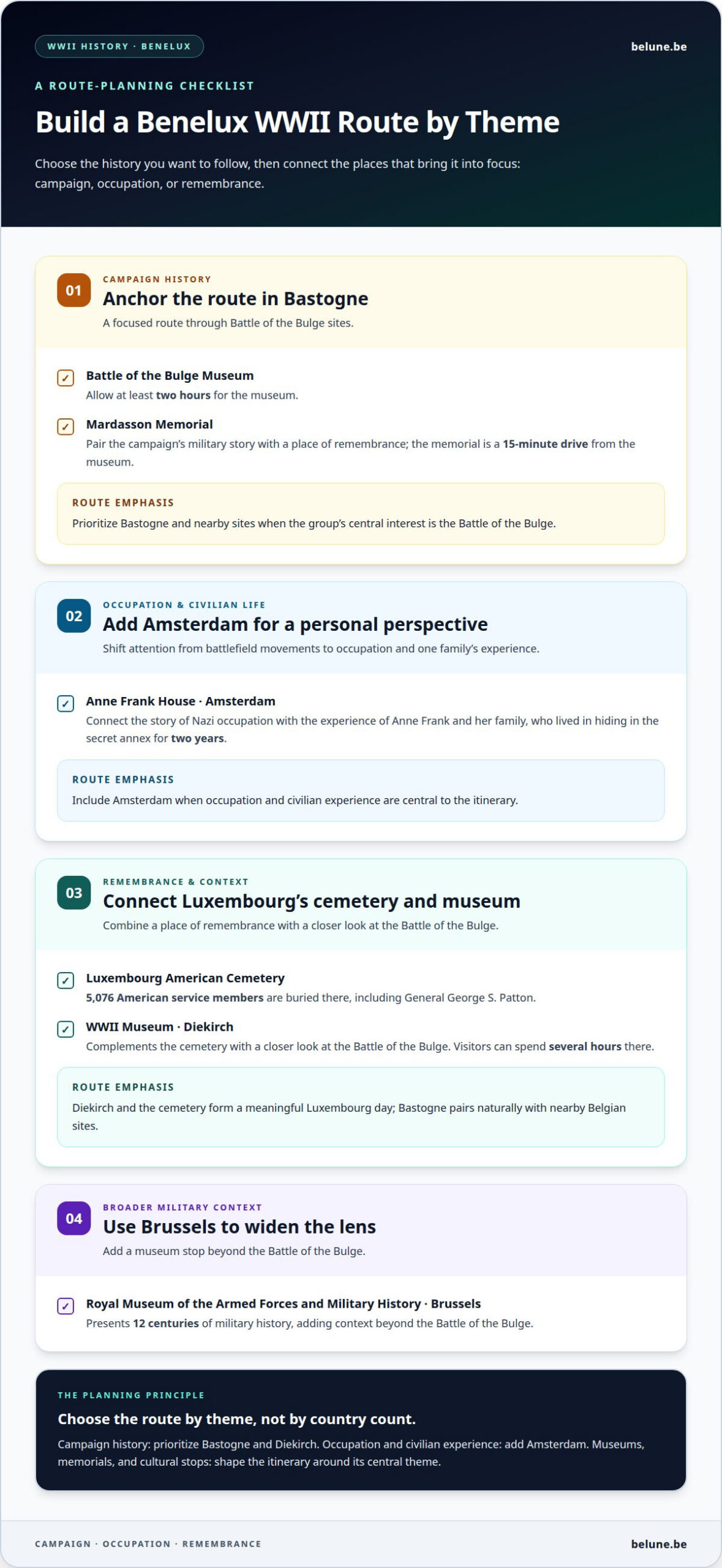
A focused Benelux itinerary can connect battlefields, museums, cemeteries, and sites of occupation. In Belgium, Bastogne works well as an anchor for Battle of the Bulge history. Allow at least two hours for the Battle of the Bulge Museum, then include the Mardasson Memorial, a 15-minute drive away. This pairing brings the campaign’s military story together with a place of remembrance, without making every stop another museum visit.
Belgium also offers a broader view of wartime life. In Brussels, the Royal Museum of the Armed Forces and Military History presents 12 centuries of military history, adding context beyond the Battle of the Bulge. For a Netherlands-focused route, Amsterdam’s Anne Frank House connects the story of Nazi occupation with the experience of one family. Anne Frank and her family lived in hiding in the secret annex for two years. That stop shifts attention from battlefield movements to persecution and civilian life.
Luxembourg adds both battlefield context and remembrance. At the Luxembourg American Cemetery, 5,076 American service members are buried, including General George S. Patton. The WWII museum in Diekirch complements the cemetery with a closer look at the Battle of the Bulge; visitors can spend several hours there. Together, Diekirch and the cemetery form a meaningful Luxembourg day, while Bastogne pairs naturally with nearby Belgian sites.
Choose your route by theme rather than by country count. For campaign history, prioritize Bastogne and Diekirch. For occupation and civilian experience, add Amsterdam. For a group journey linking museums, memorials, and cultural stops, Benelux heritage travel planning can help shape the itinerary around its central theme.
Which WWII sites are included in Benelux versus Germany tours?
Choosing Benelux vs Germany for WWII history tours starts with the story your group wants to follow. Benelux routes often connect Western Front battlefields, military cemeteries, and memorials. Germany-focused itineraries commonly center on Berlin, Nuremberg, and Dachau, exploring Nazi rule, wartime politics, and persecution. The difference is not simply how many places you visit, but the historical perspective that gives those visits meaning.
In Belgium, Henri-Chapelle American Cemetery and Memorial links the Ardennes campaign with the U.S. advance into Germany. According to the American Battle Monuments Commission, it covers 57 acres and holds 7,987 American military dead, most of whom lost their lives during that advance. Near Bastogne, the Mardasson Memorial honors almost 77,000 American soldiers killed or wounded during the Battle of the Bulge. Recogne German war cemetery offers another perspective, with almost 7,000 soldiers buried there.
Other Belgian sites broaden a battlefield itinerary. Wereth commemorates 11 American Black soldiers captured and murdered there. Bastogne Peace Wood contains more than 4,000 memorial trees honoring American soldiers and units who fought in the campaign. These locations let a route move from military events toward individual loss and collective remembrance.
Germany’s sites form a different historical sequence. Berlin frames the regime’s capital, Nuremberg connects Nazi rallies with the postwar trials, and Dachau focuses on the concentration camp and its prisoners. When choosing Benelux vs Germany for WWII history tours, consider whether your group wants to explore battlefield terrain or sites examining dictatorship and persecution.
A combined route can connect both perspectives through the story of the U.S. advance into Germany. Begin with Belgian cemeteries and memorials to establish the campaign context, then continue to German sites that deepen the account of the regime and its consequences. This creates a thematic journey rather than a checklist of locations.
English WWII tours: booking and availability
English-language WWII tours depend on the guide, itinerary, and transport plan. A group visiting Bastogne, for example, benefits from explanations that connect the battlefield, memorials, and museum into one account. In Berlin, Nuremberg, or Dachau, the schedule also needs to leave time for visits and interpretation. Tour language is therefore a planning decision, not just a label.
The coordination required depends on the route. A single-city visit to Berlin involves different logistics from a multi-country journey linking Belgium, Luxembourg, and Germany. Additional stops mean more transport legs, hotel nights, and guide arrangements to coordinate. For remote Ardennes sites, plan transport alongside museum visits. For groups travelling internationally, flight and train bookings also shape arrival and departure plans.
Start with the route, then settle the practical details in sequence:
- Choose the focus: set priorities such as Bastogne’s battlefields, Berlin’s wartime history, or Dachau’s memorial site.
- Set the language plan: align guide-led visits and the group’s preferred language across each destination.
- Map the connections: account for travel between cities and sites. Berlin to Nuremberg takes 2 ¾ hours by high-speed train.
- Coordinate the stay: match accommodation and arrival times to the route, especially when crossing borders.
Ready to shape an English-language group itinerary around your chosen WWII sites? Plan your WWII group journey with the route, travel connections, and accommodation considered together.
BELUNE
BELUNE helps tour operators and travel agents turn a choice of WWII sites into a coherent group itinerary. Whether your focus is the Battle of the Bulge in Belgium or memorials and museums in Germany, the route can be tailored to your group’s historical interests and travel plans.
For journeys across the Benelux region, BELUNE coordinates hotel accommodation management, coach hire with its own fleet of buses, and local guide services. Art and culture group tours can add context to a wider itinerary. The goal is a cohesive plan that connects the places your group wants to visit with the transport, accommodation, and guidance needed for the journey.
Contact BELUNE to discuss your WWII group tour and the sites you want to include.
Shape the journey around the story you want to follow
Choosing Benelux versus Germany for WWII history tours is ultimately a decision about perspective. Before setting dates, decide what you want your group to take away: a deeper understanding of a particular campaign, a thoughtful visit to sites of remembrance, or a route connecting several dimensions of wartime history. That focus can guide the pace, the stops, and time for reflection.
For a group itinerary, the next step is to turn that focus into a practical plan. BELUNE can coordinate the route and travel arrangements so the experience serves the story rather than feeling like a checklist of locations.
Contact BELUNE to plan your tour and begin shaping a meaningful journey for your group.
Frequently Asked Questions
What are the best WWII history tours in Germany?
Germany tours work best when their stops follow a clear historical thread. A Berlin and Nuremberg itinerary can examine Nazi rule and political spectacle, while adding Dachau shifts attention to persecution and imprisonment. For a group, decide whether the priority is political history, memorial visits, or both, then shape the route around that focus rather than rushing between places.
How do Benelux and Germany WWII tours compare in historical focus and visitor experience?
Benelux routes often take visitors through battlefields, cemeteries, and memorial landscapes; Germany routes connect urban sites with the history of Nazi rule and persecution. That difference shapes the experience: in the Ardennes, the terrain plays a central role, while Berlin or Dachau invites closer attention to political history and remembrance. Choose according to the questions your group wants to explore.
How many days are needed for a WWII history tour of Benelux or Germany?
The time needed depends on how many destinations your route connects and how deeply you want to explore each one. A focused visit to one city cluster involves less travel between sites than a cross-border itinerary linking Belgium, Luxembourg, and Germany. Schedule priority visits first, then allow for travel and reflection instead of treating every stop as a brief arrival.
What are the best WWII museums, battlefields, and memorials in Germany?
Berlin, Nuremberg, and Dachau make a strong starting set because each represents a distinct dimension of WWII history. Use Berlin to frame the regime’s capital, Nuremberg to examine Nazi rallies and postwar trials, and Dachau to explore the history of a concentration camp. A balanced itinerary pairs interpretive sites with time for quiet reflection, especially at memorials.
Which destination is better for a first-time WWII history tour, Benelux or Germany?
Neither destination is universally better for a first visit; the right choice depends on your main interest. Choose Benelux if battlefield landscapes and campaign memorials are your priority. Choose Germany to explore Nazi governance, political history, and concentration camp remembrance. If your group has varied interests, select one central theme and build the itinerary around it rather than trying to cover every aspect of the war.