A memorable Benelux tour proposition isn’t a list of destinations; it’s a clear reason a particular traveller should choose your experience. Creating a unique selling proposition for Benelux tours means identifying a defined audience, the benefit they value most, and a strength competitors can’t easily reproduce. The clearest proposition puts that answer first.
You may know what makes a tour distinctive, but customers’ priorities may differ from what an operator assumes they value. This guide shows how to research your audience, understand its needs and motivations, and shape a concise proposition around meaningful benefits. It also explains how to distinguish lasting advantages from features that are easy to imitate, so your message sells a compelling experience rather than competing on price alone.
Key Takeaways
- Define the audience whose needs your Benelux tour is designed to meet, rather than trying to appeal to everyone.
- Use interviews, surveys, and customer records to uncover what travellers value and what motivates their choices.
- Separate durable advantages, such as distinctive expertise or a carefully designed experience, from features competitors can easily copy.
- Shape your findings into a concise proposition that makes the customer benefit and your difference immediately clear.
1. How to determine your Unique Value Proposition?
Start with a specific traveller, not a catalogue of Benelux destinations. A strong value proposition connects a defined audience’s needs with a clear benefit and a credible distinction. Identify what your business does distinctively, then show how that shapes the trip. For example, a food-focused itinerary can promise close encounters with local gastronomy, not simply list restaurants. Values such as cultural curiosity or thoughtful pacing should be evident in the experience, not just stated in a slogan.
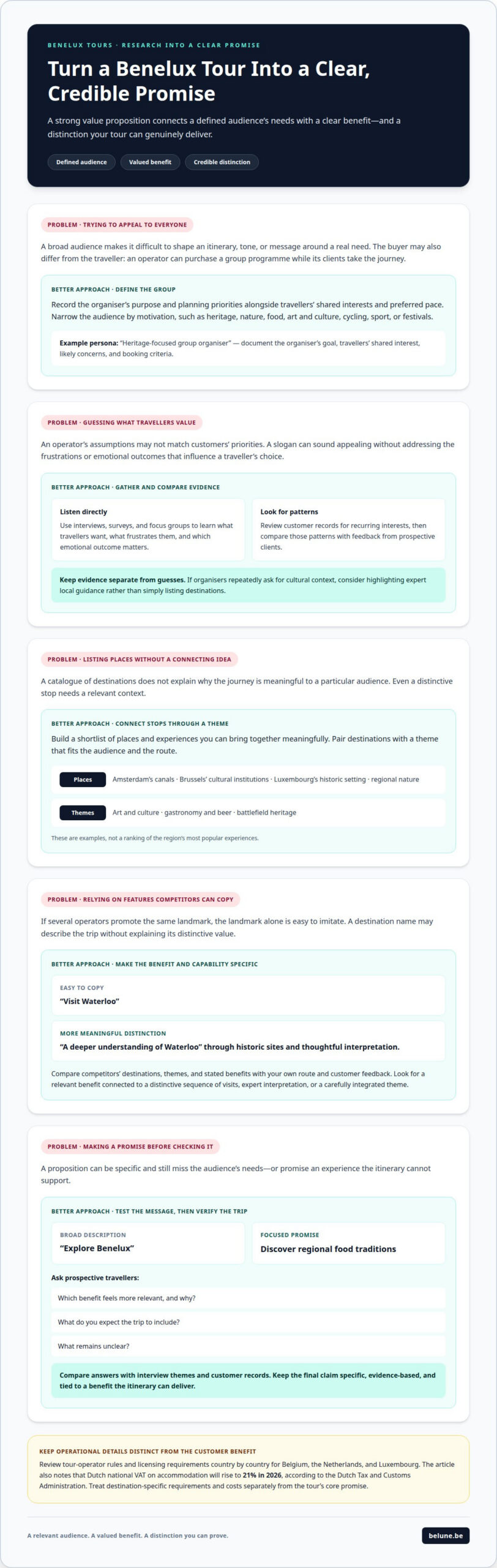
Research your audience before settling on that promise. Use interviews, surveys, and focus groups to learn what travellers want, which frustrations influence their choices, and what emotional outcome matters to them. Review customer records for recurring interests, then compare those patterns with feedback from prospective clients. Segment groups by motivation, such as heritage, nature, or food, rather than assuming one message will appeal to everyone. This gives you a clearer picture of whom the tour serves and why.
Tour operator rules and licensing requirements should be reviewed country by country, because the relevant obligations depend on the business activity and trip structure. Map requirements for Belgium, the Netherlands, and Luxembourg separately before making operational promises. For accommodation costs in the Netherlands, Dutch national VAT on accommodation will rise to 21% in 2026, according to the Dutch Tax and Customs Administration. Keep such destination-specific factors distinct from the tour’s core customer benefit.
Build a shortlist of destinations and experiences you can bring together meaningfully. Consider Amsterdam’s canals, Brussels’ cultural institutions, Luxembourg’s historic setting, or regional nature. Pair places with a clear theme, such as art and culture, gastronomy and beer, or battlefield heritage. These are examples, not a ranking of the region’s most popular experiences. A distinctive route earns its value through the perspective it offers, the audience it serves, and the details that connect each stop.
Validate a proposed USP through audience research and simple message tests. Present two concise descriptions to prospective travellers and ask which benefit feels relevant and why. Compare their answers with interview themes and customer records. A disciplined approach to creating a unique selling proposition for Benelux tours avoids common pitfalls: targeting everyone, repeating destination features competitors can copy, or making promises the itinerary cannot support. Keep the final claim specific, evidence-based, and tied to a benefit travellers can recognize.
2. Defining and researching a target market
A useful target market is specific enough to guide the itinerary, tone, and message. Start by distinguishing the buyer from the traveller: a tour operator may purchase a group programme, while its clients experience the journey. Record each group’s travel purpose, preferred pace, interests, and planning priorities. Then identify which needs your tour can meet especially well. A cultural group may value interpretation and heritage; an event-focused group may prioritize access and smooth coordination.
No single customer segment defines tours across Belgium, the Netherlands, and Luxembourg. Practical segments include art and culture travellers, gastronomy enthusiasts, cycling groups, and visitors drawn to sport or festivals. These are interest-based ways to organise an audience, not a ranking of popularity. Narrow your target by asking which motivation best fits the route, the season, and the experience you can credibly provide.
Build a persona from patterns, not assumptions. Give it a working label, such as “heritage-focused group organiser,” then document the organiser’s goal, the travellers’ shared interest, likely concerns, and booking criteria. Review customer records for recurring themes, and research what prospective clients value in comparable travel experiences. Keep evidence separate from guesses. If organisers repeatedly ask for cultural context, for example, consider highlighting expert local guidance rather than simply listing destinations.
Refine the audience by testing whether one clear message speaks to a real need. Compare a broad line such as “Explore Benelux” with a focused promise about discovering regional food traditions. Ask prospective organisers which feels more relevant, what they expect the trip to include, and what remains unclear. Use their language to sharpen the message, then check whether the itinerary can deliver the promised benefit. A disciplined group tour approach can help translate a defined audience’s interests into a coherent experience, without trying to attract every traveller with the same proposition.
3. Focusing on benefits competitors cannot easily imitate
An effective tour company USP makes a relevant promise and explains why the operator can deliver it. It names a benefit the ideal customer values and connects it to a distinctive capability. “A deeper understanding of Waterloo” is more meaningful than simply naming a destination, especially when the experience links historic sites with thoughtful interpretation. Specificity gives the offering shape; evidence makes the claim credible.
Compare direct competitors by examining the experience, not just the itinerary. Note the destinations they feature, the themes they emphasize, and the benefits they describe. Then compare those details with your own route and customer feedback. If several operators promote the same landmark, the landmark alone is easy to copy. A distinctive sequence of visits, expert interpretation, or a carefully integrated theme may create greater value for travellers.
A SWOT analysis can reveal where your distinction might emerge. Record competitors’ strengths, such as strong destination recognition, and weaknesses, such as a broad message that lacks focus. Consider opportunities in changing travel trends, including demand for more immersive historical context. Identify threats such as familiar attractions becoming interchangeable. Use these observations to improve your own offering, not to make unsupported claims about another operator.
Next, separate visible features from benefits that are harder to reproduce. A tour’s route can be copied; regional knowledge, local relationships, and a distinctive way of interpreting a place take longer to build. For a Waterloo-focused experience, the benefit might be understanding how the landscape and historical accounts illuminate the same event. Describe what the ideal customer gains, then identify the expertise or design choices that make that result credible.
Finally, test the differentiator with three questions: Does it matter to the target customer? Can your team deliver it consistently? Would a competitor need more than a quick itinerary change to imitate it? If not, refine the benefit or strengthen the capability behind it. This discipline keeps the proposition rooted in real strengths and helps the operator stand apart without relying on price or broad claims about quality.
4. Defining a unique selling proposition
Turn your research into a statement that connects a specific traveller, a meaningful benefit, and a credible distinction. Define what clients gain, not simply the places included. For example: “Discover Belgium’s artistic heritage through carefully curated visits and expert local interpretation.” This names an audience interest, an outcome, and a delivery approach. Each part should reflect the actual itinerary and the values guiding its design.
Keep the proposition concise. A travel agency’s USP can fit within one to four sentences, giving enough room to express the promise without burying it in detail. Begin with the ideal customer’s need, state the experience that meets it, then identify the supporting strength. Replace broad claims such as “exceptional tours” with tangible language about cultural insight, thoughtful pacing, or a distinctive theme. Readers should understand the benefit on the first read.
Choose three to five values that shape the promise, such as curiosity, craftsmanship, or personal attention. Connect each value to a visible choice: curiosity might come through locally informed interpretation, while craftsmanship could shape the sequence of visits. This makes values more than decorative words. It also gives staff a shared reference when communicating with organisers, preparing proposals, or describing the tour to prospective clients.
Test the wording against the experience. Does the itinerary support every claim? Does the benefit matter to the intended audience? Is the distinction clear without explanation? Remove language that could describe any operator. Once refined, use the proposition consistently across marketing messages, sales conversations, and customer proposals. Repetition helps people remember the promise; consistent delivery gives it substance.
For a Benelux group concept, connect the audience benefit to a carefully designed cultural or thematic experience. Develop a distinctive group-tour proposition grounded in a clear customer outcome and a coherent itinerary.
BELUNE
BELUNE helps tour operators translate a distinctive idea into a coherent group journey across the Benelux. When a proposition depends on more than a theme, the itinerary, movement between stops, accommodation, and interpretation should reinforce the same promise. Hotel Accommodation Management, coach hire with its own fleet of buses, Local Guide Services, and Art & Culture Group Tours can support that joined-up experience. The result is a practical foundation for communicating what makes a tour meaningful to its intended audience, while keeping the journey aligned with its central idea. For professional partners ready to shape a group concept around a clear customer benefit, contact BELUNE.
Put your proposition into motion
A proposition becomes valuable when it guides real decisions. Let it shape how you describe a tour, which details you prioritize in a proposal, and the experience you design for your audience. When creating a unique selling proposition for Benelux tours, treat the wording as a working tool, not a tagline set in stone. Customer conversations and organisers’ questions can reveal where your message is clear and where it needs greater precision.
Choose one upcoming tour concept and apply the proposition to its description. Does the central benefit come through quickly? Do the itinerary and delivery support the promise? Use those answers to refine the concept before carrying the message into future proposals and marketing. A considered discussion can help connect your audience, experience, and operational choices into a coherent direction. Discuss your tour concept with BELUNE and take the next step toward a proposition with a distinct point of view.
Frequently Asked Questions
How to determine your Unique Value Proposition?
Draft a sentence that completes this thought: “For this kind of group, our tour makes it easier to…” Then test each phrase against the actual experience. A cultural itinerary, for example, might help an organiser create a cohesive programme around shared artistic interests. Remove claims that describe only the destination, and keep the customer outcome your route and delivery genuinely support.
The Value Proposition: Why would anyone buy your tour?
People choose a tour when its experience meets a need they cannot meet as easily on their own. A group organiser may value one coordinated programme that brings a shared interest to life, rather than separate visits without a connecting idea. Make that benefit tangible in your description: show what participants will explore, how the theme holds the journey together, and why it suits their group.
What Is a USP?
A unique selling proposition, or USP, is a concise statement of the distinctive benefit a business offers a specific audience. Unlike a general value proposition, it emphasizes why the experience stands apart. For a tour operator, the USP should connect the traveller’s reason for choosing the trip with a strength the itinerary can demonstrate, rather than relying on an unsupported claim of being the best.
How do Benelux tour operators differentiate their itineraries, guides, and services?
A tour can give a familiar destination a distinct point of view through its theme, interpretation, and the way practical elements fit together. For example, an art-focused group tour could connect visits through a clear creative narrative, supported by Local Guide Services. Hotel Accommodation Management and coach hire with an own fleet of buses can also contribute to a coordinated group experience when those elements serve the itinerary’s purpose.
What local culture, language, and seasonal factors should shape a Benelux tour USP?
Build the promise around the group’s cultural interests and language needs, then reflect them in the itinerary. A programme focused on local heritage needs context that helps visitors understand the places they encounter. Seasonal timing can also shape the experience: outdoor cycling and indoor cultural visits create different expectations. Describe the tour in terms that match its actual setting, schedule, and audience.