Tag: crisis communication

  • Managing tour group emergencies from afar with clear response plans

    Managing tour group emergencies from afar with clear response plans

    Tour companies handle on-tour issues by giving local staff a clear response plan, keeping the central team informed, and sharing practical updates with travelers. Managing tour group emergencies from afar works best when responsibilities are clear and decisions reflect local conditions, language, and cultural expectations.

    Travelers reasonably expect a tour operator to stay involved when plans are disrupted, even when its team is not on the ground. Calm, consistent communication helps people understand what is happening and what to do next, while local knowledge makes instructions more useful and respectful.

    This article explains how tour companies prepare for incidents, notify travelers, and coordinate support remotely. It also covers how response plans account for cultural differences and safe travel practices, including how to use flight information when travel was booked through the tour company.

    Key Takeaways

    • Clear roles, contact pathways, and traveler-accounting procedures help a remote team coordinate with local staff during an incident.
    • Useful updates tell travelers what is happening, where to get help, and what to do next, while reflecting local conditions and language.
    • When flights were booked through a tour company, flight details can inform disruption planning and coordination alongside local response arrangements.
    • Cultural awareness and practical safety planning help make emergency instructions easier to understand and follow across different destinations.

    Emergency preparedness resources and notifications

    Preparedness connects a written response plan with local alerts, traveler counts, and clear updates. For international groups, instructions should reflect the destination’s emergency resources and communication channels.

    Emergency Action Plans

    An emergency action plan sets out how people should respond, evacuate, and account for those affected. It matters because local staff need clear roles and ready access to information before an incident interrupts the itinerary.

    For covered US general-industry workplaces, 29 CFR 1910.38 identifies the emergency action plan standard. Tour operations can apply the planning principle by defining who contacts responders, who communicates with travelers, and how staff confirm each person’s status after an evacuation.

    When responders arrive, share the incident location, conditions, and the status of the people involved. A prepared group lead can relay those details through a designated contact, while remote operations staff maintain a current traveler roster. The plan should explain how the two roles share updates if the group separates.

    Preparedness Education and Incident Updates

    Preparedness briefings give travelers useful information before an incident; notification procedures keep updates consistent during one. For international groups, identify the local alert channel and explain how to recognize an official instruction.

    How should a tour operator account for travelers and share updates during an incident? Assign a local lead to account for the group after an evacuation, then send verified instructions through the agreed channel. Each update should state the location, the action to take, and where the next update will appear.

    Public resources can support preparation. Los Angeles County emergency alerts include the Integrated Public Alert and Warning System and Alert LA County. Its Emergency Survival Guide is available in 15 languages, offering a useful example of multilingual preparedness education.

    During large-scale emergencies, Los Angeles County OEM supports public information through trained Public Information Officers, Joint Information System activities, and Joint Information Centers. The practical lesson for tour groups is to align traveler messages with local public information and avoid sharing unverified reports.

    Before departure, explain the meeting point, the group’s contact method, and what to do if someone gets separated. A short briefing and a clear written reference make emergency instructions easier to recall under pressure.

    If you booked my flights, how can you help me in an emergency?

    Flight details can help an operator understand travelers’ locations and identify planned connections that may be affected. The response still starts with immediate safety and instructions from local authorities.

    Risk Management and Emergency Response

    Risk management identifies developing hazards and links them to response decisions. This matters because a storm warning, a closed route, and an evacuation order each call for a different action.

    Build local conditions into the plan, including official alerts, transport access, and safe accommodation. Where active, a Community Emergency Response Team can be a local coordination resource. In Los Angeles County, emergency exercises follow the Homeland Security Exercise and Evaluation Program, helping responders practise coordination before an incident.

    Unsafe Destinations and Evacuations

    When a destination becomes unsafe, assess the immediate risk, official instructions, and routes to safer locations. Continuing the itinerary could expose travelers to a developing hazard.

    During a storm or flash flood, follow local evacuation instructions and avoid routes authorities identify as unsafe. If the operator booked the flights, the itinerary can help identify disrupted connections and share relevant travel information. It does not replace local emergency instructions or determine an airline’s decisions.

    Tour Leader First Actions

    A tour leader’s first actions are to move travelers away from immediate danger, contact local emergency services, and follow their instructions. Physical safety comes before itinerary decisions.

    Next, account for the group, identify anyone who needs assistance, and send the operator concise facts: location, conditions, and traveler status. During rapidly developing weather, such as flash flooding, do not direct the group onto a route without checking local instructions. Los Angeles County coordinates standardized responder training with California’s Governor’s Office of Emergency Services and FEMA.

    Operator Duties During Overseas Emergencies

    Tour operators’ legal duties overseas depend on the destination’s laws, the booking contract, and the operator’s role in arranging the trip. These factors shape what assistance and communication may be required.

    In practice, the operator should assess verified information, maintain contact with the tour leader, and explain relevant changes to travelers. A clear record of decisions helps keep responses consistent. For group itineraries, coordinated travel planning can connect flight details with the wider trip arrangements.

    Managing tour group emergencies from afar with clear response plans

    Emergency operations center readiness and activation

    An Emergency Operations Center coordinates information and decisions during serious incidents. Its role matters when weather or transport disruptions affect several tour activities or agencies.

    Contacting Operations and Safety Teams

    A contact protocol routes reports from the tour leader to operations and safety teams. This matters because urgent decisions may affect transport, accommodation, and traveler updates.

    Set a primary channel, such as a staffed phone line, and a backup text or email route. Assign someone to log key decisions and pass verified updates to relevant agencies. Costs for 24/7 travel emergency assistance services depend on coverage hours, destinations, staffing, and support scope; providers price these elements according to the service requested.

    Emergency Communications and Contact Information

    Emergency communications need a reliable contact method and information that travelers and staff can use. Before departure, collect each traveler’s preferred contact details, the tour leader’s number, accommodation details, and destination-specific emergency contacts.

    What are the best communication tools for managing tour group emergencies from afar? Use a primary voice channel for urgent instructions and a backup written channel for concise updates. Make local emergency contact details available offline, particularly if connectivity is disrupted.

    Local Services and Traveler Emergencies

    Contact local emergency services through the destination’s established emergency channel. Before travel, identify that channel with local partners and record the relevant details for the tour leader.

    If a traveler is missing, give local responders their name, last known location, and the time they were last seen. If someone is hospitalized, record the facility and designate a group contact. During an evacuation, follow local instructions and report the group’s status to operations. Sonoma County’s Department of Emergency Management is the primary coordination point for emergencies affecting multiple jurisdictions and unincorporated areas.

    Weather-Related Operating Conditions

    Weather can change whether a route, excursion, or transfer is safe. Use official local alerts to reassess activities, communicate cancellations or changes, and keep the group together while decisions are made.

    For a regional incident, an Emergency Operations Center can coordinate information across agencies. Los Angeles County Office of Emergency Management staffs its Watch Center Duty Officer program to provide coverage 24 hours a day, 7 days a week, 365 days a year. That public coordination resource illustrates why tour teams should know local escalation channels before severe weather develops.

    Cultural considerations and safe travel practices

    Time zones, language barriers, and local conditions affect how quickly remote teams can understand a situation and provide useful guidance. A tour leader on the ground can interpret local instructions; the remote team can coordinate decisions and keep messages consistent.

    Use plain, direct language during incidents. Replace idioms with specific actions, such as “remain inside the hotel lobby” or “meet beside the main entrance.” If travelers speak different languages, provide the same essential instruction in a format they understand, then ask the local leader to confirm it was received.

    Cultural expectations can shape how travelers ask for help, respond to authority, or discuss sensitive events. In the group briefing, identify someone travelers can approach privately and explain how to report a concern without sharing personal details in front of others.

    Managing tour group emergencies from afar means treating local conditions as part of the response, not just background. A road closure, local holiday, or public gathering can affect access and timing. The tour leader should use local guidance to adapt meeting points and explain changes with clear landmarks.

    During a disaster or sudden disruption, focus safety instructions on immediate actions rather than assumptions about local customs. Explain, for example, whether travelers should stay with the group or move to a designated safe location. Avoid word-for-word translations if they could make the message unclear or disrespectful.

    A useful travel briefing covers local communication norms, how to reach the tour leader, and what to do if separated. Local guide services can also help interpret cultural context during planned activities. To shape a group itinerary around local context and meaningful cultural experiences, plan a culturally informed group tour.

    BELUNE: Hotel Accommodation Management

    BELUNE helps tour operators shape group itineraries through Hotel Accommodation Management, Coach Hire with its own fleet of buses, and Local Guide Services. Coordinating these elements can support the practical structure of a trip, including where the group stays and how it travels between activities.

    For Art & Culture Group Tours, local guidance adds destination context while keeping the itinerary grounded in the places travelers visit. Consider BELUNE when planning a group trip across the Benelux region or Paris that requires accommodation and other group logistics as part of the itinerary.

    To discuss a group travel plan, visit belune.be.

    Build a more considered journey

    Preparedness belongs in the experience you design, not in a separate document you revisit only when plans change. For your next group itinerary, consider from the outset how local context, traveler communication, and practical logistics fit together. This makes managing tour group emergencies from afar a deliberate part of tour planning, while leaving local response decisions to the people best placed to act on the ground.

    BELUNE supports group travel planning through accommodation management, coach hire, and local guide services. These services help tour operators build itineraries around clear logistics and destination knowledge.

    Explore how BELUNE can support your group’s travel plans. Contact BELUNE for travel support, and take the next step toward a thoughtfully coordinated journey.

    Frequently Asked Questions

    How do tour companies manage on-tour issues?

    Tour companies handle on-tour issues by matching each problem to an appropriate decision-maker and local partner. For a missed connection, operations can assess itinerary changes; for a venue closure, a local guide can help adapt the day’s plans. The tour leader remains the group’s on-site contact, while the operator records decisions and explains how changes affect upcoming activities.

    What happens if I have a medical emergency on tour?

    For an urgent medical emergency, seek local emergency care first, then alert the tour leader. Share the location and essential details so the operator can help coordinate practical arrangements, such as updating the group or travel plans. If you have travel insurance, contact its assistance service for guidance on medical support covered by your policy. Share personal health information only with people who need it to help.

    What happens if a destination becomes unsafe before or during my trip?

    If a destination becomes unsafe, the operator assesses current official information and its effect on the itinerary. Before departure, this may mean changing the route or postponing affected activities. During a trip, the operator and local team consider safe alternatives and explain the practical impact on accommodation and transport. Follow local authority instructions, not unverified reports or social media posts.

    How can tour operators coordinate emergency response remotely?

    Remote coordination works best when the operator keeps a time-stamped incident record showing the decision made, who made it, and what remains unresolved. This helps staff taking over a shift understand the situation without piecing together scattered messages. Assigning one person to approve itinerary changes can also reduce conflicting directions when several suppliers or local agencies are involved.

    What travel insurance and medical assistance services support remote emergency coordination?

    Travel insurance may provide access to a medical assistance team, help locating care, or support with medical transport, depending on the policy. Before departure, save the insurer’s assistance number and policy details separately from your phone. During an incident, the tour operator can coordinate trip logistics, while the insurer explains the services and claims covered by the traveler’s policy. These roles complement each other but are not interchangeable.

    What emergency plans and checklists should tour groups prepare before a trip?

    Prepare a compact travel file with the itinerary, accommodation details, tour leader contacts, insurer information, and destination emergency numbers. Include each traveler’s emergency contact and any voluntarily shared information needed for practical support, such as mobility requirements. Agree on a regrouping point and a process for reporting itinerary changes. Keep an offline copy so essential details remain accessible if mobile data fails.
  • Creating a Crisis Response Plan for International Tours

    Creating a Crisis Response Plan for International Tours

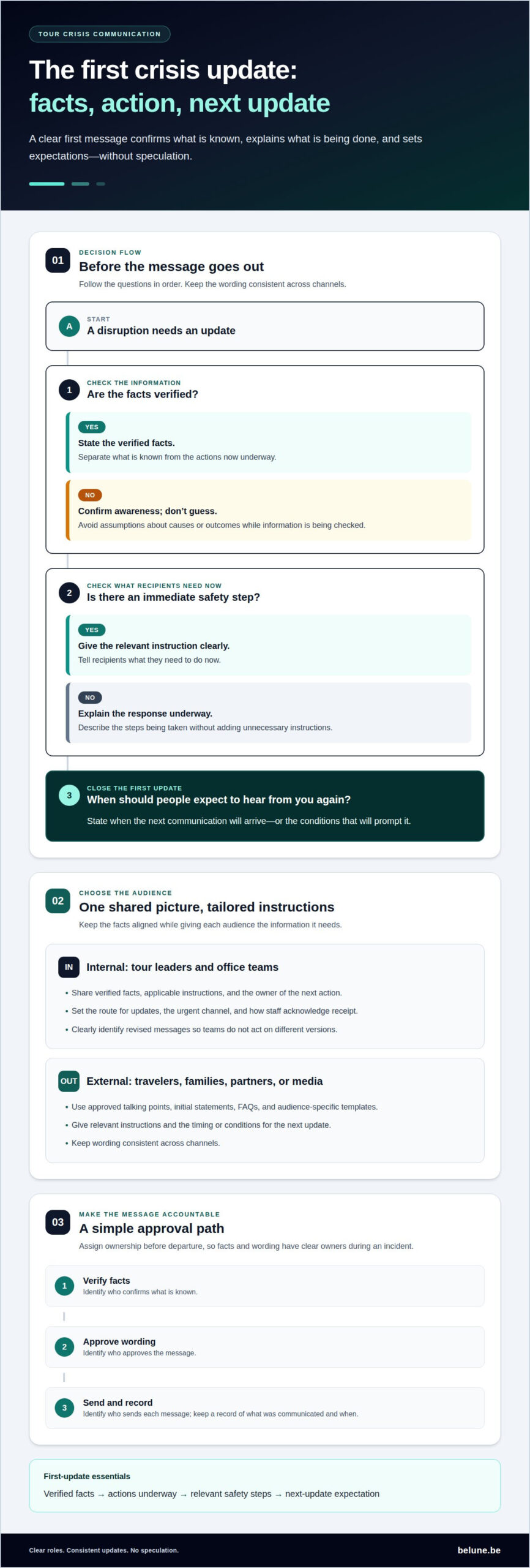
    A tour’s crisis plan must do more than preserve the itinerary: it should identify decision-makers, define when to activate the plan, and assign response tasks. When creating a crisis response plan for international tours, also prepare practical resources and an initial message that confirms what is known, explains what is being done, and sets expectations for the next update without speculation.

    It’s natural to focus on the immediate disruption, but it helps to distinguish two kinds of planning. Crisis management coordinates the response and stabilizes the situation; business continuity planning keeps critical functions running. Both perspectives help teams prepare while keeping urgent decisions separate from longer-term operations.

    This guide explains what to include in a tour crisis plan, what to communicate first, and how to review and test the plan over time. It also explains how crisis management differs from business continuity planning, so your preparation supports people during an incident and the essential work that follows.

    Key Takeaways

    • Name decision-makers, assign each response task to an owner, and define the conditions that activate the plan.
    • Prepare internal and external messages that confirm awareness, explain immediate actions, and set expectations for the next update.
    • Keep the plan current through annual reviews, updates after major changes or incidents, and scenario-based exercises.
    • Separate urgent crisis response and stabilization from business continuity planning, which focuses on keeping critical functions running.

    What Is A Crisis Management Plan?

    An international tour crisis response plan identifies decision-makers, assigns response tasks, and sets activation criteria. When creating a crisis response plan for international tours, teams should also map resources and procedures to the itinerary and host locations.

    Crisis Team Roles and Responsibilities

    Identify the decision-makers and stakeholders involved in planning and response. A crisis team may include an executive decision-maker, operations lead, HR, legal or compliance, communications or PR, IT or security, and a safety or facilities representative. Define each role’s authority and handoffs so everyone knows who makes decisions and who carries them out.

    Assign an owner to every task. A RACI chart can show who is responsible, accountable, consulted, or informed. For example, operations can coordinate tour arrangements while communications prepares updates. Department actions for the first 24-48 hours need named owners and clear handoffs.

    Crisis-Team Training

    Train team members on the roles and procedures they will use. A tabletop exercise can bring the executive decision-maker, operations lead, and communications representative together to practise a shared scenario. A walk-through can reveal unclear handoffs, missing contact details, or decisions without an assigned owner.

    Use each exercise to practise activation criteria and information flow. Participants can identify who gathers facts, who approves a message, and who coordinates operational actions. Record gaps, assign follow-up tasks, and use the next exercise to test whether revised procedures work.

    International Tour Plan Components

    A team creating a crisis response plan for international tours should consider the political, social, and economic environments of host locations. Set criteria for activating the plan and specify department actions for the first 24-48 hours. Connect each trigger to a decision-maker, so staff know who can authorize a response.

    Build a resource repository with timelines, flowcharts, checklists, stakeholder agreements, network access credentials, procedures, and pre-written statements. Include emergency resources, government agencies, consultants, experts, and nonprofit organizations that may assist. Organize the materials so staff can quickly find relevant contacts and procedures during an incident.

    What Is Crisis Communication, And What Should Organizations Say First?

    Send timely, consistent updates that confirm awareness, actions, relevant safety steps, and when to expect the next update, without speculation. Choose insurance based on the destination, activities, and travelers’ needs. Assess medical, evacuation, and interruption coverage, along with exclusions and costs.

    Internal Crisis Communications

    Internal updates should give tour leaders and office teams a shared operational picture. State what is verified, which instructions apply, and who owns the next action. A guide at a venue may need a concise instruction, while operations needs the same facts alongside clear task ownership.

    Set an internal communication route before departure. Specify who sends updates, which channel carries urgent instructions, and how staff acknowledge receipt. Clearly identify any revised message. This helps prevent teams from acting on different versions during a fast-moving disruption.

    External Crisis Communications

    External messages may be intended for travelers, families, partners, or media. Prepare approved talking points, initial response statements, FAQs, and audience-specific templates before a tour begins. A first statement should distinguish verified facts from actions underway, without making assumptions about causes or outcomes.

    Tell recipients what they need to do now, when relevant, and when to expect another update. For example, a message can confirm awareness of a disruption, describe the steps underway, and state when or under what conditions the next communication will arrive. Keep wording consistent across channels.

    Build a simple approval path into each template. Identify who verifies facts, who approves wording, and who sends each message. Keep a record of what was communicated and when, so later updates can correct or clarify details without creating confusion. For tour teams shaping a cross-border itinerary, explore international tour planning as part of the wider preparation.

    Creating a Crisis Response Plan for International Tours

    Reviewing and updating crisis plans

    Review the plan annually, after major organizational changes, and after each crisis. Scenario-specific actions, country requirements, and contact details should reflect the tour’s actual route.

    Scenario-Specific Action Plans

    Create a separate action sequence for each relevant scenario, such as transport disruption, severe weather, or a medical emergency. Identify the first decision, the responsible role, the information to gather, and the next escalation point. A scenario walk-through can reveal instructions that depend on missing details or unclear handoffs.

    Record revisions after each exercise or incident. If a transport disruption exposes uncertainty about who informs travelers, clarify the task and assign an owner. Keep the scenario checklist aligned with the current itinerary, local contacts, and communication procedures.

    Risk Assessment and Prioritization

    Assess risks by considering the route, planned activities, the host location’s political, social, and economic environment, and potential effects on travelers and operations. Prioritize scenarios according to likelihood and consequences, then connect each priority to a specific action plan. Reassess whenever an itinerary, activity, or destination changes.

    Legal requirements for tour safety and emergency planning vary by country and activity. Identify the rules that apply to each destination, document their source, and assign a legal or compliance role to review them as plans change.

    Emergency Contacts and Escalation Procedures

    For a group touring abroad, write an escalation path from the on-site lead to the designated decision-maker. Specify what information to report, who receives it, and who authorizes the next action. A scenario exercise can test whether staff can follow the route using the plan.

    Compile country-specific emergency numbers, embassy contacts, medical facilities, and other relevant support resources for each destination. Record each organization’s contact details, purpose, and location, then assign responsibility for keeping entries current. Make the list accessible to the roles expected to use it.

    Country-Specific Emergency and Support Resources

    Organize contacts by country and resource type, including emergency services, government agencies, medical resources, consultants, experts, and nonprofit organizations that may assist during a crisis. Match entries to the itinerary so staff can find relevant support without searching through information for unrelated destinations.

    Review contact details during the annual plan review and after route changes. Test the directory during tabletop exercises, which organizations commonly run 1-2 times per year. Record outdated entries and assign corrections to a named owner before the next review.

    Crisis management versus business continuity planning

    Crisis management directs the immediate response, coordinates decisions, communicates, and stabilizes a situation. Business continuity planning focuses on keeping critical functions running. For an international tour, one plan addresses the incident; the other helps preserve essential operations while the disruption continues.

    Consider a transport disruption that prevents a group from following its itinerary. Crisis management identifies who leads the response, coordinates current information, and determines immediate actions. Business continuity planning considers how essential services can continue, such as by arranging onward transport or adjusting the schedule. The difference is their purpose, not a handoff between unrelated teams.

    Build both plans around the same tour activities and operational dependencies. List critical functions, such as traveler coordination, transport, accommodation arrangements, and itinerary delivery. For each function, identify possible disruptions and operational alternatives that could keep it going. Then connect those alternatives to the crisis team’s decision process.

    Keep responsibilities distinct but connected. The crisis lead coordinates the response and sets priorities; the person responsible for continuity identifies the operational work that must continue. During a disruption, the two roles share verified information and align decisions. For example, a schedule change should account for immediate safety considerations as well as ongoing operational needs.

    Test both plans together through a scenario exercise. Start with an incident, decide who activates the crisis response, then trace how essential work continues. Note unclear decisions, conflicting instructions, or dependencies without alternatives. Update procedures so response actions and continuity measures reinforce one another rather than compete for attention.

    The practical takeaway: use crisis management to respond and stabilize, then use continuity planning to sustain critical functions. If you’re shaping a tour’s operational arrangements, plan your tour logistics with those priorities in view.

    BELUNE: Hotel Accommodation Management

    BELUNE supports tour operators and travel agents with hotel accommodation management, a practical part of organizing group itineraries. When lodging, transport, and activities need to fit together, coordinated planning can help teams map these operational elements clearly.

    Depending on the tour, BELUNE also offers coach hire with its own fleet of buses, local guide services, and art and culture group tours. These services can support a cohesive program across accommodation, travel between stops, and scheduled visits. They can be incorporated into the tour’s operating plan alongside your crisis and continuity procedures.

    To discuss group tour arrangements, contact BELUNE.

    Bring Your Tour Plans Into Focus

    Creating a crisis response plan for international tours is an opportunity to align preparation with the experience you want each group to have. Treat the plan as a working part of tour design, not a document to set aside after approval. As routes and arrangements evolve, keep operational decisions connected to travelers’ needs and each itinerary’s character.

    BELUNE works with tour operators and travel agents on group travel arrangements. Its role can complement your team’s own crisis procedures by helping shape the practical structure of a tour. For a conversation about your upcoming group itinerary, contact BELUNE to discuss your tour arrangements.

    Clear planning supports confident decisions when circumstances change. Bring your operational priorities into the conversation with BELUNE and shape a carefully planned tour experience from the outset.

    Frequently Asked Questions

    How to create a tour evacuation and medical emergency plan?

    Build a route-specific plan that links an evacuation decision to a safe destination and a named coordinator. For medical emergencies, record how staff summon local assistance, share relevant traveler information with responders, and arrange onward transport. Identify who stays with the affected traveler and who accounts for the rest of the group. Include alternate meeting points and a way to confirm everyone’s status after movement.

    How should tour operators prepare for political unrest, terrorism, natural disasters, and disease outbreaks?

    Create a separate response card for each scenario, because the first safe action may differ. For political unrest, define how staff pause movement and communicate route changes. For a natural disaster, identify shelter and regrouping steps. For suspected violence or disease, assign responsibility for gathering verified information and coordinating the next decision. Review each card against the actual itinerary and activities rather than relying on a generic emergency checklist.

    How to communicate with travelers, families, venues, and authorities during a crisis abroad?

    Designate a spokesperson and a separate communication route for each audience. Travelers need clear instructions; families need confirmed information; venues and authorities need relevant operational details. Keep messages consistent, distinguish verified facts from pending checks, and record what was sent. If a visit is paused, for example, tell travelers where to gather while the venue receives the group’s status and expected next steps.

    What are the best practices for accounting for and reuniting tour members after an emergency?

    Use a roster and one reunification point, then record each person’s status as the group regathers. Assign one staff member to check names and another to manage arrivals or departures. If travelers are separated, note their last known location and who is coordinating follow-up. Give the group one clear meeting instruction, and update it through the agreed channel if the location changes.

    How to prepare tour staff with crisis response training, drills, and emergency supplies?

    Train staff on their specific duties, not just general emergency awareness. Practise a scenario in which a group becomes separated or transport is interrupted, then review whether everyone knows whom to notify. Prepare supplies suited to the route, such as printed contact details, a charged power bank, and basic first-aid materials. Assign responsibility for checking and replacing items before departure.

    How should an international tour crisis plan be tested, documented, and updated?

    Test the plan with a scenario and observe whether staff can find the right procedure, contact, and decision-maker. Document the exercise, identified gaps, assigned corrections, and the plan version affected. Keep a change log so staff can distinguish current instructions from old copies. Revisit route details whenever itinerary changes affect transport, lodging, activities, or local support arrangements.