
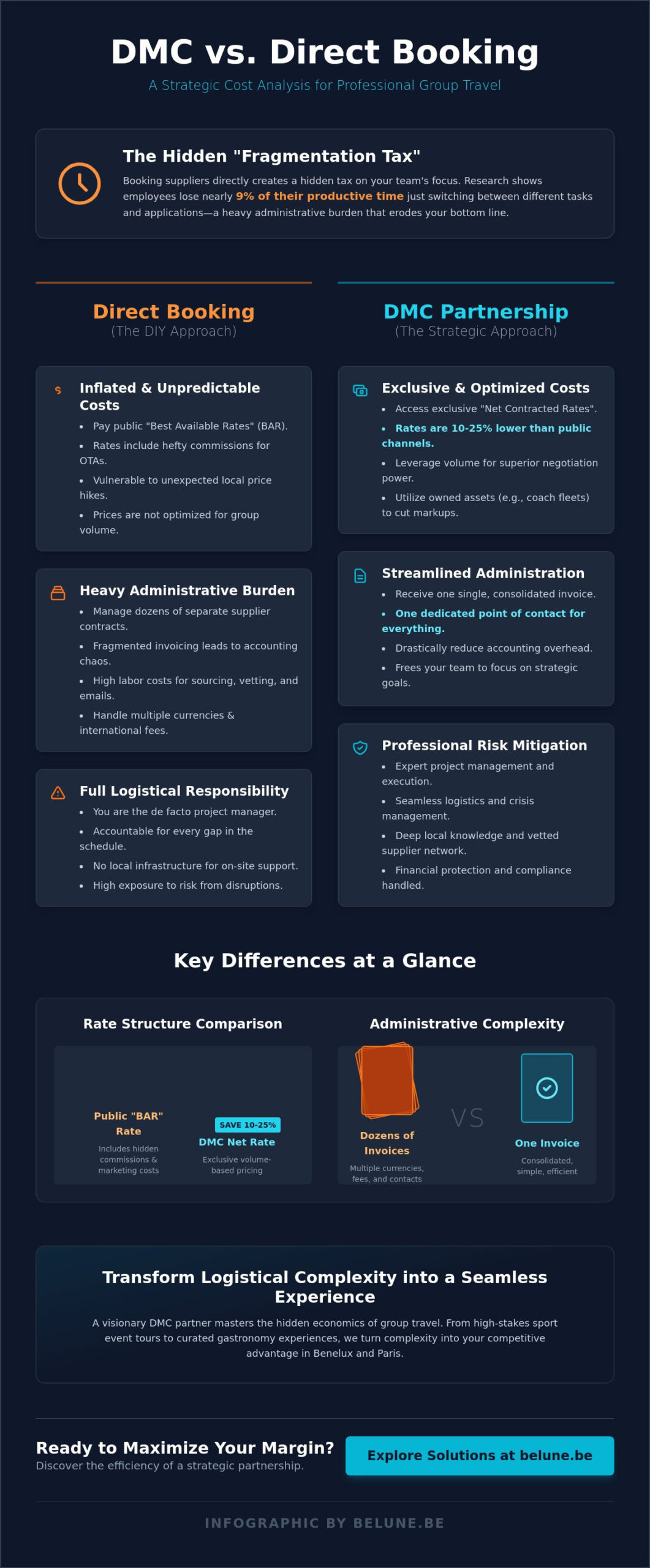
What if the apparent savings of booking suppliers directly are actually a hidden tax on your team’s focus and your company’s bottom line? While a surface-level cost analysis of dmc vs direct booking might favor the DIY approach, the logistical reality of 2026 demands a deeper look at the numbers. You’ve likely felt the exhaustion of managing fragmented invoicing across multiple suppliers or the stress of unexpected local price hikes. It’s a heavy administrative burden that often leads to what researchers call a “fragmentation tax,” where employees lose nearly 9% of their productive time just switching between different tasks and applications.
We understand that excellence in travel isn’t just about the destination; it’s about the precision of the execution. This guide explores how a strategic DMC partnership transforms logistical costs into competitive margins by leveraging owned assets like coach fleets and exclusive net rates. You’ll discover a clear framework to justify professional fees to stakeholders while reducing your administrative overhead. From high-stakes sport event tours to curated gastronomy experiences, we’ll show you how to master the hidden economics of group travel through a lens of technical expertise and creative vision.
Key Takeaways
- Identify the “fragmentation tax” inherent in multi-supplier management and how it silently erodes your team’s operational focus and productivity.
- Explore how bundled negotiation and regional volume leverage unlock exclusive net rates and superior margins often hidden from public channels.
- Master a strategic cost analysis of dmc vs direct booking to account for the real-world expenses of risk mitigation and logistical disruptions.
- Evaluate the financial efficiency of utilizing owned infrastructure, such as a private fleet of modern coaches, to eliminate unnecessary third-party markups.
- Discover how a visionary partnership in Benelux and Paris transforms logistical complexity into a seamless, high-end experience for your stakeholders.
The Illusion of Direct Savings: Defining the Cost of Fragmentation
Direct booking in a professional group travel context refers to the practice of sourcing, contracting, and managing every service provider individually. It feels like control. It looks like savings. However, when we perform a rigorous cost analysis of dmc vs direct booking, we often find that this approach introduces a “Fragmentation Tax.” This hidden cost represents the cumulative loss of efficiency when managing dozens of separate suppliers across different time zones and legal jurisdictions. While a single hotel room might appear cheaper on a public platform, the transactional nature of that purchase ignores the strategic value of a cohesive itinerary. Total profitability isn’t found in the lowest unit price; it’s found in the synthesis of the whole.
To better understand these fundamental financial trade-offs, this perspective on managerial accounting offers a helpful foundation:
The gap between a simple transaction and a strategic partnership is where margins are either won or lost. Relying on public booking engines often means paying for a supplier’s marketing and commission costs rather than the core service. In contrast, a strategic approach looks beyond the individual line item to consider the risk-adjusted cost of the entire project. When you book directly, you’re responsible for every gap in the schedule and every logistical friction point. You aren’t just the client; you’re the de facto project manager, often without the local infrastructure to succeed.
The Administrative Burden: A Labor Cost Analysis
The true price of direct coordination is often buried in labor costs. Sourcing a reliable hotel, vetting local guides, and arranging coach hire requires hundreds of hours of focused effort. According to a Harvard Business Review study, employees lose an average of 9% of their working time simply by refocusing after switching between different applications and tasks. This “context switching” is the engine of the fragmentation tax. Every new supplier adds a layer of complexity to your accounting department. You’re paying for international bank fees and the risk of managing multiple currencies. By consolidating these needs through a Destination Management Company (DMC), organizations can significantly reduce their accounting overhead. One invoice replaces fifty. One point of contact replaces a chaotic email chain.
Direct Rates vs. Net Contracted Rates
Public “Best Available Rates” (BAR) are designed for the individual traveler, not the strategic partner. These rates are rarely the lowest possible cost because they include heavy commissions for Online Travel Agencies. DMCs operate within a different ecosystem, accessing “Net Rates” that are strictly unavailable to the general public. These pricing tiers are built on long-term relationships and guaranteed volume. Leveraging the expertise of a benelux incoming tour operator ensures that you aren’t just getting a discount; you’re accessing a price structure designed for professional margins. A thorough cost analysis of dmc vs direct booking reveals that the professional management fee is frequently offset by the sheer depth of these exclusive contracted rates, which can be 10 to 25% lower than public offerings.
The Hidden Economics of DMC Partnerships
A partnership with a Destination Management Company operates on a scale that direct booking simply cannot match. It’s a purchasing consortium built on years of regional presence and trust. When we examine The Hidden Economics of DMC Partnerships, we see that volume leverage is the cornerstone of profitability. DMCs don’t just book rooms; they command entire blocks across regional hotel chains. This collective buying power allows for “Bundled Negotiation.” By integrating hotel accommodation management with our own fleet of modern coaches and curated dining, we secure discounts that are structurally impossible for a single-service direct booking.
This synergy is vital for a comprehensive cost analysis of dmc vs direct booking. Many stakeholders fear the management fee, yet this cost is frequently neutralized by the “Relationship Dividend.” Local vendors provide preferential terms, such as waived minimums or flexible attrition clauses, to partners they see every week. In many cases, the net rates secured by a DMC are 10% to 25% lower than public prices. This margin doesn’t just cover the DMC fee; it often results in a lower total project cost than a fragmented DIY approach.
Accessing Exclusive Inventory
High-demand periods like the F1 at Spa-Francorchamps or major festival tours create a scarcity that public engines can’t solve. DMCs maintain year-round allotments, ensuring your group has a place even when the city appears sold out. Having a dedicated group travel agency manage these local allotments prevents the panic of last-minute venue changes, which can cost upwards of €10,000 in a single day. It’s about securing the impossible through foresight and established infrastructure.
The Value of Local Intelligence
True cost control lies in the details that don’t appear on a website. Local intelligence identifies hidden expenses like specific city taxes, permit fees for historic centers, or coach parking surcharges before they hit your budget. We vet every gastronomy experience and beer tour personally. This rigorous quality control prevents the costly refund requests that follow a subpar meal or a logistical delay. Professional local guide services act as the guardians of your timeline, preventing itinerary drift that would otherwise trigger expensive overtime transport costs. If you’re looking to elevate your next project in the Benelux region, consider how a strategic partnership can redefine your margins.
Direct Booking vs. DMC: A Risk-Adjusted Cost Comparison
A standard 5-day group tour looks deceptively simple on a spreadsheet. Direct booking promises transparency and the elimination of middleman fees. However, a professional cost analysis of dmc vs direct booking must look beyond the initial quote to account for the “Cost of Risk.” A static budget doesn’t feel the weight of a sudden rail strike or a localized weather event. Without a regional partner, these disruptions aren’t just inconveniences; they’re financial hemorrhages. When you book direct, you’re not just buying a service; you’re assuming the full liability of every link in the logistical chain.
The hospitality industry frequently analyzes The Illusion of Direct Savings, observing that seemingly cheaper channels often carry hidden operational burdens that double the actual expense. For a tour operator, these burdens include higher liability insurance premiums and the absence of a regional safety net. Our 20 years of experience in the Benelux and Paris regions provides a fiscal security that individual contracts cannot replicate. We transform potential crises into managed transitions, protecting your margins from the volatility of foreign jurisdictions.
Quantifying the Cost of Crisis
Disruptions are expensive. Imagine the financial impact of re-booking a 40-person group at 10 PM during a peak festival season without local support. You’re at the mercy of public rack rates and immediate payment demands. A DMC’s 24/7 on-the-ground presence acts as a logistical insurance policy. We hold significant “refund leverage” over local suppliers. While an individual agent might struggle to recover costs from a cancelled venue or a delayed service, a partner managing high-volume annual contracts can negotiate credits or immediate alternatives. This leverage ensures that a single weather-related venue change, which can cost upwards of €10,000, doesn’t derail your entire project’s profitability.
The Efficiency of Curated Logistics
Precision is the silent driver of profitability. DIY itineraries often suffer from “logistical drift”—inefficient routing that leads to increased fuel surcharges and unnecessary driver hours. By utilizing our own fleet of modern coaches, we eliminate third-party markups and optimize every kilometer with technical rigor. This level of mastery is essential for sophisticated culture group tours benelux. We replace the guesswork of a DIY plan with the precision of a professional itinerary. Every gastronomy stop or battlefield visit is timed to avoid the expensive overtime costs that plague less rigorous plans. It’s an artisanal approach to logistics where every minute saved is a direct contribution to your bottom line.
The Mastery of Logistics: How Owned Assets Reduce Overhead
Direct booking often masks a series of hidden intermediaries. When you source transport through a generic portal, you aren’t just paying for the driver and the fuel. You’re paying for the broker’s commission and the portal’s service fee. Our cost analysis of dmc vs direct booking reveals that owning a fleet of modern coaches fundamentally shifts the financial equation. By eliminating third-party markups, we provide a direct line to the asset. This internal logistics management allows for more competitive per-kilometer rates and a level of quality control that outsourced services cannot match. It’s the difference between hoping for a reliable vehicle and knowing the exact maintenance history of the coach meeting your group at the airport.
Quality control is a silent contributor to your bottom line. Outsourced transport often suffers from “service drift,” where the vehicle provided doesn’t match the premium expectations of your stakeholders. By maintaining our own fleet, we reduce the risk of downtime and mechanical delays. Reliable, professionally trained drivers who understand the nuances of group dynamics are part of the core infrastructure. This artisanal approach to transport ensures that the logistical frame of your journey is as refined as the destination itself. It’s an investment in certainty that pays dividends in guest satisfaction and operational peace of mind.
The Economics of Private Coach Hire
The distinction between “dry hire” and “full-service logistics” is where many budgets fail. A simple coach rental doesn’t account for the complex permit requirements of historic European centers or the fluctuating costs of regional tolls. Our in-house fleet offers a level of agility that external suppliers simply don’t have. If a group needs a last-minute itinerary adjustment, there’s no frantic negotiation with a third-party dispatcher. We own the schedule. This structural advantage allows us to offer “fixed-price” guarantees, shielding your project from the volatility of fuel market fluctuations. It’s a level of financial predictability that direct booking through brokers can’t provide.
Integrated Management of Accommodation and Transport
True efficiency emerges when hotel accommodation and transport management exist under one roof. In a fragmented booking model, the driver’s lodging is often an afterthought that leads to unexpected surcharges. We handle “driver-room” logistics within our own framework, ensuring these costs are optimized rather than inflated. Intelligent fleet scheduling also reduces “empty leg” costs, which are the expensive kilometers driven without passengers. By coordinating arrivals and departures across multiple groups, we maximize the utility of every vehicle. This integrated approach ensures your resources are spent on the experience, not the overhead. Explore how our owned fleet of modern coaches can redefine the margins of your next group project.
Strategic Selection: Maximizing Margin with BELUNE
Choosing a partner for the upcoming season is a move from transactional logistics to transformational planning. A final cost analysis of dmc vs direct booking reveals that the most valuable asset isn’t just a discounted room; it’s the absolute certainty of execution. BELUNE stands as a visionary ally for high-end group travel across the Benelux region and Paris. Our 20-year legacy acts as a guarantee of both fiscal and operational excellence. We don’t just provide services. We craft environments where your margins are protected and your clients’ imaginations are stimulated through technical mastery and artistic vision.
The total value proposition of a strategic DMC partnership is found in the synthesis of lower risk and higher margins. By consolidating hotel accommodation management, our own fleet of modern coaches, and local guide services, we eliminate the friction that erodes profitability. You aren’t just avoiding the fragmentation tax; you’re gaining access to a level of regional leverage that direct booking simply can’t offer. It’s a shift from being a coordinator to being a creator of exceptional experiences.
Tailor-Made Itineraries as a Revenue Driver
High-margin travel products require more than just standard bookings. They require exclusivity and depth. By focusing on themed group travel, we help tour operators build “un-copyable” itineraries that command higher retail pricing. Whether it’s our deep-rooted battlefield expertise or curated gastronomy and beer tours, these artisanal details create a “peace of mind” dividend for your final client. When a product is unique and expertly executed, price sensitivity diminishes. You’re no longer competing on the lowest unit cost; you’re selling a masterpiece of coordination that competitors cannot replicate through public booking platforms.
Partnering for 2026: The Path to Seamless Execution
Our approach is built on a foundation of sophisticated minimalism. We eliminate the administrative noise of fragmented coordination to provide clear, professional partner support. The process of moving from an initial request to a fixed-price group package is designed to be fluid and transparent. This clarity allows your team to focus on sales and growth while we manage the technical rigor of the ground operation in foreign jurisdictions. We’ve spent two decades refining this balance of artistic sensitivity and logistical precision. It’s time to redefine your strategy. Request your custom Benelux cost analysis and itinerary to see how we transform logistical complexity into superior execution.
Elevating Your Logistical Strategy for 2026
The path to a profitable 2026 season lies in moving beyond the illusion of direct savings. We’ve explored how the fragmentation tax erodes focus and how a strategic partnership transforms logistical complexity into a competitive edge. A rigorous cost analysis of dmc vs direct booking proves that true value is found in the synthesis of services. By utilizing owned infrastructure and regional leverage, organizations can eliminate the hidden markups often found in middleman brokers and public platforms.
With over 20 years of specialized Benelux expertise, our team offers more than just coordination. Our private fleet of modern, eco-friendly coaches and fixed-price guarantees for complex group itineraries provide the fiscal stability your stakeholders demand. We invite you to transition from transactional sourcing to an artisanal approach where every detail is a component of a larger masterpiece. Precision in logistics is the foundation of an unforgettable experience.
Ready to secure your margins and elevate your guest experience? Partner with BELUNE for your 2026 Benelux Group Tours and discover the power of a visionary logistical ally. Let’s create something exceptional together.
Frequently Asked Questions
Is it always cheaper to book hotels directly for large groups?
No, booking directly often results in paying public marketing commissions rather than the core service costs. A professional cost analysis of dmc vs direct booking shows that hotels prioritize high-volume partners with non-public net rates. Direct bookings lack the leverage to waive minimums or secure favorable attrition clauses. This often leads to higher total expenses when group sizes fluctuate or local taxes are applied unexpectedly at checkout.
Can a DMC provide better rates than major B2B hotel portals?
Yes, DMCs frequently outperform B2B portals by accessing “offline” inventory and direct hotel allotments. Major portals operate on standardized commissions that apply to every booking. We leverage long-standing regional trust to secure pricing tiers that aren’t shared with digital aggregators. This direct line to the hotel’s management ensures priority during peak seasons and access to rooms that portals mark as sold out.
How do DMC service fees impact the final price for the traveler?
Service fees are typically absorbed by the significant discounts secured through net contracting and bundled logistics. While a management fee exists, it’s rarely a simple addition to the public price. Instead, it represents a portion of the savings generated by professional negotiation. Travelers receive a more refined, lower-risk experience for a final price that remains competitive with fragmented, unmanaged itineraries.
What are the hidden costs of managing group travel logistics in-house?
The primary hidden costs are administrative labor and the financial risk of logistical gaps. In-house teams spend hundreds of hours sourcing, vetting, and managing separate invoices. This internal overhead, combined with international bank fees and currency exposure, often exceeds the cost of a professional fee. Without local infrastructure, your team also bears the full financial weight of resolving on-the-ground disruptions like strikes or delays.
What happens to the cost if a group size changes last minute?
DMCs minimize the financial impact of last-minute changes by utilizing established “relationship dividends” with local suppliers. While direct bookings often trigger rigid cancellation penalties, we negotiate flexible attrition clauses that allow for minor adjustments without extra charges. Our role is to act as a buffer between your project and the supplier’s standard terms, ensuring that shifting group dynamics don’t derail your entire budget.
How does a DMC handle currency fluctuations in a long-term contract?
We provide fixed-price guarantees that shield your budget from the volatility of international currency markets. By contracting services in the local currency and managing the exchange risk internally, we ensure that the price you agree upon remains stable throughout the project lifecycle. This financial predictability is a cornerstone of professional logistical planning, allowing you to market your tours with absolute confidence in your final margins.
Is it worth using a DMC for a simple “coach and hotel” itinerary?
Yes, because even simple itineraries benefit from the elimination of third-party markups on transport. By utilizing our own fleet of modern coaches, we provide a direct cost advantage that brokers cannot match. You aren’t just paying for a room and a bus; you’re paying for a synthesized plan that optimizes driver hours and fuel consumption. This technical precision ensures that even basic tours maintain high standards and healthy margins.
How do DMCs secure better terms and conditions than individual bookers?
Better terms are the result of high-volume annual contracts and decades of regional presence. Suppliers offer preferential conditions to partners who provide consistent, reliable business throughout the year. These terms include extended payment windows, reduced deposit requirements, and priority status during high-demand events. Individual bookers simply lack the historical data and local trust required to unlock these strategic advantages in a cost analysis of dmc vs direct booking.