
A service-level agreement is only as strong as the remedy it sets out when service falls short. For a destination management company, an SLA defines the services, performance standards, responsibilities, and consequences agreed by both parties. The key clauses for a DMC service level agreement should make commitments clear and measurable, leaving no important expectations open to interpretation.
It’s natural to focus on what a travel programme includes, but the contract also needs to explain how the partnership works when plans, performance, or costs change. A well-structured SLA helps both parties understand what’s covered, how fees are billed, when additional charges may apply, and what happens if agreed service levels aren’t met.
This guide explains how to assess termination and renewal terms, payment and out-of-scope fees, liability limits, and service-level remedies. It also shows why each remedy should link a defined performance measure to a clear response, giving the agreement practical value throughout the relationship.
Key Takeaways
- Clarify what triggers termination, how notice is delivered, and how responsibilities transfer when the agreement ends.
- Separate included work from additional services, and make billing schedules and late-payment terms easy to interpret.
- Assess liability limits alongside excluded losses so the agreement makes clear which risks each party carries.
- Connect each service-level remedy to a measurable shortfall and a defined process for applying compensation or credits.
Termination reasons, notice periods, and contract renewal
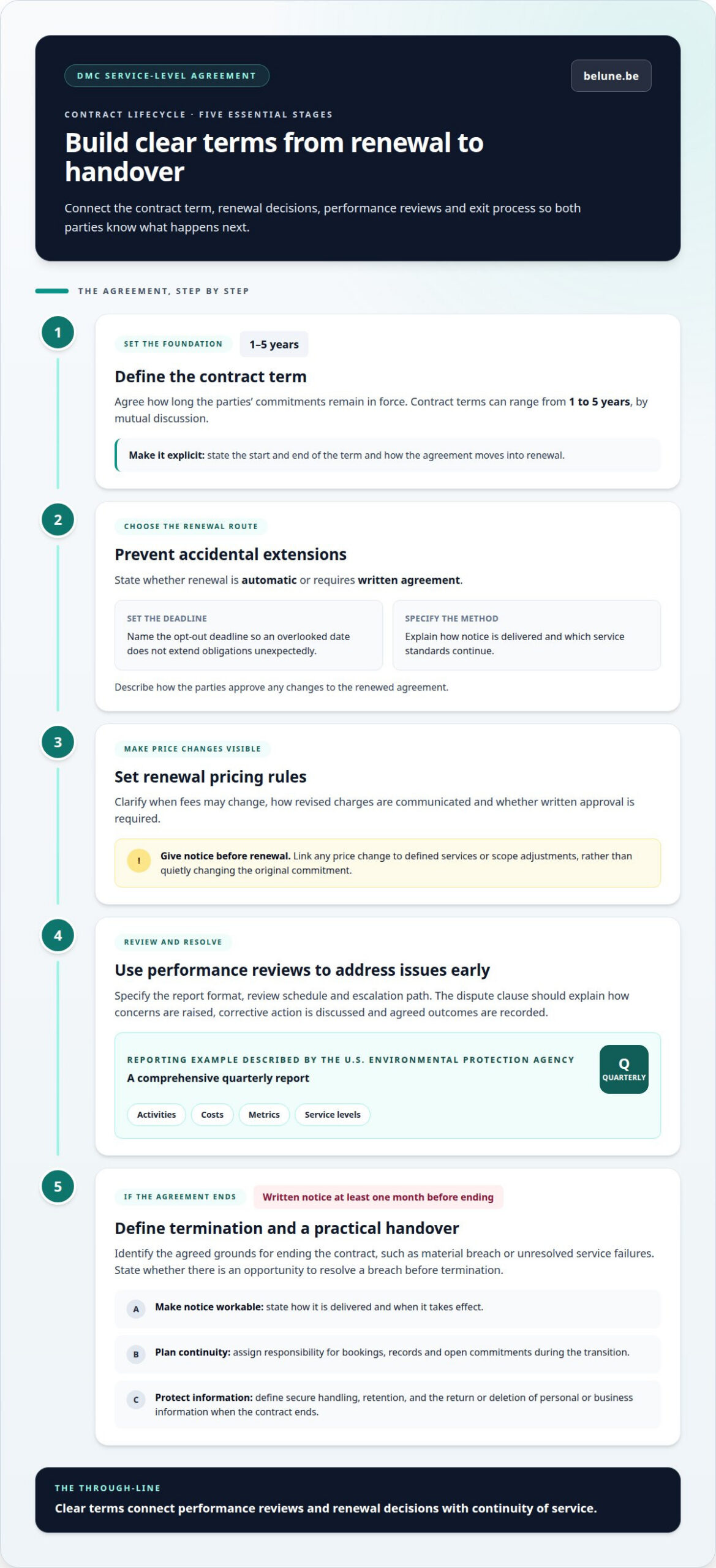
A DMC SLA should define how the relationship begins, continues, and ends. Clear terms connect performance reviews and renewal decisions with continuity of service.
Contract Term and Renewal Terms
The contract term sets how long the parties’ commitments remain in force and how renewal takes effect. Terms can range from 1 to 5 years by mutual discussion. State whether renewal is automatic or requires written agreement, then set the opt-out deadline and notice method. This prevents an overlooked date from extending obligations unexpectedly. Renewal language should also explain which service standards continue and how the parties approve changes.
Termination Reasons and Notice Periods
Termination clauses specify the events that allow either party to end the contract and the steps they must follow. Define material breach, unresolved service failures, and other agreed grounds, then state whether there is an opportunity to resolve a breach before termination. Written notice at least one month before ending an SLA gives both parties a stated planning period. Specify how notice is delivered, when it takes effect, and who handles bookings, records, and open commitments during the transition.
Renewal Pricing Changes
Renewal pricing terms explain when fees may change and how the parties approve revised charges. State whether changes apply only at renewal, how they will be communicated, and whether written approval is required. A clear notice deadline gives the other party time to assess revised terms before renewal. Link any price change to defined services or scope adjustments, so it does not quietly alter the original commitment.
Reporting and reviews should help resolve issues before termination becomes necessary. Specify the report format, review schedule, and escalation path. The U.S. Environmental Protection Agency describes a comprehensive quarterly report covering activities, costs, metrics, and service levels. The dispute clause should explain how the parties raise concerns, discuss corrective action, and record an agreed outcome.
Privacy and confidentiality terms should define what personal or business information may be shared, who may access it, and how it must be protected. Set rules for permitted use, secure handling, retention, and return or deletion when the contract ends. These details help both parties manage sensitive itinerary and traveller information throughout the relationship.
Fees, billing frequency, late payments, and out-of-scope charges
A clear fee section links payment to defined services, delivery milestones, and responsibilities. It should also explain how billing changes when the agreed scope changes.
Fees and Subscription Tiers
Fee and tier terms describe what each payment covers and which service level applies. They matter because a broad package can obscure exclusions unless each included task is named. For a DMC, the fee depends on itinerary scope, group requirements, timing, and included services, and is provided after a quote request. Rather than relying on generic subscription tiers, outline the agreed services and any separate components clearly.
For example, if local guidance is included, the contract can state the scope of the guiding service and its deliverables. Specify whether an itinerary or responsibility change requires a revised quote or written approval. This gives both parties a shared basis for understanding invoices.
Billing Cycles and Late Payments
Billing-cycle terms state when invoices are issued, when payment is due, and what happens if payment is late. Recurring arrangements may use monthly, quarterly, or annual billing cycles; the contract should identify the chosen schedule and any milestone-based invoices. State the due date, accepted payment method, and process for raising an invoice query.
Late-payment terms should explain any applicable interest or other consequence, when it begins, and how the parties resolve a disputed amount. Make these triggers explicit. A predictable process helps protect cash flow without confusing a genuine billing question with non-payment.
Out-of-Scope Charges
Out-of-scope terms define work beyond the agreed services and explain how additional charges are approved. They matter when a change affects resources, timing, or delivery. Name examples, such as an itinerary revision that adds services beyond the original scope, and state that both parties must document the change before proceeding.
Both parties have responsibilities: the DMC delivers the listed services and reports against agreed metrics, while the client supplies necessary details and approvals. Uptime is relevant only if a digital service is part of the agreement; otherwise, measure the contracted deliverables. For group programmes involving local guidance, Local Guide Services can be included as a clearly scoped service.
Liability caps, exclusions, and covered losses
A DMC SLA should define liability limits, excluded losses, force majeure procedures, safety responsibilities, and insurance requirements. These terms clarify how both parties manage disruption and protect programme delivery.
Liability Caps and Exclusions
A liability cap sets the maximum financial exposure for specified claims, while exclusions identify losses outside that limit. Both matter because a low cap can leave a client carrying risks the contract appears to address.
Describe which claims the cap covers and how its amount is calculated. For example, a contract might link the cap to fees paid during a defined period. Keep service guarantees, billing duties, and liability limits distinct so one clause doesn’t unintentionally override another.
List excluded damages in plain language, then state any exceptions. The agreement shouldn’t attempt to limit liability that can’t legally be excluded, such as liability for fraud.
Force Majeure and Safety
A force majeure clause explains how the parties respond when an event outside their control disrupts agreed services. This matters for travel programmes because severe weather or transport disruption may affect an itinerary.
Define triggering events, the notice process, mitigation steps, and consequences for affected services. For example, require prompt written notice describing the disrupted activity. The clause should also explain how the parties discuss alternatives, document decisions, and handle commitments that cannot proceed.
Safety terms should assign responsibility for communicating relevant risks and responding to an incident. Identify the escalation contact and the process for pausing or changing an activity when safety concerns arise.
Insurance Requirements
Insurance clauses identify the coverage each party must maintain for its contractual responsibilities. They matter because a liability cap alone doesn’t explain how an insured loss will be handled.
State the required policy types, coverage scope, and process for providing evidence of coverage. Clarify who notifies the insurer, preserves incident records, and coordinates claims after an event. For example, an incident during a scheduled activity should follow a defined reporting path, rather than leaving responsibilities unclear.
Finally, align insurance wording with the risks and services covered by the agreement. Specify how the parties share relevant claim information, and keep insurance obligations separate from any promise that a particular loss will be covered.
Service-level remedies and compensation
A service-level remedy links a measurable shortfall to a defined response. In a DMC SLA, that connection turns expectations into a practical process for protecting programme operations.
Useful indicators can track itinerary accuracy, delivery of agreed services, response times, and completion of documented actions. Specify the measurement method, reporting period, exclusions, and person responsible for recording each result. For example, a review might compare planned and delivered itinerary components, then record any variance and its cause. Choose metrics that reflect the contracted work, not software uptime unless the agreement includes a digital service.
Response time measures when the provider acknowledges a request; resolution time measures when the issue is addressed. Set separate expectations for routine requests and urgent disruptions, based on urgency, operational impact, and the action required. The SLA should also name escalation contacts and explain how the parties track an issue that cannot be resolved immediately.
Remedies work best when the agreement specifies the trigger, calculation, and application process. A SaaS SLA may use a 99.9% uptime threshold, while an MSP example offers a five percent discount off the next month’s service fee after missing one or two metrics in a given month. These are examples from other service contexts, not standard DMC remedies. A DMC agreement can instead define a proportionate credit, corrective action, or agreed service recovery for a recorded failure.
Itinerary-change, cancellation, and refund terms should explain how requests are submitted, who approves changes, and how each decision is documented. Define how the parties handle affected services, commitments, and amounts already paid; then distinguish a change request from a service failure. Clear triggers help prevent a remedy from being mistaken for an automatic refund.
Review remedy records with performance reports, identify recurring causes, and document corrective actions. For a group programme, discuss your service-level expectations before delivery begins.
Set separate acknowledgement and resolution deadlines for routine requests and urgent disruptions, tailored to the urgency, operational impact, and action required. Name escalation contacts and explain how unresolved issues will be tracked.
BELUNE: Local Guide Services
BELUNE’s Local Guide Services can support tour operators shaping a group itinerary around local context and cultural experiences. When a programme includes visits where knowledgeable interpretation matters, local guiding can form a clear part of the agreed scope, with responsibilities and delivery expectations reflected in the SLA.
For a broader itinerary, Hotel Accommodation Management and Coach Hire with own fleet of busses can sit alongside guiding, while Art & Culture Group Tours provide a cultural focus. Defining each element in the agreement connects planned activities with the services being delivered and gives both parties a shared reference if plans change.
For tour operators developing a group programme, contact BELUNE to discuss Local Guide Services.
Put the Agreement to Work
A well-structured SLA can be more than a contract document. It gives tour operators and their DMC a shared framework for turning a programme’s aims into clear, coordinated delivery. The key clauses for a DMC service level agreement are most useful when they reflect the actual work, the people responsible, and the experience the group should receive.
That conversation can start with the itinerary itself. BELUNE’s Local Guide Services, Hotel Accommodation Management, and Coach Hire with its own fleet of buses can each be defined within the programme’s scope. This gives both parties a practical starting point for aligning expectations with the services involved, rather than relying on broad language that may not suit the journey.
Use the agreement as a foundation for collaboration, then shape its terms around the group experience you want to create. Contact BELUNE to discuss your DMC SLA and take the next step with clarity.
Frequently Asked Questions
What is a Service Level Agreement (SLA)?
A Service Level Agreement is a contract section or separate document that records service commitments between parties. The key clauses for a DMC service level agreement connect expected outcomes to measures, reporting, and responses when delivery falls short. For example, a group programme might track whether agreed itinerary components were delivered and how deviations were recorded. This makes the SLA a working reference for reviewing performance, not simply a statement of intent.
What is a DMC service level agreement and what services does it cover?
A DMC service level agreement describes the destination services a company will coordinate for a tour operator or travel agent. The key clauses for a DMC service level agreement can define accommodation arrangements, group transport, local guidance, or cultural activities. The scope should show where one service ends and another begins, who manages hand-offs, and how itinerary updates are recorded. That clarity helps align the planned guest experience with operational responsibilities.
What pricing, fees, taxes, and payment terms should a DMC SLA include?
A DMC SLA should state the agreed fee structure, what the quoted amount covers, how taxes are treated, and how payment is handled. Identify the billing currency, invoice milestones, due dates, and any approval process for added work. For example, if a programme changes after approval, document the revised scope and its financial effect before proceeding. Clear records help the parties reconcile invoices without relying on informal assumptions.
How should a DMC SLA address suppliers, subcontractors, and service failures?
A DMC SLA should explain how supplier involvement is managed and who coordinates a response when a service fails. Identify any subcontracted elements, the communication route for reporting disruptions, and how decisions are documented. For example, if a scheduled activity cannot proceed, the agreement can set out how the DMC informs the tour operator, presents available alternatives, and records the agreed next steps. This keeps communication traceable across the delivery chain.