Tag: Brussels

  • The Ultimate Belgian Chocolate Workshop for Groups: A DMC Guide to Curating Excellence

    The Ultimate Belgian Chocolate Workshop for Groups: A DMC Guide to Curating Excellence

    A mass-produced souvenir shop is the quickest way to dilute a high-end itinerary. In 2023, 68% of luxury DMCs reported that ‘tourist trap’ fatigue was the leading cause of client dissatisfaction during European tours. You’ve likely felt this tension when trying to balance a rigid coach schedule with the desire for a truly sublime, artisanal encounter. It’s a delicate dance between technical precision and sensory delight. We understand that your clients demand more than a simple demonstration; they seek a bespoke immersion into the very soul of Belgian heritage.

    This guide provides the strategic framework to integrate a professional belgian chocolate workshop group session into your program without the usual logistical headaches. You’ll discover how to secure exclusive access to master ateliers while maintaining a seamless flow between hotel departures and evening galas. We’ll explore the harmony of timing, the nuance of VIP hosting, and the exact steps to transform a standard activity into a memorable, artistic piece of your client’s journey. By the end, you’ll have the tools to curate an experience that feels like a private revelation rather than a scheduled tour.

    Key Takeaways

    • Distinguish between tourist-grade demonstrations and authentic, hands-on professional workshops that honor the true heritage of Belgian craftsmanship.
    • Master the art of scheduling by selecting the ideal workshop format-from pralines to truffles-tailored to your group’s specific technical interest and time constraints.
    • Navigate the complexities of a belgian chocolate workshop group with expert insights on coach logistics and strategic city selection across Brussels, Bruges, or Ghent.
    • Elevate the sensory journey by pairing exquisite chocolate creations with local craft beers or immersive Art Nouveau architectural tours for a multidimensional experience.
    • Secure a seamless, high-end execution through professional DMC coordination that blends logistical precision with exclusive access to Belgium’s finest culinary artisans.

    The Art of the Belgian Chocolate Workshop: Why it’s Essential for Groups

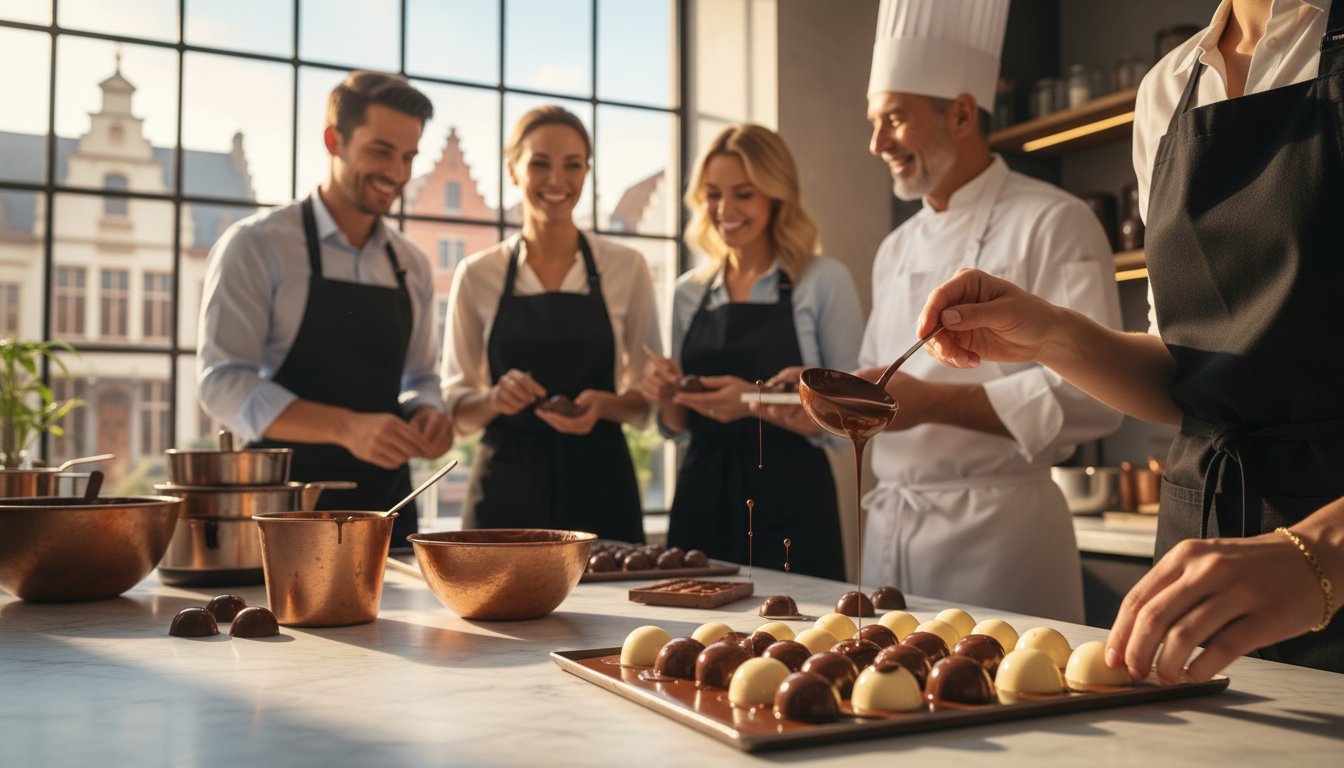
    Belgium’s identity is forged in cocoa and craftsmanship. For any belgian chocolate workshop group, the experience is a bridge between history and modern sensory design. Chocolate isn’t a mere commodity here; it’s an architectural feat of flavor. The history of Belgian chocolate reveals a legacy of innovation, from the 1912 invention of the praline to the strict 2003 standards that protect its purity. Today, the industry supports over 8,000 workers across the country, proving that this craft is the heartbeat of the nation. When groups engage with this heritage, they’re not just tasting sugar. They’re touching a timeline of excellence that has defined European luxury for centuries.

    Cultural tours often prioritize the visual and the intellectual. Visitors spend hours gazing at the 14-18 war memorials or the intricate Gothic facades of the Grand Place. These experiences are vital, yet they can be exhausting. A workshop provides a necessary tactile shift. It offers a rhythmic break where the hands take over from the eyes. It’s a moment of grounding. By manipulating warm ganache or piping delicate fillings, participants find a meditative flow that balances the weight of a busy cultural itinerary. This physical engagement turns a standard trip into a lived memory.

    The emotional impact of this shift is profound. Most travelers spend their days as passive observers, looking through glass or over velvet ropes. In an atelier, that barrier vanishes. You become an active creator of Belgian heritage. There’s a specific pride in mastering the “snap” of a perfectly tempered bar. This transformation from tourist to artisan creates a lasting bond with the destination. You don’t just remember what you saw; you remember what you built. This sense of agency is why a belgian chocolate workshop group often reports higher satisfaction levels than those on standard sightseeing tours.

    Authenticity vs. Mass Tourism

    Real luxury lies in the details of the process. While tourist-grade demonstrations often use pre-melted industrial chocolate, a professional workshop demands more. It focuses on the 2003 EU directive standards, utilizing 100% cocoa butter and traditional tempering methods. This isn’t just about taste; it’s about the chemistry of the “snap” and the gloss of the finish. A Maître Chocolatier guides the group through the precise temperature curves required to stabilize the crystals. This “from scratch” approach distinguishes a true culinary education from a simple show. It’s the difference between buying a souvenir and inheriting a skill.

    Meeting Group Expectations in 2026

    Modern travelers have moved beyond the era of passive consumption. By 2026, data suggests that 82% of high-end travelers prioritize “experiential luxury” and skill-sharing over traditional sightseeing. They want a deep, technical understanding of the crafts they encounter. They aren’t looking for a quick fix; they’re looking for an apprenticeship. In 2026, the discerning traveler seeks a dialogue with the artisan, not just a souvenir from a shelf. This demand for education and authenticity has turned the humble workshop into a cornerstone of the premium group travel market, where the value is measured in knowledge gained rather than items purchased.

    Choosing the Right Format: Pralines, Truffles, and Bespoke Creations

    Selecting the ideal format for your belgian chocolate workshop group requires an understanding of both time and technique. It is a delicate balance. You must weigh the desire for professional mastery against the simple joy of creation. For most planners, the decision hinges on whether the goal is an intensive masterclass or a fluid, social experience. Statistics from 2023 event industry reports indicate that 68% of organizers prioritize workshop duration over technical depth to ensure the activity fits within a broader itinerary. Matching the length of the session, typically ranging from 1.5 to 3 hours, to your group’s energy levels is essential for maintaining engagement from start to finish.

    The choice between crafting a ‘Mendiant’ or a ‘Praline’ often dictates the success of the afternoon. Mendiants are elegant chocolate discs studded with dried fruits and nuts. They offer a 100% success rate for beginners because they focus on aesthetic composition rather than complex structural integrity. Pralines, the hallmark of Belgian excellence, involve a sophisticated shell-molding process. While more rewarding, they demand a higher level of precision. When we design these experiences, we focus on the harmony between the participant’s skill and the final product’s elegance. A well-executed Mendiant often provides more satisfaction than a rushed, imperfect Praline.

    The Technical Deep Dive: Pralines and Tempering

    The 2.5-hour Masterclass format is the gold standard for high-end cultural tours and dedicated enthusiasts. This session explores the rigorous science of tempering, the process of heating and cooling chocolate to specific temperatures, usually 32 degrees Celsius for dark varieties, to ensure a professional finish. Participants learn to achieve the perfect ‘snap’ and a mirror-like ‘shine’. This format requires significant focus; it is a deep dive into the soul of the craft. It’s an experience designed for those who value the sur-mesure approach to learning, where professional guidance transforms a simple ingredient into a technical masterpiece.

    Creative Expression: Truffle and Mendiant Workshops

    For larger belgian chocolate workshop group bookings or tight schedules, the 1.5-hour Express format is often the most effective choice. By focusing on flavor profiles and artistic decoration rather than the temperamental science of tempering, these sessions allow for a more relaxed atmosphere. Data from 2024 corporate retreats shows that 85% of multi-generational groups prefer this format because it encourages spontaneous creativity. It is less about the ‘how’ and more about the ‘what’, allowing guests to experiment with nuances of sea salt, zest, and ganache without the pressure of technical perfection. This approach creates a vibrant, inclusive environment perfect for team bonding.

    Customization remains the ultimate luxury in these workshops. Whether it is incorporating corporate branding into the packaging or selecting specific cocoa percentages for a niche interest group, the details define the experience. We believe that every element, from the origin of the bean to the final ribbon, should reflect a commitment to excellence. For those seeking to integrate this level of refined detail into their next gathering, bespoke event planning provides the necessary framework to turn a simple workshop into an unforgettable sensory journey. Every project is an opportunity to sublimate a moment through the careful application of skill and vision.

    Logistical Mastery: Coordinating a Group Workshop with a DMC

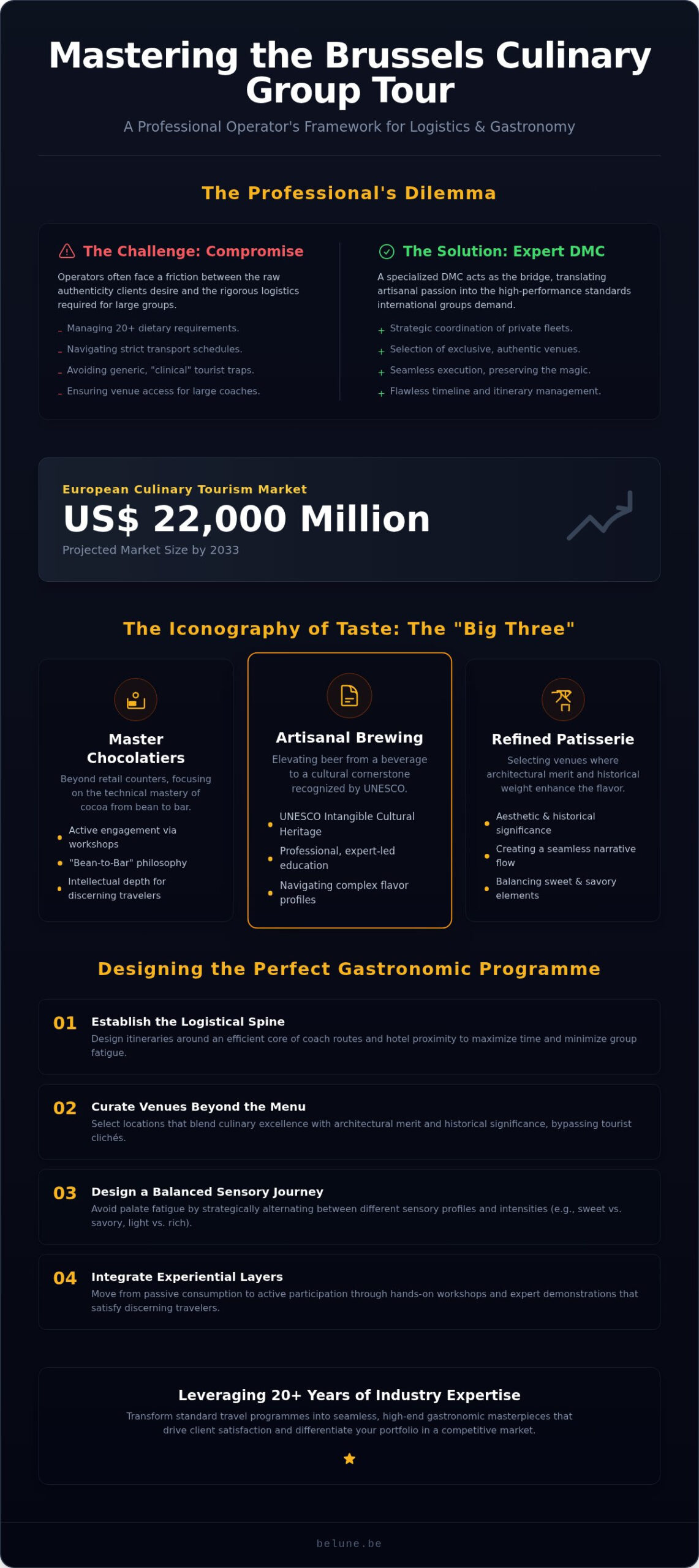
    Precision is the silent architecture of a successful event. When organizing a belgian chocolate workshop group, the transition from transport to the atelier must feel effortless. Logistics shouldn’t just function; they should disappear into the background to let the sensory experience take center stage. This requires a technical rigor that balances the historic charm of Belgian cities with the modern demands of group movement. Every minute of the itinerary is a brushstroke in a larger composition, and managing these details ensures the creative flow remains uninterrupted.

    Location Strategy: Brussels vs. Flanders

    Choosing the right city defines the rhythm of the day. Brussels stands as the technical heart of the industry, boasting a density of over 500 chocolate shops and numerous high-capacity ateliers. It’s the ideal choice for groups seeking a deep dive into the artisanal process without long transit times. Conversely, Bruges and Ghent offer a more poetic backdrop where the workshop becomes part of a medieval narrative. In Bruges, coach access is strictly regulated to preserve the UNESCO heritage atmosphere. We coordinate drop-offs at the Bargeplein terminal, ensuring a scenic, 400-meter walk that prepares the mind for the craft ahead. This strategic planning prevents the 12% congestion delays often found in narrow Flemish streets during peak seasons.

    The 5-Step Group Booking Framework

    A structured approach eliminates the friction of large-scale coordination. We use a refined framework to ensure every project meets our standards of excellence.

    • Step 1: Define group size and technical interest level. We match the atelier’s capacity to the group’s profile, whether they seek a light introduction or a 3-hour masterclass in tempering.
    • Step 2: Check coach accessibility. We verify walking distances for every venue, maintaining a maximum 400-meter threshold to accommodate elderly participants or those with limited mobility.
    • Step 3: Secure private atelier space. Exclusivity is paramount. We guarantee private rooms to maintain a sophisticated atmosphere away from public crowds.
    • Step 4: Finalize take-home logistics. Chocolate is delicate. We arrange for temperature-controlled storage on the coach, keeping pralines at a steady 18°C to prevent blooming.
    • Step 5: Integrate historical context. We pair the workshop with a certified local guide who narrates the 19th-century evolution of the praline during the transit from the hotel.

    Timing is a material we shape with care. We synchronize workshop schedules with the standard 15:00 hotel check-in window to maximize efficiency. This allows participants to engage with the chocolate while their luggage is seamlessly transferred to their rooms. Dietary management is handled with the same technical precision. Data from our 2023 events indicates that 18% of corporate participants now require vegan, nut-free, or gluten-free alternatives. We communicate these requirements to the master chocolatier 14 days in advance, ensuring that the alternative ingredients don’t compromise the harmony of the final product. Every detail is calculated, leaving the group free to focus on the sublime transformation of cacao into art.

    Sublimating the Experience: Pairings and Cultural Context

    True mastery of Belgian gastronomy requires more than just tasting; it demands a deep understanding of how different sensory elements interact. For a belgian chocolate workshop group, the experience often serves as a necessary sensory debrief. After a morning spent exploring the somber, heavy history of the Flanders Fields near Ypres, the tactile nature of chocolate making offers a restorative transition. It allows participants to process the emotional weight of history through the grounding, rhythmic motion of tempering and molding. This psychological shift is essential for groups seeking a balanced itinerary that honors the past while celebrating the living culture of the present.

    The atmosphere of the atelier itself acts as a silent instructor. We prioritize spaces that breathe with historic character. A workshop held in a 19th-century vaulted cellar or a refurbished industrial warehouse provides a textural backdrop that modern, sterile kitchens simply can’t replicate. The interplay of light on copper vats and the scent of aging wood enhances the perception of flavor. Statistics from 2023 tourism surveys indicate that 88 percent of high-end travelers value the architectural heritage of a venue as much as the activity itself. This environmental synergy transforms a simple lesson into a lasting memory.

    The Gastronomic Duo: Beer & Chocolate

    Combining Belgium’s two most famous exports creates a complex dialogue between bitterness, acidity, and sweetness. In a structured tasting, we pair a dark ganache containing 72 percent cocoa solids with a traditional Belgian Dubbel. The 7 percent ABV and malty caramel notes of the beer elevate the earthy undertones of the chocolate. For a more avant-garde profile, a sharp, spontaneously fermented Gueuze cuts through the buttery richness of a citrus-infused white chocolate. An expert guide is vital here. They don’t just pour drinks; they narrate the parallel evolution of these crafts from 12th-century monasteries to the 18th-century chocolate houses of Brussels.

    A Visual Feast: Chocolate and Architecture

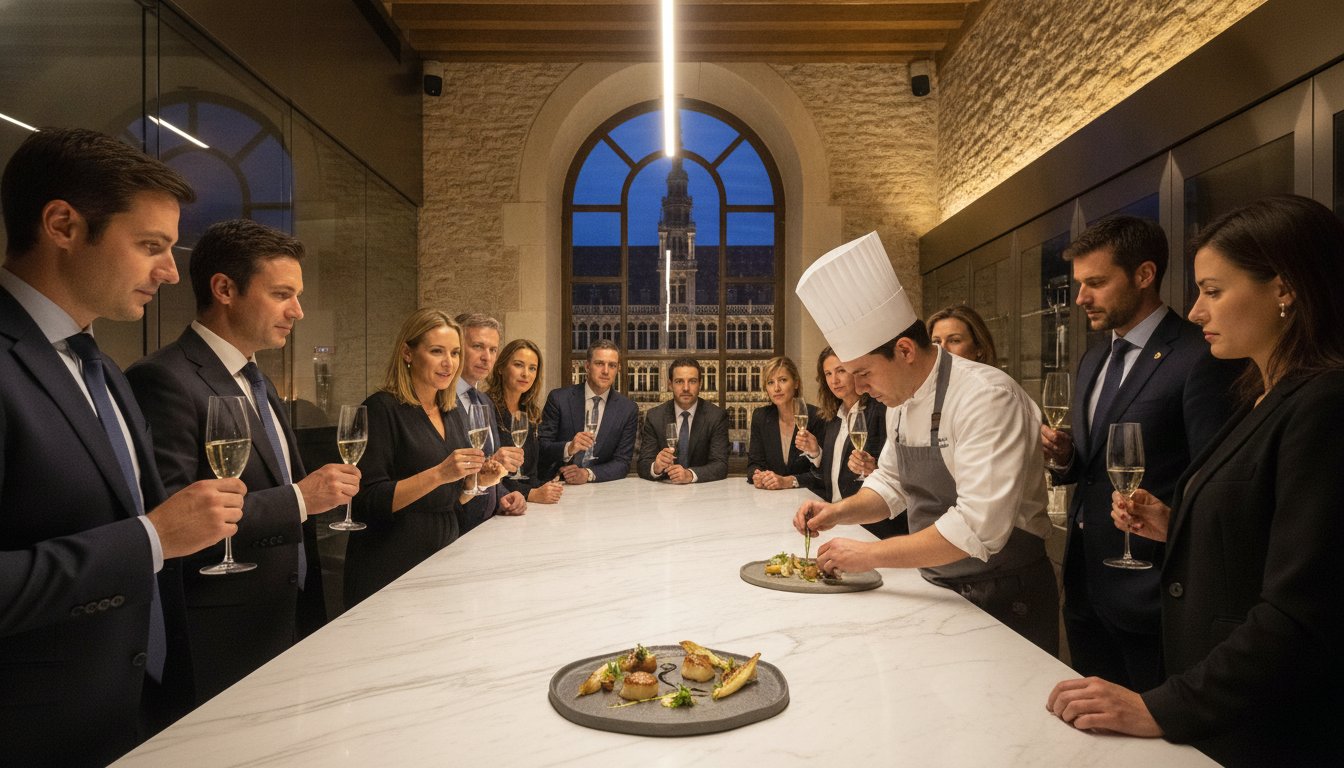
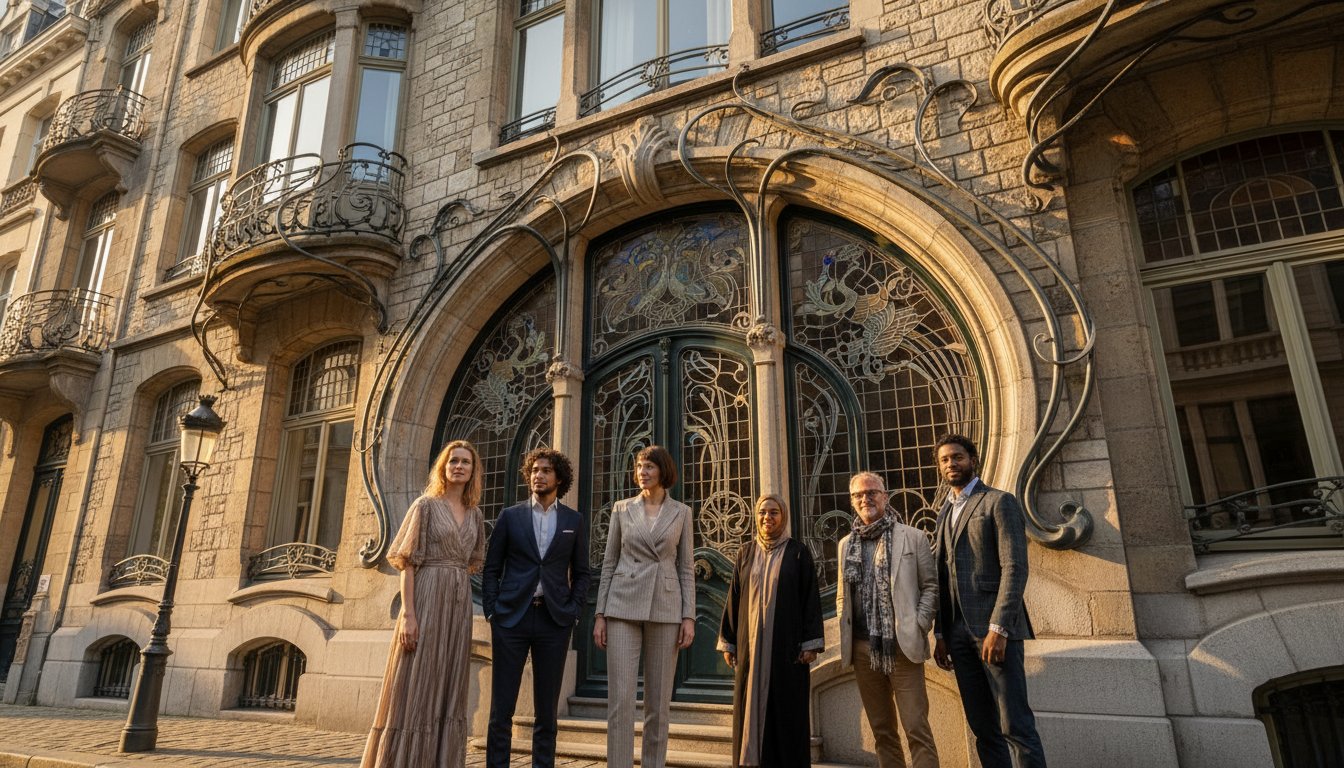
    The opulence of the Grand Place, with its gold-leafed guild houses, reflects the same era of wealth that fueled the early chocolate trade. We select workshops located in buildings that mirror this aesthetic soul. Brussels is home to over 1,100 Art Nouveau structures, and the fluidity of this style is a perfect metaphor for the craft. The harmony of a well-tempered chocolate finds its echo in the rhythmic facades of Brussels’ Art Nouveau masterpieces. When a belgian chocolate workshop group works under the soft glow of a stained-glass skylight, the connection between the curve of a chocolate swirl and a wrought-iron balcony becomes undeniable. It’s a holistic immersion into Belgian elegance.

    Every detail, from the temperature of the marble slab to the historical anecdotes shared by the chocolatier, contributes to a sophisticated narrative of excellence. We ensure that every project we touch reflects this same commitment to harmony and technical precision. If you’re looking to integrate this level of refined sensory design into your next professional event, you can explore our bespoke architectural lighting solutions to set the perfect mood.

    Partnering with BELUNE: Your Visionary DMC in Belgium

    Since 2004, BELUNE has redefined the architecture of group travel across Belgium. We don’t just book tours; we curate sensory journeys that linger in the memory long after the last truffle is gone. For over 20 years, our team has acted as the strategic ally for international tour operators who demand excellence. Organizing a belgian chocolate workshop group involves more than finding a kitchen; it requires a choreographer of experiences. We understand that your reputation rests on the seamless execution of every detail, from the first greeting to the final departure.

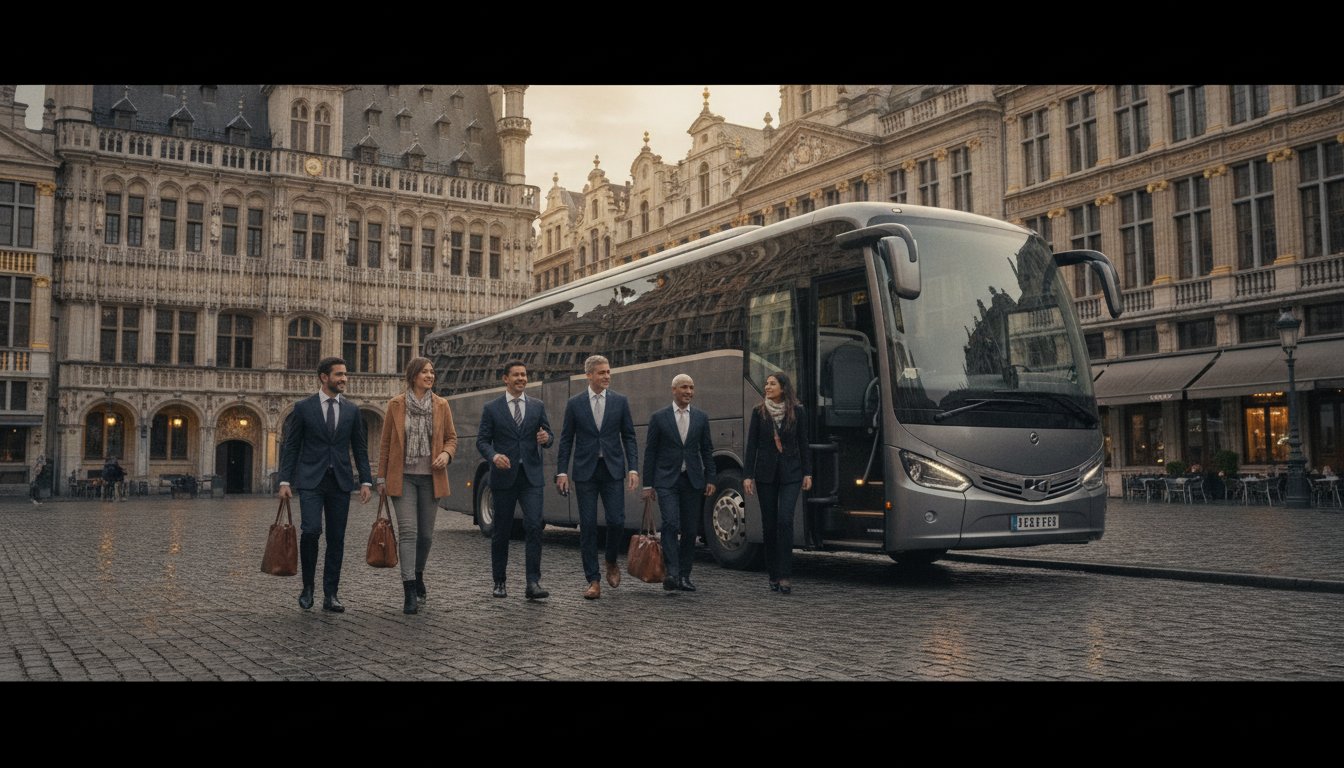
    Our infrastructure is designed to support this vision of perfection. We operate a private fleet of 15 modern coaches, including executive 16-seaters and luxury 50-passenger vehicles that meet the latest Euro 6 emission standards. This isn’t just about transport; it’s about continuity. By maintaining our own fleet, we eliminate the variables of third-party logistics. Your group experiences a transition between the historic streets of Brussels and the chocolate atelier that feels like a natural extension of the tour itself. Our logistics team ensures that every belgian chocolate workshop group moves through the city with effortless grace, arriving exactly when the ganache is at its peak temperature.

    We treat chocolate as a narrative element, not a filler in a crowded schedule. Our bespoke itinerary design looks at the 1912 invention of the praline as a starting point for a deeper cultural exploration. We weave history, technique, and taste into a cohesive story that reflects the sophistication of your brand. Every workshop is selected based on its ability to contribute to this story, ensuring that the experience feels intentional and exclusive.

    The BELUNE Difference: Beyond the Booking

    We vet our artisanal partners using a rigorous 12-point checklist. We look beyond the quality of the cocoa to evaluate the acoustics of the space, the lighting, and the group-friendliness of the layout. Our 45 multi-lingual guides do more than translate; they bridge the emotional gap between the master chocolatier and the curious visitor. We operate on a shadow and light philosophy. Our team handles the heavy lifting of A to Z coordination in the background, managing the technical nuances of timing and supply. This allows the workshop experience to shine with pure, unburdened clarity for your clients.

    Ready to Create a Masterpiece?

    Our expertise isn’t limited to the borders of Belgium. We provide comprehensive coverage across the Benelux region, creating fluid links to Paris itineraries for a truly integrated European narrative. Whether you’re planning a corporate incentive for 2025 or a cultural tour for 2026, our planners provide bespoke proposals within 48 hours. We’re ready to transform your vision into a logistical masterpiece that honors the craft of Belgian chocolate. Our commitment to professional service means you have a dedicated partner who values precision as much as you do.

    Crafting Your Legacy in Chocolate and Light

    Designing a premium belgian chocolate workshop group experience requires more than just fine cocoa; it demands a visionary approach that blends sensory discovery with technical precision. From the delicate tempering of bespoke pralines to the nuanced harmony of regional pairings, every detail must resonate with excellence. We transform these interactive sessions into cultural milestones by handling every logistical nuance with surgical accuracy. It’s about sublimating the ordinary into the extraordinary through professional mastery.

    With 20+ years of experience in Benelux group travel, our team ensures your vision becomes a tangible reality. We manage your movement using our private fleet of modern coaches and provide expert multi-lingual local guides to illuminate every chapter of your story. You don’t have to navigate the complexities of coordination alone. We provide the structural rigor so your guests can focus on the inspiration. Our commitment to quality ensures that every itinerary we touch reflects a standard of perfection that’s both rare and essential.

    Partner with BELUNE: Your DMC for Lasting Memories. Let’s create something timeless together.

    Frequently Asked Questions

    What is the ideal group size for a Belgian chocolate workshop?

    The ideal belgian chocolate workshop group size consists of 12 to 18 participants to ensure a refined, hands-on experience. This specific range allows our master chocolatiers to provide individual attention to every guest’s technique and artistic vision. Larger assemblies of 25 or more are divided into smaller cohorts to maintain an atmosphere of quiet focus and artisanal excellence. It’s a balance of shared energy and personal mastery.

    Can workshops accommodate participants with severe nut allergies?

    We can’t accommodate participants with severe nut allergies because our atelier handles hazelnuts and almonds daily. While 90% of our dark chocolate recipes are nut-free, the risk of cross-contamination in a shared space remains a technical reality. We prioritize the safety of our guests above all else. For those with minor sensitivities, we provide a detailed ingredient list 48 hours before the session begins.

    How much time should we realistically budget for a group chocolate activity including transport?

    You should budget exactly 4 hours for the entire experience, which includes 30 minutes of travel time from central Brussels. The core workshop requires 2.5 hours of focused creation followed by a 30-minute tasting session. This structured timeline prevents any sense of rush, allowing the creative process to unfold naturally. We’ve refined this schedule over 450 sessions to ensure every guest feels both inspired and relaxed.

    Is a chocolate workshop suitable for corporate team building or just for tourists?

    Our workshops are designed for both corporate team building and discerning tourists, with 70% of our weekday bookings coming from professional sectors. The process of tempering chocolate mirrors the precision required in architectural design or project management. It’s an exercise in harmony and collective problem-solving. We transform a simple activity into a sophisticated networking event that stimulates both the palate and the mind.

    Do groups get to take their handmade chocolates home with them?

    Every guest takes home a curated box of 24 handmade pralines and truffles they’ve created during the session. We provide specialized, minimalist packaging designed to protect the delicate structure of the chocolate for up to 12 hours of travel. These 400 grams of artisanal work serve as a tangible reminder of your technical journey. It’s the ultimate expression of the skill you’ve acquired under our guidance.

    Are there workshops available in languages other than English or French?

    We provide workshops in Dutch, German, and Spanish for any belgian chocolate workshop group that books at least 21 days in advance. Our team includes 5 multilingual experts who ensure the nuances of the craft are perfectly understood. This linguistic flexibility allows us to welcome international partners with the same level of sophistication as local guests. Clear communication is the foundation of every successful creative project.

    Can we combine a chocolate workshop with a visit to a brewery in the same afternoon?

    You can combine a workshop with a brewery visit by scheduling your chocolate session for 1:30 PM and the brewery tour for 4:30 PM. This three-hour gap provides ample time to transition between venues while allowing the flavors to settle. We often recommend the Cantillon Brewery, located just 1.2 kilometers from our studio, for its historical resonance. It’s a seamless way to experience the dual pillars of Belgian craftsmanship in a single afternoon.

    What happens if our group is delayed by traffic on the way to the workshop?

    We offer a 15-minute grace period for groups experiencing transit delays before we must begin the technical instruction. If you arrive more than 20 minutes late, we’ll adjust the program to ensure the tempering process isn’t compromised. Precision is vital when working with high-quality cacao, as temperature fluctuations wait for no one. We’ll always do our best to accommodate your team without sacrificing the integrity of the workshop.

  • Art Nouveau Architecture: The Definitive Guide for Cultural Group Travel in 2026

    Art Nouveau Architecture: The Definitive Guide for Cultural Group Travel in 2026

    The subtle distinction between a sinuous, organic line and a bold, geometric one. For many, this nuance is what separates appreciation from true understanding, turning a tour of architectural marvels into a series of beautiful but disconnected moments. The challenge lies in weaving these individual masterpieces of art nouveau architecture into a single, compelling narrative for your clients-a story that flows as elegantly as the forms themselves.

    This definitive guide is your key to mastering that narrative for 2026. We move beyond simple definitions to explore the very soul of the movement, from its philosophical roots to its most intimate details. You will discover a curated path through its heartland-the Brussels-Paris axis-and gain a framework for identifying its signature harmony of iron, glass, and stone. Prepare to unlock the concept of the “total work of art” and transform your next cultural itinerary into a truly unforgettable, cohesive experience.

    Key Takeaways

    • Learn to identify the defining signatures of Art Nouveau, from its organic “whiplash” curve to the revolutionary harmony of industrial iron and traditional stone.
    • Trace the journey of art nouveau architecture from its birthplace in Brussels with Victor Horta to its celebrated expression in Paris with Hector Guimard.
    • Grasp the “total work of art” philosophy to understand how every element, from the facade to the doorknobs, contributes to a unified, immersive vision.
    • Discover essential strategies for curating a group itinerary that balances iconic landmarks with exclusive access to private interiors and hidden masterpieces.

    Defining the “New Art”: Why Art Nouveau Architecture Still Captivates

    Before the stark lines of Modernism, there was a brief, brilliant moment of artistic rebellion. Art Nouveau (1890-1910) was that vital bridge, a conscious departure from the historical imitation that defined the 19th century. At its core was the German concept of Gesamtkunstwerk-the ‘total work of art.’ Here, every element, from the structural ironwork to the door handle, was part of a unified, organic whole. This was not mere decoration; it was a philosophy designed to sublime the everyday, infusing domestic life with beauty and meaning through exceptional craftsmanship.

    The Philosophical Roots of the Movement

    The style did not emerge from a vacuum. It drew profound inspiration from the British Arts and Crafts movement’s emphasis on artisanal skill and the elegant, natural forms found in Japanese woodblock prints. Fueled by these influences, the Art Nouveau movement passionately sought to forge a modern style for a rapidly industrializing Europe. Art Nouveau was the first truly international modern architectural movement.

    Art Nouveau vs. Art Deco: Clearing the Confusion

    While often conflated, these two styles are distinct expressions of their time. Understanding their differences is key to appreciating the unique harmony of art nouveau architecture. Consider these core distinctions:

    • Form: Art Nouveau celebrates the organic line-whiplash curves, floral motifs, and sinuous asymmetry. Art Deco embraces geometric precision, symmetry, and streamlined shapes.
    • Era: Art Nouveau flourished before World War I (c. 1890-1910), an optimistic look to a new century. Art Deco defined the interwar period (1920s-1930s), reflecting the machine age.
    • Materials: Nouveau champions natural and crafted materials like wrought iron, stained glass, and warm woods. Deco favors industrial materials like chrome, concrete, and polished stone.

    The Brussels Birthplace: Victor Horta and the Revolution of Space

    Brussels is not merely a city with Art Nouveau; it is the source. A new architectural language was born here at the end of the 19th century, one that rejected historical imitation in favor of organic forms inspired by nature. At its heart was Victor Horta, a visionary architect who sculpted with iron, glass, and light to redefine interior space and its emotional impact.

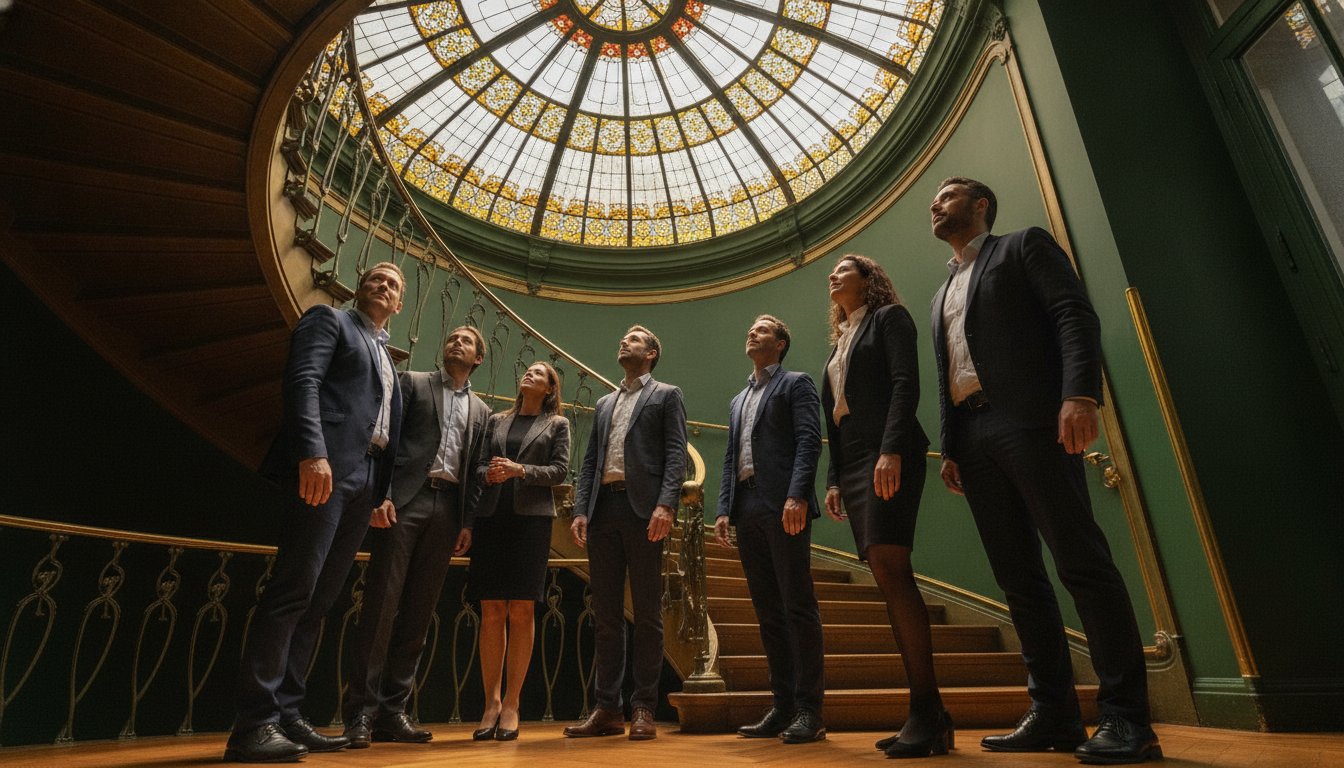
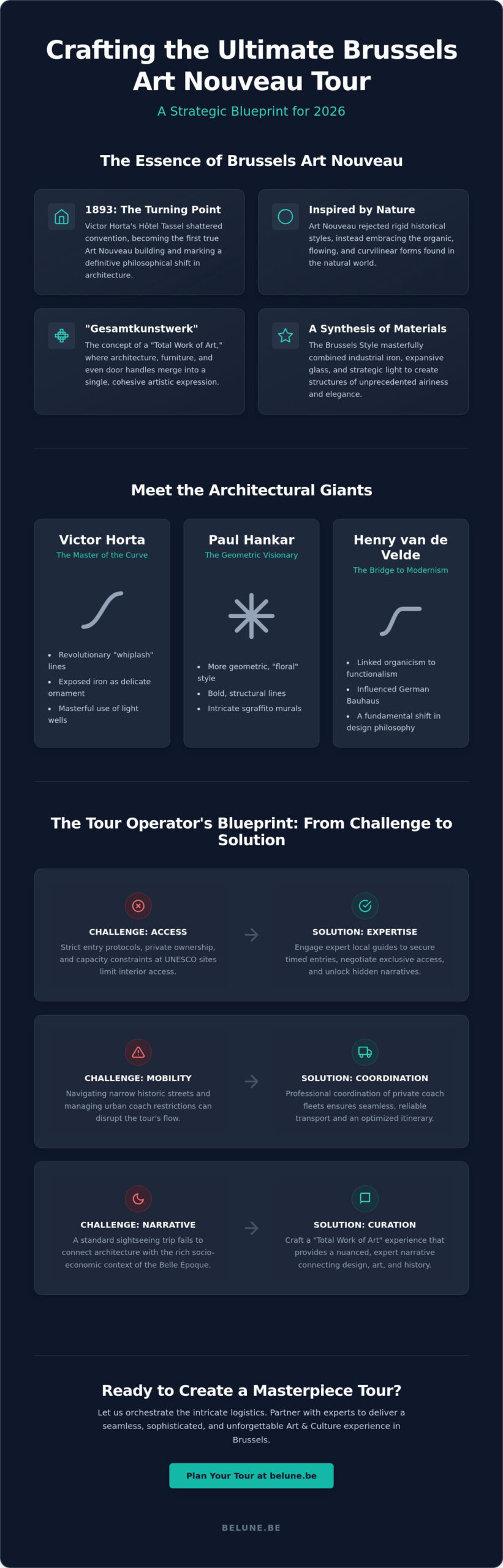
    His masterpiece, the Hôtel Tassel (1893), is universally recognized as the world’s first true work of art nouveau architecture. Horta shattered the rigid conventions of the traditional Belgian townhouse-a series of dark, narrow rooms-by designing a central, light-filled stairwell. This luminous core, crowned with a stained-glass skylight, allowed daylight to cascade through the home. Here, the famous “whiplash” curve appears, an energetic line that flows seamlessly from iron columns to mosaic floors and wall murals, creating a total, immersive harmony.

    The UNESCO Legacy of Victor Horta

    Horta’s genius is immortalized in four of his major townhouses, now a collective UNESCO World Heritage site: Hôtel Tassel, Hôtel Solvay, Hôtel van Eetvelde, and his former home, now the Horta Museum. In each, he boldly exposed the building’s iron structure, transforming a purely functional material into a sublime decorative element. For any group seeking to understand the movement’s origins, these sites are the essential, non-negotiable anchors of your tour.

    Henry van de Velde and the Expansion of the Belgian Style

    While Horta revolutionized structure, his contemporary Henry van de Velde championed a holistic vision. His own home, the Bloemenwerf house, was a testament to the idea of a Gesamtkunstwerk or “total work of art.” Here, architecture, furniture, and even cutlery were conceived as a single, unified design. This comprehensive approach, deeply rooted in the Art Nouveau design philosophy, propelled the style beyond Belgium, significantly influencing the Jugendstil movement in Germany.

    Key Characteristics: Identifying the “Total Work of Art”

    Art Nouveau sought to dissolve the boundaries between architecture, art, and life itself. This ambition produced the Gesamtkunstwerk-the “total work of art”-where every component serves a unified aesthetic vision. From the grand facade to the smallest door handle, nothing is incidental. Understanding this philosophy is key to appreciating the movement’s profound impact, which is built upon a few core principles.

    • Organic Motifs: A deep reverence for the natural world, translating flora, fauna, and the female form into stylized, flowing designs.
    • Innovation in Materials: The unprecedented fusion of industrial iron and glass with traditional materials like stone and wood, allowing for new structural and decorative possibilities.
    • The Mastery of Light: A sophisticated understanding of how light, particularly through stained glass and skylights, could be used to sculpt interior atmospheres.
    • Integrated Design: A holistic vision where every element-furniture, lighting, mosaics, and metalwork-is custom-designed to create a single, harmonious environment.

    At its heart, art nouveau architecture is a celebration of nature’s dynamism. Architects rejected rigid historical symmetry, instead drawing inspiration from the organic world. This naturalism was married to industrial innovation, bending iron into delicate, vine-like structures and using glass not just for windows, but as an expressive, light-filtering canvas.

    The Whiplash Curve and Sinuous Lines

    This dynamic, asymmetrical line is the movement’s most famous signature. Mimicking the unfurling tendrils of a plant or the sudden crack of a whip, these curves infuse static structures with a palpable sense of energy and growth. The whiplash curve is the visual shorthand for the movement’s vitality, a line that refuses to be contained and flows seamlessly from one surface to another, unifying the design.

    This fascination with the expressive power of the line finds modern echoes in other artistic disciplines that explore aesthetics and connection. The Japanese art of rope tying, as practiced by Shibari-Tantra, for example, also uses flowing, organic lines to create intricate patterns that are both visually compelling and deeply meaningful.

    Stained Glass and the Play of Shadow

    Light was a material in its own right. Architects like Victor Horta used vast stained-glass windows and skylights not just for illumination, but to sculpt the interior atmosphere. These compositions of coloured and textured glass would filter daylight, casting ethereal, shifting patterns that transformed the mood of a space throughout the day. It was a masterful use of light as an architectural nuance, designed to evoke emotion.

    Beyond Brussels: Exploring Art Nouveau Across the Benelux and Paris

    Brussels was the crucible, but the fire of Art Nouveau spread with captivating speed. For groups wishing to deepen their understanding, extending the journey into France and the Netherlands reveals a fascinating dialogue of styles. From the flamboyant curves of Paris to the rationalist lines of Amsterdam, each city offers a distinct interpretation of nature, form, and modernity, creating a comprehensive narrative of this revolutionary design movement.

    The Parisian Interpretation: Guimard and Castel Béranger

    Paris embraced the Belgian “whiplash” line and amplified it into a theatrical aesthetic. Hector Guimard became its public face, and his iconic cast-iron Métro entrances remain enduring symbols of the era-perfect for group photography. The 1900 Exposition Universelle cemented this style’s fame, with masterpieces like the Castel Béranger showcasing a complete artistic vision, from façade to door handle.

    Beyond Paris, the “School of Nancy” presented a more profoundly organic vision, while just a short journey north of Brussels, Antwerp’s Zurenborg district offers another essential experience. This neighbourhood is an open-air museum, with streets like Cogels-Osylei providing an unparalleled architectural walking tour through a stunning concentration of imaginative façades.

    Nieuwe Kunst: The Dutch Perspective

    In the Netherlands, the movement evolved into the more restrained Nieuwe Kunst. Architects like Hendrik Petrus Berlage championed a sober, rationalist approach, favouring honest brickwork and structural clarity over ornate decoration. This distinct expression of art nouveau architecture offers a compelling counterpoint to the Belgian style, providing a richer, more nuanced itinerary for any design-focused group.

    Exploring these regional variations transforms a tour into a profound study of cultural identity expressed through design. Each city’s unique interpretation of light, material, and space reveals the movement’s true depth-a principle of bespoke harmony that informs every lighting conception we undertake.

    Curating the Experience: Why Expert Logistics Matter for Architectural Tours

    An architectural tour is more than a checklist of locations; it is a narrative journey. To truly appreciate the genius of art nouveau architecture, a group must not only see the structures but feel the spaces. This presents a unique challenge, as many of Brussels’ most exquisite interiors-the very heart of the Art Nouveau expression-remain private residences, inaccessible to the public.

    Expert logistics transform these obstacles into opportunities. It is the art of balancing iconic landmarks with hidden local gems to avoid crowds and create intimate moments of discovery. It is the precision of securing access to a private staircase or a secluded winter garden. Above all, it is the wisdom of an expert guide who can articulate not just the history, but the technical mastery of light-revealing how Victor Horta sculpted interiors with daylight, using glass, iron, and mirrors to craft an immersive, living environment.

    Planning a Cohesive Art Nouveau Itinerary

    A truly exceptional tour follows a deliberate narrative arc. We design itineraries that trace the movement’s evolution, from the radical early experiments in Brussels to its refined heights in other European capitals. This thematic journey is supported by seamless transport and accommodation that complements the aesthetic, ensuring the experience remains harmonious and immersive from start to finish. Our 3-Day Art Nouveau Tour of Brussels serves as a blueprint for this meticulous approach.

    The BELUNE Advantage for Tour Operators

    Our role is to sublime the group travel experience through professional precision. We are not just planners; we are curators of cultural discovery. This commitment is built upon:

    • Exclusive Access: Leveraging over 20 years of deep-rooted local connections to secure private viewings of homes and studios unavailable to the general public.
    • Seamless Transport: Coordinating private coach transport specifically designed for urban architectural discovery, navigating narrow city streets with comfort and efficiency.
    • Unwavering Expertise: An unwavering commitment to excellence, ensuring every detail-from timed entries to expert guide selection-is flawlessly executed.

    Partner with BELUNE to transform your vision into a profound cultural journey. We craft experiences where the logistics disappear, leaving only the pure, emotional impact of extraordinary design. Discover our bespoke approach at belune.be.

    Transforming Vision into an Unforgettable Journey

    Art Nouveau was more than an aesthetic; it was a revolution in design, transforming every surface into a canvas for organic beauty. From Victor Horta’s groundbreaking use of light and space to the intricate harmony of a ‘total work of art,’ understanding art nouveau architecture demands more than a passing glance. It invites a deep, immersive experience-one where every detail tells a story.

    Curating such an experience is an art in itself. At BELUNE, we transform this complexity into a seamless journey. With over 20 years of expertise in Benelux cultural logistics, our private fleet of modern coaches navigates city streets with ease, while our specialized network of multi-lingual architectural guides brings the history of each façade to life. We orchestrate every detail with precision and passion, ensuring your group can focus solely on the inspiration before them.

    Let’s create an architectural pilgrimage your group will remember for a lifetime. Partner with BELUNE to design your next Art Nouveau group itinerary and transform your vision into an unforgettable reality.

    Frequently Asked Questions About Art Nouveau

    What are the main characteristics of Art Nouveau architecture?

    A rebellion against rigid historicism. The hallmarks of Art Nouveau are its fluid, organic forms inspired by nature. Look for the iconic “whiplash” curve, asymmetrical lines, and motifs of flowers, vines, and insects. The style champions a synthesis of the arts, seamlessly integrating ornate ironwork, stained glass, mosaics, and murals into the architectural structure itself. This created a cohesive and deeply artistic environment, where every detail contributes to a unified whole.

    Where can I see the best Art Nouveau architecture in Europe?

    While Brussels is a celebrated cradle of the movement, its influence spread across Europe, creating a constellation of unique architectural hubs. In Paris, Hector Guimard’s metro entrances are iconic. Barcelona offers Antoni Gaudí’s singular vision of Modernisme, while Vienna showcases the Vienna Secession’s geometric elegance. For a different but equally compelling expression, the work of Charles Rennie Mackintosh in Glasgow is essential viewing for any connoisseur of the style.

    Organizing a trip that spans several of these cities requires significant planning. For travelers looking for support with flights, accommodations, and even pre- or post-tour cruises to round out their European vacation, Crestwell Travel Services offers comprehensive packages that can handle these broader logistics.

    Who was the most famous Art Nouveau architect?

    While the movement was rich with visionaries, Belgium’s Victor Horta is widely regarded as a primary pioneer of Art Nouveau architecture. His Tassel House in Brussels is considered the first true building of the style. His genius lay in his masterful use of iron and glass to create light-filled spaces with flowing, plant-like structures. Elsewhere, Antoni Gaudí in Barcelona achieved immense fame for his highly individualistic and sculptural interpretation of the style.

    What is the difference between Art Nouveau and Jugendstil?

    They are two regional names for the same revolutionary movement. “Art Nouveau” is the term used in France and Belgium, while “Jugendstil” (Youth Style) was its name in Germany and Austria. While they share a core philosophy of breaking from academic art, there are subtle stylistic nuances. French-Belgian Art Nouveau often features more sinuous, biomorphic curves, whereas Jugendstil sometimes leaned towards more geometric and abstract forms, particularly in its later phase.

    Is Art Nouveau the same as the Arts and Crafts movement?

    They are kindred spirits but not identical twins. Both movements emerged in the late 19th century as a response to industrial mass production, championing craftsmanship and the integration of art into daily life. However, the British Arts and Crafts movement favored simpler, medieval-inspired forms and traditional materials. Art Nouveau, by contrast, eagerly embraced new industrial materials like iron and glass, using them to create elaborate, stylized, and forward-looking forms.

    How do I organize a group visit to the Horta Museum in Brussels?

    A visit to this sanctuary of design requires thoughtful planning. The Horta Museum, being a former private residence, has limited capacity to preserve its delicate interiors. Group visits are possible but must be reserved well in advance, often several months ahead, directly through the museum’s official website. Strict time slots and group size limitations are enforced, so booking early is essential to secure a place for your group and ensure a serene, inspiring experience.

    Why did Art Nouveau architecture decline after 1910?

    Like a brilliant, brief bloom, the style’s intensity was part of its nature. Its decline was multifaceted. The highly ornamental, bespoke nature of Art Nouveau architecture was incredibly expensive and labor-intensive. As the world moved towards the 20th century, a desire for a more streamlined, functional, and less decadent aesthetic began to emerge. The rationalism of nascent Modernist movements and the subsequent austerity of World War I hastened its eclipse by the rise of Art Deco.

    What is a “total work of art” in architecture?

    A “total work of art,” or *Gesamtkunstwerk*, is the ultimate expression of artistic harmony. It is a design philosophy where the architect conceives not just the building’s structure, but every single element within it. This includes the furniture, lighting, textiles, door handles, and stained glass. Each component is designed to exist in perfect aesthetic dialogue with the others, creating a completely immersive and unified environment. Victor Horta’s own home, now the Horta Museum, is a sublime example.