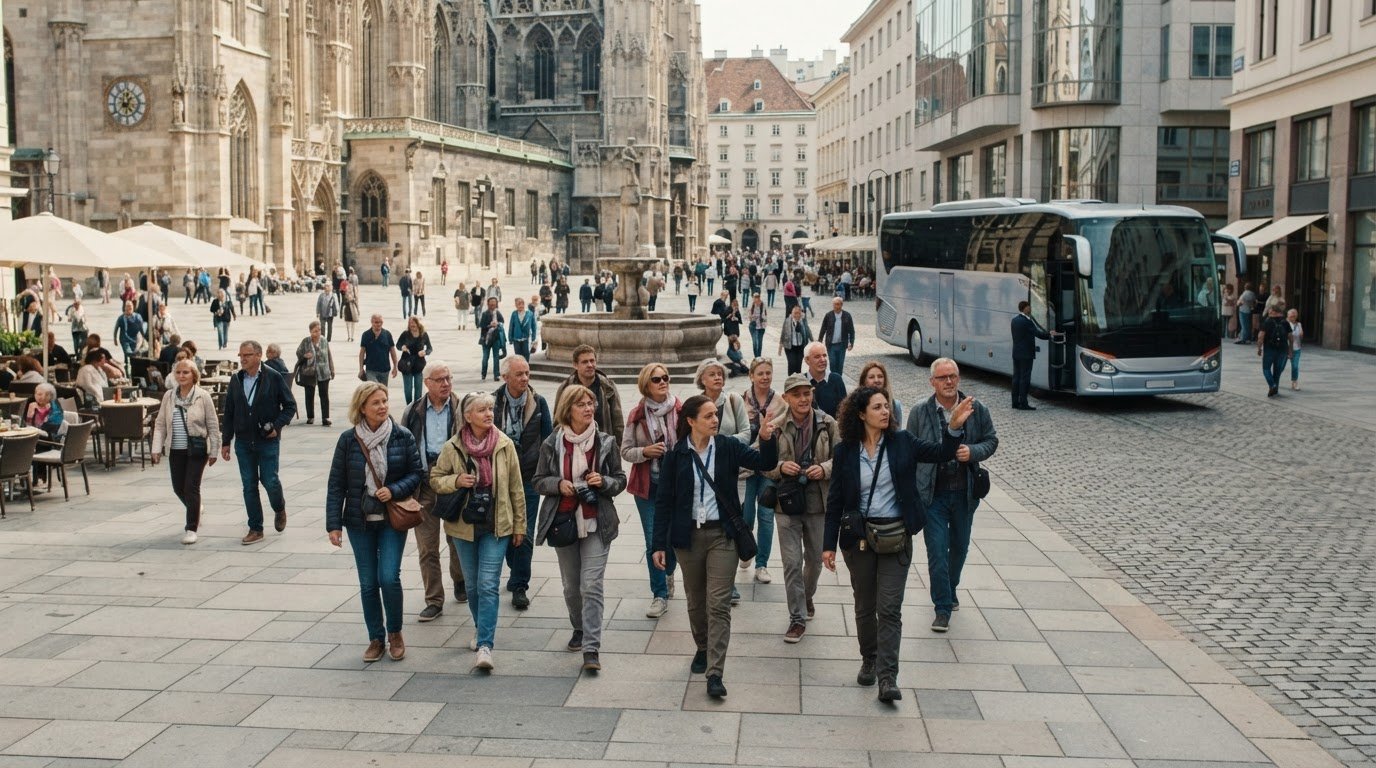
What if the best way to protect a group’s experience in a crowded destination is to plan for change, rather than try to control every moment? Crowds can separate travellers, delay a carefully paced itinerary and make a vague meeting point difficult to find. Effective risk mitigation for tours in high-traffic tourist areas starts with anticipating these pressure points while keeping the day enjoyable and flexible.
Clear movement procedures, agreed regrouping points and a calm communication plan help groups respond when conditions change. A tailored itinerary, coordinated coach transport and local guide support can make it easier to keep the day organised without making the experience feel restrictive. BELUNE brings these elements together when planning group travel.
This guide explains how to identify likely crowd-related risks before departure, give guides and travellers practical steps for staying connected, and adapt the plan when conditions shift. From timing and group movement to delays and reunification, you’ll find a clear framework for responding calmly while preserving the moments that make a tour memorable.
Key Takeaways
- Risk mitigation for tours in high-traffic tourist areas starts with identifying where crowds could affect group movement, visibility and timing.
- Prioritise risks by considering the group’s needs, schedule pressure and site access, then assign clear responsibility for each control.
- Choose prevention, monitoring and response measures to match the specific risk and operating conditions.
- Use a simple on-the-day rhythm: brief the group, observe conditions, communicate changes, make decisions and review the outcome.
- Coordinate itinerary timing, transport and local guidance to support smoother movement and leave room to adapt when plans change.
Why tours in high-traffic tourist areas need a specific risk plan
Crowds affect how a group moves, how long it takes to reach the next stop and how easily a guide can see every traveller. A narrow passage may slow the pace, noise can obscure instructions, and an access restriction can change the route. Risk mitigation for tours in high-traffic tourist areas starts with anticipating these conditions, rather than assuming the group will move as one.
Tour risk mitigation means identifying where people, plans or surroundings may be exposed to harm or disruption, then reducing the likelihood or impact of that exposure. As a practical application of Risk Management Principles, it is not a promise that nothing will go wrong. It is a considered way to prepare, assign responsibility and respond proportionately.
For a concise overview of a structured approach to travel risk, watch this video:
Which crowd-related risks should a tour planner anticipate?
Risks vary with the setting, the group and the day’s conditions. A busy open space presents different challenges from a narrow entrance or a venue with controlled access. Review the route and consider how travellers with different needs and walking speeds will experience it.
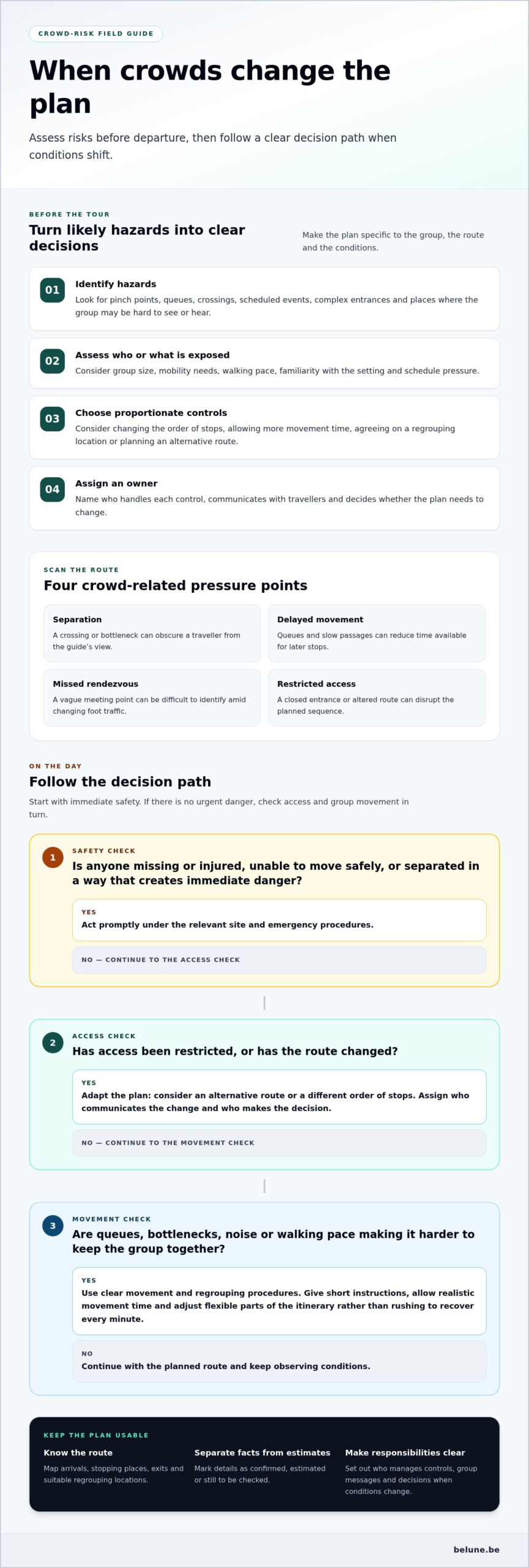
- Separation: A crossing or bottleneck can obscure a traveller from the guide’s view.
- Delayed movement: Queues and slow passages can reduce time available for later stops.
- Missed rendezvous: A vague meeting point can be hard to identify amid changing foot traffic.
- Restricted access: A closed entrance or altered route can disrupt the planned sequence.
Fatigue, accessibility needs and differences in walking pace also affect how comfortably a group can stay together. Build realistic movement time into the plan and identify places where the group can pause without blocking others. A brief delay is usually a manageable inconvenience. A missing or injured traveller, someone unable to move safely, or a separation that creates immediate danger calls for prompt action under the relevant site and emergency procedures.
How does crowd pressure affect the group experience?
Density and noise make simple coordination harder. Travellers may not hear a spoken direction, see a guide’s signal or notice that the group has turned. Short instructions and a recognisable meeting point give people a reference they can remember under pressure. They also help the guide notice when the group is stretching out before the gap becomes difficult to manage.
Small disruptions can ripple through the day. A late departure may affect a timed booking, onward transport or a planned meal break. Instead of rushing to recover every minute, identify which parts of the itinerary are flexible and which need a timely decision. Calm preparation gives the guide options and helps travellers feel supported when the schedule changes.
How to assess and prioritise risks before the tour
A useful assessment turns broad concerns into decisions the team can act on. For risk mitigation for tours in high-traffic tourist areas, use a repeatable sequence: identify hazards, assess who or what may be exposed, choose proportionate controls, then assign someone to carry them out. This makes the plan specific to the group and route, rather than a generic checklist.
A practical risk assessment connects each plausible hazard to its likelihood, potential impact and a clear owner, so the team can choose proportionate controls. Record what is known, what remains uncertain and what would prompt a change of plan.
- Identify hazards. Review the itinerary for pinch points, queues, crossings, scheduled events, complex entrances and places where the group could become difficult to see or hear.
- Assess exposure. Consider group size, mobility needs, walking pace, familiarity with the setting and how schedule pressure could affect safe movement.
- Choose controls. Select practical measures such as changing the order of stops, allowing more movement time, agreeing on a regrouping location or planning an alternative route.
- Assign owners. Name the person responsible for each control, traveller communication and decisions if conditions change. Without clear ownership, important tasks can be missed.
Build a useful crowd-risk picture
Before departure, review available venue guidance, access arrangements and information about expected busy periods. Map the arrival point, route through the site, planned stopping places, exits and suitable regrouping locations. Check whether a planned pause would obstruct other visitors or leave the group in the path of moving foot traffic. Label each detail as confirmed, estimated or still to be checked. For example, a published entrance location may be confirmed, while an assumed queue duration remains uncertain. This distinction helps prevent guesses from becoming the basis for a decision.
Rank risks and assign responsibility
Compare each risk by likelihood and potential impact, then prioritise scenarios that are both plausible and consequential. A short delay may call for schedule flexibility; a route that could separate travellers may need a clear movement and regrouping procedure. For every priority, name who is responsible for the control, the message to the group and the decision to adapt the plan. Set escalation triggers in plain language, such as restricted access, the group no longer staying together or a traveller needing urgent assistance. Triggers should reflect the setting and agreed procedures, not an assumed universal threshold.
Connect the risk assessment to the itinerary. Tailored group travel planning can bring route timing, coach coordination and local guidance into one programme. For an itinerary shaped around your group’s needs, explore BELUNE’s group travel planning.
Which crowd-management measures work best for different tour risks?
No single measure removes every crowd-related risk. A timed arrival may ease pressure at one entrance but won’t help if a route becomes inaccessible. A regrouping point can help reunite travellers, but only if everyone knows where it is and how to reach it. Effective risk mitigation for tours in high-traffic tourist areas combines prevention, monitoring and response, matched to the group, setting and conditions.
Prevention shapes the plan before a problem develops. Monitoring helps the team notice when conditions change. Response measures give guides and travellers a shared next step when disruption occurs. Use the table as a starting point, tailor each control to the itinerary and assign someone to oversee it.
| Risk | Useful measures and limitations | Responsible role |
|---|---|---|
| Congestion or queues | Allow timing flexibility where feasible and monitor delays. A buffer can absorb some disruption but can’t guarantee access. | Itinerary lead tracks schedule changes. |
| Group separation | Use clear movement instructions and agreed check-ins. Regrouping procedures help, but travellers need to know them. | Guide monitors cohesion and communicates. |
| Route or entrance disruption | Prepare an alternative route or sequence, then adapt to available access information and site conditions. | Guide assesses conditions; itinerary lead approves plan changes. |
| Missed meeting point | Set a recognisable primary point and a fallback procedure. Visibility and access may change. | Guide briefs travellers and manages regrouping. |
Compare timing, routing and group-size controls
Where timing is flexible, a less constrained arrival window can reduce pressure to move through a crowded area on a fixed schedule. Moving as one group can make instructions and oversight straightforward. Smaller coordinated units may be easier to guide through a narrow route, but require clear roles and a reliable way to reunite everyone. If congestion builds or access changes, adjusting the stop order or using a planned alternative route may preserve the wider itinerary, though it can affect transport and booking times.
Compare communication and regrouping methods
Choose a primary meeting point that is easy to describe, then agree on what travellers should do if it is inaccessible or they cannot reach it. A pre-tour briefing can explain the route, guide instructions and check-in arrangement before noise and movement make coordination harder. Don’t rely on one communication tool for everyone. Consider access to a phone, connectivity, language, hearing and other traveller needs. Pair digital updates with simple spoken directions or agreed visual cues. Revisit the plan if conditions change, and keep instructions calm, brief and consistent.
How to brief, monitor and adapt a tour on the day
A plan becomes useful when everyone knows how to act on it. On the day, guides can follow a steady sequence: brief the team and travellers, observe conditions, communicate changes, decide whether to adapt, then review what happened. This keeps risk mitigation for tours in high-traffic tourist areas practical and responsive, rather than leaving it in the planner’s hands.
Deliver a concise traveller and team briefing
Before setting off, explain the route, expected pace, primary meeting point and regrouping instructions. Be specific: tell travellers what to do if they lose sight of the group, where to wait and how to alert the guide. Share the same core information with the tour team, including who leads, who monitors group cohesion and who communicates itinerary changes. Make the briefing accessible to the travellers present and allow time for questions.
A briefing should prepare people without creating unnecessary alarm. Present instructions as practical steps that help the group stay together and enjoy the visit. If the planned route or timing changes, explain the update calmly and tell travellers what to do next.
Respond when conditions change
Monitoring is active work. As the group moves, the guide can watch whether travellers remain visible, whether the pace is comfortable and whether queues or access restrictions affect the schedule. If visibility, access or group cohesion deteriorates, pause in a suitable place or adjust the movement plan instead of pressing ahead just to protect the timetable.
Use the agreed fallback plan, then communicate the decision in plain language. A useful response sequence is:
- Separation: Follow the group’s reunification procedure and keep the rest of the travellers together in a suitable place. If someone may be at immediate risk, use the relevant site or emergency procedures.
- Delay: Reassess the remaining schedule and explain any changes to the group. Coordinate adjustments to onward transport, bookings or breaks as needed.
- Access change: Stop before entering a blocked or unsuitable route, then use the agreed alternative or revise the order of activities.
- Regrouping: Give one clear instruction, confirm that travellers understand it and account for the group before moving on.
After a notable change or disruption, record the decision, what prompted it and how the group responded. A short debrief can show whether the route, timing, briefing or fallback plan needs refining for a future tour. Focus on useful learning, not blame.
When on-the-day decisions are built into a tailored itinerary, guide coordination and transport planning can support a more composed experience. Plan a coordinated group itinerary with BELUNE.
How coordinated tour logistics support safer group experiences
A well-designed group tour connects the route, transport and on-the-ground guidance into one coherent plan. That coordination matters in busy settings: a delayed arrival can affect access, a slow transition can compress the next activity, and changing foot traffic may call for a different sequence. Risk mitigation for tours in high-traffic tourist areas is stronger when movement and timing decisions are considered together, rather than in isolation.
BELUNE coordinates group travel around the programme and the people taking part. Itinerary planning, coach transport, accommodation management and local guide services can be considered as connected elements. A broader perspective on planning group journeys appears in this group travel agency guide, while incoming tour operator coordination offers another view of the work behind a well-organised visit.
Connect itinerary design with movement and timing
Sequence shapes the day. Placing a busy site before a more flexible activity, for example, can create room to adapt if entry takes longer than planned. Transitions matter too: allow time for travellers to leave a venue, reach the agreed transport point and board without rushing. A considered itinerary includes breathing room, so one delay doesn’t automatically unsettle every later stop.
Transport arrangements should support those transitions. A clear plan for coach arrival and departure points helps the group move between the vehicle and the activity in an organised way. Align transport timing with the itinerary, and keep venue access information and applicable arrival arrangements current. Since conditions and site procedures can change, verify specific access details and timings for each tour instead of treating them as permanent assumptions.
Make local guidance and contingency planning work together
Local guides bring practical context to a route and help communicate changes as the group moves. For instance, in popular park destinations where visitor traffic fluctuates daily, regional tour specialists such as Moab In A Day rely on experienced guides to navigate peak hours and access windows smoothly. Their understanding of the visit’s flow can support decisions such as pausing before a congested entrance, adjusting where the group stops or following an agreed alternative when access changes. These decisions work best when connected to the wider itinerary and transport plan, so a local adjustment doesn’t leave the rest of the programme unclear.
BELUNE brings itinerary planning and group logistics together in tailored programmes. The aim is thoughtful coordination, not a rigid script: a clear route, aligned timings and workable contingencies that support both movement and the quality of the experience. Explore BELUNE’s group travel support for coordinated planning shaped around your programme.
Make thoughtful planning part of the experience
The strongest plans leave room for the unexpected without letting uncertainty define the day. Treat risk mitigation for tours in high-traffic tourist areas as a design principle: shape a programme that can flex, give the team clear authority to adapt and help travellers understand what to expect. Preparation doesn’t need to feel restrictive. Done well, it creates space for people to enjoy the setting and trust the journey, even when the pace changes.
For your next group programme, consider how each transition connects, where the itinerary has room to breathe and how a change in access or timing could affect the wider experience. BELUNE brings tailored itinerary planning together with coach hire, accommodation management and local guide services as part of coordinated group travel.
Plan a considered group travel experience with BELUNE, and take the next step towards a journey that feels composed, adaptable and memorable.
Frequently Asked Questions
What are the main risks for tours in high-traffic tourist areas?
The main risks are group members becoming separated, slower movement, missed rendezvous points and unexpected access changes. Dense foot traffic and ambient noise can also make it harder for travellers to see or hear their guide. The level of exposure depends on the route, group and conditions. Consider how fatigue, mobility needs or different walking speeds could affect the group, rather than assuming every busy site creates the same challenges.
How can tour guides keep a group together in a crowd?
Guides can set a steady pace, keep instructions brief and check the group at natural transition points, such as before leaving a stop or crossing a busy area. A clearly identified lead guide and a designated person watching the rear can help reveal when the group is stretching out. Where appropriate, ask travellers to alert the guide if someone nearby falls behind. Adapt the method to the group’s needs and the setting—a formation also used by guided expedition specialists like Adrenalin Rush Trail to maintain group cohesion through congested traffic corridors and challenging terrain.
What should a tour risk assessment include?
A tour risk assessment should record the hazards, who may be exposed, the possible consequences and the measures selected to reduce risk. Include itinerary transitions, access arrangements, mobility needs, schedule constraints, communication methods and regrouping procedures. Note who is responsible for each action. Separate verified information from assumptions, such as an estimated queue time, so planners know what needs attention before departure and don’t mistake an estimate for a confirmed detail.
How do you choose a meeting point for a group tour?
Choose a point that is easy to describe and recognise, accessible to the group and suitable for waiting without obstructing movement. A distinct entrance feature or clearly identified landmark may work better than a broad description such as “near the main gate.” Consider whether the location remains reachable if the group approaches from another direction, and establish what travellers should do if it becomes crowded, closed or difficult to access.
What should a tour operator do if a group becomes separated?
Follow the agreed procedure, keep the travellers who are together in a suitable place and establish who will coordinate the search or communication. Avoid sending multiple people in different directions without a clear plan. Use the agreed check-in method and meeting point, and share concise instructions with the separated traveller if contact is possible. If there’s immediate danger or urgent medical need, follow the relevant site or emergency procedures.
How can a tour itinerary adapt to unexpected crowds?
Build flexibility into the programme by identifying activities whose order can change and transitions that can absorb some delay. If a queue grows or access is restricted, the guide or itinerary lead can assess whether to move to a later stop, take a planned alternative route or adjust a break. Communicate the change and its effect on onward transport or timed activities. Base decisions on current access information, not assumptions.
How often should tour risk plans be reviewed?
Review the plan before each departure, then update it when the itinerary, group needs, access arrangements or operating conditions change. A disruption, near miss or traveller concern can reveal a gap worth addressing before the next tour. Record what changed and why, so the team can distinguish a useful adjustment from an outdated assumption. The review interval should reflect the tour’s setting and how quickly relevant details change.