
What if a DMC partnership isn’t another layer to manage, but a way to coordinate complex programme delivery? Convincing stakeholders on a DMC partnership starts with answering their real concern: how will responsibilities, decisions and delivery support the organisation’s priorities?
It’s reasonable for stakeholders to scrutinise a proposal, especially when budgets and outcomes need to be clear. A persuasive case doesn’t rely on broad promises of savings. It shows how itinerary design, transport, accommodation management and local guidance can work together to support a group travel or MICE programme. BELUNE brings more than 20 years of tourism experience to this collaborative process.
This guide will help you build a balanced, evidence-led approval case. You’ll learn to connect DMC responsibilities to programme goals, show where coordination could simplify planning, and present value without overstating what a partnership can deliver. The result is a clearer discussion, grounded in delivery details, with a practical next step stakeholders can assess.
Key Takeaways
- Frame convincing stakeholders on a DMC partnership around programme goals and evidence your organisation can assess, not broad promises.
- Make the proposed scope visible by mapping responsibilities and comparing it with the current planning approach.
- Address concerns about cost and control through transparent scope, fair-price discussions and clear ownership of decisions.
- Structure the approval proposal around the need, recommended support, evidence and specific decision requested.
- See how BELUNE brings itinerary design, accommodation management, coach transport, local guidance and distinctive group experiences into a coordinated programme.
Why a DMC partnership deserves a place in the stakeholder conversation
Stakeholders need a clear reason to change the current planning approach. If the existing process can deliver the programme, adding a partner may look like unnecessary complexity. Start by identifying where coordination takes time, where ownership is unclear, or where the group experience needs more deliberate design.
A Destination Management Company (DMC) brings destination-focused planning and delivery together. Rather than arranging each element in isolation, an organisation can work with a partner to coordinate accommodation management, coach transport, local guidance and tailored experiences around a shared programme brief.
Partnership thinking also means considering the value created for everyone involved. This video offers a useful perspective on building win-win-win partnerships:
Start with the planning challenge, not the supplier
Map the work before proposing a partner. A group programme may involve aligning accommodation, transport, guides and activities, while internal teams also manage approvals, attendee information and programme changes. Note where details are handed between people, where decisions lack a clear owner, and which tasks recur. A one-off coach booking is different from a need to coordinate several connected services.
These pressure points have practical consequences. Teams may repeat updates, reconcile different versions of an itinerary, or resolve who is responsible when a detail changes. That can draw attention away from programme objectives and make delivery harder to oversee. Describe the current process in observable terms, then separate the tasks that need coordination from occasional, self-contained requests.
Translate DMC support into organisational priorities
Connect each planning need to an outcome stakeholders recognise. Coordinated logistics can make it clearer who is handling each element and how those elements fit together. A tailored itinerary can reflect the programme brief, whether the priority is group engagement, cultural discovery or a corporate event. Local guidance and partnerships can also help planners choose experiences that give the programme a stronger sense of place.
For example, present accommodation management, coach transport and local guidance as connected responsibilities rather than separate arrangements. BELUNE brings these capabilities together with tailor-made itineraries, on-the-ground logistics and access to unique experiences. Define the proposed scope around the programme’s needs, with responsibilities clear from the outset.
A DMC partnership is not simply a purchase of separate services; it is a coordinated working relationship shaped around the programme’s goals. That distinction gives stakeholders a useful basis for discussion: would clearer coordination and a more intentional attendee experience support the organisation’s priorities?
Build a DMC business case around goals, responsibilities, and evidence
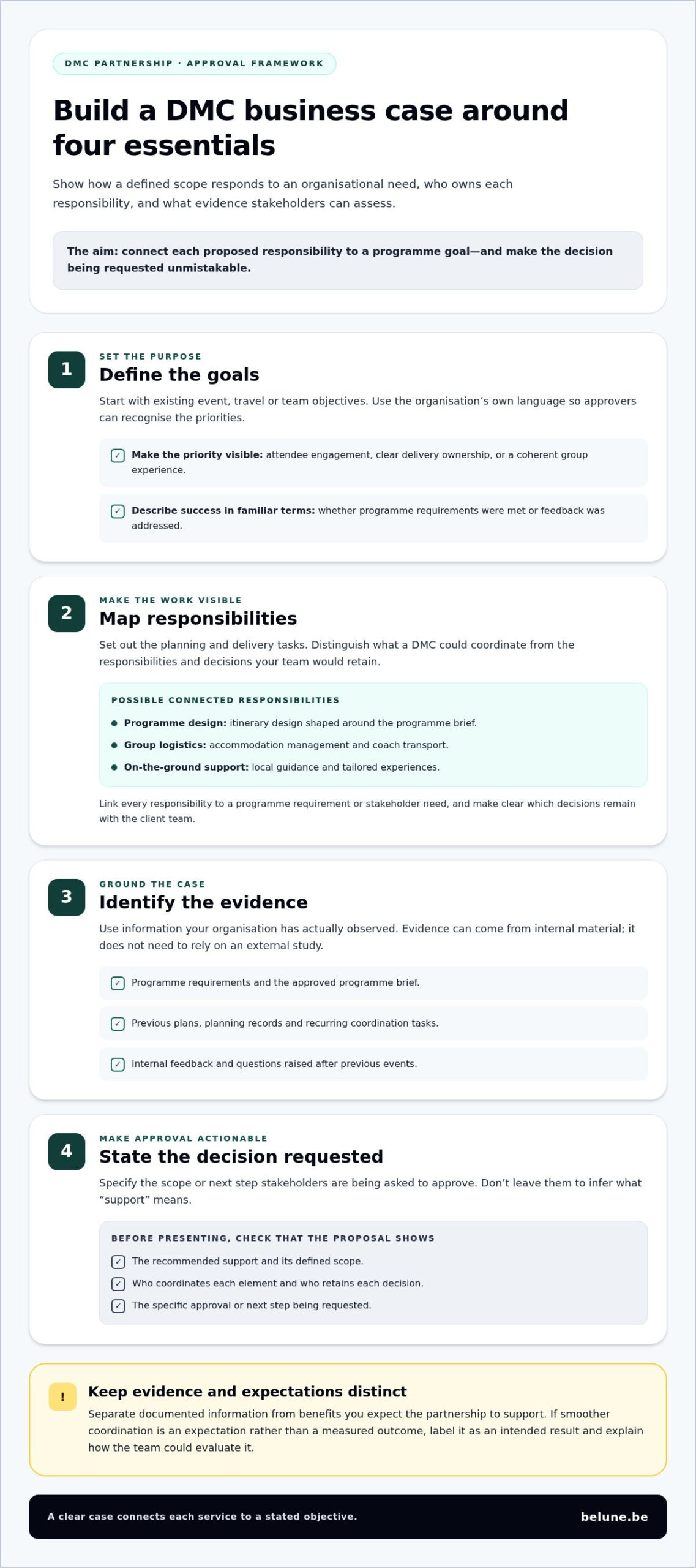
A strong proposal gives stakeholders more than a list of services. It shows how a defined scope responds to an organisational need, who would be responsible for each part, and what evidence can help assess the decision. This makes convincing stakeholders on a DMC partnership a practical exercise in alignment, not a contest of general promises.
Build the case in four steps:
- Define the goals. Start with existing event, travel or team objectives, then identify the outcomes that matter to the people approving the proposal.
- Map the work. Set out the planning and delivery tasks involved. Distinguish responsibilities a DMC could coordinate from those your team would retain.
- Identify the evidence. Use programme requirements, previous plans, internal feedback and agreed measures. Separate documented information from benefits you expect the partnership to support.
- State the decision requested. Specify the scope or next step stakeholders are being asked to approve, rather than leaving them to infer what “support” means.
Set objectives stakeholders can recognise
Use the organisation’s own language. If the brief prioritises attendee engagement, reflect that. If it focuses on clear delivery ownership or a coherent group experience, make those priorities visible. Then define what successful delivery would look like using measures your organisation already understands, such as whether programme requirements were met or feedback was addressed. Don’t present hoped-for improvements as established results.
Make scope and accountability visible
Translate each proposed responsibility into a clear planning connection. Accommodation management, coach transport, local guidance and itinerary design may all contribute to a group programme, but the proposal should show who coordinates each element and which decisions remain with the client team. Link every responsibility to a programme requirement or stakeholder need, so the scope feels deliberate rather than open-ended.
Evidence doesn’t need to come from an external study. Internal material can make the case more relevant: the approved programme brief, recurring coordination tasks, attendee feedback, planning records or questions raised after previous events. Use what your organisation has actually observed. If smoother coordination is an expectation rather than a measured outcome, label it as an intended result and explain how the team could evaluate it.
A credible business case connects each service to a stated objective, and each expected benefit to evidence the organisation can assess. That distinction builds trust: stakeholders can see what is known, what the proposed scope covers and what remains an outcome to evaluate. BELUNE’s collaborative approach can help shape a clear, tailored discussion about group travel and MICE planning.
Address concerns about cost, control, and partner fit
Cost, control and fit are reasonable approval questions. Rather than dismissing them, show exactly what would change, what would remain in-house and how the proposed scope relates to the programme. This makes convincing stakeholders on a DMC partnership a grounded discussion, not a debate over broad claims about what a DMC might deliver.
A side-by-side view can reveal where support would be practical. The current approach will vary by organisation, so use this framework to describe your own process accurately.
| Planning area | Current approach | Defined DMC-supported scope |
|---|---|---|
| Coordination | Internal staff coordinate separate arrangements and handoffs. | The DMC coordinates only the agreed elements, with responsibilities documented. |
| Programme design | The team assembles activities and logistics around the brief. | The DMC contributes tailored itinerary planning and relevant local guidance. |
| Decision-making | Approvals and updates follow existing internal processes. | Client approval points and communication responsibilities are set out in advance. |
For cost discussions, compare like with like. Set out the services included, the work retained by the internal team and any assumptions behind the proposed scope. Discuss fair pricing in relation to those responsibilities, rather than relying on unsourced savings claims or an incomplete comparison with current arrangements. A clear scope also helps stakeholders see what they are being asked to approve.
Respond to the objection that the team can manage everything internally
Internal expertise is an asset, not an argument against partnership. Your team understands organisational priorities, approval pathways and attendee needs. The question is whether destination-specific coordination or additional execution support would complement that knowledge. For example, your team could retain programme decisions and internal communications while a DMC coordinates agreed accommodation, coach transport or local guidance. Defined roles make collaboration additive, not a transfer of control.
Evaluate fit through practical criteria
Assess the proposed partner against the programme itself, not a generic checklist. Consider relevant experience, whether the scope matches actual requirements, the strength of local partnerships and whether the communication approach supports clear coordination. BELUNE brings more than 20 years of tourism experience and a collaborative, no-nonsense approach. A guide to choosing a group travel agency can also help frame the wider evaluation.
- Scope: Are proposed services tied to specific programme needs?
- Accountability: Are client decisions, partner responsibilities and approval points clear?
- Working approach: Is communication collaborative and transparent?
Partner fit is the alignment between your needs, the agreed scope and the way delivery will be coordinated. When stakeholders can see that alignment, they can weigh the proposal on practical grounds, including fair pricing, defined control and relevance to the programme.
Turn stakeholder questions into a clear approval proposal
A proposal should make the decision easy to understand, even for stakeholders who haven’t followed every planning discussion. Lead with the programme need, then show the recommended scope, responsibilities, supporting evidence and specific decision requested. This helps turn convincing stakeholders on a DMC partnership from a broad pitch into a focused approval conversation.
Create a concise decision document
Put the essentials on the first page. State the planning challenge in plain language, describe the outcomes the programme is designed to support, and summarise which responsibilities the DMC would coordinate. Be equally clear about what stays with your team, such as approving the programme brief or making internal decisions. Name the evidence behind the recommendation and distinguish it from assumptions that still need evaluation.
A concise opening summary might follow this pattern:
- Need: Identify the planning requirement or coordination pressure the programme must address.
- Scope: Describe the proposed support, such as itinerary planning, accommodation management, coach transport or local guidance, where relevant.
- Responsibilities: State who coordinates each agreed element and which decisions remain internal.
- Evidence and assumptions: Reference programme requirements or internal feedback, and label expected benefits as expectations rather than proven results.
- Decision: Specify whether stakeholders are being asked to approve the scope, provide feedback or agree on a next planning step.
Keep supporting detail available for readers who need it. This could include a responsibility breakdown, the programme requirements that informed the scope, and a concise explanation of how the proposed work would be coordinated. A layered proposal respects stakeholders’ time without leaving important questions unanswered.
Lead a focused stakeholder discussion
Open the discussion by inviting stakeholders to assess the proposal against the programme’s agreed priorities. Prepare direct responses to likely questions: how the scope relates to the budget, what approval points remain with the client team, how delivery responsibilities will be coordinated, and which tasks may shift from internal staff. Be transparent about what the proposal does and doesn’t establish.
Separate open questions from concerns already addressed by the document. If a stakeholder asks about internal workload, point to the responsibility breakdown. If the question is about delivery, clarify ownership and communication. Where evidence is incomplete, record what needs further discussion instead of presenting an assumption as fact.
Close with a clear decision prompt. For example: “Can we approve this proposed scope for the programme, or should we revise the responsibilities before proceeding?” That gives the conversation direction while leaving room for informed feedback. A defined next step is useful even when approval isn’t immediate.
For a group or MICE programme, discuss a tailored programme with BELUNE and shape the scope around your priorities, responsibilities and planning needs.
Move from approval to a collaborative DMC partnership with BELUNE
Approval is the start of the working relationship, not the finish line. The next step is to turn the agreed scope into a programme brief that gives BELUNE a clear view of your objectives, priorities and expectations. With more than 20 years of tourism experience, BELUNE works collaboratively with group travel organisers, corporate clients and businesses planning events or team-building activities.
Match BELUNE’s services to the approved scope
Begin with the responsibilities stakeholders have approved. If the programme calls for a tailored itinerary and coordinated ground arrangements, BELUNE can bring itinerary planning and on-the-ground logistics together. Accommodation management, coach transport using BELUNE’s own fleet, and local guide services can support the elements relevant to your brief. Each service should have a clear purpose within the programme, rather than being added without a defined need.
Experiences can also be shaped around attendee objectives. Art and culture, gastronomy and beer, cycling, sport events, festivals or river cruises with local excursions can suit different group programmes. For a corporate event or team-building programme, MICE services can connect the experience to the purpose of bringing people together. Choose the elements that fit the brief and the scope agreed with stakeholders.
This alignment keeps collaboration practical. Your team brings organisational context and retains the decisions assigned to it; BELUNE contributes destination expertise and coordinates the agreed services. Clear communication about responsibilities, priorities and programme requirements gives both sides a shared foundation for shaping the details.
Make the next step straightforward
To begin a tailored discussion, gather the essentials in one concise brief. Share the programme objectives, the type of group or corporate support sought, the approved responsibilities and the priorities that should guide itinerary design. You can also outline what your team will manage internally. This gives BELUNE useful context to develop a tailor-made programme around your needs without making assumptions about what matters most.
If you’re building context for a group programme, this incoming tour operator guide offers related planning perspective. Use it to inform your thinking, then bring the specific goals and approved scope of your own programme into the discussion.
For planners focused on convincing stakeholders on a DMC partnership, this is where the case becomes a collaborative plan: the organisation’s objectives meet a defined scope and the expertise needed to shape its delivery. A thoughtful proposal keeps responsibilities visible while leaving room for the programme’s character to emerge.
Request a tailored proposal from BELUNE to start shaping a programme around your objectives, scope and group needs.
Turn stakeholder approval into a shared starting point
Once stakeholders are aligned, the next opportunity is to shape a programme that feels coherent to the people attending it. Treat approval as the beginning of a creative working conversation: bring the priorities that matter, the experience you want to create and the responsibilities your team has agreed to share. That clarity gives a DMC a useful foundation for developing a programme around your organisation’s needs.
Convincing stakeholders on a DMC partnership isn’t only about securing agreement. It’s about building confidence in a way of working, with room for thoughtful planning and a distinctive attendee experience. The strongest next step is specific and collaborative: move from an approved idea to a conversation about what the programme could become.
Let’s create something extraordinary together, start a tailored proposal with BELUNE. Your next programme can begin with a clear purpose and an open-minded partnership.
Frequently Asked Questions
What does a DMC partnership give an organisation?
A DMC partnership gives an organisation destination-focused expertise to complement its internal planning. For a group programme, that can mean bringing connected details, such as accommodation arrangements, transport and local activities, into a more coordinated plan. The organisation retains its internal priorities and decisions, while the DMC supports the agreed destination-related work. This can be especially useful when programme elements need to fit together rather than be handled as isolated requests.
How do I convince stakeholders to work with a DMC?
Start with a programme challenge stakeholders already recognise, then explain how a defined partnership would address it. When convincing stakeholders on a DMC partnership, use the organisation’s own priorities and relevant evidence, such as programme requirements or feedback from previous events. Be specific about the proposed scope and the decisions your team will retain. A focused request, such as approval to develop a tailored programme proposal, gives stakeholders a clear action to consider.
How can I explain the value of a DMC without promising cost savings?
Describe value through delivery relevance rather than predicted savings. Explain how the proposed support relates to the programme brief, attendee objectives and internal planning needs. For example, a cultural group itinerary can be designed around the purpose of the programme, with activities and local guidance selected accordingly. Present any expected improvement as an intention, not a proven result, and use agreed internal feedback or programme measures to assess the outcome.
What concerns should I expect from stakeholders?
Stakeholders may ask whether the partnership fits the budget, reduces the team’s control, adds work or overlaps with internal expertise. They may also want to know how delivery responsibilities will be communicated and assessed. Prepare a concise response for each concern, grounded in the proposed scope. If a question depends on an assumption, identify it openly and describe how the team would resolve or evaluate it before making a broader claim.
How should I compare a DMC partnership with managing a programme in-house?
Compare responsibilities, not just supplier fees or individual tasks. Map the internal work required to coordinate each programme element, including who manages handoffs and resolves planning questions. Then outline which responsibilities a DMC would take on under a clearly defined scope, and which remain with your team. This gives stakeholders a fair view of the two approaches without assuming that in-house management is inadequate or that a partnership automatically costs less.
What should a proposal to stakeholders include?
A stakeholder proposal should identify the programme need, intended outcomes, recommended scope, responsibility split, supporting evidence and exact decision requested. Add relevant details from the programme brief and internal feedback, while clearly labelling assumptions. A short opening summary helps decision-makers grasp the request quickly; an appendix or supporting page can hold operational detail for those who need it. Keep the proposal focused on the decision at hand rather than every possible service.
When should I involve a DMC in programme planning?
Involve a DMC once you can describe the programme’s purpose, audience and broad requirements, but before key choices are fixed. Early discussion can help shape how destination expertise fits the plan, including the relationship between activities, accommodation and transport. If internal approvals are still underway, share the priorities and constraints already established, and make clear which decisions remain provisional. This gives planning a useful starting point without treating an early concept as a final commitment.