Tag: Rijksmuseum

  • Rijksmuseum Group Tour: Professional DMC Guide 2026

    Rijksmuseum Group Tour: Professional DMC Guide 2026

    A masterpiece deserves more than a frantic arrival; it requires a choreographed entrance that respects the gravity of the art within. Orchestrating a rijksmuseum group tour in 2026 is no longer just about securing tickets. It’s about mastering the delicate balance between the Dutch Golden Age and the complex logistics of Amsterdam’s Museumplein. You likely recognize the mounting pressure of keeping a sophisticated itinerary on track while navigating strict timed entries and the evolving nuances of coach parking regulations. It’s a challenge that can easily turn a cultural pilgrimage into a logistical hurdle if not handled with professional precision.

    We believe the transition from the private coach to Rembrandt’s The Night Watch should feel entirely invisible to the guest. This guide provides the expert logistical insights needed to transform a standard visit into a curated, high-impact experience that adds value far beyond a guidebook. We’ll examine the specific 2026 entry protocols, the strategic advantages of expert multi-lingual guidance, and the technical mastery required to move large groups through crowded galleries without losing the sense of intimacy. By the end, you’ll have a clear blueprint for sculpting a seamless journey that honors both the art and the traveler.

    Key Takeaways

    • Master the specific 2026 entry protocols for groups exceeding 12 participants to ensure a seamless transition from transport to gallery.
    • Learn how to optimize a rijksmuseum group tour by timing visits for Vermeer’s intimacy and positioning for Rembrandt’s volumetric grandeur.
    • Discover the tactical advantages of bespoke multi-lingual guide services over standard museum-led options for high-end clientele.
    • Navigate the complex coach parking and drop-off regulations near Museumplein with modern logistical precision and expert local knowledge.
    • Explore the BELUNE methodology for weaving the Dutch Golden Age into a broader, cross-border artistic narrative throughout the Benelux region.

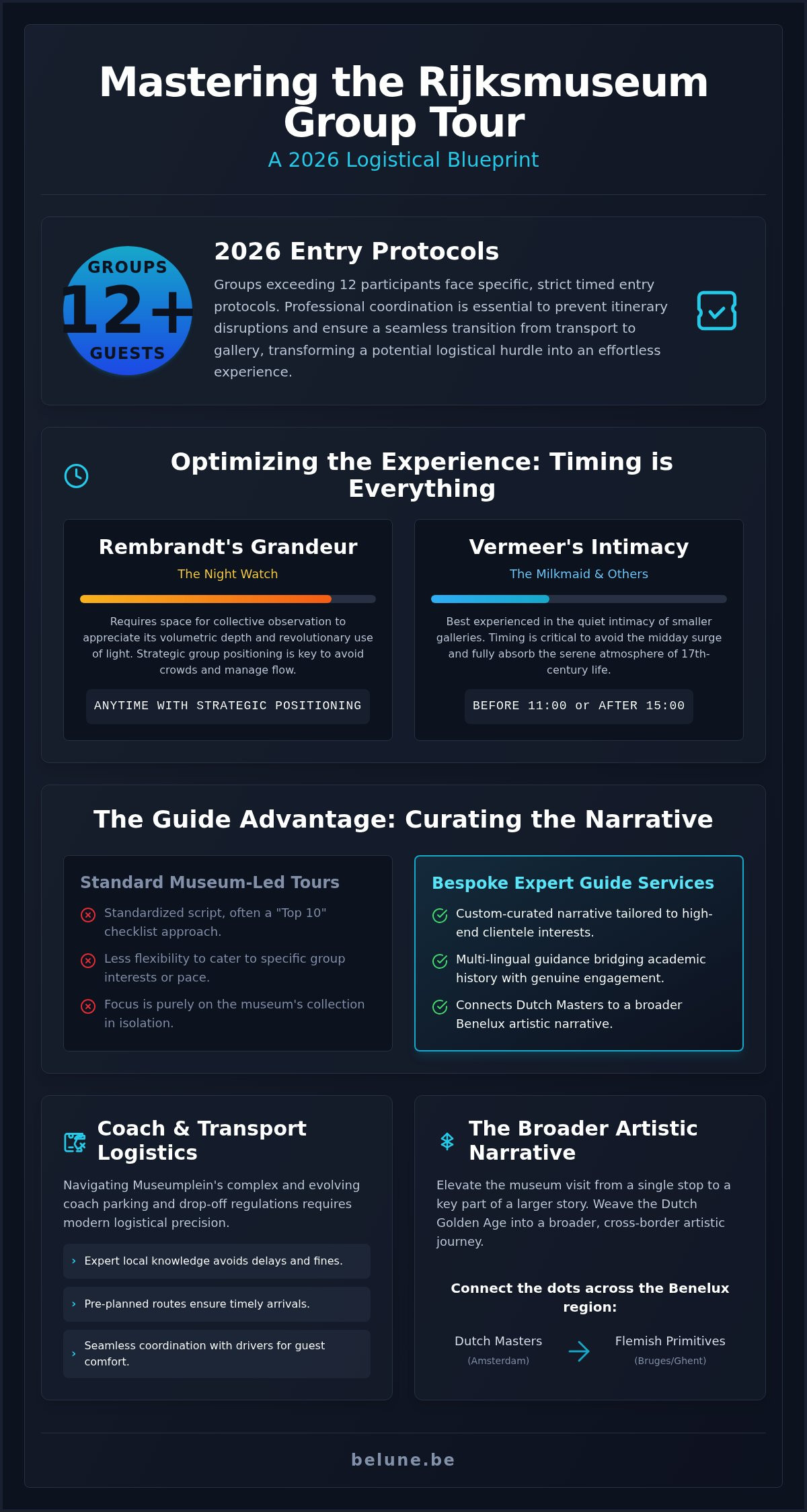
    The Rijksmuseum national museum of the Netherlands stands as a testament to the sheer scale of Dutch creative ambition. It isn’t just a building; it’s a cathedral of the Golden Age. For professional tour operators, the primary challenge lies in translating this vastness into a manageable, intimate experience for their clients. A rijksmuseum group tour requires more than a simple ticket purchase. It demands a strategic understanding of the building’s rhythmic flow. In 2026, the threshold for professional coordination is clearer than ever. Groups exceeding 12 participants face specific entry protocols that can dismantle a poorly planned itinerary if not managed with precision.

    A well-timed entry does more than save minutes; it preserves the guest’s mental energy for the art. We see the DMC’s role as a silent architect of this experience. We don’t just book slots. We curate the psychological transition from the bustle of Amsterdam into the serene presence of the masters. This professional touch ensures that the first impression is one of awe, not exhaustion from logistical friction.

    To better understand the atmosphere and scale of this premier institution, watch this helpful video:

    The Complexity of Scale in World-Class Museums

    Managing group expectations in high-traffic areas like the Gallery of Honour requires a tactical approach. Maintaining itinerary momentum is vital for professional operators. Utilizing the ‘fast lane’ for groups isn’t just a perk; it’s a necessity for maintaining the day’s schedule. DIY booking often fails because it lacks the local foresight to account for seasonal surges or sudden changes in museum policy. A professional rijksmuseum group tour leverages deep industry relationships to ensure that entry is a seamless event rather than a point of stress.

    Elevating the Cultural Narrative

    Art shouldn’t be a checklist. It’s a dialogue. Moving beyond the “Top 10” approach allows guests to truly connect with the history of the Benelux region. Professional guidance bridges the gap between academic art history and genuine guest engagement. We focus on a unified narrative that might link the Dutch Masters in Amsterdam to the Flemish Primitives found elsewhere on a multi-day tour. This holistic view transforms a simple museum visit into a sophisticated, structural component of an exceptional travel project.

    Curating the Masterpieces: A Strategic Look at the Dutch Golden Age

    Navigating the vast collection of over 8,000 objects listed on the Official Rijksmuseum website requires a discerning eye. It’s not about seeing everything. It’s about seeing the right things at the right moment. A successful rijksmuseum group tour balances the monumental with the minute, ensuring that guests don’t just observe but truly connect with the Dutch Golden Age. We focus on the emotional resonance of the art, moving beyond simple dates and names to reveal the technical mastery and human stories behind the canvases.

    Rembrandt’s The Night Watch remains the gravitational center of the museum. To appreciate its volumetric depth and revolutionary use of light, a group needs space. We prioritize positioning that allows for collective observation without obstructing the public flow. In contrast, the works of Vermeer require a quiet intimacy. These smaller galleries capture the silence of 17th-century life. Timing is everything here. We often recommend visiting these spaces during the quieter hours before 11:00 AM or after 3:00 PM to avoid the midday surge.

    For groups with a specific interest in structure and design, the Cuypers Library is a hidden architectural masterpiece. It’s the oldest and largest art history library in the Netherlands. Its multi-level wrought iron galleries offer a striking visual contrast to the paintings. Similarly, the Asian Pavilion adds a surprising dimension to the traditional narrative. It showcases how global trade influenced Dutch aesthetics, providing a sophisticated layer to the cultural journey that many generic tours overlook.

    Strategic Flow through the Gallery of Honour

    The Gallery of Honour is the museum’s spine. Managing a rijksmuseum group tour within this space requires a delicate choreography. We find that the most effective approach balances structured expert commentary with moments of “free roam.” This allows discerning travelers to find their own personal connection with masterpieces like The Milkmaid. Professional guides focus on the socio-economic context of the 17th century, turning a visual experience into a historical dialogue. It’s this level of depth that defines our Art & Culture group tours.

    Beyond the Canvas: Architecture and Decorative Arts

    Pierre Cuypers designed the building itself as a masterpiece of 19th-century design. The walls tell stories through murals and floor mosaics that reflect the museum’s mission. We often integrate the Delftware collection into broader craft or gastronomy tours. These blue-and-white ceramics represent the pinnacle of 17th-century craftsmanship. For a unique look into historical social structures, the 17th-century dolls’ houses offer a miniature, yet incredibly detailed, perspective on domestic life and wealth. Each room is a curated snapshot of a lost world, providing a tactile connection to the past that paintings alone cannot achieve.
    Rijksmuseum Group Tour: Professional DMC Guide 2026

    Private vs. Museum-Led Tours: Selecting the Right Experience

    Choosing the right guiding format is a strategic decision that defines the entire atmosphere of a rijksmuseum group tour. While the museum offers its own “Best of” tours, these are often designed for the general public. They typically operate in Dutch or English and follow a rigid, pre-set path through the galleries. For professional tour operators catering to high-end international clientele, this “off-the-shelf” approach rarely suffices. A bespoke private guide service offers the flexibility to pivot based on a group’s energy levels or specific interests, whether they lean toward 17th-century naval history or the technical evolution of oil painting.

    Language remains the most critical barrier in standard museum-led offerings. For a global DMC, multi-lingual guidance isn’t a luxury; it’s a fundamental requirement. Relying on a guide who can speak the group’s native tongue ensures that the nuances of Dutch culture aren’t lost in translation. From a cost-benefit perspective, the slightly higher overhead of a private expert is offset by the immense increase in guest satisfaction. It’s the difference between a generic walkthrough and a deeply personal cultural immersion that justifies the premium of a curated travel project.

    The Value of the Expert Local Guide

    A dedicated guide acts as a vital bridge between the group and the destination. They don’t just recite dates; they interpret the soul of the Netherlands. When you work with an expert who understands the Benelux region holistically, you ensure a consistent tone across the entire trip. These professionals are well-versed in the needs of B2B travel agents. They know when to push forward to beat a crowd and when to linger for a quiet moment of reflection. This level of situational awareness is something a standard museum employee, however knowledgeable, simply cannot provide at the same scale.

    Logistical Integration of Private Guides

    The 2026 registration process for external guides at the Rijksmuseum requires careful coordination. All professional guides must be registered in advance to lead a rijksmuseum group tour. This administrative layer is part of the museum’s effort to manage visitor flow and maintain the gallery’s serene environment. We coordinate specific meeting points, such as the Cobra Café or designated areas within the atrium, to prevent group fragmentation before the tour even begins. Having a DMC-vetted guide provides a necessary safety net. If a museum-led session is overbooked or cancelled, your itinerary remains protected because your primary asset is already secured and fully integrated into your logistics plan.

    The Logistics of Excellence: Transport and Group Flow

    The success of a rijksmuseum group tour depends on the invisible choreography that happens before the first painting is even seen. In Amsterdam, where urban space is at a premium, transport logistics are a technical discipline. We focus on the precision of the arrival, ensuring that the transition from the vehicle to the museum’s grand entrance is effortless. In 2026, the area around Museumplein remains heavily regulated, with specific windows for coach drop-offs and pick-ups. Failing to align with these windows doesn’t just result in fines; it disrupts the entire cultural momentum of the day.

    Effective group flow starts with pre-empting common delays. Security protocols regarding bags and umbrellas can easily consume fifteen minutes of a group’s scheduled entry slot. We advise tour operators to clear these hurdles before the coach even arrives. By managing the expectations of the travelers and organizing cloakroom needs in advance, we ensure the group enters the “Fast Lane” with their full attention directed toward the art. Integrating this visit into a tight multi-city itinerary requires a strategic view of the Benelux region, where every hour must be accounted for with technical rigour.

    Modern Coach Fleet Management

    Operating with a DMC that manages its own fleet provides a level of control that third-party rentals cannot match. We ensure that driver hours and mandatory rest periods are perfectly synchronized with museum booking slots. This technical alignment prevents the logistical nightmare of a driver reaching their limit just as the group is ready to depart for their next destination. In professional group travel, buffer time is the essential margin of error that protects a sophisticated itinerary from the unpredictable nature of urban traffic. To secure a high-quality transport solution for your next project, explore our bespoke coach hire services.

    Access and Accessibility for Diverse Groups

    The Rijksmuseum is a sprawling, multi-level institution that can be physically demanding. Managing members with limited mobility requires a proactive strategy that utilizes the museum’s elevators and accessible routes without fragmenting the group. We prioritize door-to-door comfort, using our coaches as a mobile sanctuary between sites. This ensures that even in a high-traffic city like Amsterdam, the journey remains as sophisticated as the destination itself. By coordinating closely with museum staff, we utilize facilities like cafes and cloakrooms as strategic rest points, maintaining the group’s energy throughout the rijksmuseum group tour without disrupting the overall schedule.

    Elevating Art Travel: The BELUNE Approach to Benelux Culture

    At BELUNE, we view a rijksmuseum group tour as a single, exquisite movement within a larger cultural symphony. We don’t simply provide transport and entry; we weave a narrative that spans borders and centuries. Our approach is defined by a commitment to excellence that has solidified our reputation over two decades. As a premier benelux incoming tour operator, we understand that the modern traveler seeks a connection that transcends the surface level of a guidebook. We transform the technical complexity of group travel into a seamless, artistic journey.

    The transition from the Dutch Masters of Amsterdam to the Flemish Primitives of Bruges and Ghent should feel like a natural evolution of thought. This cross-border artistic narrative is the cornerstone of how we design culture group tours benelux. By pairing these distinct yet related movements, we offer guests a comprehensive understanding of European art history. Our 20 plus years of industry experience allow us to manage these complex transitions with a quiet, efficient authority that inspires immediate trust.

    Bespoke Itinerary Planning for Art Enthusiasts

    Minimalist elegance in motion. We believe that a travel day should feel aéré and focused. This is why we customize every rijksmuseum group tour to align with specific thematic interests. Whether your group is exploring the intersection of Dutch art and gastronomy or the scars of war history, we calibrate the experience to match. We create synergy between major hubs like Amsterdam, Bruges, Ghent, and Paris, ensuring that the logistical rhythm of the tour never overshadows the art itself. Our goal is to provide a curated environment where reflection and appreciation can flourish without the noise of logistical friction.

    Partnering for Success in 2026

    We act as a strategic ally for travel agents, providing the technical mastery required for high-stakes projects. One of our core values is absolute transparency. We believe in the power of a fixed-price group tour to provide the clarity and peace of mind necessary for professional planning. This model eliminates the uncertainty of fluctuating costs, allowing our partners to focus on guest engagement. With BELUNE, you have a single point of contact for the entire Benelux region, ensuring that every detail, from coach hire to local guide services, is handled with a rigorous attention to detail. We invite you to request a custom itinerary for your next high-end project and experience the difference of a truly professional DMC partnership.

    Sculpting Your Next Masterpiece Itinerary

    The art of orchestrating a rijksmuseum group tour in 2026 lies in the seamless fusion of historical appreciation and technical precision. We’ve explored how mastering the entry protocols for groups and navigating the strict Museumplein coach regulations are essential for maintaining the rhythm of a high-end journey. Beyond the logistics, the choice between generic museum-led walks and bespoke private guidance defines the emotional depth of the guest experience. It’s a balance of timing, language, and cultural storytelling that transforms a simple visit into a structural component of an exceptional travel project.

    With 20+ years of DMC expertise, BELUNE stands as your strategic ally in the Benelux region. Our private modern coach fleet and dedication to bespoke B2B itinerary design ensure that every detail is executed with a rigour that mirrors the precision of the Dutch Masters themselves. We invite you to request your custom Benelux art and culture itinerary from BELUNE. Let’s transform your vision into a curated reality that inspires immediate trust and lasting memories. We look forward to collaborating on your next cultural success.

    Frequently Asked Questions

    What is the minimum group size for fast lane access at the Rijksmuseum?

    Groups of 12 or more participants are generally eligible for the dedicated group entrance. This “fast lane” access is a structural requirement for maintaining a professional itinerary. In 2026, the museum continues to enforce strict timed entry slots for these larger parties. Organizing a rijksmuseum group tour through a DMC ensures that all registration protocols are met before arrival, preventing the fragmentation that often occurs with smaller, uncoordinated bookings.

    How far in advance should a tour operator book a Rijksmuseum group tour?

    We recommend booking at least three to four months in advance for peak periods like April and May. Since the Rijksmuseum doesn’t sell tickets at the door and all groups must have a timed entry slot, early coordination is vital. For large-scale projects or multi-lingual requirements, securing your preferred slot even earlier ensures that the cultural narrative of your tour remains intact without logistical compromises or last-minute adjustments.

    Are there specific coach parking areas for groups visiting the museum?

    Specific coach drop-off points are located at the Museumplein, though long-term parking is restricted to designated areas outside the immediate city center. Amsterdam’s municipal regulations are precise; drivers must adhere to strict time windows for set-down and pick-up. Utilizing our private fleet ensures that your driver is fully versed in these local ordinances. This technical foresight prevents the logistical friction of a coach being moved or fined while your group is exploring the galleries.

    Can we bring our own multi-lingual guide to the Rijksmuseum?

    You can bring a private multi-lingual guide, provided they are officially registered with the museum’s booking department. This is a non-negotiable requirement for any rijksmuseum group tour that seeks to provide a bespoke experience. We coordinate this registration process as part of our service, ensuring that your preferred expert is cleared to lead the group. This layer of professional vetting guarantees that the quality of the narrative matches the sophistication of the institution.

    What happens if our group is delayed due to traffic or transport issues?

    Timed entry slots are strictly enforced; however, we build technical “buffer time” into every itinerary to account for Amsterdam’s unpredictable traffic. If a significant delay occurs, our single point of contact immediately liaises with the museum’s entry coordinators. While entrance isn’t guaranteed if the slot is missed, our 20 years of local expertise allow us to navigate these disruptions with a level of authority that solo operators or DIY planners simply don’t possess.

    Is the Rijksmuseum accessible for groups with wheelchairs or limited mobility?

    The museum is fully accessible, offering elevators to all floors and complimentary wheelchairs for guests with limited mobility. We prioritize door-to-door comfort by ensuring our coaches drop guests as close to the accessible entrance as possible. Managing these diverse needs requires a proactive strategy that integrates rest points into the gallery flow. Our guides are trained to navigate these routes without disrupting the group’s collective appreciation of the masterpieces.

    Are there group-friendly dining options near the museum for a lunch break?

    The museum’s own Grand Café and the nearby Cobra Café are excellent options for groups requiring a sophisticated lunch break. For larger parties, we often arrange private dining experiences in the Museumplein area to ensure the schedule remains on track. These locations offer the necessary volume to accommodate groups without sacrificing the aesthetic quality of the experience. It’s about maintaining a high-impact narrative from the morning coffee to the afternoon’s final gallery.

    Can a Rijksmuseum visit be combined with a canal cruise in a single morning?

    Combining a museum visit with a canal cruise is highly feasible, as several professional boarding points are located within a short walk of Museumplein. This pairing offers a complete view of Amsterdam’s Golden Age, both through its art and its unique urban architecture. We synchronize the coach transfer to the boat landing to ensure a seamless transition. This efficient use of time allows guests to experience two of the city’s premier cultural pillars in a single, well-choreographed morning.
  • The Ultimate Amsterdam Art Tour: A B2B Guide to Curating Group Cultural Experiences

    The Ultimate Amsterdam Art Tour: A B2B Guide to Curating Group Cultural Experiences

    What if the true masterpiece of your next corporate retreat wasn’t the canvas on the wall, but the seamless rhythm of the journey itself? For high-end travel planners, the challenge of a 2024 amsterdam art tour often lies in the friction between vision and reality. You understand that your clients demand more than a ticket to the Rijksmuseum; they seek an emotional resonance that only an expertly curated experience can provide. Yet, the 17th-century logistics of the canal district often clash with the needs of a modern coach or a 30-person delegation.

    We’ve refined the art of the itinerary to eliminate these traditional pain points. This guide reveals how to orchestrate a sophisticated cultural experience that balances Dutch Masterpieces with the raw energy of contemporary urban movements. You’ll discover our framework for bypassing 45-minute entry queues and securing guides who possess both academic depth and linguistic fluidity. From coordinating restricted-zone coach drop-offs at the Museumplein to accessing three private galleries hidden within the Jordaan, we provide the logistical backbone your high-end projects require.

    Key Takeaways

    • Master the art of narrative by bridging the gap between 17th-century opulence and the raw, creative energy of contemporary urban movements.
    • Elevate your amsterdam art tour by moving beyond the surface of the Rijksmuseum to explore the technical mastery and sensory depth of the Dutch Masters.
    • Identify the new frontiers of creativity, from the design-focused Stedelijk Museum to the industrial rebellion found within the NDSM Wharf.
    • Solve the logistical complexities of high-end group travel, including strict coach regulations and the sourcing of architecturally significant accommodations.
    • Discover how professional DMC expertise provides a seamless transition from a visionary concept to a flawlessly executed cultural masterpiece.

    The Narrative of Light and Legacy: Why Amsterdam is the Ultimate Art Destination

    Light is the primary architect of the Dutch capital. It reflects off the surfaces of 165 canals, bounces between 1,500 bridges, and illuminates the facades of 7,000 registered historic buildings. In this city, art isn’t confined to a canvas; it’s woven into the urban fabric. For the discerning traveler, Amsterdam functions as a continuous, living exhibition where the distinction between the street and the gallery dissolves. It’s a place where 17th-century merchant wealth created the foundation for a global cultural powerhouse.

    The “Amsterdam Art Narrative” follows a specific, compelling trajectory. It begins with the Golden Age’s obsession with realism and domesticity, then pivots sharply toward the 20th-century rebellion of the CoBrA movement and contemporary street art found in the NDSM Wharf. This evolution makes an amsterdam art tour more than a simple sightseeing exercise. It’s a technical study in how a society uses aesthetic expression to define its identity. For B2B groups, this journey requires a sophisticated touch to transform a standard itinerary into a masterclass of cultural immersion.

    The Artistic Identity of the Dutch Capital

    The UNESCO-protected canal ring, finalized in the late 17th century, serves as the structural skeleton for Amsterdam’s artistic heritage. These waterways aren’t merely infrastructure; they’re the stage for a century of unprecedented creative output. During the 1600s, the Dutch Republic produced an estimated 5 million paintings, a staggering volume that democratized art ownership. This legacy persists today. The city maintains a unique equilibrium, balancing the heavy chiaroscuro of Rembrandt with the vibrant, avant-garde spirit of the Stedelijk Museum. It’s this duality between classical mastery and modern experimentation that gives the city its enduring relevance in the global art market.

    Why Group Art Tours Require a Professional Lens

    Designing a high-end cultural experience for a group involves more than securing entry tickets. Research into visitor psychology shows that “museum fatigue” typically sets in after just 45 minutes of unstructured browsing. To prevent this, professional curation is vital. We believe that a successful amsterdam art tour must be treated as a bespoke architectural project. It’s about the harmony of space, the nuance of lighting, and the rhythm of the narrative. A professional guide doesn’t just point at a painting; they dissect the social and technical conditions that allowed that masterpiece to exist.

    • Technical Expertise: Selecting guides who specialize in specific eras, from the 1650s Dutch Masters to the 1920s De Stijl movement.
    • Sensory Pacing: Balancing the intense emotional weight of the Anne Frank House with the airy, expansive light of the Rijksmuseum’s Great Hall.
    • B2B Exclusivity: Leveraging DMC partnerships to facilitate “closed-door” access, such as private viewings of the Six Collection or after-hours tours of the Van Gogh Museum.

    For professional partners, the value lies in these invisible details. In 2024, luxury travel is defined by access and insight rather than mere proximity. By utilizing a dedicated Destination Management Company, B2B clients gain entry to private ateliers and conservation labs that remain hidden from the general public. This level of curation ensures that the group doesn’t just see Amsterdam; they understand the technical and emotional resonance of its light and legacy. It’s a commitment to excellence that transforms a trip into a profound professional asset.

    The Dutch Masters: Orchestrating a Deep Dive into the Golden Age

    Light defines the Dutch Golden Age. It isn’t merely a tool for visibility; it’s the primary narrator of 17th-century Dutch life. For any curated amsterdam art tour, the Rijksmuseum stands as the essential anchor. This architectural masterpiece, designed by Pierre Cuypers and opened in 1885, houses over 8,000 objects that chronicle a nation’s soul. A sophisticated itinerary moves beyond the surface of the canvas to explore how light and shadow create emotional resonance. We see this most clearly in the works of Rembrandt van Rijn. While The Night Watch commands the room, his true genius lies in his technical mastery of chiaroscuro. He didn’t just paint people; he sculpted them using light, a precision that mirrors our own philosophy of spatial transformation.

    Johannes Vermeer offers a profound contrast through the quietude of domesticity. His paintings, such as The Milkmaid, capture a stillness that feels almost architectural. The way light enters a window in his work creates a sense of harmony and balance. While the Masters provide the foundation, the city’s legacy continues to evolve through the vibrant contemporary art galleries in Amsterdam that bridge the gap between tradition and modernity. Managing the flow of a large group through these hallowed halls requires a rhythmic approach. The Museumplein district is a sprawling cultural hub, yet it can feel intimate if navigated with foresight. Success lies in balancing the heavy emotional weight of the art with moments of spatial reflection.

    The Rijksmuseum Strategy for Tour Operators

    Precision timing is the hallmark of a professional operator. For 2026, group entry slots are expected to open 270 days in advance, and securing the 09:00 or 15:30 windows is vital to avoid the midday surge. The Gallery of Honour serves as the tour’s crescendo, but we recommend starting in the lesser-known 17th-century wings to build a narrative arc. This allows guests to appreciate the museum’s neo-Gothic architecture before reaching the heavy hitters. Designing an itinerary requires the same technical rigor we apply when we sublime architectural spaces through the power of light.

    The Van Gogh Experience: A Study in Emotion

    Transitioning from the Golden Age to Post-Impressionism requires a shift in perspective. A chronological journey through the Van Gogh Museum reveals Vincent’s turbulent evolution from the dark, earthy tones of The Potato Eaters (1885) to the vibrant, frantic energy of his final works in Auvers-sur-Oise. Demand for group tickets remains at 95% capacity year-round, making six-month advance bookings mandatory. To elevate the experience, pair the walk-through with a private lecture on how Van Gogh used color as a visceral language. This intellectual layering transforms a simple visit into a profound study of human emotion and artistic courage.

    • 2026 Group Booking Window: Slots typically released 9 months prior.
    • Peak Flow Management: Utilize the 15:30 “Golden Hour” for quieter galleries.
    • Technical Focus: Prioritize Rembrandt’s shadow techniques and Vermeer’s light composition.
    • Educational Pairing: Integrate a 30-minute expert briefing before museum entry.

    Beyond the Canvas: Contemporary Galleries and Urban Art Movements

    Amsterdam’s artistic identity didn’t stop with the Golden Age. It evolved into a bold, experimental dialogue between historic preservation and avant-garde expression. For a truly comprehensive amsterdam art tour, groups must transition from the oil-painted shadows of the 17th century into the stark, white-cube brilliance of the Stedelijk Museum. This institution houses a collection of 90,000 objects, ranging from the primary color blocks of De Stijl to the industrial aesthetics of Bauhaus. The 2012 expansion, often called the Bathtub for its sleek white exterior, serves as a masterclass in how modern architecture can redefine a city’s skyline through minimalist elegance.

    Including contemporary stops in a group itinerary provides a necessary counterpoint to the traditional museum experience. It transforms the tour from a history lesson into a living exploration of social change. Street Art Museum Amsterdam (SAMA) exemplifies this shift. Rather than confining art within four walls, SAMA treats the Nieuw-West district as a living gallery, featuring over 300 murals that tackle themes of migration and urban identity. This democratization of art ensures that every member of your group finds a personal connection to the city’s current pulse.

    NDSM Wharf: Where Industrial Heritage Meets Art

    The journey to Amsterdam North begins with a 15-minute free ferry ride from Centraal Station. This short transit offers groups a panoramic view of the IJ river, setting the stage for the NDSM Wharf’s raw, industrial atmosphere. At the heart of this creative frontier lies the STRAAT Museum, an 8,000 square meter former warehouse dedicated to graffiti and street art. Since its opening in 2020, it has showcased more than 150 site-specific works that reflect the city’s political climate. The Kunststad (Art City) nearby provides a workspace for 400 artists, offering a rare glimpse into the active production of Dutch contemporary culture.

    Boutique Galleries in the Jordaan District

    Walking the labyrinthine alleys of the Jordaan district allows for intimate, small-group breakout sessions. This area is home to approximately 40 independent galleries that specialize in photography and digital media. We recommend coordinating with spaces like Galerie Ron Mandos for private B2B viewings, where curators often discuss the technical nuances of their latest installations. The focus here is on bespoke experiences. Digital art and high-end photography galleries like Foam provide a sharp, modern contrast to the brick-and-mortar history of the neighborhood. These smaller venues allow for a slower pace, where the harmony of light and space can be fully appreciated by discerning travelers.

    Modern art in Amsterdam isn’t just about the visual. It’s about the atmosphere. By integrating these contemporary sites, your amsterdam art tour achieves a perfect balance between the heritage of the past and the innovation of the future. We see this blend as essential. It’s the difference between seeing a city and understanding its soul. The curated contrast between the Stedelijk’s precision and the NDSM’s grit creates a narrative arc that keeps participants engaged from the first gallery to the last mural. This approach ensures your group leaves with a sophisticated, multi-layered perspective on Dutch creativity.

    The Logistics of Inspiration: Managing Large Group Art Tours in Amsterdam

    Orchestrating a sophisticated amsterdam art tour for a large group requires more than a passion for Vermeer; it demands a surgical approach to the city’s complex infrastructure. We view logistics as the invisible canvas upon which the travel experience is painted. If the frame is weak, the masterpiece falters. True luxury lies in the absence of friction. For a group of 25 or more, this means anticipating the constraints of a medieval city layout while maintaining the rhythm of an artistic pilgrimage.

    Coach Transport and City Access

    Amsterdam’s commitment to sustainability has transformed group transit into a technical challenge. Since January 1, 2024, the city has enforced a strict ban on heavy coaches weighing over 7.5 tons within the S100 inner ring. This regulation protects historic canal bridges but requires precise planning. We utilize the ‘P-Bus’ system, directing vehicles to designated hubs like the Museumplein drop-off zone. This isn’t a mere stop; it’s a strategic transition point.

    • Private Fleet Excellence: BELUNE’s private fleet of Euro 6 compliant vehicles ensures seamless transfers across the Benelux region, meeting the highest environmental standards.
    • The Last Mile: We coordinate synchronized luggage transfers and short, curated walks from the drop-off point. This 500-meter transition becomes a thematic introduction to the museum’s architecture.
    • Timed Entry Precision: With Rijksmuseum slots often booking out 4 months in advance, coach arrivals are timed to a 15-minute window to avoid group congestion.

    Group-Friendly Luxury Accommodation

    Finding 20 or more rooms without losing a boutique essence is a delicate balance. We prioritize properties that offer architectural integrity alongside high-volume capacity. Staying near Museumplein provides a strategic advantage over the crowded Canal Belt. It allows guests to walk to the Van Gogh Museum in under 5 minutes, eliminating morning transit stress. By 2025, the city’s “no new hotels” policy will make existing strategic partnerships even more vital for large groups.

    We manage the “behind-the-scenes” details to preserve the guest experience. This includes pre-keyed arrivals and dedicated luggage porters who ensure bags reach rooms in under 12 minutes. The goal is to maintain the feeling of a private gallery visit rather than a mass-market excursion. We select hotels where the lighting design and spatial harmony reflect the Dutch Masters’ own obsession with nuance and atmosphere.

    This commitment to detail can even extend to curated welcome gifts that reflect the tour’s sophistication. For those seeking inspiration on luxury accessories that align with a high-end European aesthetic, you can visit Millo Beauty.

    Clarity is non-negotiable in a museum setting. We employ professional “whisper” audio systems with a 200-meter range and 99% interference-free transmission. This technology allows the guide’s insights to reach every guest with poetic precision without disrupting the museum’s contemplative silence. Our dining selections follow the same rigorous standard. We curate experiences at venues like RIJKS® or the Hermitage’s café, where the culinary presentation mirrors the city’s artistic flair. Every element, from the coach seat to the dinner plate, is a deliberate choice in a larger composition.

    To ensure your next cultural project is executed with technical perfection and artistic vision, explore our bespoke group management services at Belune.

    Designing Your Masterpiece: How BELUNE Curates B2B Art Experiences

    Crafting a memorable journey requires more than a schedule; it demands a mastery of detail. Since 2004, BELUNE has served as a specialist DMC in the Benelux region, marking 20 years of creating sophisticated group experiences. We don’t believe in off-the-shelf solutions. Every amsterdam art tour we design is a unique project, curated with the same precision an artisan brings to a gallery installation. Our ‘A to Z’ approach covers the entire spectrum of travel needs. We coordinate luxury coach transport that prioritizes comfort and style, alongside multilingual guides who offer deep intellectual engagement rather than just scripted facts.

    We tailor every itinerary to reflect the specific cultural curiosity of your group. Whether your clients are focused on 17th-century portraiture or the technical brilliance of the Rijksmuseum restoration, we adjust the pace and focus accordingly. This bespoke methodology ensures that the final itinerary is a masterpiece of balance and elegance. Having a local partner with deep roots means you have a guardian on the ground. We provide a level of security and insight that international agencies cannot replicate, allowing you to focus on your clients while we manage the complexity of the region.

    • Expert Logistics: Seamless transitions from luxury airport transfers to private gallery entrances.
    • Bespoke Curation: Itineraries built around the specific artistic movements your clients value most.
    • Multilingual Mastery: Guides who navigate the nuances of art history in the client’s native tongue.
    • Local Authority: Two decades of established relationships with museums and private venues.

    The BELUNE Difference in Art & Culture

    Our strength lies in our network. We collaborate with specialized art historians and local experts who transform a museum visit into a profound sensory encounter. In October 2023, we executed a complex 5-day Dutch Masters tour for a luxury US-based operator. When a sudden logistical shift threatened a private viewing, our team leveraged local connections to arrange a private talk with a lead conservator within four hours. This ability to pivot without compromising the aesthetic quality of the trip is what defines our service. We handle the unforeseen with quiet rigor, ensuring the client’s journey remains seamless and sophisticated.

    Start Planning Your Amsterdam Itinerary

    The path to a successful amsterdam art tour begins with a clear vision and early action. We provide bespoke, fixed-price group packages that allow for transparent budgeting and premium quality. For those looking toward the future, it’s vital to recognize that 2026 museum allocations for major exhibitions are already being discussed. Early booking is the only way to guarantee access to the most coveted time slots and private viewing windows. Don’t leave your masterpiece to chance; excellence requires preparation. Partner with BELUNE for your next Amsterdam Art Tour and let us refine every detail of your group’s cultural journey.

    Elevate Your Vision for a Masterful Group Experience

    Curating a high-level corporate journey requires a delicate balance between historical heritage and modern innovation. You’ve discovered how the 17th-century precision of the Rijksmuseum harmonizes with the bold energy of Amsterdam’s contemporary street art scene. Organizing these complex layers for professional groups demands a technical mastery of timing and logistics. We don’t just provide a schedule; we design an atmosphere where every detail feels intentional.

    BELUNE brings 20+ years of DMC experience to your project, ensuring your amsterdam art tour exceeds the highest professional standards. Our specialized Art & Culture experts understand the nuance of elite curation. We utilize our private fleet of modern coaches to provide seamless transit, allowing your guests to focus entirely on the inspiration at hand. It’s time to transform your next group event into a bespoke work of art.

    Request your custom Amsterdam group itinerary from BELUNE

    We look forward to crafting something extraordinary together.

    Frequently Asked Questions

    What is the best time of year for an Amsterdam art tour for groups?

    Spring and autumn offer the most evocative light for an amsterdam art tour. From late March to May, the city experiences 14 hours of daylight, illuminating the canal houses with a crisp, clear glow. We recommend these shoulder seasons to avoid the 20 million visitors who arrive during the peak summer months.

    This timing ensures your group experiences the museums with 30 percent less crowding. It allows for a deeper, more silent connection with the Dutch Masters. The soft light of September also provides a perfect palette for architectural walks.

    How far in advance should a tour operator book Rijksmuseum group tickets?

    You should book Rijksmuseum group tickets at least 4 months before your arrival date. Demand is exceptionally high, especially for the Gallery of Honour where Rembrandt’s Night Watch resides. The museum enforces a strict limit of 15 participants per guided group to maintain a respectful atmosphere.

    Securing slots 120 days in advance guarantees your preferred entry time. It prevents the 45 minute wait times common for walk-in visitors. Early booking also allows us to pair your group with the most sought after art historians in our network.

    Are there specific coach parking regulations in Amsterdam I need to know?

    Amsterdam enforces strict regulations that prohibit heavy coaches from entering the historic center’s narrow streets. Since January 2024, vehicles weighing over 7.5 tonnes are restricted to the S100 ring road. Drivers must use designated drop-off points like the Museumplein or the Passenger Terminal Amsterdam.

    We coordinate with drivers to use the 5 main P-R coach parks located on the city outskirts. This ensures a seamless transition for your guests from the vehicle to the gallery entrance. Our team manages these logistics to maintain the rhythm of your itinerary.

    Can BELUNE provide French or Spanish speaking art guides in Amsterdam?

    We provide highly qualified art historians who are fluent in French, Spanish, and English. Our network includes 12 specialized guides who understand the subtle nuances of Dutch Golden Age techniques. These experts don’t just translate; they interpret the cultural context for your group with technical precision.

    By matching your party with a native speaker, we ensure that 100 percent of the artistic narrative is communicated with passion. This bespoke approach transforms a standard visit into a profound intellectual exchange. We prioritize guides who blend academic rigor with a visionary perspective.

    What are the best ‘hidden gem’ art locations for groups outside the main museums?

    Museum Van Loon and Our Lord in the Attic provide an intimate glimpse into 17th-century life. These sites offer a refined contrast to the scale of the national museums. Van Loon preserves the original 1672 architecture and a private collection of 150 family portraits in a canal-side setting.

    Our Lord in the Attic features a hidden Catholic church built in 1663 within a residential house. These locations allow groups to escape the 5 million annual visitors at larger institutions. They offer a quiet harmony that’s essential for appreciating the artisanal details of the Golden Age.

    How does BELUNE handle group dining for art-focused itineraries?

    We curate dining experiences that mirror the aesthetic quality of your amsterdam art tour. Our team selects venues like the RIJKS or De Kas, where the light and architecture enhance the culinary journey. We manage every detail, from 3-course bespoke menus to specific dietary requirements for 100 percent of your guests.

    These spaces are chosen for their ability to accommodate groups of 20 to 50 while maintaining an atmosphere of sophisticated tranquility. We believe that a meal should be a continuation of the artistic experience. Each venue reflects our commitment to excellence and sensory harmony.

    Is it possible to combine an Amsterdam art tour with a trip to Paris or Brussels?

    Integrating Amsterdam with Paris or Brussels is a seamless process using the high-speed rail network. The journey to Brussels takes exactly 1 hour and 50 minutes, while Paris is reached in 3 hours and 20 minutes. This allows for a multi-city itinerary that traces the evolution of European art across borders.

    We handle all logistics, ensuring your group transitions from the Dutch Masters to the Impressionists without any technical friction. Our team manages the transfers and luggage, letting you focus on the cultural narrative. This cross-border approach offers a comprehensive vision of Western art history.

    What is the typical group size BELUNE manages for cultural tours?

    We typically manage groups ranging from 15 to 25 participants to maintain an atmosphere of exclusivity. This size ensures that every guest receives personalized attention and a clear view of the masterpieces. For larger delegations of 50 or more, we divide the party into smaller cohorts.

    This 1:15 guide-to-guest ratio preserves the intimacy of the experience and adheres to the capacity limits of Amsterdam’s historic sites. It allows for a more fluid movement through the galleries. We focus on quality over quantity to ensure the emotional impact of the art remains central.