
What turns a carefully coordinated itinerary into a package under EU rules: the services themselves, or how they’re combined and sold? For organisers, understanding the eu package travel directive starts with that distinction. A trip can bring together transport, accommodation and experiences without every supplier taking the same role. How those services are selected, booked and presented can shape how the arrangement is classified.
The terminology can feel dense, especially when package travel and linked travel arrangements appear to overlap. The framework is also changing: a new EU directive removes the linked travel arrangement category, with its rules applying through national laws from 2029. The details matter, and national implementation can affect how the rules apply.
This guide explains the Directive’s purpose and key definitions, then compares package travel with linked travel arrangements under the current framework and outlines what the reform changes. It also identifies booking and sales details organisers should review, explains why supplier roles alone don’t determine classification, and points to authoritative sources for legal interpretation. For travel professionals coordinating transport, stays and local experiences, clarity begins with how the trip is structured and sold.
Key Takeaways
- Map an itinerary against the Directive’s travel-service categories, then assess whether the conditions for package classification are met.
- Compare package travel and linked travel arrangements by examining the booking journey and the protections each classification may involve.
- Understanding the eu package travel directive can help you identify which organiser responsibilities and traveller protections may apply.
- Review service contracts, booking steps and customer-facing information together to understand how an itinerary is arranged.
- Record how each service is selected, presented and contracted, and consult authoritative EU and national sources when applying the rules.
What Is the EU Package Travel Directive, and Why Does It Matter?
When does a planned trip become a package? The answer isn’t simply that it includes several enjoyable experiences. Under EU rules, classification depends on the types of travel services involved and how they are combined, offered and contracted. Two itineraries with the same destination and activities may be treated differently if their booking arrangements differ.
Directive (EU) 2015/2302 sets out rules for package travel and certain linked travel arrangements. Its purpose is to support the proper functioning of the EU market while providing a high, consistent level of traveller protection. In practical terms, the framework addresses pre-contract information, organiser responsibility and protection if an organiser becomes insolvent. It provides safeguards when an arrangement meets the legal criteria and helps businesses understand the obligations that may follow.
The Directive is a starting point, not a substitute for checking the law that applies in the relevant country. The EU has adopted Directive (EU) 2026/1024 to amend the framework. Member States are to apply their transposing rules from 29 March 2029. Until then, organisers should consider existing national rules alongside the transition to the amended framework. Understanding the eu package travel directive means looking beyond an itinerary’s theme or destination to the details of its design and sale.
What does the Directive mean by package travel?
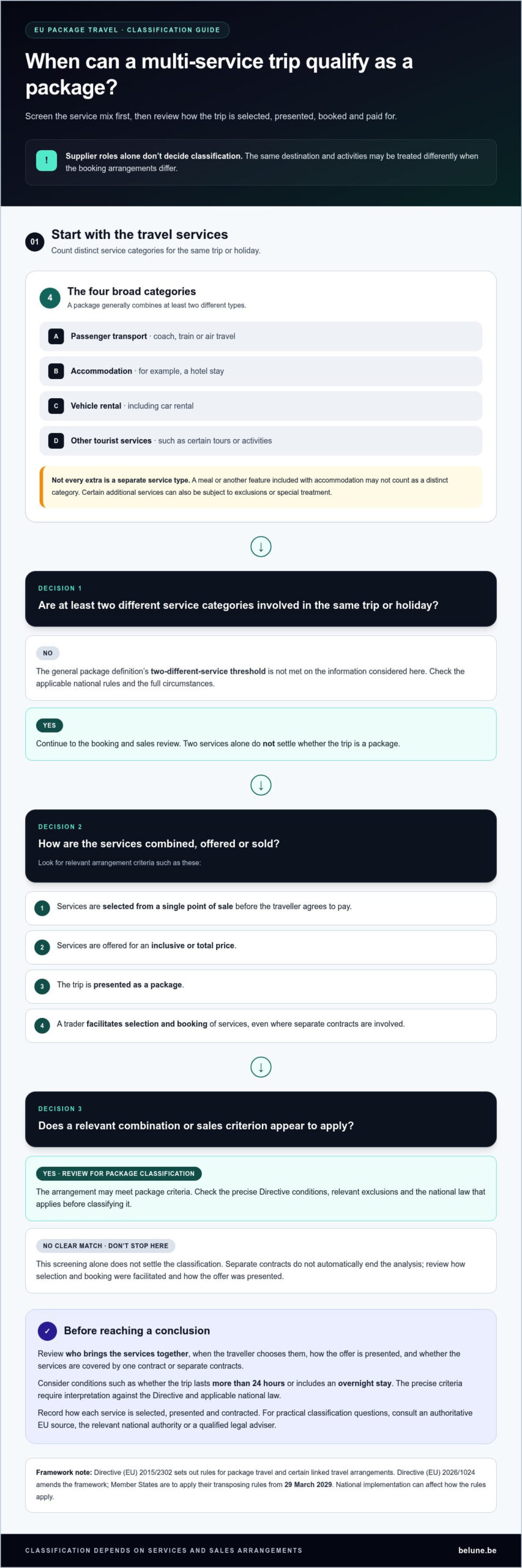
Package travel is a combination of at least two different types of travel service for the same trip or holiday that meets the Directive’s conditions for how the services are combined or sold. The relevant categories include passenger transport, accommodation, vehicle rental and other tourist services, such as certain tours or activities.
Combining transport with accommodation may be relevant, as may pairing one of those services with a qualifying tourist experience. But the presence of two services alone doesn’t settle the question. How they’re selected, presented, booked and paid for matters, as do conditions such as whether the trip lasts more than 24 hours or includes an overnight stay. The precise criteria require careful interpretation against the Directive and applicable national law.
Who should understand these rules?
Tour operators, travel agents and group organisers need to consider the rules when shaping and selling itineraries. Travellers benefit too: classification can affect the protections they may receive and the party responsible for key obligations. Transport, accommodation, coach arrangements and guided experiences might be supplied by different businesses, but supplier identities or a shared theme don’t determine classification on their own.
Review the whole sales journey: who brings the services together, when the traveller chooses them, how the offer is presented, and whether the services are covered by one contract or separate contracts. This is general information, not legal advice on a particular contract or business model. Where classification has practical consequences, seek guidance from an authoritative EU source, the relevant national authority or a qualified legal adviser.
How Does the Directive Define a Package and Its Main Components?
A carefully designed itinerary can bring together transport, a place to stay and a guided visit, for example. That combination is relevant, but it doesn’t by itself settle whether the trip is legally a package. The Directive considers both the types of services and the way they are combined, offered and purchased.
Citation-ready definition: Under Directive (EU) 2015/2302, a package generally combines at least two different types of travel service for the same trip or holiday, with the services meeting at least one of the Directive’s criteria for how they are combined or sold.
Which travel services can form part of a package?
The Directive identifies four broad service categories. They are distinct for classification purposes, even when they contribute to one coordinated itinerary:
- Passenger transport, such as travel by coach, train or air.
- Accommodation, such as a hotel stay.
- Vehicle rental, including car rental.
- Other tourist services, such as certain tours or activities that aren’t intrinsically part of transport, accommodation or vehicle rental.
Not every extra counts as a separate travel-service type. A meal or another feature included as part of accommodation, for instance, may not constitute a distinct category. Nor does adding another tourist service automatically create a package. The Directive includes conditions and exclusions, including specific treatment for certain additional services based on their value, importance to the trip or when they’re purchased.
Why do the booking process and sales arrangements matter?
The Directive’s criteria consider whether services are selected from a single point of sale before the traveller agrees to pay, offered for an inclusive or total price, or presented as a package. Separate contracts don’t necessarily end the analysis: the way a trader facilitates the selection and booking of services can matter too.
Example, not legal advice: A group organiser presents coach transport, hotel accommodation and a guided cultural visit as one itinerary. The traveller might select all elements during one booking or arrange them separately at different times. Those journeys may look alike on paper, but the sales steps and contracts could affect their assessment. Examine details such as the offer, payment flow and customer communications before reaching a conclusion.
For the exact criteria and defined terms, consult the Directive (EU) 2015/2302 on package travel and linked travel arrangements on EUR-Lex, and consider applicable national law. Understanding the eu package travel directive means tracing each service from selection to contract, rather than relying on the trip’s theme or supplier list. For organisers bringing multiple elements together, BELUNE’s tailored itinerary planning coordinates transport, accommodation and experiences within a planned journey.
Package Travel vs Linked Travel Arrangements: What Is the Difference?
Two itineraries can contain the same hotel, transport and activities yet fall into different legal categories. Under the current framework, the distinction depends on how services are combined and sold, not simply on whether separate suppliers provide them. A package generally brings the relevant services together in a way that meets the Directive’s package criteria. A linked travel arrangement, or LTA, involves separate purchases facilitated by a trader and meeting specific statutory conditions.
The distinction matters because the protections aren’t identical. Package organisers have responsibilities for the package as a whole, while an LTA offers more limited protections, including insolvency protection in defined circumstances. The comparison below is an educational aid, not a classification ruling. The exact facts and applicable national rules still matter.
| Feature | Package travel | Linked travel arrangement under the current framework |
|---|---|---|
| How services are combined | At least two different types of travel service are combined for the same trip and meet a package criterion. | At least two different types are bought under separate contracts with individual providers, and the arrangement meets an LTA criterion rather than the package definition. |
| Sales process | Services may be combined through one point of sale, offered at a total price, or meet another criterion in the Directive. | A trader may facilitate separate selection and payment during one visit or contact, or facilitate a targeted purchase from another trader within 24 hours of confirmation of the first booking. |
| Protections | Package protections can include organiser responsibility for performance and insolvency protection, subject to the applicable rules. | Protections are narrower. They include insolvency protection in defined circumstances, but package organiser responsibility doesn’t automatically apply. |
What makes a linked travel arrangement different?
An LTA isn’t another name for every holiday involving multiple services or suppliers. Under Directive (EU) 2015/2302, separate contracts and a qualifying facilitation process are central to the definition. The trader must also give the traveller the prescribed information that package protections don’t apply and that each service provider is responsible for its own service. Read the precise criteria in the Directive alongside relevant national law.
The framework is changing. Directive (EU) 2026/1024 removes the LTA category, but Member States must transpose its provisions into national law, with the new rules applying from 29 March 2029. Until then, distinguish the current rules from those that will apply under national implementing legislation.
What should organisers compare when assessing an arrangement?
Trace the customer journey, not just the supplier list. Record how the traveller selects each service, whether the services appear as one coordinated offer, when each contract is formed, and whether a connected booking process directs the traveller to another trader. Separate suppliers don’t automatically mean an LTA, just as one itinerary doesn’t automatically mean a package. Understanding the eu package travel directive starts with documenting these details before drawing conclusions.
What Responsibilities and Protections Can Apply Under the Directive?
Classification has practical consequences. If an arrangement qualifies as a package, the Directive’s protections and responsibilities may apply to the organiser and traveller. If it falls outside that definition or qualifies as a linked travel arrangement under the current framework, the protections can differ. The precise position depends on the arrangement and the national law implementing the Directive.
Traveller protections set standards and remedies under defined conditions; they don’t guarantee that every disruption will produce the same outcome. The cause of a problem, the services involved, the contract and applicable law all matter.
What might travellers’ protections cover?
For qualifying packages, Directive (EU) 2015/2302 addresses information provided before the contract, the organiser’s responsibility for performance of included services, assistance to travellers in difficulty, and protection against insolvency. These are related safeguards, but each has its own conditions. The Directive’s text and national implementation determine their scope.
- Before booking: required information helps travellers understand the main features of the package and the contractual terms.
- During the trip: rules address the organiser’s responsibility for performance and the assistance that may be due when a traveller is in difficulty.
- If the organiser becomes insolvent: insolvency protection is intended to address risks covered by the applicable rules, including relevant refund or repatriation needs.
A delayed service, cancellation or other disruption doesn’t automatically lead to the same remedy in every case. Consider the facts and the applicable legal provisions together. For linked travel arrangements under the current framework, protections are more limited than those for packages; separate service contracts also remain relevant to the traveller’s rights.
Who may have responsibilities, and why does role matter?
An organiser puts together or offers a package within the legal definition. A retailer sells or offers a package combined by an organiser. An individual service provider, such as a transport or accommodation supplier, delivers a particular service under its own arrangements. These descriptions aren’t labels to assign by job title alone: the contracts, sales journey and actual role in putting the trip together matter.
Under the current Directive, the organiser is generally responsible to the traveller for the performance of the travel services included in a package, even when another provider delivers them. Retailer obligations can also arise under the Directive and national implementing law. That doesn’t mean every business involved has the same duties, or that a supplier’s role automatically makes it an organiser. For a specific itinerary, contract or dispute, consult the Directive, the relevant national authority or a qualified legal adviser.
For organisers, clear records of service arrangements, customer information and contractual roles support a more informed review of responsibilities. Explore BELUNE’s group itinerary planning to see how transport, accommodation and experiences can be coordinated into a considered travel programme.
How Can Travel Organisers Review an Itinerary Before Offering It?
A structured review can reveal where an itinerary’s design and sales process need closer attention. It won’t determine the legal classification by itself, but it gives organisers a clear record of the facts to assess against the Directive and applicable national law. This distinction matters as rules change: check which provisions apply to the relevant booking and date rather than relying on a general summary.
Understanding the EU Package Travel Directive: A Practical Review Sequence
Work through the itinerary in order, keeping supporting documents and customer-facing materials together. This checklist is an organisational tool, not legal advice or a ruling on status.
- Inventory every travel service. Note whether the itinerary includes passenger transport, accommodation, vehicle rental or other tourist services. Record who provides each element and the role it plays in the trip.
- Map the traveller’s journey. Document where and when the traveller selects each service, how the options are presented, and whether a connected booking process leads from one service to another.
- Trace contracts and payments. Record who contracts with the traveller for each service, when each agreement is formed, and how payment is requested. Keep copies of booking flows, confirmations, terms and invoices.
- Review the offer and pre-contract information. Compare itinerary descriptions, prices as presented, booking conditions and required customer information with the rules currently applicable in the relevant jurisdiction. Keep versions of the materials used at the time of sale.
- Flag uncertainty for qualified review. If the combination or booking journey raises questions, don’t guess. Refer the facts and documents to a qualified legal adviser or relevant national authority.
Good records make the review more precise. A coach, hotel stay and guided experience might be selected together, separately or through a connected sales journey. Capture what actually happens, not only what the itinerary is intended to deliver. Understanding the eu package travel directive in practice begins with this evidence, followed by careful interpretation under current law.
How can a DMC support itinerary coordination?
A destination management company can bring the practical elements of a group itinerary into a coherent plan. BELUNE coordinates tailor-made itineraries and on-the-ground logistics, including hotel accommodation management, coach transport and local guide services. This operational coordination can help partners align the moving parts of a trip; it doesn’t, on its own, establish whether the arrangement is legally a package or another type of travel arrangement.
For broader context on destination management, the Benelux incoming tour operator guide explores the DMC role. Organisers developing group programmes can also use the group travel agency guide when considering how itinerary planning and logistics fit together. These resources can inform operational planning, while legal classification remains grounded in the sales facts, contract documents and applicable law.
Turn Clearer Planning Into Stronger Journeys
Legal clarity is most useful when it becomes part of the planning process. Make itinerary reviews a regular step as offers evolve, booking journeys change or national rules are updated. Keep relevant records together, distinguish operational coordination from legal classification, and seek qualified guidance when a specific arrangement raises questions. This discipline helps teams plan with greater confidence while keeping the traveller’s experience at the centre.
For group organisers and travel professionals, a thoughtful itinerary depends on both detail and perspective. BELUNE brings more than 20 years of tourism experience to tailor-made itineraries and on-the-ground logistics, supported by its own fleet of modern, comfortable coaches. Understanding the eu package travel directive can inform how you review an offer; collaborative planning helps bring its moving parts into focus.
Let’s create something extraordinary together, with care, clarity and a shared vision for the journey ahead.
Frequently Asked Questions
What is the EU Package Travel Directive?
The EU Package Travel Directive, Directive (EU) 2015/2302, establishes common rules for package travel and linked travel arrangements, with the aims of supporting the internal market and providing a high level of traveller protection. For organisers, understanding the eu package travel directive means treating classification as a practical planning issue: it can affect the information given to travellers and responsibilities if services don’t go as agreed. National laws implement the Directive, so local rules matter too.
When does a trip count as a package under the Directive?
A trip may count as a package when at least two different types of travel service for the same trip are combined and at least one legal combination or sales criterion is met. The booking may involve, for example, transport and accommodation, but that alone doesn’t settle classification. The Directive generally excludes trips lasting less than 24 hours without overnight accommodation. Review how services are offered and booked, as well as the trip’s duration and contracts.
What is the difference between a package and a linked travel arrangement?
A package meets the Directive’s criteria for combining travel services. A linked travel arrangement involves separate contracts for separate services, with a trader facilitating the purchases in a way the law specifies. Under the current framework, this can include selection and payment during one visit or contact, or a targeted booking with another trader within 24 hours. LTAs have more limited protections. A new EU directive removes this category, with its rules applying from 29 March 2029 through national laws.
Does the EU Package Travel Directive apply to every group trip?
No. A group label, shared itinerary or common destination doesn’t automatically bring a trip within the Directive. The services, duration, sales process and contracting arrangements all need consideration, along with any exclusions under applicable law. For instance, a short group outing without an overnight stay may fall outside the package definition, while a longer programme combining different travel services needs closer review. Group organisers should assess the actual offer rather than assume every group booking is treated alike.
Who is responsible to the traveller under the Directive?
For a qualifying package, the organiser is generally responsible for the performance of the included travel services, even when suppliers deliver them. A retailer may also have obligations under the Directive and national law. An airline, hotel or guide remains the provider of its own service, but supplier identity alone doesn’t determine who is legally the organiser. The traveller’s contracts, booking journey and the parties’ actual roles help establish which responsibilities apply.
How can a tour operator check whether an itinerary may be a package?
Start by listing each service, its provider and the contract covering it. Then trace how the traveller chooses, books and pays for those services, noting whether they’re presented together or connected through a booking process. Keep copies of the itinerary, booking screens, terms and pre-contract information. This record helps identify questions for legal review; it can’t determine classification by itself. Check the current national rules and seek qualified advice for uncertain arrangements.