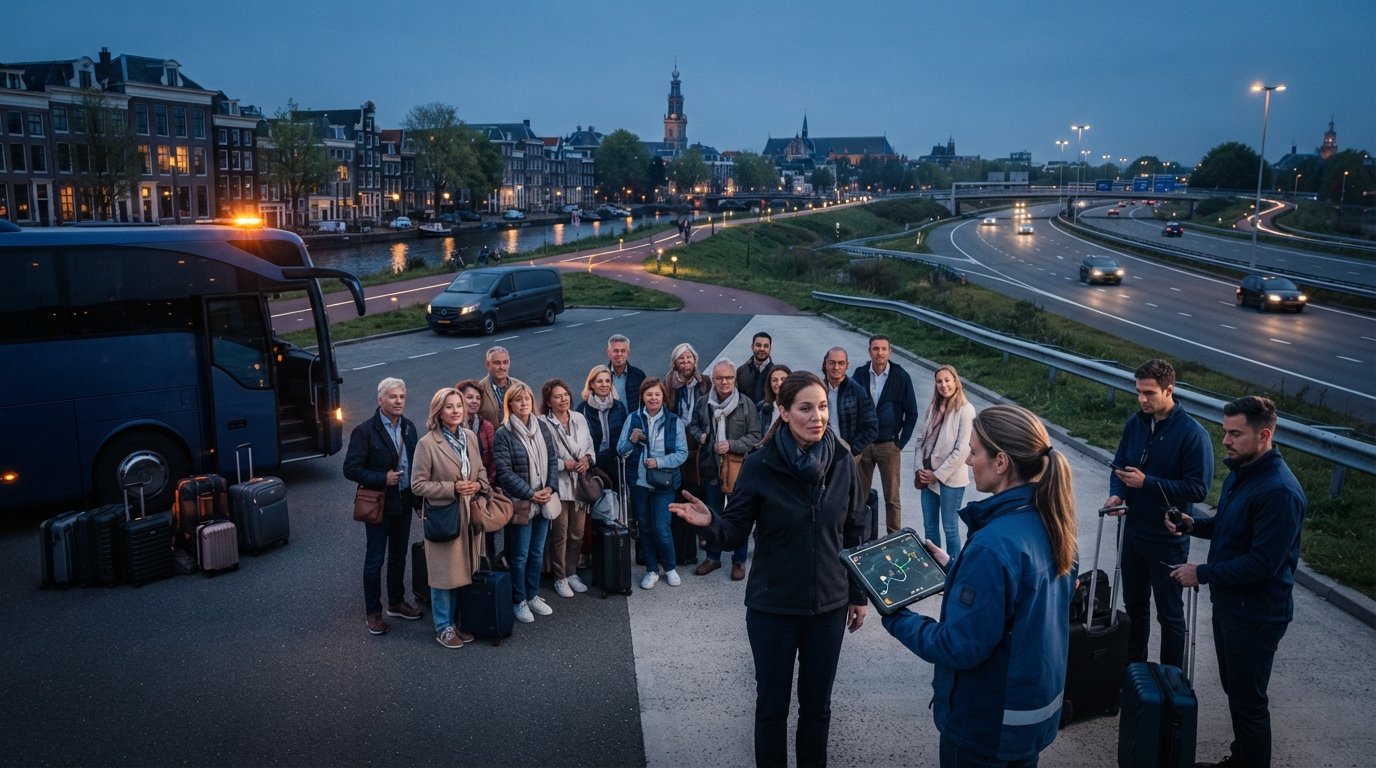
Theoretical crisis checklists cannot reroute a stranded coach or instantly resolve a sudden cross-border transit stoppage. When itineraries span Belgium, the Netherlands, and Luxembourg, paper procedures quickly collapse under real-world friction. Building an effective tour operator emergency response plan benelux demands dedicated local infrastructure and instant logistical agility, not abstract protocols.
Managing group tours across distinct regulatory jurisdictions is demanding. Delayed communications between overseas headquarters and field guides, unexpected transit bottlenecks, and strict duty-of-care liabilities leave no room for hesitation. You shouldn’t have to scramble when sudden logistical friction threatens your travelers and your brand’s reputation.
This guide demonstrates how to build, deploy, and operationalize a rigorous crisis management framework tailored specifically to Benelux group travel. We’ll examine actionable escalation protocols, direct ground coordination across transport fleets and accommodations, and the exact compliance measures needed to shield your business from legal exposure.
Key Takeaways
- How to build an actionable tour operator emergency response plan benelux that aligns seamlessly with cross-border European travel directives and duty-of-care obligations.
- Core command structures and rapid communication protocols that eliminate delays between outbound travel planners and on-the-ground group leaders.
- A proactive five-step implementation framework to identify itinerary vulnerabilities and conduct rigorous pre-departure risk assessments.
- Immediate contingency strategies to resolve unexpected coach transit disruptions, cross-border corridor delays, and emergency accommodation changes.
- The operational advantage of partnering with an experienced regional DMC to secure dedicated vehicle fleets and direct lodging management during critical incidents.
Fundamentals of a Tour Operator Emergency Response Plan in Benelux
Executing group travel across Western Europe requires operational resilience. An actionable crisis blueprint isn’t a static folder stored in an overseas office; it’s a living, real-time command structure. Formalized emergency management principles dictate that tour operators must anticipate hazards, establish mitigation protocols, and execute rapid recovery when transit networks stall. For travel designers orchestrating cross-border journeys, an effective tour operator emergency response plan benelux transforms abstract safety concepts into decisive field action.
To visualize how structured containment and incident protocols operate during unexpected disruptions, review this foundational walkthrough:
Passive insurance coverage merely reimburses financial loss after an incident concludes. In contrast, an active crisis plan preserves physical group safety and brand reputation during the event itself. Demonstrating direct operational oversight builds measurable trust with outbound partners and discerning travelers alike.
Defining Duty of Care and Operational Risk in Group Travel
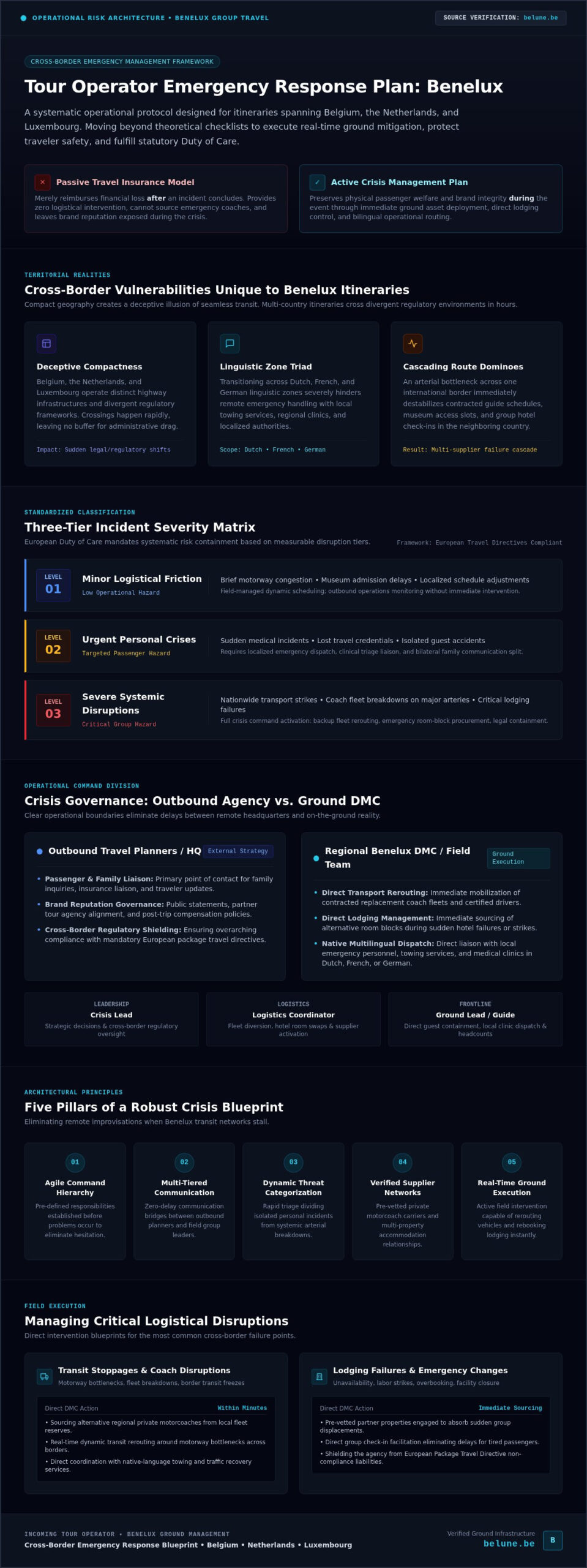
European travel directives hold outbound planners strictly liable for passenger welfare across every tour component. Legal duty of care mandates systematic risk containment, not just reactive apologies. Incidents generally fall into three tiers:
- Minor logistical friction: Brief motorway congestion, museum admission delays, or localized itinerary adjustments.
- Urgent personal crises: Sudden medical incidents, lost travel credentials, or isolated guest accidents requiring localized emergency dispatch.
- Severe systemic disruptions: Nationwide transport strikes, fleet breakdowns on major arteries, or critical accommodation failures.
Crisis governance requires clear boundaries. Travel planners handle passenger communications and family liaison, while field partners execute immediate logistical recovery.
Cross-Border Vulnerabilities Unique to Benelux Itineraries
The geographical compactness of Belgium, the Netherlands, and Luxembourg creates a deceptive illusion of seamless travel. In practice, multi-country itineraries traverse distinct highway infrastructures and divergent regulatory frameworks within hours. A sudden arterial bottleneck across one border can instantly disrupt scheduled hotel check-ins and contracted guide hours in the next country.
Linguistic complexity heightens these frictions. Crossing from Dutch-speaking regions into French or German linguistic zones complicates direct liaison with local emergency personnel, towing services, and medical clinics. When unexpected transit stoppages occur, generic travel insurance cannot source alternative private motorcoaches or secure sudden room blocks. Only an integrated tour operator emergency response plan benelux backed by physical ground assets can maintain itinerary continuity.
Core Pillars of a Robust Crisis Management Plan for Travel Agents
Managing operational disruptions across multiple sovereign territories demands an intentional structural framework. Remote desks cannot improvise solutions when transit corridors freeze between borders. Instead, five foundational pillars form the architecture of resilience: command hierarchy, multi-tiered communication, dynamic threat categorization, verified supplier networks, and real-time operational execution. Collaborating with an experienced benelux incoming tour operator bridges the gap between outbound agency planning and physical, on-the-ground capability.
Establishing an Agile Incident Chain of Command
Clarity under pressure saves itineraries. A functioning crisis team establishes defined responsibilities before problems occur:
- Crisis Lead: Retains strategic decision-making and cross-border regulatory oversight.
- Logistics Coordinator: Directly manages transport rerouting, hotel adjustments, and supplier coordination.
- Stakeholder Liaison: Manages inbound communications from overseas retail agencies and concerned relatives.
Clear thresholds trigger direct escalation. When an event impacts tour timing by more than two hours, custody of the response shifts automatically from field leaders to dedicated operations personnel.
Communication Tiers: Field Guides, Passengers, and Stakeholders
Uncertainty breeds panic. A resilient tour operator emergency response plan benelux deploys dedicated channels between motorcoach drivers, multilingual guides, and central operations desks. Pre-drafted verbal briefs give tour managers factual, reassuring talking points within minutes of a disruption. Concurrently, scheduled briefing windows keep overseas travel planners informed with verified logistical facts, keeping emotional panic separate from operational problem-solving.
Dynamic Incident Severity Classification Matrix
Not every disruption warrants an emergency alert. Calibrating reactions prevents operational paralysis:
- Tier 1 (Operational Delay): Isolated traffic bottlenecks or minor schedule deviations handled directly by drivers and guides within a thirty-minute resolution window.
- Tier 2 (Logistical Deviation): Motorcoach mechanical faults or sudden accommodation reassignments requiring regional dispatcher intervention within sixty minutes.
- Tier 3 (Critical Incident): Cross-border corridor blockades, major health events, or severe transit union strikes requiring immediate crisis mobilization.
Systematic time-stamped logs of all decisions protect operators during subsequent legal audits and insurance reviews. If you are refining your contingency networks across Belgium, the Netherlands, and Luxembourg, discover how to strengthen your ground logistics with BELUNE’s operational management.
Step-by-Step Implementation of an Emergency Action Plan
Translating crisis theory into operational reality requires methodical preparation long before passengers step aboard. A reliable tour operator emergency response plan benelux follows five sequential stages: comprehensive risk profiling, intake standardization, rigorous personnel briefings, supplier audits, and continuous table-top simulation. Skipping any stage leaves your group exposed when unexpected regional events disrupt travel.
- Audit itinerary pathways: Identify transit chokepoints and localized operational hazards.
- Standardize manifest data: Consolidate traveler medical details, emergency contacts, and mobility limits.
- Brief field crews: Deliver tactical training for drivers and tour leaders across cross-border routes.
- Vet ground suppliers: Validate transport maintenance records, lodging safety certifications, and guide credentials.
- Execute live simulations: Test incident workflows against realistic mechanical and environmental disruptions.
Pre-Departure Risk Profiling and Itinerary Auditing
Every itinerary carries distinct vulnerabilities. Cycling programs along shared rural paths require specialized medical evacuation protocols, while high-density cultural tours face elevated crowd and pickpocket risks. When evaluating cross-border itineraries, map out transit alternatives along major national corridors to bypass unexpected border friction. Integrating clear safety benchmarks is essential when vetting a qualified group travel agency.
Operational Briefings for Field Escorts and Drivers
Field teams serve as primary crisis managers. Drivers and guides must hold unified contact directories containing regional emergency dispatchers, tow networks, and consulate services across Belgium, the Netherlands, and Luxembourg. Before departure, teams run practical safety checks on vehicles, verify emergency exits, and review contingency scenarios such as sudden passenger illness or vehicle breakdowns.
Supplier Verification: Hotels, Transport, and Local Venues
Subcontractor negligence creates legal liability for outbound organizers. Tour operators must verify that chartered coaches meet rigorous mechanical inspection standards and driver rest regulations. Hotel accommodations require documented fire safety protocols, accessible exits, and clear evacuation plans for large groups. Local guides must possess recognized regional credentials and first-aid expertise. Enforcing these verification standards ensures your tour operator emergency response plan benelux protects passenger safety and shields your company from contractual exposure.
Managing Logistical Disruptions: Coaches, Hotels, and Route Contingencies
A single mechanical breakdown or sudden highway closure triggers an immediate domino effect. When a coach stalls, missed museum time-slots, expired driver shifts, and forfeited hotel dinner reservations quickly follow. Paper protocols cannot rescue stranded travelers when local transport corridors freeze. A resilient tour operator emergency response plan benelux relies on physical ground capability, replacing theoretical flowcharts with immediate asset mobilization.
Rapid Coach Fleet Dispatch and Transit Rerouting
Relying on digital transport brokers during an emergency leaves groups vulnerable. When disruptions occur across high-traffic transit corridors, brokers must hunt for available sub-contractors on the open market, often discovering regional fleets are fully committed. Operators with direct control over an owned fleet of modern coaches bypass these bottlenecks entirely. Dispatchers can redirect an operational coach immediately, ensuring passenger safety while maintaining itinerary momentum.
Rerouting also demands strict regulatory compliance. EU tachograph regulations strictly limit driver hours, meaning unexpected detours can lead to legal penalties if replacement drivers aren’t promptly positioned. Field operations must maintain secondary regional corridors mapped in advance, ensuring travel continues safely without violating mandatory rest intervals.
Emergency Accommodation Sourcing and Group Relocation
Sudden property closures, water damage, or transit diversions can leave large groups without rooms late in the afternoon. During peak travel seasons, securing fifty adjacent rooms across regional destinations on short notice is nearly impossible through public booking channels. Direct contractual hotel accommodation management bridges this critical gap.
Established relationships with nationwide hospitality networks allow ground partners to activate contingency room blocks rapidly. This coordination extends far beyond room keys:
- Coordinated transfers: Directing private coaches to alternate properties without luggage loss or traveler confusion.
- Dietary preservation: Transmitting pre-vetted passenger dietary restrictions and allergies to replacement kitchen teams.
- Administrative check-ins: Executing pre-keyed group arrivals to minimize lobby congestion and emotional fatigue.
Protect your clients from unexpected travel interruptions. You can secure direct ground mobility and hotel management with Belune to safeguard your itineraries across Belgium, the Netherlands, and Luxembourg.
The Strategic Advantage: Partnering with an Experienced Benelux DMC
A destination management company is far more than a booking intermediary. When managing cross-border itineraries, an experienced regional partner functions as an operational shield, actively managing risk and protecting your brand’s reputation. An actionable tour operator emergency response plan benelux succeeds only when underpinned by direct local authority, where physical presence replaces remote guesswork.
Local Ground Presence vs. Remote Travel Management
Overseas coordinators working across distant time zones face compounding obstacles when disruptions strike. Native fluency in Dutch and French transforms critical communication, enabling rapid, clear dialogue with national transit authorities, emergency responders, and regional service providers. Long-standing local relationships ensure regional suppliers prioritize your travelers during widespread disruptions, converting potential travel disasters into smoothly orchestrated itinerary adjustments.
BELUNE’s Integrated Operational Shield for Group Tours
With over two decades of specialized experience managing complex group travel across Belgium, the Netherlands, and Luxembourg, BELUNE grounds risk mitigation in direct asset control. Operating an owned private fleet of modern coaches guarantees mobility continuity, removing the uncertainty of third-party charter availability during unexpected transit emergencies. Direct contractual hotel accommodation management and professional multilingual local guides ensure that both lodging security and on-the-ground leadership remain uncompromised.
Operational excellence extends beyond immediate incident resolution. Thorough post-incident debriefings evaluate response metrics, refine itinerary contingencies, and update compliance documentation. This methodical evaluation strengthens duty-of-care records, shielding tour operators from regulatory exposure while preserving traveler trust. Aligning your itineraries with dedicated on-the-ground specialists ensures that your tour operator emergency response plan benelux delivers complete protection across every journey.
Operationalize Your Cross-Border Travel Resilience
A resilient itinerary isn’t built on wishful thinking; it’s forged through proactive preparedness and decisive ground capability. Aligning clear incident chains of command with verified supplier standards transforms duty-of-care compliance into practical passenger protection. When your groundwork is thorough, sudden transit disruptions or accommodation shifts cease to be operational crises, becoming manageable itinerary adjustments instead.
Executing an uncompromising tour operator emergency response plan benelux requires dedicated infrastructure that remote coordination desks simply can’t replicate. Backed by over two decades of specialized group travel logistics, an owned fleet of modern touring coaches, and direct hotel management across Belgium, the Netherlands, and Luxembourg, BELUNE provides the operational depth your itineraries demand.
Safeguard your upcoming departures and reinforce traveler confidence across every border. Partner with BELUNE for seamless, risk-resilient Benelux group travel and deliver exceptional journeys backed by true on-the-ground expertise.
Frequently Asked Questions
What is the primary difference between travel insurance and a tour operator emergency response plan?
Travel insurance provides retrospective financial reimbursement for losses, whereas a tour operator emergency response plan benelux delivers proactive, real-time crisis containment in the field. An insurance policy repays medical bills or cancelled hotel nights weeks later, but an operational emergency plan coordinates alternative routing, deploys replacement vehicles, and protects passenger safety immediately. Relying solely on insurance leaves travelers stranded without physical assistance when disruptions strike.
How does cross-border travel across Benelux countries impact emergency medical protocols?
Cross-border itineraries require navigating distinct national healthcare systems, language zones, and regional emergency dispatch services across Belgium, the Netherlands, and Luxembourg. While the universal 112 emergency number operates across all three nations, local hospital admissions, direct police lines, and medical billing practices vary. On-the-ground leaders must maintain multi-jurisdictional medical protocols and pre-vetted clinic directories to ensure travelers receive immediate, high-standard care without administrative delays.
What should a tour leader do in the first fifteen minutes of a group travel incident?
A tour leader must first confirm the physical safety of every passenger and move the group away from active hazards. Once the headcount is verified, the leader delivers a calm, factual briefing to prevent panic and calls the central operations dispatcher. Gathering exact incident details, logging initial timestamps, and initiating the pre-defined internal chain of command takes precedence over public statements or calling outside commercial entities.
How does partnering with a local DMC enhance crisis management for international travel agents?
Partnering with an experienced DMC provides overseas travel planners with an active operational shield backed by local infrastructure and physical assets. A regional DMC eliminates language barriers when coordinating with municipal authorities and leverages direct contractual relationships with hotels and venues. This regional presence ensures rapid incident containment, keeping group itineraries intact while outbound operators maintain complete duty-of-care compliance from afar.
What legal liabilities do outbound travel operators face during transit disruptions in Europe?
Outbound travel planners face strict legal liability under European travel directives for the fulfillment of all booked package components. When transit failures occur, operators must provide appropriate duty of care, arrange equivalent alternative transportation, and secure substitute accommodations without extra cost to travelers. Neglecting these obligations or failing to maintain a documented tour operator emergency response plan benelux can result in formal complaint penalties, mandatory compensation, and severe reputational damage.
How can tour operators secure emergency coach replacements quickly during peak travel seasons?
Securing emergency coaches during peak periods requires pre-established partnerships with ground operators who control dedicated vehicle fleets. Open-market charter brokers often experience severe shortages during high-demand months, leaving stranded groups without viable options. Working with ground partners who maintain direct oversight of their own modern touring coaches guarantees priority dispatch, ensuring rapid replacement vehicles reach displaced passengers without hours of costly downtime.
Why is an owned fleet of coaches safer for group operations than broker-hired transport?
Operating an owned coach fleet guarantees rigorous oversight over vehicle maintenance schedules, safety equipment, and driver rest compliance under European road regulations. Broker-hired transport introduces third-party risk, variable vehicle standards, and fragmented communication during sudden breakdowns. Direct fleet management eliminates middleman friction, giving dispatchers instant visibility over driver hours, telemetry, and alternative vehicle positioning to execute swift logistical recoveries during critical transit failures.