
What if the strongest sustainability claim in a travel proposal is the one you verify, not the one that sounds most convincing? A search for “eco-certified travel partners belgium” can surface polished labels and broad promises, but neither proves that a certification is current, independently assessed, or relevant to every service in your group itinerary.
It’s reasonable to expect clear evidence before choosing a partner. Check who issued the certification, what it covers, and whether it remains valid, then weigh that evidence against your group’s accommodation, transport, guiding, and itinerary needs. Green Key and the EU Ecolabel are relevant to accommodation; Travelife certifies tour operators and travel agencies at different levels.
This guide explains how to assess those credentials, compare partners against consistent criteria, and request useful documentation instead of relying on vague sustainability language. It also covers practical questions to raise with a Belgian DMC. BELUNE brings more than 20 years of group travel experience, but no specific eco-certification is confirmed here. Discuss your sustainability expectations and request relevant partner evidence before planning.
Key Takeaways
- For eco-certified travel partners belgium, check whether each credential is current and covers the specific organization and services you plan to use.
- Compare certification scope, published criteria, assessment method, and renewal requirements rather than relying on a label alone.
- Use the same sustainability and operational criteria to compare partners, including accommodation, transport, guiding, and itinerary coordination.
- Before booking, request current certificates, relevant supplier information, and written details about the practices that matter to your group.
- BELUNE coordinates group travel services and brings more than 20 years of experience; discuss your sustainability requirements and request relevant partner documentation during planning.
What Eco-Certified Travel Partners in Belgium Actually Mean
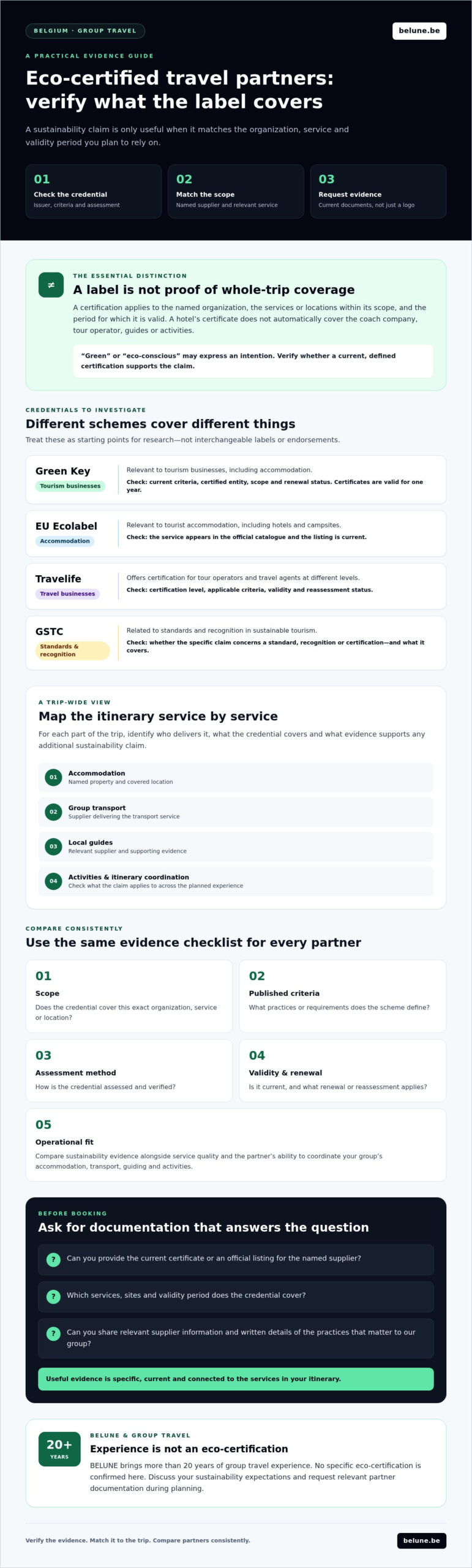
The phrase eco-certified should point to evidence, not atmosphere. An eco-certified travel partner is an organization that holds a relevant environmental certification issued under defined criteria and verifiable through the certifying body or its records. The credential applies only to the named organization, the services and locations within its scope, and the period for which it remains valid.
That distinction matters because a hotel’s certificate doesn’t automatically cover the coach company, tour operator, guides, or activities in a group itinerary. A business describing itself as “green” or “eco-conscious” may be sharing an intention, not an independently assessed status. The broader idea of Sustainable tourism also includes social and economic considerations, but individual certifications define their own boundaries.
What does an eco-certification verify?
Schemes can assess different practices and types of organization. Green Key and the EU Ecolabel are relevant examples to investigate for tourist accommodation, while Travelife offers certification for tour operators and travel agents. These labels aren’t interchangeable, and you shouldn’t assume they assess identical standards or outcomes.
Check the scheme’s published criteria and verification process. Look for the certified entity’s exact name, the services or sites covered, the certificate’s validity, and any renewal requirements. A credible claim should be traceable to current documentation or an official listing, not just a logo on a website. Treat each scheme as a starting point for questions, not a substitute for checking whether it fits your trip.
Which travel services should a group planner assess?
Map the trip service by service: accommodation, group transport, local guides, activities, and itinerary coordination. For each element, ask which supplier delivers it, whether that supplier’s certification covers the service, and what evidence supports any additional sustainability claims. Choosing certified accommodation may be meaningful, but that certification doesn’t cover the full journey.
Certified status means a defined organization or service has been assessed against a named scheme’s criteria within a stated scope and validity period. A general green claim is not proof of that assessment.
For a tour operator, environmental evidence is only one part of a sound decision. Compare it with service quality and practical itinerary fit: can the partner coordinate the accommodation, transport, guiding, and activities your group needs? Shortlist eco-certified travel partners belgium using evidence that matches your actual plans, rather than choosing a reassuring-looking label that covers little of the experience.
How to Evaluate Eco-Certifications and Sustainability Evidence
A label is useful only when you know what it verifies. Compare each scheme by its scope, published criteria, assessment method, validity period, and renewal requirements. Then confirm that the certificate covers the supplier and service you’re considering, not just a related business or one part of its operation. When assessing eco-certified travel partners belgium, this makes current certification evidence more useful than a logo or broad sustainability statement.
The examples below are starting points for research, not endorsements. Criteria and certificate details can change, so verify current information with each scheme before relying on it.
| Scheme | Area to investigate | Check before relying on it |
|---|---|---|
| Green Key | Tourism businesses, including accommodation | Current criteria, certified entity, scope, and annual renewal status |
| EU Ecolabel | Tourist accommodation, including hotels and campsites | That the service appears in the official catalogue and the listing is current |
| Travelife | Tour operators and travel agents | Certification level, applicable criteria, validity, and reassessment status |
| GSTC | Standards and recognition related to sustainable tourism | Whether the specific claim concerns a standard, recognition, or certification, and what it covers |
For example, check Green Key certification against the scheme’s current criteria and the named establishment’s status. Green Key certificates are valid for one year, and new criteria took effect on October 1, 2026. Confirm the applicable criteria and current status directly with the scheme for each establishment.
What should a certificate or listing show?
Look for the certificate holder’s exact name, covered operations or locations, issue date, and expiry or renewal status. If the scheme provides a certificate number or public directory, use it to cross-check promotional material. A certificate image alone may not show whether the specific service is included. Contact the certifying organization if the scope is unclear.
How do you assess claims without a certification?
Ask for written policies, measurable practices, and evidence relevant to the service being supplied. A transport provider, for instance, should be able to explain the practices it claims to follow in its transport operations. Distinguish documented actions from future aims, and ask what records support any stated impact. An absence of certification doesn’t prove poor practice, but it makes clear, service-specific evidence especially important.
A certification’s scope matters as much as its label: it shows which organization, service, and period the verified claim actually covers. For group itinerary coordination, you can also discuss sustainability requirements and partner documentation with BELUNE as part of planning.
How to Compare Certified Travel Partners in Belgium
A certificate is one part of a group travel decision. The partner must also be able to coordinate the services your itinerary needs, from accommodation management and transport to local guides and activities. Compare every candidate against the same requirements, so one partner isn’t judged on detailed documentation while another is assessed on a broad promise.
Start with the group’s practical needs. Consider group size, itinerary complexity, accessibility requirements, and how services will be coordinated if plans change. Ask about relevant group experience, communication processes, and contingency planning. If services are subcontracted, find out how suppliers are selected and what documentation is available. A DMC may coordinate several suppliers, but that doesn’t mean it holds or extends each supplier’s certification.
Which partner criteria matter beyond certification?
Assess the partner’s experience and service scope alongside its environmental evidence. Check whether it can manage the accommodation, transport, guiding, and itinerary coordination your plans require. Ask which suppliers will deliver each service and whether their relevant credentials or practices can be documented. Match the level of detail to the trip: a multi-part itinerary may need clearer coordination and contingency arrangements than a simpler one.
How can a buyer compare evidence fairly?
Use one comparison record for every candidate. Keep environmental evidence separate from operational fit, and mark gaps as “unverified” until you can follow up. Missing documentation is a reason to ask another question, not automatic proof that a partner has poor practices.
| Comparison area | What to record | Follow-up question |
|---|---|---|
| Certification scope | Holder, services, locations, and validity | Does the evidence cover the supplier and service in this itinerary? |
| Current evidence | Certificate or listing checked, with date reviewed | Can the certifying body confirm the status? |
| Service fit | Accommodation, transport, guiding, and coordination needs met | Who delivers each part, including subcontracted services? |
| Open questions | Missing documents or unclear claims, marked unverified | What written explanation or supporting record can be provided? |
For a broader framework on operational selection, see The Definitive Guide to Choosing a Group Travel Agency in 2026. Then use the same evidence-and-fit approach for your shortlist of eco-certified travel partners belgium. BELUNE, a DMC with over 20 years of transport and tour operation experience, may be considered for group coordination. Request relevant partner documentation and discuss sustainability requirements directly, without assuming a certification.
Questions to Ask Before Booking an Eco-Conscious Group Trip
Good sustainability planning starts before a proposal is finalized. Set out what matters to your group, then ask prospective partners to show how their services and suppliers align with those priorities. A clear sequence helps you compare eco-certified travel partners belgium on evidence, itinerary fit, and practical delivery rather than broad claims alone.
- 1. Define your priorities. Decide which environmental considerations matter most for the trip, such as certified accommodation or documented practices among transport and activity suppliers. Separate essential requirements from preferences.
- 2. Map the services. Ask which elements the partner delivers directly and which depend on external suppliers. Request a supplier list relevant to your itinerary, and identify who is responsible for each service.
- 3. Verify certification claims. For each claimed credential, ask which service or supplier it covers, which certifying body issued it, and whether the certificate is current. Request a copy or public listing, and confirm the scope instead of relying on a logo.
- 4. Request practice-based evidence. Where a supplier has no relevant certification, ask for written policies and examples of practices related to the service. Find out how subcontractors are screened and what documentation supports environmental claims.
- 5. Connect choices to the itinerary. Ask how your priorities would influence accommodation, transport, guiding, and activities. Discuss any trade-offs involving group logistics, accessibility, comfort, and operational feasibility.
- 6. Confirm the agreement. Before booking, record the agreed sustainability requirements, each party’s responsibilities, and when supporting evidence will be provided. This gives both sides a clear reference during planning and delivery.
How should sustainability requirements enter the brief?
Include your evidence requirements in the initial brief, before comparing proposals. Specify what certification scope is acceptable, which suppliers need to be identified, and what written explanations or reporting you expect. This makes responses easier to assess consistently. Leave room for practical discussion too: a preferred option must work for the group’s schedule, service needs, and itinerary.
For a coordinated group trip, BELUNE can discuss itinerary planning, accommodation management, coach hire, and local guide services alongside your sustainability requirements. No specific eco-certification for BELUNE is confirmed here, so ask directly about relevant supplier documentation and practices before planning. Discuss your group travel requirements with BELUNE.
Working with BELUNE on Group Travel in Belgium
BELUNE is a Destination Management Company with over 20 years of experience in transport and tour operations. Its group travel capabilities include accommodation management, coach hire using its own fleet, local guide services, and itinerary coordination. These services can provide a practical foundation for planning a group journey, while sustainability requirements remain a separate point to discuss and document.
BELUNE’s eco-certification is not confirmed in the supplied business information. This guide therefore doesn’t present the company as eco-certified or environmentally verified. Buyers considering eco-certified travel partners belgium should assess BELUNE on its confirmed services and ask for current evidence relating to any specific environmental claims or suppliers included in a proposed itinerary.
Where can a DMC support sustainability-focused planning?
A DMC can coordinate different parts of a group itinerary, including accommodation, transport, guides, and other planned services. That coordination can help buyers identify who provides each service and what information is available for review, but it doesn’t certify those suppliers. Ask which services BELUNE delivers directly, which involve external partners, and whether relevant certificates or written practice documentation can be provided for each supplier. Verify credentials for the specific organization and service they cover.
Keep the distinction clear: coordination can make supplier information easier to gather, but it isn’t a guarantee of environmental outcomes or a certified supply chain. Discuss your criteria, evidence needs, and priorities before itinerary decisions are finalized.
What should you share when requesting a proposal?
A focused brief helps a DMC assess operational fit and respond to your sustainability expectations. Include:
- Your group profile and travel dates.
- Required services, such as accommodation management, coach hire, local guides, and itinerary coordination.
- Any accessibility, comfort, or scheduling needs that affect the itinerary.
- Your environmental priorities and any labels or certification schemes you require.
- The certificate scope you’ll accept, plus expectations for supplier lists, current documentation, and written explanations of relevant practices.
If gastronomy is part of your plans, include it in the brief so it can be considered as an itinerary element; BELUNE offers gastronomy and beer experience tours. Once a proposal identifies relevant suppliers, check their documentation against your criteria and clarify any gaps before deciding. A shared understanding of responsibilities and evidence supports a more dependable planning process.
For a tailored discussion of group services and sustainability requirements, discuss a tailored group travel proposal with BELUNE.
Plan Your Belgium Group Trip with Clarity
Choosing among eco-certified travel partners belgium starts with evidence: confirm a certificate’s current status, scope, and coverage of the specific supplier and service. Then compare that information with the partner’s ability to coordinate your group’s accommodation, transport, guiding, and itinerary needs. A clear brief makes sustainability expectations easier to discuss and verify.
BELUNE brings more than 20 years of experience in transport and tour operations, with accommodation management, coach hire, local guides, and itinerary coordination among its confirmed capabilities. Its eco-certification is not confirmed, so request relevant supplier documentation and discuss your criteria before deciding. Transparency is a stronger foundation than an unsupported claim.
Discuss your group travel requirements with BELUNE and take the next step toward a thoughtfully planned itinerary. With clear priorities and the right questions, your group can make informed choices while keeping the experience cohesive and rewarding.
Frequently Asked Questions
Is an eco-certified travel partner automatically sustainable across every service?
No. A certification has a defined holder, scope, and validity period, and it may cover only certain operations. Check whether the certificate applies to the accommodation, transport, or planning service you intend to use. Assess other suppliers separately, too. One credential isn’t proof that every part of a group trip meets the same environmental standard, even if the certified supplier plays a central role in the itinerary.
How can I verify whether a travel partner’s eco-certification is current?
Ask for a copy of the certificate or a public listing, then check the certificate holder, covered services, issuing body, and validity period. Where possible, confirm those details directly with the certifying organization. If a supplier can’t provide evidence, record the claim as unverified rather than treating it as confirmed. Ask what other written documentation supports its environmental practices before relying on the claim in procurement.
What certifications should I look for when choosing travel partners in Belgium?
There isn’t one label that fits every travel service. Green Key and the EU Ecolabel are examples to investigate for tourist accommodation; Travelife is relevant to tour operators and travel agents. GSTC relates to recognized sustainable tourism standards, so clarify exactly what a GSTC-related claim refers to. Criteria and scope differ. Check current requirements and verify that the specific organization or service holds a valid credential. No single label covers a whole itinerary by default.
Can a tour operator be eco-certified if some suppliers are not?
Yes, a tour operator may hold a certification without that credential extending to its accommodation, transport, guides, or other suppliers. Ask what the operator’s certificate covers and how external providers are selected or assessed. If your group requires certified services, request current evidence from the relevant suppliers. Confirm in writing which itinerary elements meet your criteria and which don’t have verified certification, so the distinction is clear before booking.
What should I ask an eco-certified travel partner before booking a group trip?
Ask which certification applies, who issued it, which organization and services it covers, and when it expires or needs renewal. Request evidence for subcontracted services and ask how the partner will reflect your environmental priorities in the itinerary. Also clarify group capacity, service responsibilities, and how agreed sustainability criteria will appear in the proposal. Comparing eco-certified travel partners belgium against the same questions helps keep your assessment consistent.
Does BELUNE hold an eco-certification for group travel in Belgium?
The business information available for this guide doesn’t confirm that BELUNE holds an eco-certification, so the company shouldn’t be described as certified. BELUNE is a Destination Management Company with over 20 years of transport and tour operation experience, offering accommodation management, coach hire, local guides, and itinerary coordination. Prospective clients can discuss their sustainability requirements and request relevant documentation for proposed suppliers, then verify any certification claim directly before relying on it.