Tag: coach hire

  • Coach Hire Safety and Liability Insurance Regulations in the Benelux

    Coach Hire Safety and Liability Insurance Regulations in the Benelux

    What if a coach looks ready for the road, but the paperwork behind the journey tells a different story? Searching for “coach hire safety regulations benelux” can quickly reveal why the answer isn’t always simple: EU rules provide a shared framework, while national requirements and cross-border details still matter. A polished itinerary is only part of the picture.

    It’s right to ask whether the vehicle and operator meet applicable safety requirements, and what insurance protects passengers, third parties and the coach itself. These are related checks, but they aren’t interchangeable. Regulatory compliance concerns whether an operation meets relevant rules; insurance concerns financial protection if something goes wrong.

    This guide sets out practical questions to ask a coach provider before booking travel through Belgium, the Netherlands and Luxembourg. We’ll explore which vehicle and operator documents to request, how to discuss insurance evidence, and why route details should be checked across borders. The aim is clarity before departure, with responsibilities considered as carefully as the journey itself.

    Key Takeaways

    • Use a structured approach to coach hire safety regulations benelux, checking the operator, vehicle, driver arrangements and itinerary rather than relying on appearance alone.
    • Ask what vehicle roadworthiness, maintenance and passenger safety information the provider can share, and confirm which documents apply to your journey.
    • Separate regulatory compliance from insurance protection, then review policy scope, exclusions and limits instead of relying on a general statement that the coach is insured.
    • Before confirming a cross-border booking, record who is responsible for each check and how the route’s requirements will be addressed.
    • See how transport coordination can fit into a wider group itinerary, including BELUNE’s own modern coach fleet and more than 20 years of group travel experience.

    What coach hire safety regulations mean for Benelux group travel

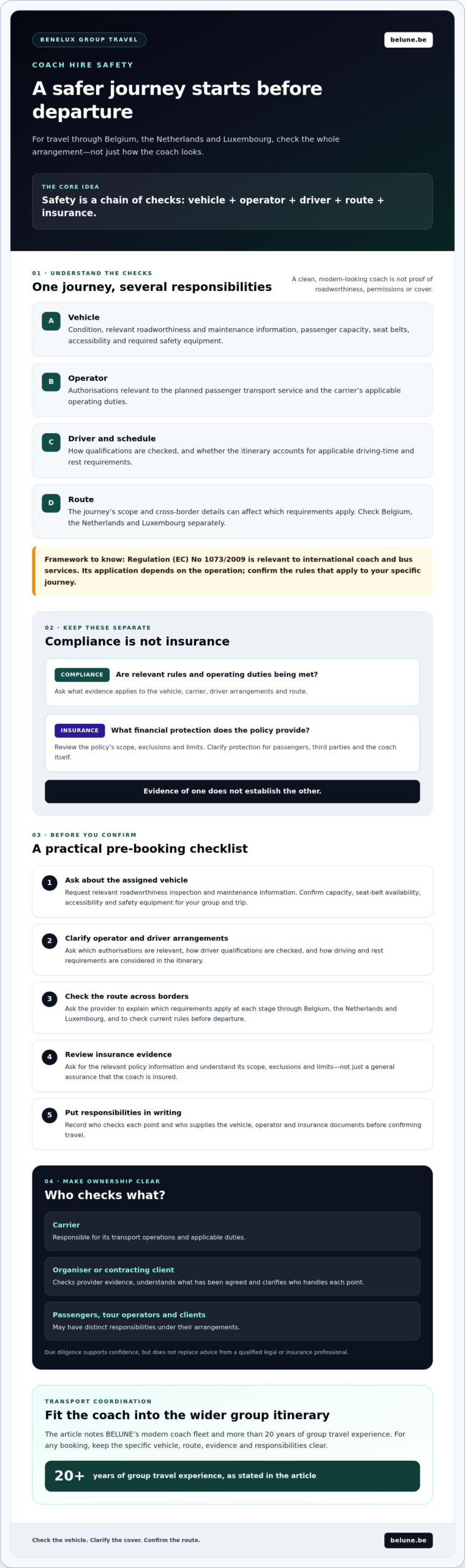
    Coach safety compliance is a chain of responsibilities, not a single certificate or visual check. It can involve the vehicle’s condition and equipment, the carrier’s operating arrangements, the driver’s qualifications and working time, and the details of the journey. For group organisers, coach hire safety regulations benelux means considering how those elements fit together across the planned route.

    A clean, modern-looking coach may be reassuring, but appearance alone can’t confirm roadworthiness, operator permissions or insurance terms. EU frameworks create shared rules in areas such as road transport, while member states also apply national requirements. The EU’s role is outlined in this overview of EU policies for the transport sector.

    For a visual reminder that passenger safety also involves clear onboard guidance, watch this coach safety video:

    Compliance and insurance serve different purposes. Compliance concerns whether the relevant safety and operating rules are met. Insurance responds to specified losses under the wording, limits and exclusions of a policy. Evidence of one doesn’t establish the other.

    Which rules can apply to an international coach journey?

    Regulation (EC) No 1073/2009 is an EU framework relevant to international coach and bus services, but its application depends on the transport operation and should be checked against the journey’s scope. Other EU rules address matters such as driving and rest times. National implementation and route details can also affect what applies. Confirm requirements separately for Belgium, the Netherlands and Luxembourg, and check current rules before departure.

    Who is responsible for checking safety and cover?

    The carrier is responsible for its transport operations and applicable duties. The organiser or contracting client has a different role: checking the provider’s evidence, understanding what has been agreed and clarifying who handles each point. Passengers, tour operators and clients may have distinct responsibilities under their arrangements. Put those responsibilities in writing before confirming travel, including who supplies vehicle, operator and insurance documents. This practical due diligence supports confidence, but it doesn’t replace advice from a qualified legal or insurance professional.

    The vehicle, operator and driver checks behind safe coach hire

    A useful safety review starts with the specific coach and journey, not a generic assurance that a fleet is modern or well maintained. Requirements can depend on the vehicle, the transport service and the route, so ask the carrier which documents and checks apply to the coach assigned to your group.

    A modern-looking coach is not the same as documented safety assurance. Evidence helps you understand what has been checked and whether the arrangements suit your itinerary.

    What vehicle documents and safety features should organisers ask about?

    Request the relevant roadworthiness inspection and maintenance information for the booked vehicle, and ask how the operator confirms it is fit for the planned service. Then match the vehicle to the group’s needs. Confirm passenger capacity, seat-belt availability and accessibility arrangements, including whether these meet any specific requirements your travellers have.

    Ask which safety equipment is carried and how the operator verifies it against current rules for the vehicle and route. Avoid assuming that one standard checklist covers every coach or journey. A cross-border itinerary may call for the provider to confirm which national requirements apply at each stage.

    How do driver and operator obligations affect the journey?

    Ask the carrier to identify the authorisations relevant to the planned passenger transport service and explain how it checks driver qualifications. Scheduling matters too: request confirmation that the itinerary accounts for applicable driving-time and rest requirements, including any driver changes or long travel days.

    Regulation (EC) No 561/2006 and Directive 2003/59/EC are useful references when discussing driving times and professional driver qualifications, but their application and current national implementation should be verified for the service. Treat them as prompts for a current, route-specific check, not as a substitute for the operator’s confirmation.

    Keep the responses together before booking. A practical evidence checklist can include:

    • Vehicle inspection and maintenance documents relevant to the assigned coach.
    • Confirmation of capacity, seat belts, accessibility and required safety equipment.
    • Details of the carrier’s relevant operating authorisation.
    • An explanation of how driver qualifications, working time and rest are managed for the itinerary.

    Passenger rights and carrier liability are also distinct from proof of vehicle condition. The EU passenger rights and carrier liability overview explains protections under Regulation (EU) No 181/2011; it doesn’t confirm the scope or limits of a specific insurance policy. For group travel planning that brings coach transport into a wider itinerary, explore BELUNE’s coach hire and group travel planning, and request the relevant vehicle and operator documents for your journey.
    Coach Hire Safety and Liability Insurance Regulations in the Benelux

    Coach liability insurance versus safety compliance: what to compare

    Insurance is a separate layer of assurance from the checks on the coach and its operation. A provider saying “we’re insured” doesn’t show which vehicle, activities, passengers or territories a policy covers. For groups comparing coach hire safety regulations benelux, request written evidence and review the actual scope, exclusions, limits and validity period. Applicable legal minima and insurance terminology can vary, so verify them for the operator, vehicle and route.

    Cover category What to clarify
    Compulsory motor insurance Ask for confirmation that the vehicle is insured for the intended passenger transport use, and clarify the relevant territorial scope. Verify current legal requirements and minimum cover with a qualified source.
    Carrier liability Ask what liability protection applies to the carrier’s passenger transport activities, and how the policy relates to claims such as passenger injury or loss or damage to belongings. The wording and applicable law matter.
    Optional additional cover Ask whether any additional cover is in place, what losses it addresses and which exclusions or limits apply. Don’t assume extra protection is included or that it fills every gap.

    These categories can overlap in how a claim is handled, but they aren’t interchangeable. Insurance also doesn’t make an unsafe vehicle compliant. It can’t replace maintenance, appropriately qualified drivers or a schedule that accounts for applicable working-time and rest requirements.

    What insurance evidence should a group organiser request?

    Request written confirmation of motor insurance for the vehicle and intended passenger use, along with details of relevant carrier liability cover, policy period, exclusions and limits. If transport is subcontracted, ask which company operates the coach and which provider will supply the documents. Make sure the evidence relates to the service actually booked, not only to a contracting intermediary.

    How should buyers compare insurance documents?

    Check the named insured parties, covered activities, territorial scope and policy validity against your itinerary. Ask who receives incident reports, manages claims and serves as the contact if an incident occurs. If a clause is unclear, or the evidence doesn’t clearly match the service, seek clarification in writing from the insurer or a qualified adviser before confirming the booking.

    A pre-booking checklist for cross-border Benelux coach journeys

    Turn due diligence into a short, written sequence before confirming the booking. For coach hire safety regulations benelux, the key is matching the evidence to the actual itinerary, operator and vehicle, then keeping track of who supplied each document. If the route, coach or provider changes, revisit the checks rather than assuming the original paperwork still applies.

    • Itinerary: Record every country, travel date, passenger needs and planned stops. Ask the carrier which permits and operating documents apply to that specific route.
    • Carrier: Confirm which company will operate the coach and whether any part of the transport is subcontracted.
    • Vehicle: Identify the coach assigned to the group and request the relevant roadworthiness, maintenance and passenger-safety evidence.
    • Driver arrangements: Ask how qualifications, scheduling and rest arrangements are managed for the itinerary.
    • Insurance: Check that the documents relate to the intended passenger service and that the territorial scope covers every country on the route.

    Keep a simple record of each response, the document received, its date and the person or company responsible for providing it. That gives the organiser a clear reference if details change or a question arises later. The same emphasis on verified licensing and reputable service applies when arranging private transfers elsewhere in Europe; travellers organising itineraries in southern Italy can discover NCC Bardi for professional local chauffeur services.

    Ask who operates the coach, whether transport will be subcontracted, and who will provide the relevant vehicle and insurance documents. Have the agreement identify the route, dates, passenger requirements and each provider’s responsibilities. Clarify how cancellations, breakdowns, replacement vehicles and incident reporting are handled, including who will communicate changes to the group.

    What should organisers confirm for multi-country itineraries?

    Request written confirmation of the permits and operating documents considered relevant to the planned route, and verify that insurance territory includes every country listed. If the route, travel dates, vehicle or operator changes, ask for updated confirmation and evidence before relying on the original file. Broader supplier coordination can also be explored in this Benelux incoming tour operator guide.

    A clear checklist supports a more considered booking, but it doesn’t replace current professional advice on legal or insurance questions. For help coordinating coach hire within a group itinerary, discuss coach transport with BELUNE.

    How BELUNE can coordinate coach transport within a group itinerary

    Coach transport works best when it’s planned as part of the journey, not treated as an isolated transfer. Accommodation, activities, passenger needs and travel between countries all shape the itinerary. As a Benelux-focused Destination Management Company, BELUNE coordinates group travel logistics and offers coach hire through its own modern fleet. The team brings more than 20 years of group travel and transport industry experience.

    That planning context can help organisers raise the practical questions early, while keeping the distinction clear: coordination doesn’t replace the need to review the provider’s current vehicle, operator and insurance information. For an overview of choosing a planning partner, see this group travel agency selection guide.

    What a DMC can clarify during group transport planning

    Share the outline of the trip while plans are taking shape. Passenger numbers, luggage, accessibility needs, dates and cross-border routing can all affect the coach arrangements to discuss. Keeping these details alongside accommodation and activities makes it easier to identify questions or dependencies before confirming suppliers.

    • Which route and travel dates should transport planning cover?
    • What passenger, luggage or accessibility needs should be considered?
    • Who will confirm the vehicle, operating company and any subcontracting?
    • Which documents and insurance details will be provided for the planned service?

    What to request from a coach provider before confirming

    Ask for current documentation relevant to the vehicle, operator and planned passenger service. Request written insurance confirmation and clarification of its scope, exclusions and validity. If another company may operate the coach, establish which provider will supply the evidence and how changes will be communicated. These checks give the group a clearer basis for discussing coach hire safety regulations benelux without assuming that any particular certificate or coverage is in place.

    Before the booking is confirmed, record the answers and note who provided each document. If the itinerary, assigned vehicle or transport provider changes, ask whether the evidence still applies and request updated information where needed. This keeps the transport plan connected to the journey as it is actually arranged.

    For a tailored discussion about coach hire and group travel planning, contact BELUNE about your itinerary. We can consider the transport requirements alongside the wider group plan, while you verify the relevant vehicle, operator and insurance documentation for your specific trip.

    Plan your next group journey with confidence

    Strong coach hire safety regulations benelux checks bring together three distinct questions: is the vehicle and operation appropriately documented, are responsibilities clear for every leg of the route, and does the insurance evidence match the service being booked? Compliance and insurance serve different purposes, so review each on its own terms and request current information for the specific journey.

    Good planning also connects transport with the wider itinerary. BELUNE brings more than 20 years of group travel and transport industry experience, operates its own modern coach fleet, and coordinates customised group itineraries and travel logistics. As with any provider, ask for the relevant vehicle, operator and insurance documents, and clarify their scope before confirming arrangements.

    Shape a considered itinerary around your group’s needs. Discuss your group transport requirements with BELUNE, including the route, passenger needs and documentation you’d like to review. With clear questions and careful coordination in place, your group can look ahead to the journey with greater confidence.

    Frequently Asked Questions

    What safety regulations apply to coach hire in the Benelux?

    Coach hire safety regulations benelux involve EU frameworks and national requirements that depend on the vehicle, service and route. Rules on international passenger transport, vehicle condition, driver qualifications and driving and rest times may be relevant. Regulation (EC) No 1073/2009 and Regulation (EC) No 561/2006 are useful references, but don’t assume every provision applies to every booking. Confirm current requirements with the carrier or a qualified adviser for the planned journey.

    Is coach liability insurance the same as motor insurance?

    No. Motor insurance relates to the vehicle and legally required motor cover, while carrier liability insurance concerns the carrier’s potential responsibility for specified losses arising from passenger transport. The policies may address different risks and can have different conditions, exclusions and limits. Ask the operator to explain which policy applies to each type of claim. A general statement that the coach is insured doesn’t establish what protection passengers or organisers have.

    What insurance documents should I ask a coach hire company for?

    Ask for written confirmation of motor insurance for the vehicle’s intended passenger use, plus details of relevant carrier liability cover. Check the insured parties, covered activities, territorial scope, policy period, exclusions and limits. If transport is subcontracted, ask which company operates the coach and whose documents apply. Keep the evidence with your booking records. If wording is unclear, seek clarification from the insurer or a qualified insurance adviser before confirming.

    Do coach safety rules change when travelling across Belgium, the Netherlands and Luxembourg?

    Some requirements are shared through EU frameworks, but national implementation and route-specific rules can differ. A cross-border itinerary may also make the operator’s documents, driver arrangements or vehicle requirements relevant to more than one jurisdiction. Ask the carrier to confirm what applies in each country on the route, including any transit countries. Recheck the details if the itinerary, vehicle or operating company changes, and verify current requirements before travel.

    How can I check whether a coach operator is compliant?

    Request current, journey-relevant evidence rather than relying on appearance or a broad assurance. Ask about the carrier’s applicable authorisations, the assigned vehicle’s roadworthiness and maintenance records, passenger safety features, and how driver qualifications and rest arrangements are managed. Confirm who will provide each document, especially if transport is subcontracted. Requirements depend on the operation, so use the evidence to raise specific questions and consult a qualified source if compliance remains unclear.

    Does liability insurance guarantee compensation after a coach incident?

    No. Insurance doesn’t guarantee that every claim will be accepted or paid. The outcome can depend on the circumstances, applicable law, policy wording, exclusions, limits and whether liability is established. Ask the provider who handles incident reporting and claims, and keep the relevant policy details accessible. Passengers may also have legal rights that are separate from an insurer’s decision. For a specific incident or disputed claim, seek qualified legal or insurance advice.
  • Accessible Group Tours in Belgium: 2026 Travel Guide

    Accessible Group Tours in Belgium: 2026 Travel Guide

    In 2026, the hallmark of a premier travel experience is defined by the seamless orchestration of universal access rather than mere exclusivity. Organizing accessible group tours in Belgium represents a sophisticated challenge where the preservation of historic beauty must meet the uncompromising demands of modern mobility. It’s a delicate balance that requires more than just a checklist; it demands a vision that integrates technical precision with human empathy.

    You’ve likely faced the uncertainty of navigating heritage sites or the frustration of securing reliable, high-standard coach hire for diverse groups. It’s a common pain point for professionals who refuse to compromise on the quality of their guests’ experience. This guide provides the essential standards and expert strategies required to plan inclusive journeys that feel effortless. We’ll examine the latest Belgian accessibility regulations, the logistical necessity of a private, modern fleet, and how a strategic DMC partnership turns complex requirements into a masterpiece of travel design. By the end, you’ll have a clear framework for selecting partners who view logistics as a form of craftsmanship.

    Key Takeaways

    • Master the implications of the 2026 European Accessibility Act to ensure your itineraries align with the latest national certification standards.
    • Identify the essential criteria for selecting hotel accommodation and private coach hire to guarantee a seamless experience for accessible group tours in Belgium.
    • Learn how to conduct a rigorous accessibility audit that balances cultural immersion with the technical realities of group mobility.
    • Explore the strategic advantages of partnering with a DMC that manages its own fleet of modern coaches to maintain uncompromising quality control.
    • Gain a framework for planning sophisticated travel projects where logistical precision serves as the foundation for an emotional, worry-free guest experience.

    The Landscape of Accessible Group Travel in Belgium

    Excellence in travel is no longer measured solely by the rarity of a destination, but by the fluidity of the journey itself. For professionals curating accessible group tours belgium, the landscape in 2026 represents a definitive shift toward total immersion. Accessibility has evolved from a series of separate modifications into a comprehensive philosophy of universal hospitality. It’s a commitment to ensuring that every guest experiences the same narrative depth and aesthetic beauty, regardless of their physical requirements.

    Universal Design Principles in National Tourism

    In the Belgian context, Universal Design is the art of creating environments that are usable by all people without the need for adaptation. It’s a move away from the clinical approach of the past toward an integrated aesthetic. National standards now demand that physical, sensory, and cognitive entry points are woven into the very fabric of the travel experience. This means ensuring that a group’s encounter with a historic site or a culinary venue remains uninterrupted by logistical barriers. By adhering to global accessibility standards and inclusive design, we ensure that every traveler experiences the same level of sophistication and engagement. It’s about architectural integrity meeting human necessity.

    The Growing Demand for Accessible B2B Itineraries

    The “Silver Economy” isn’t just a demographic trend; it’s a market reality. As the global population of active, affluent travelers ages, the demand for high-standard accessibility has spiked. For tour operators, offering inclusive itineraries is both an ethical imperative and a strategic advantage. In 2026, legal frameworks have turned these requirements into a baseline for professional operations. It’s about marketability. A tour that guarantees seamless movement across diverse terrains is inherently more valuable. It provides peace of mind to the organizer and dignity to the traveler. It’s a mark of quality that resonates with a discerning global audience.

    Bridging the gap between these high expectations and the reality of historic infrastructure requires a strategic ally. Professional logistics serve as the invisible scaffolding of a successful tour. We leverage 20 years of expertise to transform technical requirements into effortless movement. Through our private fleet of modern coaches and specialized hotel management, we ensure that the Belgian landscape remains open and inviting. We don’t just provide transport; we engineer the freedom to explore without hesitation.

    European Accessibility Standards and National Regulations

    Operational excellence in 2026 is anchored in a rigorous understanding of the regulatory tapestry. For those designing accessible group tours belgium, compliance is no longer a peripheral concern. It’s the structural core of a high-end travel product. The current legal framework provides a clear, technical roadmap for ensuring dignity and safety across every touchpoint of the journey. Technical mastery of these rules isn’t just about avoiding liability; it’s about guaranteeing a seamless experience.

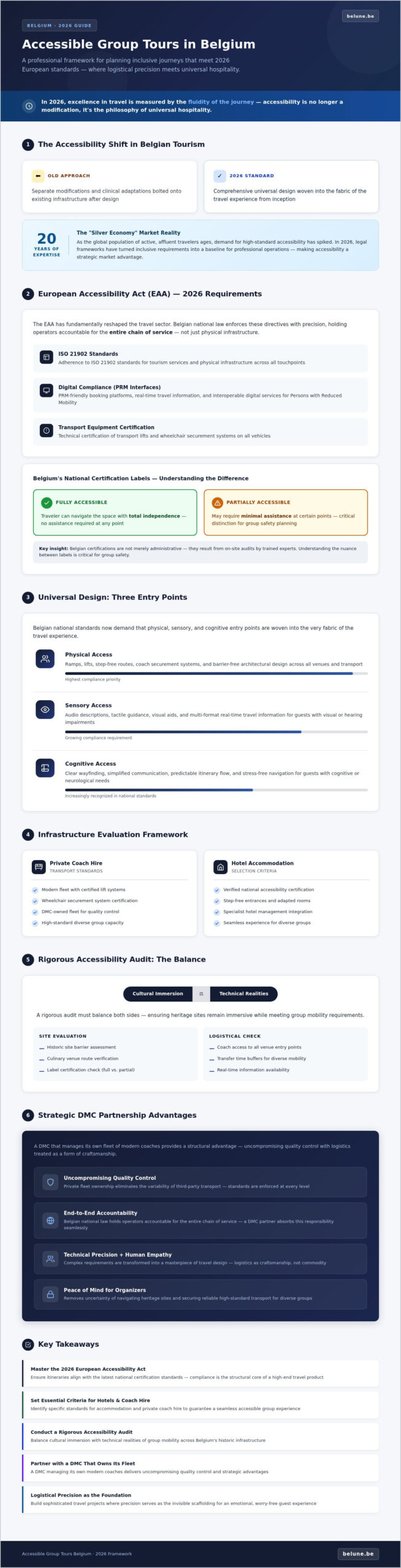
    The European Accessibility Act (EAA) in 2026

    The implementation of the EAA has fundamentally reshaped the travel sector. It mandates specific European Accessibility Act requirements that extend far beyond physical infrastructure. In 2026, these standards govern digital booking platforms, real-time travel information, and the interoperability of transport services. Belgian national law enforces these directives with precision, holding operators accountable for the entire chain of service. When verifying an itinerary, you must look for alignment with several key markers:

    • Adherence to ISO 21902 standards for tourism services and infrastructure.
    • Digital compliance for PRM-friendly (Persons with Reduced Mobility) booking and information interfaces.
    • Technical certification of transport lifts and wheelchair securement systems.

    National Certification and Quality Labels

    Belgium employs a sophisticated hierarchy of accessibility labels that serve as a reliable barometer for quality. These certifications aren’t merely administrative; they’re the result of on-site audits by trained experts. Understanding the nuance between ‘fully accessible’ and ‘partially accessible’ is critical for group safety. A fully accessible label implies that a traveler can navigate the space with total independence. Partially accessible venues may require minimal assistance or have specific limitations in certain areas. For a tour operator, these labels provide the necessary data to perform a rigorous risk assessment before the group arrives. It’s the difference between a successful tour and a logistical failure.

    Navigating these technicalities requires a partner who treats compliance as an art form. We specialize in interpreting these regulations to create itineraries that are as safe as they are inspiring. By choosing an expert in bespoke destination management, you ensure that every legal and ethical requirement is met with uncompromising rigour. This technical mastery allows the traveler to focus on the beauty of the destination while we manage the complexity of the standards.

    Accessible Group Tours in Belgium: 2026 Travel Guide

    Evaluating Infrastructure: Transport, Accommodation, and Logistics

    The success of accessible group tours belgium rests on the invisible precision of its infrastructure. It’s not enough to know a destination is beautiful; one must know exactly how a group will traverse its historic cobbles or reach its hidden galleries. This logistical rigour ensures that the poetic experience of travel remains undisturbed by technical friction. In 2026, the standard for excellence is a pre-vetted route where every curb and doorway has been measured against the reality of group mobility. Professional planning transforms potential obstacles into a fluid, curated narrative.

    Accessible Coach Hire and Transport Standards

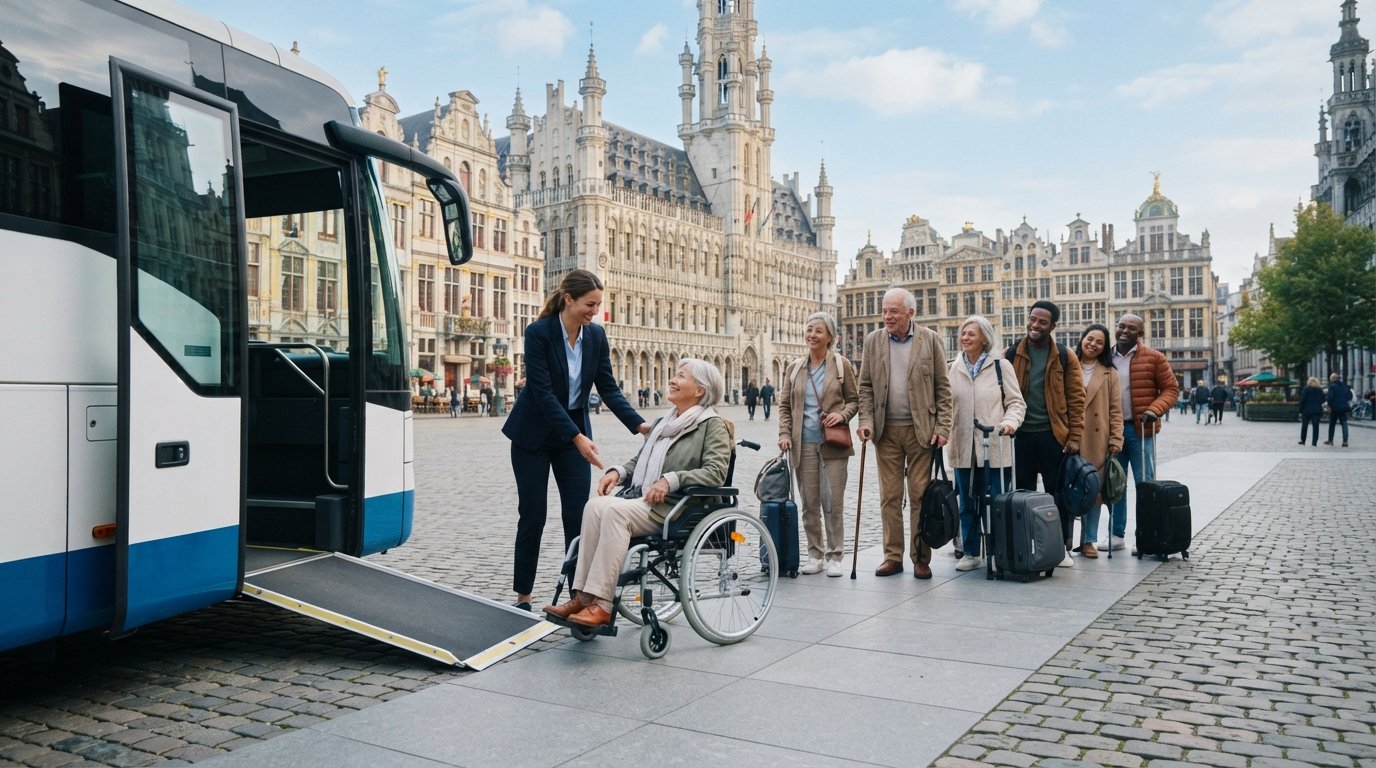
    Reliable transport is the structural spine of any tour. For groups with reduced mobility, the distinction between a hydraulic lift and a manual ramp is a matter of both safety and dignity. Modern coaches must offer flexible space configurations that allow for secure wheelchair placement without isolating travelers from the rest of the group. Beyond the machinery, driver training is paramount. A professional driver in 2026 acts as a logistical guardian, skilled in the technical operation of lifts and sensitive to the pacing of the group. By utilizing our private fleet of modern coaches, we eliminate the variability of third-party providers, ensuring every vehicle meets our uncompromising standards for comfort and safety.

    Strategic Hotel Accommodation Management

    Securing a block of rooms is only the first step in sophisticated group planning. True hotel accommodation management involves auditing lift capacities to prevent bottlenecks and verifying that “accessible” rooms actually meet the diverse needs of the group. Often, a room described as accessible may lack the lateral space required for certain mobility aids or feature bathroom fixtures that don’t align with international safety norms. We bridge this information gap by conducting on-site inspections and consulting official accessible tourism resources in Belgium to cross-reference certifications. This proactive approach prevents the common pitfalls that can disrupt a group’s rhythm, allowing guests to focus on the narrative of their journey rather than the limitations of their room.

    Managing the “last mile” at historic national sites requires a deep, local understanding of the environment. National heritage often presents obstacles like narrow medieval passages or uneven surfaces that don’t appear on standard maps. A strategic DMC maps these challenges in advance, identifying the most elegant entry points that maintain the group’s momentum. It’s about technical rigour serving artistic vision. This level of detail ensures that every excursion, from a quiet museum visit to a bustling gastronomy tour, is executed with minimalist elegance and zero compromise on accessibility.

    Strategic Planning for Inclusive Belgian Itineraries

    Planning is more than a sequence of stops; it’s a choreography of movement. Designing accessible group tours belgium requires a methodology that respects both the traveler’s energy and the destination’s complexity. A successful itinerary doesn’t just happen. It’s engineered through a rigorous audit of every transition, ensuring that the emotional resonance of a visit isn’t diluted by logistical fatigue. We view each journey as a structural whole where the flow between venues is as vital as the venues themselves.

    The 5-Step Accessibility Audit for Tour Operators

    We employ a structured approach to validate the feasibility of every project. This methodology serves as a blueprint for excellence and a guarantee of group safety:

    • Step 1: Profile Assessment. We analyze the specific mobility needs and sensory requirements of the group to tailor the pace of the day.
    • Step 2: Chain Verification. Every link in the transport and accommodation chain is vetted for technical compliance and real-world functionality.
    • Step 3: Venue Auditing. We confirm the physical accessibility of heritage sites, breweries, and restaurants, looking beyond the official labels to find hidden barriers.
    • Step 4: Rhythm Design. We create “low-friction” schedules that prioritize quality over quantity, building in necessary rest periods to maintain group morale.
    • Step 5: Professional Validation. The final itinerary is reviewed by a specialized Benelux incoming tour operator to ensure on-the-ground viability.

    Curating Cultural Experiences without Barriers

    Art and culture should be accessible to the soul, not just the body. When we design gastronomy and beer experiences, we ensure the venues offer the same level of comfort for everyone. Battlefield tourism and heritage tours are adapted to include sensory descriptions and tactile elements where possible. It’s about inclusive communication. Our local guides are trained to adjust their delivery to the group’s specific needs, ensuring no one is left out of the narrative. They don’t just speak; they connect.

    Communication protocols are the final safeguard of a professional tour. We maintain a constant dialogue between the agency, our team, and the client. This transparency allows for rapid adjustments if needs change on the ground. Emergency planning is integrated into every project, with support mechanisms ready to address any unforeseen challenges. It’s a commitment to total reliability that allows you to promise a worry-free experience to your clients. If you’re ready to elevate your travel portfolio with expertly designed journeys, partner with a visionary DMC today.

    The BELUNE Approach: Excellence in Accessible Destination Management

    Experience is the ultimate architect of reliability. With over 20 years of industry leadership, we’ve refined the art of managing accessible group tours belgium into a precise science. Our approach transcends the standard checklist; it’s a commitment to transforming the technical challenges of national travel into a fluid, artistic expression of hospitality. We believe that true luxury in group travel is found in the absence of friction. It’s the result of a vision that balances high-end aesthetics with uncompromising technical rigour.

    Sophisticated Logistics as a Strategic Asset

    Complexity shouldn’t be a barrier to beauty. We act as an “Advisor of Trust” for our international partners, providing a bridge between ambitious creative visions and the rigorous technical demands of accessibility. Our role is to ensure that every transition, from arrival to the final excursion, is managed with an elegance that feels effortless to the guest. By centralizing hotel accommodation management and local expertise, we eliminate the fragmentation that often plagues large-scale inclusive projects. We don’t just solve problems; we prevent them through meticulous design and a deep understanding of the national landscape. Our expertise transforms logistical hurdles into a seamless narrative of exploration.

    Partnering for Success in 2026

    The landscape of 2026 demands more than a simple service provider. It requires a strategic ally who understands that the success of a group travel agency depends on the reliability of its local partners. Our private fleet of modern coaches is a cornerstone of this promise. By maintaining our own vehicles, we guarantee that every ramp, lift, and safety protocol meets our internal standards of excellence. There is no reliance on external vendors, meaning no uncertainty for your clients. We control the quality of the journey from the first mile to the last.

    We invite you to co-create journeys that celebrate heritage with uncompromising inclusivity. Our mastery of art, culture, and gastronomy tours is matched only by our technical discipline. We provide the invisible scaffolding that allows your vision to shine. Together, we can build itineraries that are as sophisticated as they are accessible, ensuring that every traveler experiences the very best of what the country has to offer. Excellence is a collaborative effort, and we are ready to be your most trusted partner on the ground.

    Elevating the Standard of Inclusive Travel

    Travel in 2026 is no longer about overcoming barriers; it’s about designing environments where barriers never existed. We’ve explored how technical compliance with the European Accessibility Act and the rigorous auditing of infrastructure form the backbone of high-end tourism. Mastering accessible group tours belgium requires more than just local knowledge. It demands a fusion of artistic vision and uncompromising technical rigour.

    Realizing these complex itineraries depends on the strength of your logistical scaffolding. We offer the serenity of 20 years of DMC expertise, supported by our private fleet of modern, accessible coaches and specialized B2B hotel management. This control over the entire supply chain guarantees that your creative concepts are executed with flawless precision. It’s time to transform the logistical challenge of accessibility into a hallmark of your brand’s quality.

    Design your sophisticated, accessible group itinerary with BELUNE and let’s co-create travel experiences that inspire every guest.

    Frequently Asked Questions

    What are the primary accessibility standards for group travel in Europe for 2026?

    Standards are primarily defined by the European Accessibility Act (EAA) and the ISO 21902 global standard. These regulations mandate that transport services, digital booking platforms, and physical infrastructure meet specific universal design criteria. In 2026, compliance isn’t optional for professional operators. It ensures that every guest experiences a seamless journey. These frameworks provide a technical roadmap for mobility, sensory, and cognitive access across all member states.

    How do I verify if a Belgian hotel is truly group-accessible?

    Look for national accessibility labels that distinguish between “partially” and “fully” accessible facilities. However, labels are only the starting point for professional accessible group tours belgium. We conduct rigorous on-site audits to verify lift capacities and room configurations. This prevents bottlenecks during group check-ins. A specialized hotel accommodation management partner ensures that “accessible” descriptions match the technical reality of the group’s specific mobility profiles.

    Can large coaches in Belgium accommodate multiple wheelchair users?

    Yes, modern coaches with flexible interior configurations can safely transport multiple wheelchair users simultaneously. The key is securing a vehicle equipped with a heavy-duty hydraulic lift rather than a simple ramp. This allows for dignified entry and secure positioning within the main cabin. By utilizing our private fleet of modern coaches, we guarantee that the technical setup meets the exact requirements of your group’s size and mobility needs.

    What is the role of a DMC in ensuring accessibility for an international group?

    A Destination Management Company acts as your strategic ally and “Advisor of Trust” on the ground. We bridge the gap between your creative vision and the technical realities of local infrastructure. Our role involves vetting every link in the travel chain, from transport lifts to restaurant entry points. We manage the complex logistics of accessible group tours belgium, allowing you to focus on the guest experience while we handle the technical precision.

    Are historic national heritage sites in Belgium accessible for groups?

    Many historic sites have integrated modern accessibility solutions to meet national standards. While medieval architecture presents natural challenges, professional planning identifies “low-friction” routes that bypass traditional barriers. We map these entry points in advance, ensuring that heritage tours remain inclusive. It’s about technical rigour serving artistic appreciation. We find elegant ways to navigate narrow passages or uneven surfaces, making the country’s rich history available to all travelers.

    What should I look for when hiring a coach for an accessible group tour?

    Prioritize providers who own and maintain their own fleet to ensure consistent quality control. Look for coaches equipped with hydraulic lifts, modern securement systems, and enough interior volume for easy movement. Driver training is equally critical. A professional driver must be skilled in operating accessibility equipment and sensitive to the group’s pacing. Our private fleet eliminates the uncertainty of third-party rentals, providing a guaranteed standard of safety and comfort.

    How does the European Accessibility Act impact tour operators in 2026?

    The EAA mandates that all travel-related services, including digital booking and real-time information, must be accessible to everyone. Tour operators are now legally and ethically responsible for ensuring their entire supply chain complies with these directives. This impacts how you present information and how you select national partners. Working with a compliant DMC ensures that your itineraries meet these high standards, protecting your brand from liability while enhancing the traveler’s journey.

    Why is a custom itinerary better for groups with specific accessibility needs?

    Custom itineraries allow for a precise audit of every transition, matching the pace of the day to the group’s energy levels. Standard packages often overlook the “last mile” logistics that can cause friction for travelers with reduced mobility. A tailor-made approach ensures that every gastronomy venue or museum visit has been pre-vetted for feasibility. This bespoke design merges artistic vision with technical rigour, creating a worry-free experience that feels effortless and sophisticated.

  • Mastering Benelux Group Travel Logistics: A Strategic Framework for 2026

    Mastering Benelux Group Travel Logistics: A Strategic Framework for 2026

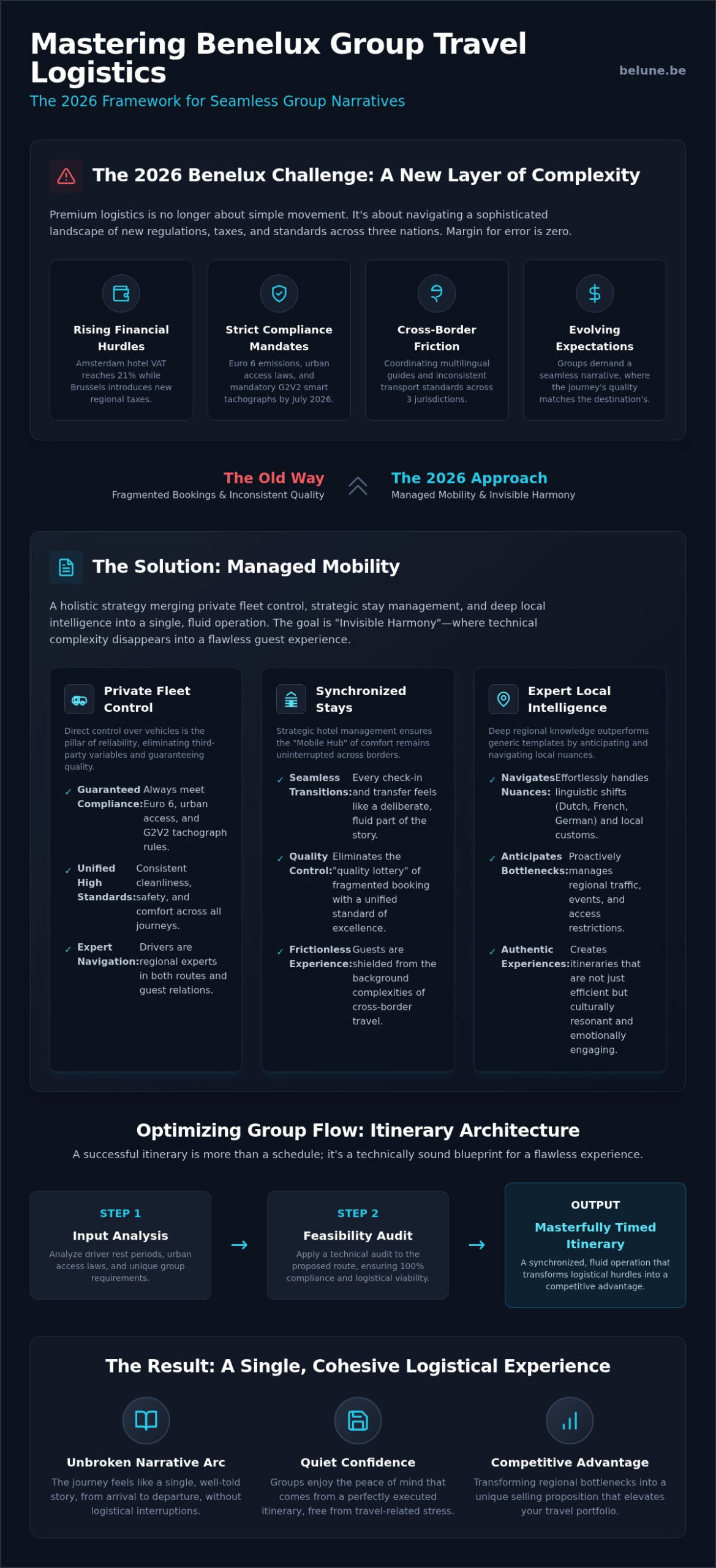
    In 2026, premium logistics is no longer about moving people; it is about the invisible architecture of a curated group narrative. When Amsterdam’s hotel VAT reaches 21% and Brussels implements new regional taxes, the margin for error in benelux group travel logistics disappears. You aren’t just booking coaches and rooms. You’re engineering an experience where every border crossing feels like a seamless transition between chapters of a story.

    We understand the pressure of managing inconsistent transport standards or the exhaustion of coordinating multilingual guides across three different legal jurisdictions. It’s a delicate balance to maintain high-end standards while facing new Euro 6 compliance mandates and mandatory rest periods for drivers. This strategic framework provides a roadmap to synchronize your transport, luxury accommodations, and local expertise into a single, fluid operation. You’ll discover how to transform these regional bottlenecks into competitive advantages, ensuring your groups enjoy the quiet confidence that only comes from a masterfully timed itinerary.

    Key Takeaways

    • Understand the 2026 shift toward “Managed Mobility,” where private fleet control and local intelligence merge to create a seamless group narrative.
    • Master benelux group travel logistics by synchronizing high-end coach hire with strategic hotel management to eliminate cross-border friction.
    • Discover how local guide expertise navigates the region’s linguistic and regulatory nuances more effectively than generic global templates.
    • Learn to apply technical feasibility audits to your itinerary architecture, ensuring every journey respects modern rest periods and urban access laws.
    • Recognize the value of a single-source visionary ally in providing a cohesive logistical experience across the Benelux region and Paris.

    The Evolution of Benelux Group Travel Logistics in 2026

    The travel landscape in 2026 demands more than simple movement. It requires a vision. As the Benelux Union continues to deepen its cooperation, the logistical requirements for high-end groups have become increasingly sophisticated. We’ve moved beyond the era of fragmented bookings. Today, benelux group travel logistics is defined by “Invisible Harmony,” a state where the technical complexity of transport and stay disappears into the background of a flawlessly executed journey. This evolution centers on the rise of sustainable, high-end experiences where the quality of the transition is as vital as the destination itself.

    The Benelux region, with its dense urban centers and varied linguistic landscapes, presents a unique challenge for the modern planner. Precision matters. A successful itinerary isn’t a list of stops; it’s a structural component of the group’s emotional experience. By integrating technical mastery with a deep understanding of regional diversity, we transform the logistical framework from a hurdle into a competitive advantage.

    The Complexity of Cross-Border Synchronization

    Navigating the three nations requires more than a passport. While borders are open, regional regulations regarding coach emissions and urban access vary significantly between Antwerp, Amsterdam, and Luxembourg City. Coordinating these shifts while managing multilingual guide services across Dutch, French, and German speaking regions creates a layer of friction that generic templates cannot solve. Managed Mobility is the synergy between owned assets and local expertise. This model allows us to anticipate regional bottlenecks, such as the new smart tachograph requirements for international transport, before they impact the guest experience.

    Shifting Expectations for Tour Operators

    Modern groups no longer accept “just getting there” as a standard. They seek a narrative arc that remains unbroken from the moment they land until their final departure. Relying on a specialized benelux incoming tour operator ensures that this narrative is safeguarded against the unpredictability of regional logistics. By moving away from fragmented bookings toward holistic management, we transform logistics into a structural asset. This approach guarantees that every hotel check-in and every coach transfer feels like a deliberate, artistic choice rather than a functional necessity. It’s about providing a single point of contact that bridges the gap between a technical plan and a human experience.

    The Pillars of Managed Mobility: Private Fleets and Strategic Stays

    The architecture of a successful journey relies on tangible assets. While many operators rely on a patchwork of sub-contractors, true mastery in benelux group travel logistics requires direct control over the primary touchpoints: the vehicle and the hotel. This integration forms a “Mobile Hub,” a sanctuary of consistency that shields guests from the external chaos of travel. According to official EU tourism statistics, the demand for high-quality, reliable group experiences in Belgium and the Netherlands continues to rise, making asset control a necessity rather than a luxury. When transport and accommodation are synchronized, the group’s comfort remains uninterrupted, regardless of the border they cross.

    Maintaining consistent quality across diverse regional standards is a technical challenge. A coach in Amsterdam must meet the same rigorous cleanliness and safety benchmarks as one in Luxembourg. By managing both the fleet and the stay, we create a unified standard of excellence. This approach removes the “quality lottery” often found in fragmented supply chains, replacing it with a predictable, high-end environment for every guest.

    The Private Fleet Advantage

    A private coach fleet is a reliability pillar. It eliminates the variables introduced by third-party vendors who may not share your commitment to excellence. Our drivers aren’t just operators; they’re experts in regional navigation and guest relations. This control allows for deep customization, especially for specialized culture group tours in Benelux. From ensuring Euro 6 compliance for city center access to implementing the mandatory G2V2 smart tachographs by July 2026, owning the fleet means we don’t just hope for compliance; we guarantee it. It’s the ultimate hedge against seasonal disruptions.

    Synchronized Hotel Management

    Hotel Accommodation Management serves as the anchor of the logistical chain. We don’t just book rooms; we curate logistical nodes. This involves sourcing group-friendly hotels that align perfectly with the coach’s route to minimize unnecessary drive times and maximize rest. The check-in choreography is vital. We manage the flow to ensure guests move from coach to room without friction, maintaining the group’s momentum. Long-term partnerships with regional hospitality leaders allow us to secure premium space even during peak periods. If you’re looking for a partner who understands this delicate balance, exploring our managed mobility model can transform your next itinerary from a plan into a masterpiece.

    Mastering Benelux Group Travel Logistics: A Strategic Framework for 2026

    Why Expert Local Knowledge Outperforms Global Templates

    A global template is a skeleton; local mastery is the breath that brings it to life. While digital platforms offer the illusion of control, they cannot replace the intuition required to manage benelux group travel logistics in a high-stakes environment. Many operators believe they can source components independently online. However, a booking confirmation isn’t a guarantee of flow. True regional mastery understands that a transfer isn’t just a distance between points A and B. It’s a “Narrative Layer” where the logistics actively support the storytelling of the tour. When the coach arrives exactly as the sun hits the Grand Place, that isn’t luck. It’s the result of technical precision meeting local insight.

    The European Parliament report on transport and tourism highlights the complexity of regional infrastructure and the need for seamless interconnectivity. Relying on a global algorithm often misses the human nuances of this data. Local guides do more than recite history; they bridge the gap between technical coordination and the guest’s emotional journey. They ensure the logistical framework remains invisible, allowing the group to focus on the experience rather than the schedule. This expertise transforms a simple itinerary into a structural component of a successful brand portfolio.

    Beyond the Map: Real-Time Problem Solving

    The Multilingual Connection

    Communication is the lubricant of logistics. Coordination with local sites, restaurants, and authorities requires a multilingual approach that respects cultural etiquette. In the Benelux, language barriers can quickly become technical bottlenecks. Expert guide services ensure the “Narrative Layer” remains intact by translating the technical needs of the group into the local dialect of the service provider. This nuance transforms a standard transfer into a cultural introduction. It’s a sophisticated approach where the journey itself becomes an artisanal realization of the client’s vision, far removed from the cold rigidity of a global booking template.

    Optimizing Group Flow: Itinerary Architecture and Feasibility

    Itinerary Architecture is the structural soul of a journey. It transforms a simple list of sights into a rhythmic, cinematic experience. In the complex landscape of benelux group travel logistics, beauty arises from precision. We don’t just schedule stops; we design the flow of energy throughout the day. This involves balancing the intellectual depth of a museum visit with the physical reality of group movement. A masterfully timed journey feels effortless to the guest, precisely because the technical constraints have been meticulously managed behind the scenes.

    A feasibility audit is the foundation of this architecture. In 2026, the EU Mobility Package mandates a 45-minute break after 4.5 hours of driving and 11 hours of daily rest. These aren’t just regulations; they’re the parameters of the group’s comfort. We assess every route against these standards, alongside city-specific mandates for Euro 6 or zero-emission vehicles in low-emission zones. If you’re ready to elevate your planning, audit your next itinerary with our team to ensure every transition is a masterpiece of timing.

    The Logistical Audit Process

    Our methodology follows a rigorous three-step framework. First, we conduct a route feasibility study, allocating realistic time-blocks that account for 2026 traffic patterns and mandatory driver rest periods. Second, we identify “Logistical Anchors.” These are the hotels and primary sites that dictate the group’s geographic center. Finally, we implement contingency mapping. This step anticipates regional bottlenecks or high-regulation zones, ensuring the narrative remains intact even when the unexpected occurs. It’s a proactive stance that replaces reactive stress with structural serenity.

    Curating Thematic Logistics

    Thematic journeys demand a bespoke logistical response. Integrating themed group travel in Benelux requires more than just a bus; it requires specialized assets. For cycling tours, this means modern trailers and secure equipment handling. For commemorative battlefield visits, it involves coordinating sensitive timing to ensure the group arrives in a state of quiet reflection rather than rushed exhaustion. Even a gastronomy experience relies on transport timing. A world-class beer tasting loses its charm if the group is checking their watches for a departing coach. We synchronize these elements so the theme remains the focus, supported by an invisible, flawless logistical framework.

    Elevating Your Portfolio with BELUNE’s Logistical Mastery

    Excellence is a choice. It’s the result of a partnership that values technical precision as much as creative vision. By positioning BELUNE as your visionary ally, you move beyond the limitations of traditional vendor relationships. We don’t just provide services; we integrate into your workflow to refine your benelux group travel logistics. This strategic collaboration allows you to offer more than just a trip. You offer a structural masterpiece where every transition is intentional and every detail is secure.

    Our reach extends beyond the immediate borders of Belgium, the Netherlands, and Luxembourg. We provide a seamless transition between the Benelux region and Paris, offering a single-source solution for your most ambitious European itineraries. With 20+ years of industry experience, we’ve refined our “Managed Mobility” model to a point of effortless execution. This depth of knowledge translates directly into client peace of mind. You aren’t managing a fragmented supply chain; you’re orchestrating an experience with a partner who understands the high stakes of premium group travel.

    The BELUNE Commitment to Excellence

    We believe in absolute transparency. Our fixed-price comprehensive group programs eliminate the uncertainty of hidden costs, allowing you to budget with confidence. This approach provides “Respiration” in your service. It creates the mental and operational space you need to focus on your clients while we handle the invisible architecture of the journey. If your organization requires interim leadership or strategic support to navigate these complex industry changes, you can find out more about how Lange Nelle bv provides specialized management advice. Our bespoke planning process for 2026 is designed to anticipate every variable, from evolving urban access regulations to the nuances of regional hospitality. We don’t just solve problems; we prevent them through structural foresight.

    Designing Your Next Masterpiece

    Collaboration begins with a conversation. We work closely with international tour operators to design custom itineraries that reflect their brand’s unique identity. Our on-the-ground support is professional, multi-lingual, and deeply rooted in local culture. We’re your eyes and ears in the region, ensuring that every detail aligns with the original vision from the first mile to the last. It’s time to shift from transactional bookings to a strategic alliance that elevates your entire portfolio. Request your custom Benelux group tour logistics consultation to start the journey toward your next masterpiece.

    The Future of Seamless Regional Journeys

    Mastering benelux group travel logistics in 2026 demands a shift from transactional coordination to structural artistry. True excellence lies in the “Invisible Harmony” where technical constraints, from driver rest periods to city access regulations, become the silent foundation of a flawless group narrative. By prioritizing asset control and regional expertise, you ensure that every transition across the Benelux borders feels like a deliberate, high-end experience rather than a functional necessity.

    Success isn’t found in global templates but in the hands of a visionary ally who understands the region’s technical and emotional geography. With over 20 years of specialized DMC experience, we provide the stability of a private fleet of modern coaches and the precision of comprehensive hotel and guide management. It’s time to elevate your brand by choosing a partner dedicated to the artisanal realization of your vision. Partner with BELUNE for seamless Benelux group travel logistics and transform your next itinerary into a masterpiece of timing and comfort. The road ahead is clear; let’s build something exceptional together.

    Frequently Asked Questions

    What are the primary challenges of group travel logistics in the Benelux region for 2026?

    The primary challenges include navigating the 21% hotel VAT in Amsterdam and the Euro 6 compliance required for city centers. Tour operators must also manage the 2026 tax year regional lodging fees in Brussels. These financial shifts require a specialized benelux group travel logistics framework to maintain premium standards without compromising the group’s budget or the flow of the itinerary.

    How does owning a private coach fleet improve the reliability of group tours?

    Owning the fleet ensures direct control over maintenance, cleanliness, and driver expertise. It eliminates the unpredictability of third-party sub-contracting and guarantees that every vehicle meets the mandatory G2V2 smart tachograph standards by July 2026. This technical ownership allows us to prioritize your group’s schedule and safety, providing a consistent quality level that a fragmented supply chain simply cannot match.

    Can BELUNE manage group travel logistics that include both Benelux and Paris?

    Yes, we provide a seamless logistical bridge between the Benelux countries and Paris. This allows tour operators to maintain a single point of contact for complex, multi-region European itineraries. By synchronizing transport and stay across these borders, we ensure the group narrative remains intact and the quality of service remains high, regardless of the geographic transition.

    What is the role of a Destination Management Company (DMC) in hotel accommodation management?

    A DMC acts as a strategic anchor by sourcing group-friendly hotels that align perfectly with the coach’s route. We don’t just book rooms; we manage the “check-in choreography” to ensure guests move from coach to room without friction. This proactive coordination maintains the group’s momentum and ensures that the hotel serves as a restful node within a masterfully timed journey.

    How do you ensure transport regulations are met across different European borders?

    We ensure compliance by integrating regional variations into our initial itinerary audit. Navigating benelux group travel logistics requires a deep understanding of the EU Mobility Package, including the 11 hours of mandatory daily rest for drivers. Our team monitors the specific low-emission zone requirements in cities like Antwerp and Amsterdam, ensuring every vehicle in our fleet is fully compliant with local laws.

    Is it possible to customize logistical plans for specific themes like battlefield or culinary tours?

    Absolutely. We customize logistical plans for specialized themes like battlefield tourism, cycling tours, or gastronomy experiences. This includes providing specialized equipment trailers for bikes or precisely timing arrivals at commemorative sites to respect the group’s emotional journey. We synchronize these thematic elements so the logistics remain invisible, allowing the chosen narrative to take center stage throughout the trip.

    How does BELUNE handle real-time logistical disruptions during a tour?

    We use an “Invisible Hand” approach, resolving hiccups like unannounced road closures or sudden festival traffic before the group even notices. Our local presence and multilingual guides provide a strategic safety net for immediate, on-the-ground problem-solving. This proactive stance protects the integrity of the tour and ensures that the guest experience remains smooth and uninterrupted by external variables.

    What benefits do tour operators gain from a fixed-price group travel package?

    Fixed-price packages offer absolute budget security by eliminating hidden costs or seasonal price surges. This transparency allows tour operators to focus entirely on their clients’ engagement while we handle the technical architecture of the entire program. It’s a model that values collaboration and trust, providing the “respiration” needed to execute high-end journeys with structural serenity and financial confidence.