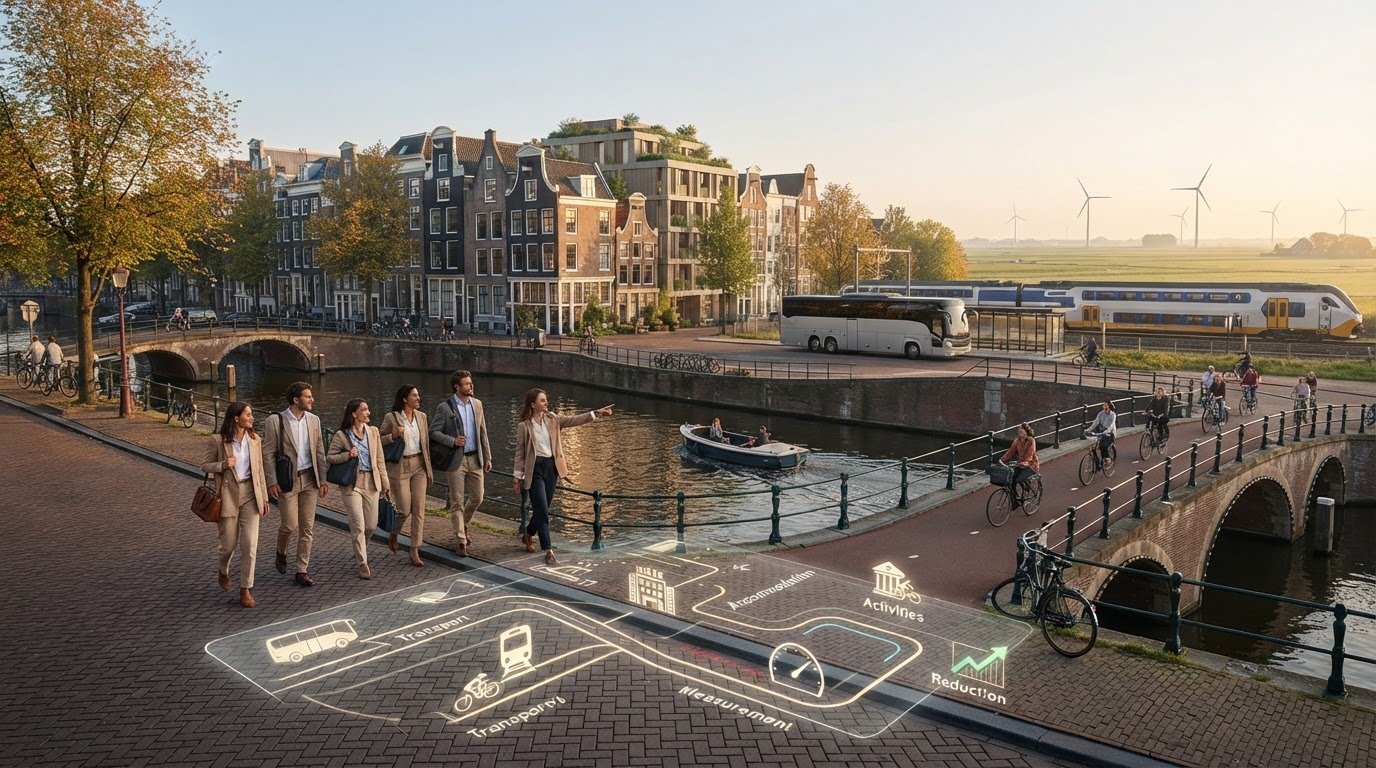
A tour can be carefully offset and still fall short of a credible carbon claim. For operators asking how to offer carbon-neutral tours in the Netherlands, the stronger starting point is to measure emissions across the itinerary, then reduce them wherever practical. The distinction matters: since September 27, 2026, EU rules prohibit product-level carbon-neutral claims based on offsetting.
The choices can be complex. Transport, accommodation and activities each involve different data and supplier considerations, while vague environmental language can undermine trust. A defensible plan begins with consistent measurement and changes at source, not a credit purchase used to make a tour sound impact-free.
This guide explains how to map a group tour’s emissions, compare travel and supplier options, and identify reductions you can substantiate. It also covers how to treat residual emissions responsibly, assess compensation evidence and describe progress transparently. The aim is a lower-carbon Netherlands itinerary supported by clear decisions and claims that stand up to scrutiny.
Key Takeaways
- Set a clear itinerary boundary so your emissions assessment accounts for relevant travel, stays, activities and transfers.
- Build a usable baseline by gathering activity data, applying suitable emissions factors and documenting assumptions for each transport leg.
- Compare rail, coach and other options alongside accommodation and activity suppliers. Use itinerary fit and verifiable evidence rather than broad sustainability language.
- Learn how to offer carbon-neutral tours in netherlands by prioritising measurable reductions and assessing any compensation against clear evidence and transparent records.
- Turn your findings into an operating plan by assigning responsibility for supplier data, claim approval and post-tour review.
What Does a Carbon-Neutral Tour in the Netherlands Actually Mean?
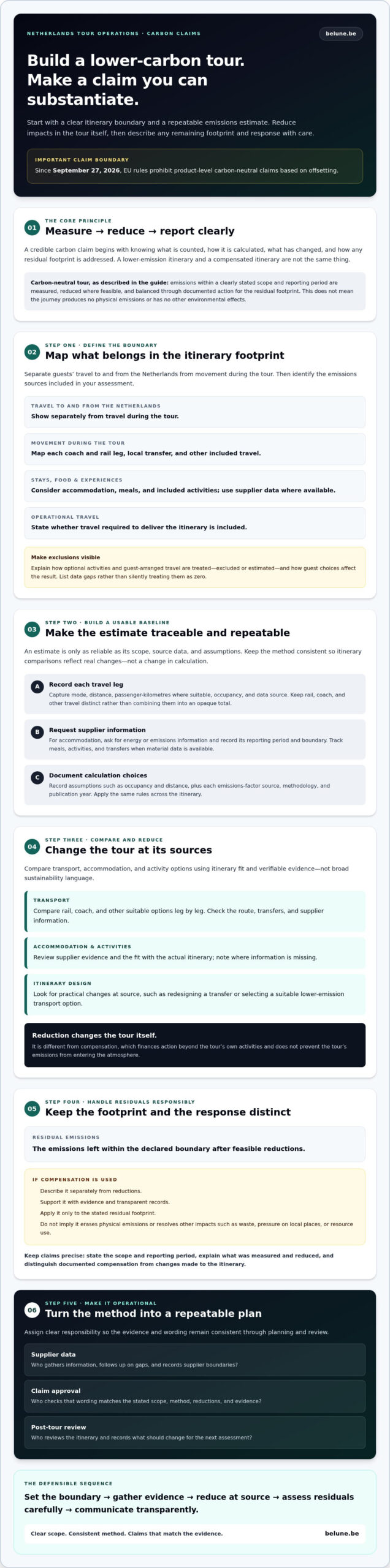
A credible carbon claim starts with a boundary, not a label. Before describing a tour as carbon-neutral, an operator needs to know which emissions are counted, how they’re calculated, what reductions have been made and how any remaining impact is addressed. A lower-emission itinerary and a compensated itinerary are not the same thing.
A carbon-neutral tour is one whose emissions within a clearly stated scope and reporting period have been measured, reduced where feasible and balanced through documented action for the residual footprint. That definition depends on transparent evidence. It doesn’t mean the journey produces no physical emissions or has no other environmental effects. The wider principles of Sustainable tourism also encompass economic and social considerations.
For context, watch this video on carbon-neutral travel experiences:
Which emissions belong in a Netherlands tour footprint?
Set the itinerary boundary before gathering data. Show guests’ travel to and from the Netherlands separately from travel during the tour. Then map the included journey: coach and rail legs, local transfers, accommodation, meals and activities. Use supplier data where it’s available. Operational travel required to deliver the itinerary may also belong in the assessment, so state whether it’s included.
Be explicit about what sits outside the calculation. For optional activities, explain whether they’re excluded or estimated and how guest choices affect the result. Record assumptions such as occupancy and distance, along with the emissions-factor source, its methodology and publication year. A Netherlands-specific assessment reflects the actual route, transport mix, stays and activities, rather than applying a generic sustainability label to every itinerary.
Carbon reduction, carbon neutrality and compensation
Reduction changes the tour itself, for example by redesigning a transfer or choosing a suitable lower-emission transport option. Compensation is different. It finances action beyond the tour’s own activities and doesn’t prevent the tour’s emissions from entering the atmosphere.
Residual emissions are those left within the declared boundary after feasible reductions. If you use compensation, describe it separately, support it with evidence and apply it only to that stated residual footprint. Don’t imply it erases the tour’s physical emissions or resolves impacts such as waste, pressure on local places or resource use. For operators learning how to offer carbon-neutral tours in netherlands, precise scope and wording are part of the work, not an afterthought.
How to Measure Tour Emissions Before Promising Carbon Neutrality
A useful emissions estimate starts with a defined itinerary and a repeatable method. For operators considering how to offer carbon-neutral tours in netherlands, the aim isn’t to produce a single impressive number. It’s to build a transparent account of what was measured, what was estimated and what remains outside the calculation.
An emissions estimate is only as reliable as its scope, source data and assumptions. Keep these visible so you can compare itinerary versions without mistaking a change in calculation for a real reduction.
Build a consistent Netherlands itinerary inventory
Map each leg separately, including travel to and from the Netherlands and movement within the tour. Record distance and passenger-kilometres where suitable, along with the mode, occupancy and data source. Don’t combine rail, coach and other travel into one opaque total. Separate figures make it easier to identify where itinerary changes could matter.
Request accommodation energy or emissions information, including its reporting period and boundary. Track meals, included activities and transfers when material data is available, and list gaps rather than silently treating them as zero. Decide how to handle optional activities, guest-arranged travel and supplier operations, then apply the same rule across the itinerary.
Make estimates transparent and repeatable
Use this workflow for each tour version:
- Define the tour. Set the reporting period and itinerary boundary, and identify the guests and relevant operational activity included.
- Collect activity data. Gather distances, passenger-kilometres, accommodation information and supplier details for each itinerary component.
- Apply suitable emissions factors. Select factors that fit the activity and geography. Record the source, publication year, units and system boundary.
- Review and document. Note conversion factors, occupancy and allocation assumptions, estimates, missing data and exclusions. Keep the calculation so it can be repeated.
Use consistent factors when comparing suppliers or redesigning an itinerary. If one coach leg is measured using actual distance and another relies on an estimate, flag the difference. Don’t present the comparison as more precise than the data supports. GHG Protocol guidance can serve as a reference framework, but check that the selected approach and boundary fit the tour calculation.
Report a total per tour when the full group and included activities are clearly defined. A per-traveller figure also needs a transparent allocation method, including the group size used and how shared transport or accommodation emissions are divided. If those inputs change, the result may change too.
A destination management company can help coordinate itinerary details and supplier information for a consistent assessment. Operators shaping custom group itineraries can set data requirements alongside the route plan, then check each factor and claim against their own evidence.
Which Netherlands Tour Choices Reduce Emissions Most?
No single transport mode or supplier choice makes every itinerary lower-carbon. The result depends on the full journey, including distance, occupancy, transfers, route and the quality of the emissions data. Compare alternatives using the same itinerary boundary, then make changes where the evidence points to a meaningful opportunity.
Compare like-for-like itinerary options using consistent boundaries and current evidence. Rail may suit one route, while a well-used coach may better connect a group to accommodation or activities elsewhere. Avoid basing claims on vehicle labels alone.
Compare transport and itinerary design
Assess rail for suitable journeys, including door-to-door logistics and transfers to and from stations. For coach travel, use actual route distance and occupancy assumptions. Check whether transfers or detours add distance without giving guests meaningful value. Comfort needn’t be an afterthought: compare the complete journey, including connections, waiting, luggage and how smoothly the group moves together.
| Choice | Decision factors | Evidence to request | Trade-off to check |
|---|---|---|---|
| Rail | Route suitability, stations and onward connections | Distance, travel mode and relevant emissions-factor source | Transfers may affect total distance, time and group logistics |
| Coach | Occupancy, route and transfer requirements | Actual itinerary distance and the assumptions used for passenger allocation | A low-occupancy journey can change the per-traveller comparison |
| Accommodation | Location, operational practices and available data | Dated energy or emissions information, including scope and reporting period | Supplier figures may use boundaries that don’t match the tour calculation |
| Meals and activities | Relevance to the itinerary and supplier practices | Available environmental data and an explanation of what it covers | Local sourcing or plant-forward choices may be options, not guaranteed savings |
Assess stays, food and activities with evidence
Ask accommodation providers for dated, scoped information, and record gaps rather than assuming a sustainability label proves lower emissions. Local sourcing and plant-forward meals can be considered as part of itinerary design, but don’t claim a carbon benefit without supporting data. Choose activities for their quality and relevance, then ask suppliers what their environmental information measures.
For operators exploring how to offer carbon-neutral tours in netherlands, consistent comparison turns supplier conversations into practical planning. A destination management company can coordinate itinerary choices and information requests across accommodation, coach travel and local guidance. The strongest option fits the group, works as a complete journey and has evidence to support a fair comparison.
How to Address Residual Emissions and Make Responsible Claims
Consider compensation only after measuring the itinerary and making feasible reductions. It can support climate action beyond the tour, but it doesn’t remove the tour’s physical emissions or make its wider environmental effects disappear. Treat compensation as a distinct response to a defined residual footprint, not a substitute for redesigning the itinerary.
Evidence matters more than a project’s marketing language. Before relying on credits, review the project type and claimed outcome, independent verification, evidence of additionality, and how permanence risks are managed. Ask for records showing that credits have been retired for the stated purpose, so they can’t be claimed again. No single document guarantees that every claim is appropriate; assess the evidence against the purpose and scope you’re communicating.
Choose and document any carbon compensation
Keep the emissions calculation, supplier records, factor sources, project documentation, verification details, retirement evidence and claim approvals together. Confirm that the volume of compensation corresponds to the tour’s declared residual emissions, not a wider or vaguely defined footprint. If project evidence is incomplete, disclose that limitation or don’t rely on the credit for a public claim.
Communicate the claim without overstating it
Be specific about the tour boundary, calculation period, reduction measures and treatment of residual emissions. For example, if each detail is documented, state that you measured emissions from specified itinerary elements for a stated period, changed identified travel arrangements, and separately funded a named type of climate project for the calculated remainder. State exclusions clearly. Avoid broad labels such as “green” or “zero-impact” when the evidence doesn’t support them.
There’s also an important regulatory distinction. As of 27 September 2026, EU rules under Directive (EU) 2024/825 prohibit product-level carbon-neutrality claims based on offsetting. A tour shouldn’t be marketed as “carbon-neutral” if that claim depends on purchased credits. Check current European Commission and Netherlands Authority for Consumers and Markets (ACM) guidance before approving environmental advertising. Requirements can depend on the precise claim and context, so have qualified advisers review the wording; this section isn’t legal advice.
For operators considering how to offer carbon-neutral tours in netherlands, transparent reporting is stronger than an absolute promise. Keep the evidence trail current, revisit claims when the itinerary or calculation changes, and distinguish direct reductions from separately financed climate action.
To coordinate itinerary planning and supplier information around your sustainability criteria, discuss your group itinerary needs with BELUNE.
How a Tour Operator Can Put a Lower-Carbon Netherlands Tour into Practice
Turn the method into a repeatable operating process. Start with a pilot itinerary to test supplier responses, data quality and group logistics before applying the approach to more departures. Treat it as a learning exercise, not a promise that the tour is carbon-neutral.
Use a repeatable planning and review checklist
Before contacting suppliers, agree on the intended audience, itinerary boundary and evidence you’ll accept. Then assign an owner to each step:
- Set the scope: confirm which travel, stays, activities and operational elements the assessment includes.
- Establish a baseline: record the planned itinerary, available activity data, calculation method and known gaps.
- Redesign: compare feasible itinerary changes using consistent assumptions, and note the expected reductions.
- Confirm suppliers: request comparable, dated information and follow up if the boundary or source is unclear.
- Calculate and disclose: assess the delivered itinerary, identify residual emissions and approve precise, evidence-based wording.
- Review after the tour: compare actual travel and supplier data with the plan, then update assumptions for future departures.
Assign responsibility for data collection, supplier follow-up, emissions calculations, claim approval and post-tour review. Record decision owners, planned changes and remaining uncertainty. If actual occupancy or routing differs from the plan, document the change rather than presenting the original estimate as a measured result.
Coordinate suppliers and specialist planning support
Ask each partner for the source, reporting period and scope behind environmental figures. A destination management company can coordinate custom itinerary planning, accommodation management, coach logistics and local guidance, while the operator remains responsible for verifying evidence and approving claims. A partner’s involvement alone doesn’t establish that a tour or service is carbon-neutral.
For a partner assessment, read this guide to choosing an incoming tour operator. Broader criteria for evaluating group-travel partners are covered in the group travel agency selection guide.
Learning how to offer carbon-neutral tours in netherlands starts with a process your team can repeat and improve, not a label applied before the evidence is ready. For professional operators, a conversation about itinerary needs and sustainability criteria can help identify where coordination and supplier information fit into the planning process.
Make Your Next Netherlands Itinerary More Measurable
A credible lower-carbon tour starts with a clear scope, consistent emissions data and practical changes to the itinerary. Measure transport, stays and activities using stated assumptions, then compare supplier options on a like-for-like basis. Prioritise reductions and describe any remaining impact carefully, with supporting evidence.
For operators exploring how to offer carbon-neutral tours in netherlands, the essential step is a repeatable plan, from baseline to post-tour review. Precise communication matters as much as the calculation: say what you measured, what you changed and what remains uncertain. Avoid claims that suggest a tour is impact-free.
BELUNE brings more than 20 years of group-travel and transport-industry experience, with custom itinerary planning, accommodation management, its own coach fleet and local guide services. These capabilities can help coordinate itinerary details and supplier information without implying that any tour or service is carbon-neutral. Discuss a tailored group itinerary with BELUNE and explore how your sustainability criteria can inform the planning process.
Each well-documented decision helps make tours more thoughtful, transparent and ready to improve over time.
Frequently Asked Questions
How can a tour operator make a Netherlands tour carbon-neutral?
Start by measuring the tour’s emissions within a clearly defined boundary, then reduce them through practical itinerary and supplier choices. Document the calculation method, reporting period, data sources and exclusions. Any compensation should relate only to measured residual emissions and be described separately. As of September 27, 2026, EU rules prohibit product-level carbon-neutrality claims based on offsetting. When considering how to offer carbon-neutral tours in netherlands, prioritise documented reductions and check current guidance before making public claims.
What should be included when calculating a tour’s carbon footprint?
Include relevant guest and operational travel, accommodation, transfers, meals and included activities where suitable data is available. Separate travel to and from the Netherlands from transport within the itinerary, and record each mode and distance. State how you handle optional activities, guest-arranged travel and supplier operations. Document emissions-factor sources, reporting year, group-size assumptions and exclusions so readers can understand what the total represents and comparisons remain consistent.
Is carbon offsetting enough to call a tour carbon-neutral?
No. Purchasing credits doesn’t reduce the tour’s own physical emissions, and EU rules in effect from September 27, 2026, prohibit product-level carbon-neutrality claims when they rely on offsetting. Measure the itinerary and reduce emissions at source first. If you support climate projects, disclose that action separately, explain the residual footprint it relates to, and retain evidence. Don’t suggest that compensation makes a tour impact-free or erases its wider environmental effects.
Which transport is lower-carbon for a group tour in the Netherlands?
There’s no single answer for every itinerary. Compare rail, coach and other options using the complete journey, including distance, occupancy, transfers and available emissions data. Rail may suit a route with convenient connections; a coach may work well for a group when occupancy and routing are considered. Calculate options using the same boundary and current factors, and include door-to-door logistics rather than relying on a vehicle label alone.
How can I check whether a carbon-credit project is credible?
Request documentation describing the project, its claimed climate outcome and the method used to quantify it. Check whether independent verification is available, how additionality and permanence are addressed, and whether there’s evidence that the credits were retired for the stated purpose. Confirm that the project type matches the compensation claim. Keep records with your tour calculation, and disclose gaps rather than treating a credit purchase as proof that emissions have been eliminated.
What environmental claims should a tour operator avoid?
Avoid broad, unqualified phrases such as “green,” “zero-impact” or “carbon-neutral” unless the specific claim is supported and appropriate under current guidance. Don’t imply that one sustainable feature makes the entire tour environmentally friendly, or that compensation removes physical emissions. Explain the claim’s scope, calculation period, reduction measures, exclusions and evidence. Environmental marketing rules can change, so check current ACM and EU guidance and seek qualified advice before publishing claims.
Can a destination management company help plan lower-carbon group tours?
Yes. A destination management company can coordinate itinerary logistics and gather information from accommodation, transport and local activity suppliers, helping an operator compare options across a group tour. BELUNE has more than 20 years of group-travel and transport-industry experience, with custom itinerary planning, accommodation management, its own coach fleet and local guide services. Its coordination can support planning, but it doesn’t by itself establish that a tour or supplier is carbon-neutral.