
The cheaper-looking option can cost more once planning time, coordination and risk are counted. That’s why calculating the roi of a destination management partner means comparing more than supplier invoices. Weigh the full cost of an in-house alternative against results you can reasonably attribute to the partnership.
It’s understandable to want clear evidence before committing budget. Guest satisfaction, stronger relationships and smoother logistics don’t fit neatly into a cost-savings claim, particularly when other factors shape the outcome. A defensible assessment separates documented financial inputs from non-financial measures, then links each result to an agreed objective.
This guide gives you a practical framework for doing that. Learn how to compare direct and indirect costs consistently, select evidence-based measures for experience and business outcomes, and distinguish a DMC’s contribution from the wider programme. BELUNE’s tailor-made itineraries, accommodation management, coach transport and expert guidance offer a concrete example of how to define a project-specific scope and assess it against agreed criteria. The aim is a clear-eyed decision: not a promised return, but a partnership assessed on transparent inputs and meaningful results.
Key Takeaways
- Define ROI around value you can attribute to the partnership, rather than treating revenue, savings and return-to-cost as interchangeable.
- Choose financial, operational and guest-experience indicators, then compare them against a consistent baseline and measurement period.
- Use the standard net ROI formula, and make the scope, inputs and attribution method explicit.
- Build a fair in-house comparison from equivalent trip requirements, documented staff time, supplier coordination and trip costs.
- Make calculating the roi of a destination management partner an ongoing review: turn findings into measurable priorities and a clear project scope.
What Does ROI Mean When You Work with a Destination Management Partner?
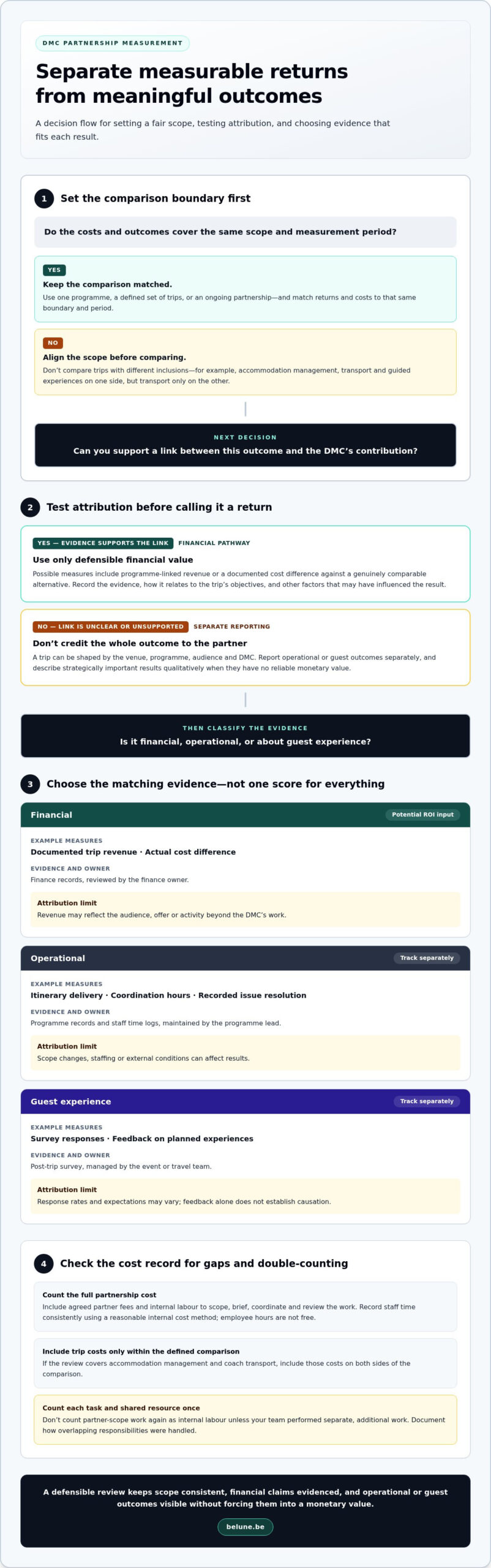
Partnership ROI compares the value attributable to a destination management company (DMC) with the full cost of the partnership. “Attributable” is important: a successful trip may reflect the venue, programme, audience and DMC’s work, so the entire outcome shouldn’t automatically be credited to one partner.
Quotable definition: DMC ROI is the financial value reasonably linked to the partner’s contribution, assessed against the full cost of that contribution. Operational and guest outcomes are reported separately unless they can be valued defensibly.
A Destination Management Company (DMC) can coordinate accommodation, transport, itinerary planning and local experiences. To assess that work fairly, first set the measurement boundary: one programme, a defined set of trips or an ongoing partnership. Match returns and costs to the same scope and period. A single programme review shows project-level performance; a longer view may reveal patterns across repeated work, but shouldn’t blur the results of distinct trips.
That boundary also separates ROI from related measures. Revenue is an outcome, not ROI by itself. Cost reduction is one possible financial return, not the whole value. A return-to-cost ratio shows how much return was generated per unit of investment, but not the net gain as a percentage. Calculating the roi of a destination management partner requires a clear view of both attributable benefit and total investment.
Which costs belong in a DMC partnership assessment?
Include agreed partner fees and the internal labour needed to scope, brief, coordinate and review the work. Record staff time consistently, using a reasonable internal cost method rather than treating employee hours as free. Add trip-related costs only when they fall within your defined comparison. For example, if the review covers accommodation management and coach transport, include those costs on both sides.
Keep the accounting clean. If a task is included in the partner’s scope, don’t count it again as internal labour unless your team performed separate, additional work. Apply the same rule to shared resources: assign each cost once and document how you handled overlapping responsibilities.
What counts as a return from a DMC relationship?
Financial returns may include revenue linked to the programme or documented cost differences against a genuinely comparable alternative. The connection should be supported by evidence, not assumed. Record the revenue measure, how it relates to the trip’s objectives, and other factors that may have influenced it.
Operational and guest outcomes matter, but track them separately from financial returns. Measures could include staff time spent coordinating the programme, delivery against agreed itinerary requirements, guest feedback or participation in planned experiences. Define each measure and how you’ll collect it in advance, so a favourable impression doesn’t become an unsupported savings claim.
Some outcomes, such as stronger relationships or a more distinctive guest experience, may be strategically important without having a reliable monetary value. Report them as qualitative evidence or against a clearly defined objective. Don’t assign a monetary value simply to make the ROI appear larger.
Which DMC Partnership Metrics Show Financial and Operational Value?
A useful scorecard doesn’t force every outcome into one number. Separate financial results from operational delivery and guest experience, then connect each measure to its evidence, a responsible owner and a clear attribution limit. This makes calculating the roi of a destination management partner more transparent, especially when external factors influence the result.
Before collecting data, define a baseline and measurement period. For one programme, compare actual results with a documented plan or a genuinely comparable past programme. For a continuing partnership, use consistent periods and scopes. Don’t compare a trip that includes accommodation management, transport and guided experiences with one that covers only transport.
| Indicator type | Example measure | Possible data source and owner | Attribution limit |
|---|---|---|---|
| Financial | Documented trip revenue or actual cost difference | Finance records, reviewed by the finance owner | Revenue may reflect the audience, offer or activity beyond the DMC’s work. |
| Operational | Itinerary delivery, coordination hours or recorded issue resolution | Programme records and staff time logs, maintained by the programme lead | Changes in scope, staffing or external conditions can affect results. |
| Guest experience | Survey responses or feedback on planned experiences | Post-trip survey, managed by the event or travel team | Response rates and expectations may vary; feedback alone doesn’t establish causation. |
Financial indicators to track without overstating savings
Keep the financial comparison like for like. Use the same trip scope, accounting basis and period for revenue and costs, and retain records that explain each figure. If internal coordination time is included, measure it consistently across the baseline and review period. A staff estimate made after the trip isn’t equivalent to a time log kept throughout it.
Treat projected savings as hypotheses, not realised returns. Record them separately until actual, comparable records support the difference. Changes in itinerary, supplier requirements or participation can make a simple before-and-after comparison misleading.
Operational and guest measures that add context
Operational measures show how the programme was delivered: whether agreed itinerary elements took place, how much coordination time the internal team recorded, and what issues arose and were resolved. For a tailor-made itinerary involving coach transport, accommodation management and expert guidance, specify the deliverables in scope and how each will be documented.
Guest feedback gives you a distinct view of service quality. It can show how people experienced the programme, but don’t automatically translate a positive response into revenue or savings. Qualitative outcomes belong beside financial ROI as evidence of experience and objective achievement, not inside the financial calculation unless a defensible valuation method exists. Note external influences, such as changes in programme scope, so the review credits the DMC only for outcomes its contribution can reasonably support.
A tailor-made group travel programme can be assessed against agreed itinerary, logistics and guest-experience measures, keeping financial results distinct from service-quality evidence.
How Do You Calculate DMC Partnership ROI Without Double-Counting?
Define the scope and use a cautious attribution method before calculating the result. The standard net ROI formula is ((attributable benefit − total investment) ÷ total investment) × 100. The result is a percentage, but it isn’t proof by itself: its reliability depends on whether the inputs cover the same programme, period and agreed scope.
Net ROI percentage shows the net benefit relative to investment; the benefit-to-cost ratio shows total benefit for each unit of investment and doesn’t subtract the investment from that benefit. Keep the measures distinct and state which one you’re reporting.
Use your own documented figures in this fill-in template. Leave a field blank or mark it unavailable if records don’t support it; don’t present an unsupported estimate as fact.
- Programme and period: [defined trip, programme or partnership] / [measurement dates]
- Attributable benefit: [documented benefit] − [portion not linked to the DMC] = [benefit included in ROI]
- Total investment: [partner costs] + [relevant internal costs] + [other in-scope costs] = [total investment]
- Net ROI: ([attributable benefit] − [total investment]) ÷ [total investment] × 100 = [result]
A practical calculation sequence for tour operators
Start with the decision the review should inform, such as whether a defined group travel programme met its financial objective. Set the programme scope, comparison period and baseline before collecting results. Then record costs using consistent categories and source records, including partner costs and relevant internal coordination. Include a benefit only when you can explain its connection to the DMC’s contribution.
- Write down the included services, such as itinerary planning, accommodation management, coach transport or expert guidance.
- Choose a baseline and period that match the scope, and record the intended outcome.
- Reconcile costs against invoices, internal time records and other relevant accounting records.
- Document the evidence and attribution method for each benefit before applying the formula.
How to handle shared results and uncertain attribution
Travel outcomes often have several contributors. A programme’s revenue or guest response may reflect the itinerary, audience, offer and other partners, not just the DMC. Separate observed outcomes from estimates, label assumptions clearly, and apply the same allocation rule throughout the review rather than choosing a share after seeing the result.
- Observed: Supported by records, with the source identified.
- Estimated: Based on a stated method and shown separately from confirmed results.
- Unattributed: Relevant to the programme but not reliably assignable to the DMC.
If evidence is missing or unreliable, report that limitation. A transparent calculation with a narrow, well-supported benefit is more useful than a larger figure built on guesses. This discipline is central to calculating the roi of a destination management partner without counting the same outcome twice.
How Can You Compare a DMC Partnership with Managing Travel In-House?
A fair comparison starts with the same trip, not two differently shaped budgets. Set an equivalent scope, deliverables, service standards and accounting period for both options. If the DMC coordinates a tailor-made itinerary, accommodation management, coach transport and expert guidance, include those same responsibilities in the in-house model where they apply. Otherwise, the apparent difference may reflect a narrower brief, not better value.
Build the in-house alternative from records, not assumptions. Include staff time spent planning, coordinating suppliers, managing itinerary details and reviewing delivery, along with relevant trip costs. Compare that result with the partner’s agreed fees and the costs included in the same scope. Calculating the roi of a destination management partner is meaningful only when both alternatives represent work that would actually be done.
Build a like-for-like comparison
Map who performs each task. Note which work the partner handles and which stays with your team, then apply the same service standard to both scenarios. Use actual time records where available; don’t assume every hour disappears when a DMC is involved. Separate one-off planning effort from recurring trip delivery so setup work isn’t repeatedly charged to each trip or omitted from the comparison.
- Partner scope: List relevant deliverables, such as itinerary planning, accommodation management, coach transport or local guidance.
- Internal scope: Record retained tasks, supplier coordination and review work, with the source for each time or cost figure.
- Shared scope: Assign overlapping tasks once and explain how responsibilities are divided.
Keep the accounting period consistent. When assessing a continuing partnership, distinguish initial planning effort from repeated delivery costs. If trip requirements differ, document the difference rather than presenting the totals as directly comparable.
Assess qualitative value without turning it into invented revenue
Set guest-feedback and service-quality measures before delivery. For example, define how you’ll collect feedback about itinerary elements or what counts as delivery against the agreed programme. Record issues and their resolution using the same process for both options. These details help explain the experience and operational performance without assuming that a resolved issue prevented a specific financial loss.
Present this evidence alongside the financial comparison, not inside the ROI formula unless you have a defensible valuation method. Guest responses, service quality and documented issue resolution can inform the decision even when they don’t translate cleanly into money. Be explicit about outside influences, such as changes to trip scope or factors beyond the DMC’s control.
Partner fees may appear higher than an in-house estimate. Test that concern against the complete, like-for-like record: equivalent deliverables, actual internal effort and relevant trip costs. A project-specific review shows where the difference lies without promising savings or treating qualitative outcomes as revenue. Discuss a tailored group travel programme with BELUNE to define scope, responsibilities and measures for assessment.
How Should You Turn a DMC ROI Review into a Better Partnership?
An ROI review is most useful when it shapes the next brief. Turn findings into a short set of agreed priorities, indicators and responsibilities, then define success before the next programme begins. If coordination workload was difficult to assess, decide how the team will record it next time. If guest feedback mattered, agree on what to ask and how to review the responses.
This makes calculating the roi of a destination management partner a repeatable management practice, not a one-off verdict. Report financial outcomes and guest feedback separately but connect them in the review: one shows documented financial results, while the other adds evidence about the experience and delivery.
Create a review cycle that supports useful decisions
After each programme, compare results with the original baseline and agreed measures. Record what changed, what the evidence supports and what remains uncertain. Then decide what to retain or adjust in the next scope. A missed indicator may call for better record-keeping; an unclear responsibility may need a more precise division of work. Keep definitions consistent where possible so results remain comparable over time.
For a programme involving BELUNE’s tailor-made itineraries and on-the-ground logistics, useful measures might include delivery against the agreed itinerary, recorded coordination effort and guest feedback on planned experiences. These are measures to assess, not promised outcomes. BELUNE brings more than 20 years of tourism experience and its own fleet of modern, comfortable coaches to the partnership, but neither should be treated as a guarantee of ROI.
Prepare a focused brief for a DMC discussion
A clear brief gives the review a practical next step. Summarize the programme’s purpose, required services, constraints and the measures that matter. State which elements are in scope, such as coach transport, accommodation management, local guidance or distinctive experiences. Note what your team will manage, which records are available and how you intend to review results. A focused scope helps both sides align delivery with your priorities from the outset.
- Objectives: Describe the intended business or guest outcome.
- Scope: Identify relevant itinerary, transport, accommodation, guidance and experience requirements.
- Measures: Specify the evidence, owner and review point for each indicator.
- Constraints: Record operational needs and responsibilities that shape the programme.
For additional planning context, connect this brief with the group travel agency guide and incoming tour operator guide as you refine your requirements. Then bring your priorities and evidence into a conversation about a tailored group programme. BELUNE takes a collaborative, no-nonsense approach to shaping programmes around project needs. Share your brief to discuss your programme and request a tailored quote.
Make Your Next Programme More Intentional
Treat the next programme as an opportunity to sharpen the decision, not simply repeat the last one. Before planning begins, agree on which outcomes matter most to your organisation, what evidence will demonstrate progress and who will capture it. That shared starting point gives both teams a clear reference for reviewing the work and deciding what should evolve.
That is the practical value of calculating the roi of a destination management partner: the review becomes part of the design process, shaping scope, priorities and collaboration before the next itinerary takes form. A strong partnership isn’t defined by one percentage alone, but by clear expectations and a willingness to learn from each programme.
Ready to apply that thinking to your next group trip? Explore a programme shaped around your priorities and request a quote based on your brief. Bring the goals you want to advance and the experience you want guests to remember. A thoughtful plan begins with a clear conversation, and your next programme can build from there.
Frequently Asked Questions
Can a DMC partnership have a positive ROI without reducing direct trip costs?
Yes. A partnership may contribute value through attributable revenue or documented internal effort, even if direct trip costs don’t fall. For example, if your team records fewer hours coordinating suppliers, that change may be relevant when compared with a consistent baseline. Keep it distinct from guest feedback and other qualitative outcomes. Positive guest responses can strengthen the case for the programme, but they aren’t financial gain unless their effect can be valued and supported.
How much historical data do I need to calculate DMC partnership ROI?
Use the most reliable comparable records available, even if they cover only the programme under review. Consistency matters more than a large volume of history: use the same cost categories, outcome definitions and time period for both the baseline and comparison. When calculating the roi of a destination management partner, note gaps such as missing staff time logs or changed trip requirements. Treat the result as provisional if those gaps make the comparison less dependable.
Is guest satisfaction part of the DMC ROI formula?
Guest satisfaction is useful evidence, but it doesn’t have a monetary value by default. Gather feedback consistently, such as by asking the same questions after comparable programmes, and report the findings beside financial ROI. This shows whether the experience met its objectives without turning positive comments into assumed revenue. Include satisfaction in the financial calculation only when you have a defensible valuation method and can reasonably connect the effect to the partnership.
Can I calculate ROI for one group trip instead of a long-term DMC relationship?
Yes. A single trip can be the full measurement scope, provided the calculation includes its costs and attributable outcomes. Decide whether planning, transport, accommodation management, guidance and experiences are in scope, then apply that boundary consistently. A one-trip review can identify questions for the next programme, such as whether internal coordination was recorded clearly. It shouldn’t be presented as proof of how a longer partnership will perform.
What should I do if I cannot attribute a result to the DMC alone?
Don’t assign the full result to the DMC. Record it as shared or uncertain, and identify other plausible contributors, such as programme design, guest profile or work performed by your team. Use an allocation method only if it can be applied consistently and supported by evidence. If the contribution can’t be separated credibly, leave the outcome outside financial ROI and retain it as context for the partnership review.
Is a benefit-to-cost ratio the same as ROI?
No. A benefit-to-cost ratio divides total benefits by total costs, while net ROI subtracts the investment from the attributable benefit before dividing by that investment. The measures answer different questions, so label the figure and show the inputs whenever you report it. A ratio indicates benefits relative to costs, while net ROI expresses the net return as a percentage. Mixing the labels can mislead stakeholders comparing proposals.
What information should I prepare before requesting a DMC proposal?
Prepare a concise brief with the programme’s objectives, required services, constraints and outcomes you want to assess. Describe relevant elements, such as coach transport, accommodation management, expert guidance or unique experiences, and clarify what your team will handle. Include the intended measurement period and any baseline records you have. A clear brief gives the DMC a practical foundation for shaping a tailored programme and gives your team a stronger starting point for evaluation.