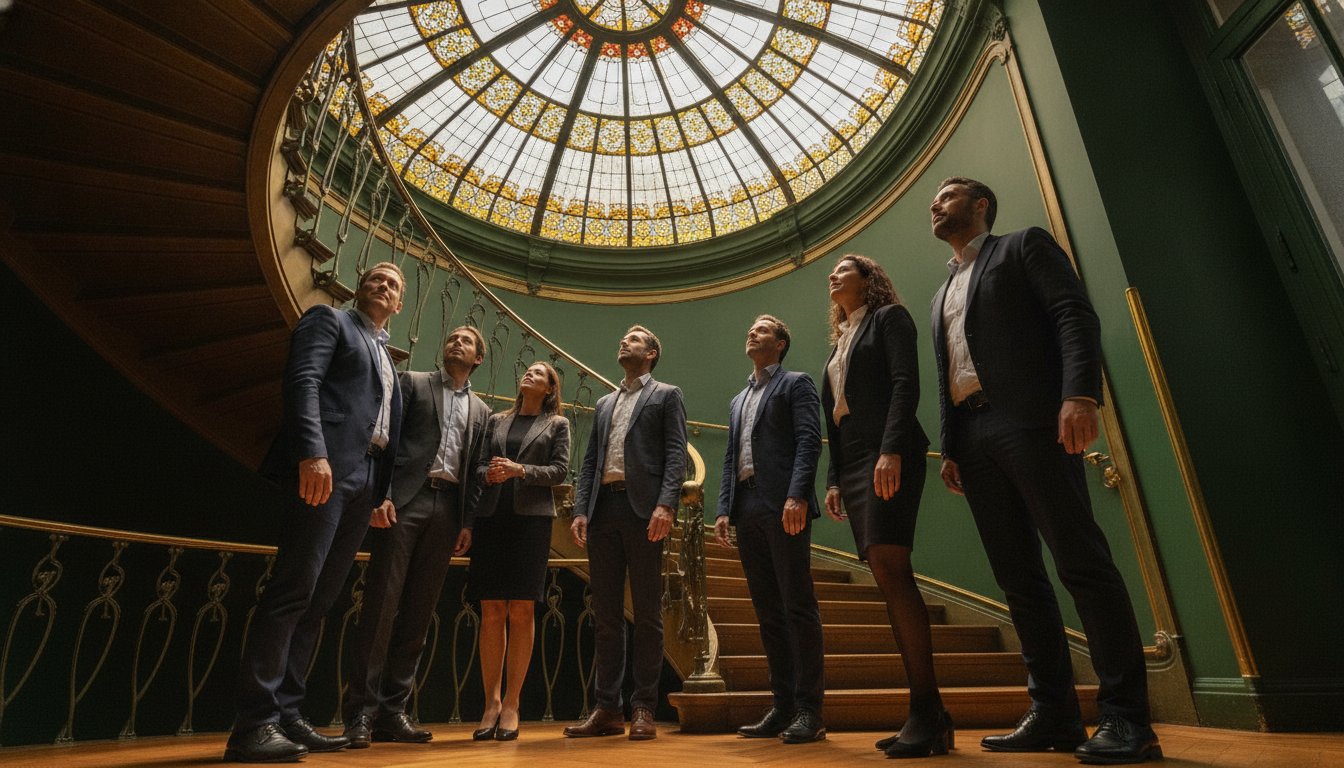
Tag: Art Nouveau

  • Brussels Art Nouveau Architecture Tour: A Masterclass in Curated Group Travel (2026)

    Brussels Art Nouveau Architecture Tour: A Masterclass in Curated Group Travel (2026)

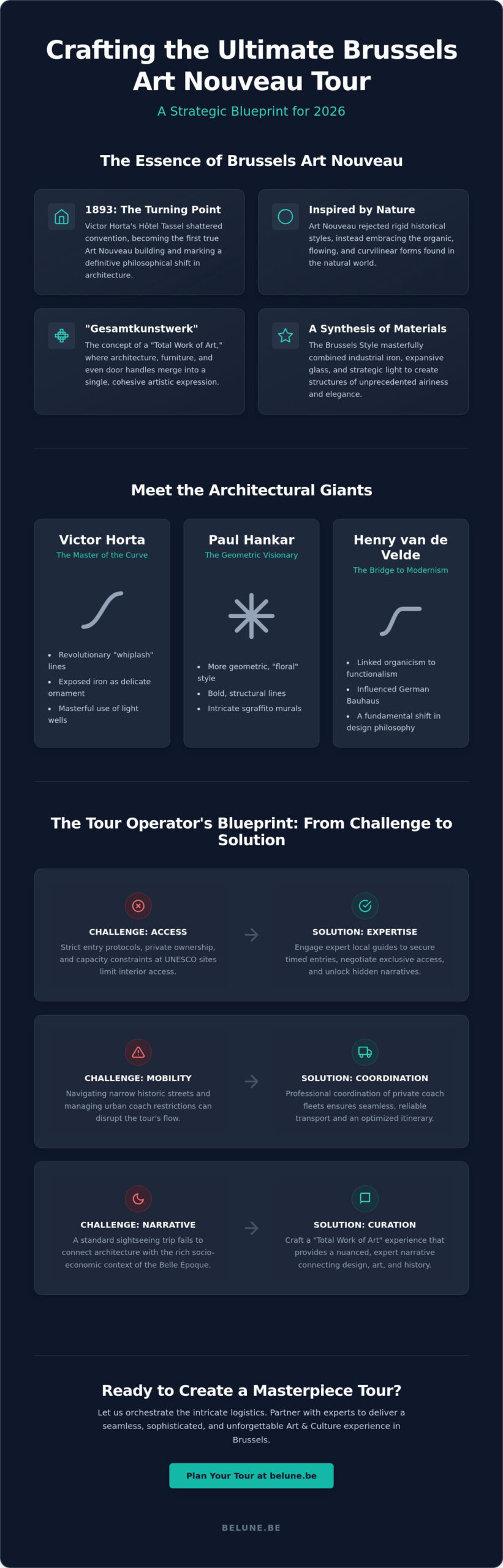
    A true architectural masterpiece isn’t just observed; it’s choreographed. In the winding streets of Brussels, the organic curves of Victor Horta and Henry van de Velde demand more than a casual glance. They require a logistical symphony. You understand that orchestrating a premium brussels art nouveau architecture tour involves far more than selecting famous facades. It’s about balancing the delicate requirements of UNESCO-listed interiors with the rigid realities of urban coach restrictions and the pressure of securing timed group entries at the Horta House.

    This guide provides the strategic framework you need to transform a standard sightseeing trip into a sophisticated masterclass for 2026. You’ll discover how to navigate the current “Newveau” design revival and leverage the 2026 Art Nouveau Week events to your advantage. We’ll outline a logically sequenced itinerary that handles everything from reliable coach transport to expert local guide selection. By the end of this article, you’ll have a clear blueprint for managing hotel logistics and securing exclusive interior access. We’ll ensure your clients experience the cradle of Art Nouveau with the elegance, precision, and technical mastery it deserves.

    Key Takeaways

    • Understand the philosophical shift of 1893 and how Victor Horta’s Hôtel Tassel redefined structural space through revolutionary organic forms.
    • Distinguish between the fluid ironwork of Horta and the geometric motifs of Paul Hankar to provide a nuanced, expert narrative for your clients.
    • Master the logistical complexities of a brussels art nouveau architecture tour by managing capacity constraints and timed entries at exclusive UNESCO sites.
    • Learn to curate a “Total Work of Art” experience that connects architecture and interior design with the socio-economic rise of the Belle Époque.
    • Discover how professional coordination of private coach fleets and hotel management ensures a seamless journey through historic urban environments.

    Brussels: The Philosophical Cradle of Art Nouveau Architecture

    In the late 19th century, Brussels became an experimental laboratory for a new visual language. Art Nouveau emerged not as a mere decorative trend but as a radical rejection of the past. It discarded the rigid rules of Neo-Gothic and Neo-Renaissance styles. Instead, architects turned to the organic flow of nature to redefine structural space. This transformation reached its zenith in 1893. That year, Victor Horta completed the Hôtel Tassel, a building often cited as the first true Art Nouveau residence. This event marked a definitive shift in Brussels: The Philosophical Cradle of Art Nouveau Architecture. The city’s rapid industrialization provided the necessary capital for such boldness. Wealthy patrons, fueled by the Belgian industrial boom, commissioned these avant-garde private residences to reflect their modern, progressive identities. Central to this movement was the concept of the Gesamtkunstwerk. In these spaces, the architecture, furniture, and even the smallest door handle merge into a singular, cohesive expression of art.

    The 2026 Perspective on Heritage Preservation

    As of 2026, the preservation of this heritage has reached a sophisticated maturity. Brussels’ UNESCO World Heritage sites are no longer just static monuments; they are living testaments to technical mastery. Recent restorations, most notably the Maison Hannon, have revitalized the city’s aesthetic landscape. These projects highlight the meticulous craftsmanship required to maintain such delicate structures. The Brussels Style is a synthesis of iron, glass, and light. For those organizing a brussels art nouveau architecture tour, these restored gems offer a fresh perspective on how heritage can be both preserved and celebrated in a modern urban context.

    Beyond the Façade: Why Interior Access Matters

    While the exteriors are striking, the true soul of Art Nouveau lies within. Later architectural movements often embraced modular, interchangeable components. In contrast, Art Nouveau celebrates a sense of “wholeness” where every room is a bespoke creation designed for a specific volume. Accessing these interiors remains a complex challenge in 2026. Many masterpieces remain in private hands, while others have transitioned to public museum status with strict entry protocols. Navigating these nuances requires deep expertise. Engaging professional local guide services benelux is essential for uncovering the narratives hidden behind closed doors. These experts bridge the gap between technical architectural theory and the human emotion embedded in the stone. A well-curated brussels art nouveau architecture tour relies on this interior access to reveal the movement’s true depth and artistic intention.

    The Architectural Giants: Victor Horta and the Vanguard of the Belle Époque

    While Victor Horta remains the undisputed master of the whiplash curve, he wasn’t alone in reshaping the city’s aesthetic identity. The Architectural Giants: Victor Horta introduced a revolutionary use of exposed iron, treating industrial materials with the delicacy of lace. His light wells didn’t just illuminate rooms; they transformed the very atmosphere of the home. In contrast, Paul Hankar pursued a more geometric, “floral” Art Nouveau. His work often featured bold lines and intricate sgraffito, a technique of scratching through layers of colored plaster to create narrative murals. This diversity ensures that a brussels art nouveau architecture tour offers a multifaceted view of the Belle Époque.

    Henry van de Velde expanded this vision even further. He acted as the vital bridge between Belgian organicism and the functionalism that would later define the German Bauhaus. This evolution shows that the movement wasn’t just a fleeting style but a fundamental shift in design philosophy. Stained glass and sgraffito weren’t merely decorations. They served as structural storytelling elements that dictated how light and narrative flowed through a space. For the professional tour operator, understanding these nuances is key to delivering a narrative that resonates with sophisticated travelers.

    Key UNESCO Sites for Group Itineraries

    Three primary locations form the backbone of any high-end itinerary. The Hôtel Solvay represents the pinnacle of luxury and technical innovation. No expense was spared in its construction, making it a definitive “total work of art.” The Hôtel van Eetvelde showcases the “winter garden” concept, where a central glass dome serves as the lungs of the house, drawing light into the core of the building. Finally, the Horta Museum offers an intimate look at the architect’s creative process within his own home and studio, providing a rare glimpse into the mind of a visionary.

    The Hidden Gems of Saint-Gilles and Ixelles

    Beyond the famous landmarks, districts like Saint-Gilles and Ixelles hide treasures like the Cauchie House. Its facade is a masterpiece of sgraffito, designed by Paul Cauchie to advertise his own artistic services. The Autrique House, Horta’s first major breakthrough, provides a fascinating look at the transition from tradition to innovation. Successfully connecting these scattered sites requires precision. Planning routes through these historic neighborhoods is best achieved with modern coach hire that understands local access restrictions. If you’re looking to elevate your next itinerary, we recommend consulting an expert who can orchestrate these complex cultural experiences with seamless professionalism. This ensures your brussels art nouveau architecture tour remains focused on the art, not the logistics.
    Brussels Art Nouveau Architecture Tour: A Masterclass in Curated Group Travel (2026)

    Organizing a brussels art nouveau architecture tour for a large group is a delicate logistical puzzle. Unlike grand cathedrals or sprawling museums, the Major Town Houses of the Architect Victor Horta were designed as intimate, private sanctuaries. Most interiors have strict capacity limits, often capping entry at 15 to 20 guests at any single time. For a professional tour operator managing a group of 40, this necessitates a staggered entry system. While one half of the group explores the intricate ironwork of a winter garden, the other half can engage in a curated exterior narrative of the surrounding neighborhood. Precision in timing prevents bottlenecking and ensures each guest receives the quiet contemplation these spaces demand.

    Mobility adds another layer of complexity. Brussels’ Low Emission Zone (LEZ) and the narrow, cobblestone streets of residential Ixelles aren’t naturally friendly to standard coaches. Navigating these constraints requires a driver who understands the specific geography of Art Nouveau clusters. It’s about more than just getting from point A to B; it’s about knowing exactly where a 50-seater can safely drop passengers without disrupting the local flow or violating municipal codes. Balancing “exterior only” walking segments with high-value interior visits keeps the group moving without causing the fatigue that often plagues dense architectural itineraries.

    Strategic Timing and Seasonal Considerations

    Light is a structural component in these buildings. In 2026, planning visits to coincide with the morning sun is vital for experiencing the full effect of Horta’s iconic light wells and glass ceilings. We recommend avoiding the peak tourist surges of mid-summer. Target the Brussels Art Nouveau & Art Deco (BANAD) Festival in the spring. It’s a period when private owners often open their doors to the public, though it requires booking months in advance to secure those coveted slots for professional groups.

    Group-Friendly Hospitality and Logistics

    The narrative shouldn’t end when the tour stops. Selecting the right group hotel accommodation is key to maintaining the architectural theme throughout the stay. We look for properties that echo the city’s heritage, providing a seamless transition from the street to the suite. Gastronomy offers another touchpoint; historic brasseries like the Falstaff provide the perfect backdrop for a mid-day pause. Finally, ensuring these movements remain fluid depends on reliable private coach rental. A modern fleet, equipped for the city’s environmental standards, is the invisible backbone of a successful brussels art nouveau architecture tour.

    Crafting the Perfect Narrative: Themes for an Architectural Deep-Dive

    A successful brussels art nouveau architecture tour transcends simple sightseeing by weaving a compelling narrative through the city’s streets. We move beyond the stone and iron to explore the “Total Work of Art” philosophy in its most literal sense. This theme invites groups to witness how the curve of a forged iron staircase mirrors the delicate lines of a silver jewelry piece or the mahogany grain of a custom-built cabinet. It’s a sensory immersion. This artistic unity reflected the aspirations of a rising middle class in the late 19th century. These industrial titans and intellectuals sought a style that broke from aristocratic tradition, favoring social progress and urban innovation over historicist repetition.

    Contrast is the key to deep engagement. By comparing the fluid, organic “whiplash line” of early Horta works with the emerging geometric modernism of later architects, we provide a visual masterclass for your clients. This transition marks the fascinating birth of Art Deco, where the floral motifs of the Belle Époque began to stiffen into the streamlined shapes of the 1920s. Tracing this evolution helps groups understand the entire 20th-century design trajectory, making the history feel immediate, relevant, and technically profound.

    Integrating Art Nouveau into Wider Benelux Tours

    Brussels serves as the anchor, but the story extends far beyond the city limits. Connecting these Belgian masterpieces to the decorative arts of Paris or the unique rationalist brickwork of the Netherlands creates a broader cultural perspective. As a specialized DMC, we build these cross-border bridges, integrating architectural highlights into comprehensive culture group tours benelux. This approach ensures a cohesive story that respects national nuances while celebrating a shared European aesthetic movement.

    Specialized Workshops and Expert Lectures

    True depth comes from interaction and expert insight. We arrange private lectures with recognized architectural historians who provide technical details unavailable to the general public. For a more tactile experience, hands-on workshops in sgraffito or stained glass allow guests to appreciate the artisanal skill required for these historic restorations. Leveraging over 20 years of local heritage connections, we open doors to private collections and expert ateliers that remain hidden from standard tourist paths. If you want to offer more than just a walk, we can help you design a themed architectural program that transforms history into a living, technical masterclass.

    Orchestrating Art & Culture Group Tours with BELUNE’s Expertise

    Turning an architectural vision into a functional reality requires more than just a list of addresses. It demands an ally who understands the technical weight of a brussels art nouveau architecture tour. For professional tour operators and travel agents, we provide a tailor-made itinerary design that respects the rhythm of discovery. We don’t just manage bookings; we orchestrate a complete environment. This includes everything from the precision of modern coach logistics to the refined selection of hotel accommodations that align with your group’s expectations. Our process is built on a foundation of technical mastery and artistic sensitivity, ensuring every project we touch reflects the excellence your clients demand.

    The greatest hurdle in Brussels is often the threshold. While the city’s facades are public, its soul remains behind private doors. We solve the “interior vs exterior” access challenge through established relationships with heritage curators and private owners. This ensures your group isn’t just standing on the sidewalk looking up. They are inside, experiencing the volume and light exactly as the architects intended. Our local guides specialize in this specific architectural narrative. They offer technical depth and historical context that generic city tours simply cannot match. This professional approach transforms a standard visit into a profound cultural experience.

    Why Choose a Specialized Benelux DMC?

    Navigating local regulations requires more than a map. It requires local intuition. We secure exclusive group access to sites that are often restricted to the general public, managing the complex timing required for staggered entries. By offering fixed-price group packages, we provide the budget transparency essential for successful B2B partnerships. BELUNE is dedicated to providing high-quality, seamless travel experiences that transform technical challenges into artistic triumphs. Our expertise acts as a structural component of your tour, providing the stability needed for a truly inspiring journey.

    Start Planning Your 2026 Architectural Journey

    Preparation for the 2026 season begins with a conversation. Requesting a custom proposal allows us to align our expertise with your specific group profile and interests. One of our most significant advantages is our own fleet of modern coaches. This ownership guarantees a level of reliability and flexibility that third-party rentals cannot offer. We control the schedule, the maintenance, and the quality of the transit experience. Partner with BELUNE for your next Art Nouveau group tour to ensure your architectural journey is as flawless and inspiring as the masterpieces you’ve come to see.

    Elevating the Architectural Experience in 2026

    A successful brussels art nouveau architecture tour is a structural achievement in its own right. It requires the seamless integration of historical narrative, logistical precision, and exclusive access. You understand that the transition from a facade to an interior is where the true magic of the Belle Époque resides. By prioritizing technical mastery and local heritage connections, you ensure that every group journey becomes a living masterclass in design and urban evolution. The complexity of the city shouldn’t hinder the appreciation of its beauty.

    With over 20 years of Benelux travel expertise, BELUNE provides the essential backbone for these sophisticated itineraries. Our private fleet of modern, high-capacity coaches and our specialized network of expert architectural guides remove the friction from urban exploration. We invite you to request your custom Brussels Art Nouveau itinerary from BELUNE. Together, we can transform the technical challenges of the city into a fluid, unforgettable experience for your clients. Let’s design a journey that honors the legacy of Horta with the excellence it deserves.

    Frequently Asked Questions

    Can large groups visit the interiors of Art Nouveau houses in Brussels?

    Large groups can certainly experience these interiors, but they require a staggered entry strategy. Most UNESCO-listed townhouses have strict capacity limits, often restricting entry to 15 or 20 guests at a time to preserve the delicate structures. We manage this by splitting the group, allowing one half to explore the interior while the other enjoys a curated exterior narrative of the neighborhood.

    Is a guide necessary for an Art Nouveau architecture tour?

    A specialized guide is essential for a meaningful experience. Beyond just identifying facades, an expert provides technical insight into the revolutionary use of light wells and exposed ironwork. They transform a simple walk into a technical masterclass, uncovering the social and philosophical motivations behind the movement that generic city tours often overlook.

    How much time should a group allocate for a comprehensive Brussels Art Nouveau tour?

    You should allocate a full day, approximately six to eight hours, for a comprehensive brussels art nouveau architecture tour. This timeframe allows for two or three high-value interior visits, a lunch pause in a historic brasserie, and transit between the major clusters in Saint-Gilles and Ixelles. Shorter three-hour options are available but usually limit groups to exterior views only.

    What are the main differences between Art Nouveau and Art Deco in Brussels?

    Art Nouveau is defined by its organic, whiplash curves and floral motifs inspired by nature. In contrast, Art Deco emerged later with a focus on geometric symmetry, streamlined shapes, and modern industrial materials. Brussels offers a unique opportunity to see this evolution firsthand, as many architects transitioned from the fluid lines of the 1890s to the structured elegance of the 1920s.

    Are Brussels Art Nouveau sites accessible for coaches and large groups?

    Access is complex due to the city’s Low Emission Zone (LEZ) and the narrow residential streets where many gems are located. Success depends on using a modern, compliant coach fleet and drivers who understand the specific geography of these neighborhoods. We plan precise drop-off points to ensure group mobility remains fluid without disrupting the quiet residential atmosphere.

    What is the best time of year for an architectural tour in Belgium?

    Spring and autumn are ideal for architectural tours. The natural light during these seasons perfectly illuminates the glass ceilings and light wells characteristic of the Brussels style. In 2026, World Art Nouveau Day on June 10th and the various events during Art Nouveau Week in July provide excellent thematic hooks for specialized group itineraries.

    Can an Art Nouveau tour be combined with other cultural themes?

    Architectural journeys pair beautifully with other local experiences. We frequently integrate visits with gastronomy and beer experience tours, choosing venues that reflect the city’s heritage. A lunch in a preserved Art Nouveau setting allows the group to stay immersed in the aesthetic while enjoying the city’s culinary traditions, creating a more holistic cultural narrative.

    How does BELUNE manage timed entry for UNESCO World Heritage sites?

    We secure timed entry blocks through long-standing relationships with site curators and private owners. Our team coordinates these slots with our private coach fleet to ensure a seamless flow for the group. This proactive management eliminates waiting times and prevents the fatigue often associated with dense architectural programs, maintaining a sophisticated pace throughout the day.
  • The Ultimate Guide to Culture Group Tours in Benelux for 2026

    The Ultimate Guide to Culture Group Tours in Benelux for 2026

    The most evocative cultural journeys in 2026 won’t be defined by the miles covered, but by the depth of the narrative woven between the canals of Ghent and the valleys of Luxembourg. True elegance in travel lies in the transition. It’s the seamless shift from a morning in a sun-drenched Dutch atelier to an evening in a Belgian manor. You understand that the complexity of coordinating three distinct nations often threatens the creative vision of your itinerary. Finding a group-friendly hotel within the historic heart of Bruges, or avoiding the 22% surge in tourist-trap dining, requires more than a map; it requires a master’s touch.

    When planning culture group tours benelux, your goal is to create a masterpiece of movement and light. We’re here to help you execute that vision with a clear 10-day framework that bridges the gap between logistical rigor and artistic inspiration. You’ll learn how to navigate specific niches like the Art Nouveau movements of 1893 and identify B2B partners who prioritize quality over volume. This guide provides the strategic insights needed to transform a standard trip into a bespoke cultural legacy.

    Key Takeaways

    • Discover the seamless harmony of the Benelux region, where Belgium, the Netherlands, and Luxembourg converge into a single, sophisticated cultural masterpiece.
    • Master the art of designing culture group tours benelux by blending the timeless legacies of the Dutch Golden Age with the avant-garde elegance of Art Nouveau.
    • Learn to balance iconic capitals with the quiet charm of secondary gems like Delft and Ghent to create a truly bespoke travel rhythm for your clients.
    • Navigate complex multi-country logistics with precision, ensuring a fluid experience through strategic private transport and expert group management.
    • Leverage the local insight of a dedicated DMC to secure fixed-price reliability and transform your professional offering into a vision of travel excellence.

    Defining the Benelux Cultural Landscape: A Cross-Border Masterpiece

    The Benelux region isn’t just a map; it’s a curated gallery where three distinct identities converge with the precision of a master artisan. Belgium, the Netherlands, and Luxembourg form a cohesive travel unit that functions with remarkable fluidity. For 2026, this territory has emerged as the definitive heart of Europe for those seeking a sophisticated culture group tours benelux experience. We find beauty in the “Harmonious Contrast” between these nations. One moment you’re standing before a 17th-century Dutch masterpiece, and the next, you’re exploring the avant-garde glass structures of Luxembourg City. Benelux group travel serves as a sublime blend of artistic heritage and modern logistical ease.

    The Historical Roots of the Union

    This cross-border narrative began long before modern treaties. The 15th-century Burgundian Netherlands first established the region as a global center for art and commerce. This shared history acts as a golden thread for group itineraries. It weaves through the 1556 Spanish occupation and the Napoleonic era of the early 1800s, periods that deeply influenced regional architecture and identity. The formalization of the Benelux Union in 1944 transformed these historical echoes into a modern economic reality. This deep-seated cooperation allows groups to transition between cultures without friction, following a timeline that spans from the Ghent Altarpiece to the contemporary European Parliament.

    Why Groups Choose Benelux Over Traditional Single-Country Tours

    Efficiency meets inspiration in this compact geography. Travel times between major cultural hubs are remarkably brief; a high-speed train connects Brussels and Amsterdam in exactly 1 hour and 50 minutes. This proximity allows culture group tours benelux to offer incredible diversity within a 300km radius. Travelers experience three distinct languages and architectural styles without the exhaustion of long-haul transits. While the Flemish Primitives and Dutch Masters draw significant crowds, seasoned travelers now seek the quiet elegance of Luxembourg. The capital’s old quarters, recognized by UNESCO since 1994, provide an off-the-beaten-path sophistication that complements the vibrant energy of the larger Dutch and Belgian cities. It’s a bespoke approach to travel where the transition between spaces is as beautiful as the destinations themselves.

    The Three Pillars of Benelux Heritage: Art, Architecture, and Gastronomy

    Stepping into the Low Countries is like entering a living gallery where light and history converge with clinical precision. Our culture group tours benelux offer more than a simple itinerary; they provide an immersive study of human creativity across seven centuries. The region’s rich cultural and artistic heritage manifests in the meticulous brushstrokes of the Flemish Primitives and the bold, atmospheric shadows of the Dutch Golden Age. In 1642, Rembrandt’s “The Night Watch” redefined movement in art, while Peter Paul Rubens’ 17th-century baroque masterpieces brought a new sense of theatrical drama to the Antwerp skyline.

    Artistic Legacies: From Altarpieces to Modernism

    The 1432 Ghent Altarpiece remains a cornerstone of Western art, drawing thousands to St. Bavo’s Cathedral to witness its restored vibrance. In Amsterdam, the Rijksmuseum houses over 8,000 objects that narrate the Dutch story through the eyes of Vermeer and Hals. Specialized groups often focus on Brussels, where Belgian Art Nouveau transformed urban landscapes at the turn of the century by replacing rigid industrial lines with organic, flowing ironwork and glass. For a contemporary shift, the Mudam in Luxembourg, designed by I.M. Pei and opened in 2006, serves as a sharp, minimalist counterpoint to the classical tradition.

    Architectural Marvels: Stones That Tell Stories

    Walking through the Grand-Place in Brussels, a UNESCO site since 1998, reveals an intricate harmony of gold-leafed guildhalls. Amsterdam’s 17th-century canal ring offers a different rhythm, defined by narrow facades and over 1,500 bridges. Contrast is this region’s greatest strength. You’ll see the preserved medieval stillness of Bruges, which dates back to the 13th century, set against Rotterdam’s experimental skyline, rebuilt almost entirely after the 1940 bombardment. Luxembourg City’s fortifications, known as the “Gibraltar of the North,” showcase centuries of military engineering carved directly into the sandstone cliffs.

    Gastronomy: More Than Just a Meal

    Culinary traditions here are deeply rooted in geography and communal identity. Belgium’s Trappist breweries, with only five authentic monasteries remaining in the country as of 2024, represent a centuries-old commitment to craft and charity. In the Netherlands, cheese markets in cities like Alkmaar function as living museums, preserving trade rituals that have existed since the 1600s. We believe that integrating hands-on workshops, like chocolate tempering or traditional “Stamppot” cooking, creates a sensory bridge to the past. To truly sublime your understanding of these historical spaces, one must appreciate how the local atmosphere and craft traditions shape the modern experience.

    Essential Cultural Hubs: Designing the Perfect Regional Itinerary

    Creating a bespoke itinerary requires a master’s touch. It’s about light and shadow; balancing the high-energy pulse of a capital with the silent resonance of a medieval courtyard. We view the “Golden Triangle” of Brussels, Amsterdam, and Luxembourg as the structural foundation of the Benelux cultural landscape. These hubs don’t just host tourists; they provide the technical and artistic framework for understanding European identity. By integrating these three anchors, planners can ensure culture group tours benelux maintain a rhythm that’s both sophisticated and intellectually stimulating.

    The Capitals: Brussels, Amsterdam, and Luxembourg

    Brussels functions as a sanctuary of Art Nouveau. The Horta Museum, designed by Victor Horta between 1898 and 1901, showcases the organic harmony of iron and stone. It’s a masterclass in architectural detail. Amsterdam offers a different perspective through its 165 canals, which earned UNESCO World Heritage status in 2010. These waterways reflect the 17th-century wealth of the Dutch East India Company. Luxembourg City provides the final layer. Its Bock Casemates, a 23-kilometer network of tunnels dating back to 1644, reveal a multi-layered history of fortress architecture and modern European integration.

    The Medieval Jewels: Flanders and beyond

    Flanders remains a living museum where the textile trade of the 14th century still feels present in the stone. Bruges and Ghent aren’t merely stops; they’re immersion points. In Ghent, the “Adoration of the Mystic Lamb,” completed by the Van Eyck brothers in 1432, serves as the ultimate pilgrimage for art historians. To add nuance to the journey, consider these specific locations:

    • Delft: The 17th-century home of Vermeer, where light and blue pottery define the city’s aesthetic.
    • Leiden: The 1575-founded university town and birthplace of Rembrandt in 1606.
    • Dinant: A vertical marvel in the Meuse Valley, anchored by its 11th-century Collegiate Church.

    The Hidden Gems for Return Travellers

    For those who’ve seen the icons, we look toward the forest and the frontier. The Kröller-Müller Museum is a revelation. It houses 90 paintings and over 160 drawings by Vincent van Gogh, situated within the 5,400 hectares of Hoge Veluwe National Park. This juxtaposition of raw nature and curated genius creates a profound emotional impact. In Luxembourg, the Castle of Vianden, constructed between the 11th and 14th centuries, stands as one of the largest fortified estates west of the Rhine. Finally, Tongeren, established in 15 BC, allows groups to touch Belgium’s Roman roots. These sites provide the quiet, reflective moments that transform a standard trip into a visionary experience. For those who wish to explore these classical foundations through literature, publishers like Plume Charmers offer a gateway to the ancient texts that shaped the continent.

    Designing Seamless Multi-Country Itineraries: Logistics and Group Management

    Orchestrating high-end culture group tours benelux requires more than a map; it demands a mastery of three distinct legal frameworks and logistical rhythms. The primary challenge lies in the friction between French, Belgian, and Dutch regulations. Each country enforces unique labor laws for drivers and specific municipal access codes for historic centers. We eliminate this friction through meticulous synchronization of every border crossing and city entry, ensuring the transition between nations is as fluid as the art we visit.

    Transport and Mobility: The Private Coach Advantage

    Rail travel often fails groups of 20 or more. Luggage handling becomes a logistical bottleneck, and fixed schedules strip away the spontaneity of an art-focused journey. A private coach serves as a mobile sanctuary. It offers the flexibility to pivot when a gallery opening changes or a sunset over the North Sea demands a detour. Modern fleets must adhere to Euro 6 environmental standards to maintain access to urban hearts. Planning a 2026 tour requires accounting for the stricter low-emission zones (LEZ) expanding across Brussels, Antwerp, and Amsterdam, where non-compliant vehicles face daily fines starting at €350.

    Accommodation Management for Groups

    Securing room blocks in heritage zones is a delicate balancing act. We seek out properties that offer the charm of 17th-century architecture alongside the logistical capacity for 30 guests. Staying in the city center saves approximately 55 minutes of transit time each morning, allowing for a slower, more inspired start to the day. Our criteria for group-friendly stays include:

    • Dedicated check-in desks to bypass public queues.
    • Coach drop-off points located within 150 meters of the main entrance.
    • Dining rooms capable of simultaneous service for the entire party.
    • Modern elevator capacity in historic buildings to ensure accessibility.

    Expert Guidance: The Human Element

    Local guides act as the essential bridge between the traveler and the landscape. In a region where four languages intersect within a 200-kilometer radius, multi-lingual expertise is non-negotiable. These professionals don’t just recite facts; they manage the 15-minute timed entry windows at the Rijksmuseum or the Louvre. Their presence ensures the group avoids the 45% longer wait times typically found at main tourist gates. They transform a complex itinerary into a fluid, emotional experience through their mastery of local nuance and timing.

    Ready to elevate your next project? Partner with our logistics experts to design a flawless journey.

    Partnering with a Local Expert: Why a Benelux DMC Elevates Cultural Tours

    Success in B2B travel hinges on local precision. A Destination Management Company (DMC) acts as the architect of your vision; they ensure every logistical detail aligns with the artistic narrative of the journey. For international operators, this partnership provides fixed-price reliability. In an economy where costs fluctuate, having a guaranteed rate for 2025 or 2026 itineraries protects profit margins and builds trust with travelers. It’s about moving beyond generic, mass-produced packages toward bespoke experiences that resonate on a deeper level. Our 24/7 on-the-ground support provides a safety net that allows group leaders to focus on their guests rather than worrying about a missed connection or a closed gallery.

    The BELUNE Difference: 20 Years of Benelux Mastery

    Our headquarters in Dottignies serves as a strategic pivot point between Brussels, Paris, and Amsterdam. This location, situated minutes from major European transport veins, is our command center for culture group tours benelux. We manage our own fleet of premium vehicles. This means we never outsource the quality of the group transport experience. Whether we’re exploring the floral curves of Art Nouveau in Brussels, the solemn silence of WWI Battlefields, or the refined gastronomy of the Flemish Ardennes, we maintain 100% control over the timing and comfort of every transfer. We don’t just book tours; we craft the atmosphere.

    Building Lasting Partnerships with Tour Operators

    We function as the invisible hand for our partners. Your clients see your brand, while we handle the complex, high-quality logistics from A to Z. Our commitment to seamless execution transforms a standard trip into a sophisticated cultural immersion. We prioritize the following for every partner:

    • Bespoke Curation: Itineraries tailored to specific artistic or historical interests.
    • Logistical Certainty: Total control over transport and timing through our private fleet.
    • Local Access: Connections to private collections and expert guides that generic agencies can’t reach.

    Our role is to provide the technical mastery that allows your creative vision to shine. We are the artisans of the itinerary, ensuring that every nuance of the journey is handled with professional rigor and aesthetic grace.

    Ready to elevate your travel offerings? Request your custom Benelux group tour itinerary from BELUNE.

    Elevating Your 2026 Benelux Perspective

    Designing a 2026 itinerary across Belgium, the Netherlands, and Luxembourg requires more than a map. It demands a vision that harmonizes the region’s artistic heritage with seamless logistical execution. You’ve explored how the three pillars of art, architecture, and gastronomy form a cross-border masterpiece. Success in 2026 relies on balancing these cultural hubs with the precision of local management. We believe every journey should feel like a curated gallery of experiences.

    Expertise transforms a simple trip into a sensory journey. With 20+ years of DMC experience, we refine every detail of your culture group tours benelux to ensure an effortless flow between historic sites. Our private fleet of modern coaches provides the comfort your guests deserve while exploring specialized itineraries for Art, Culture, and Battlefields. We don’t just provide transport; we curate an atmosphere of discovery. Our team acts as a visionary partner to ensure your vision becomes a technical and aesthetic reality.

    Partner with BELUNE for your next Benelux group tour and let’s craft an experience that resonates long after the journey ends. The landscapes of 2026 are waiting to be revealed.

    Frequently Asked Questions

    How many days are recommended for a comprehensive Benelux cultural group tour?

    A 10 to 12-day itinerary provides the necessary depth to appreciate the architectural nuances and artistic heritage of the region. This timeframe allows for 3 days in Amsterdam, 2 days in Brussels, and 3 days in Paris, ensuring a balanced rhythm between travel and discovery. Shorter 7-day circuits often sacrifice the quiet contemplation required to truly experience the Flemish Primitives or the Louvre’s galleries.

    What is the best time of year to visit the Benelux region for cultural groups?

    The optimal period for culture group tours benelux falls between mid-April and June, or throughout September. During these months, the natural light achieves a clarity that enhances the textures of historic facades and museum interiors. Specifically, visiting between March 20 and May 11 allows groups to witness the Keukenhof gardens at their peak, where over 7 million bulbs create a living masterpiece of color and form.

    Are Benelux cities accessible for large groups and elderly travellers?

    Benelux cities offer high accessibility standards, with over 90 percent of major cultural institutions equipped for mobility-impaired visitors. The Rijksmuseum and the Magritte Museum feature modern lift systems and wide galleries designed for seamless movement. We recommend utilizing the low-floor tram networks in Brussels and Amsterdam; they provide efficient transit for groups of 20 or more without the physical strain of cobblestone navigation.

    Do we need different guides for each country in the Benelux region?

    Engaging local specialist guides for each specific territory ensures an authentic interpretation of regional history and artistic movements. While a single tour manager handles logistics, we utilize certified local experts in cities like Bruges and The Hague to reveal hidden architectural details. This approach respects the distinct cultural identities of the 3 nations, providing a richer, more nuanced perspective than a generalist overview could ever offer.

    How do we manage meals for large groups in historic city centres?

    Securing private dining rooms or “salons” in historic brasseries allows groups of 25 to 40 to dine without compromising the intimate atmosphere. We typically arrange lunch seatings for 12:00 PM to avoid the peak 1:30 PM rush in centers like the Grand Place. This precise scheduling ensures that the culinary experience remains a harmonious part of the cultural journey rather than a logistical hurdle.

    What are the main cultural differences between Belgium, the Netherlands, and Luxembourg?

    The region’s character is defined by its diversity, from the Calvinist pragmatism of the Netherlands to the Catholic baroque elegance of Belgium. In Belgium, 60 percent of the population speaks Dutch, while French and German serve as official languages, reflecting a complex social tapestry. Luxembourg offers a unique synthesis, acting as a sovereign financial and judicial hub that bridges the Germanic and Gallic worlds through its distinct Lëtzebuergesch tongue.

    Can we combine a Benelux cultural tour with a trip to Paris?

    Integrating Paris into a culture group tours benelux itinerary is a seamless transition thanks to high-speed rail links. The journey from Brussels Midi to Paris Nord takes exactly 1 hour and 22 minutes, making it an effortless extension of your artistic exploration. This connection allows groups to compare the Dutch Golden Age with French Neoclassicism in a single, fluid movement, enhancing the overall narrative of the European experience.

    What are the most popular themes for culture group tours in Benelux?

    The most sought-after themes focus on the Flemish Masters, Art Nouveau architecture, and contemporary urban design. Groups often dedicate 4 days to exploring the legacy of Rubens and Van Eyck across Antwerp and Ghent. Another prominent choice is the Art Nouveau circuit in Brussels, featuring Victor Horta’s 4 UNESCO-listed townhouses, where light and iron work together to transform domestic spaces into sculptural masterpieces.