
Building your agency’s reputation as a Europe specialist takes consistent, visible proof of your knowledge and the quality of your planning. Monitor reviews and public conversations, make your regional expertise clear, respond thoughtfully to criticism, and ensure your online presence reflects the experience you deliver. Trust comes from steady, specific actions, not a claim of expertise alone.
Travel agencies know that a polished itinerary is only part of the decision. Prospective clients also want confidence in the people designing the journey, coordinating its details, and guiding them through unfamiliar places.
This guide shares practical ways to strengthen that confidence. Learn how to monitor reviews and mentions, distinguish your agency through focused expertise, communicate thoughtfully, and respond to reputation challenges with care. The aim is a clear, credible presence that reflects the quality of your work across Europe.
Key Takeaways
- Set a routine for tracking reviews, social conversations, media coverage, and brand mentions so recurring perceptions become visible.
- Make your agency’s specialist identity concrete through the destinations, themes, and travel experiences you know best.
- Respond to criticism with respect and understanding, addressing the concern rather than escalating the exchange.
- When a reputation issue emerges, acknowledge it clearly, explain the steps you’re taking, and keep your response consistent across channels.
- Build credibility through experiences that connect the itinerary with its practical details, including accommodation, transport, local guidance, and cultural visits.
Monitoring online reviews and public perception
Building your agency’s reputation as a Europe specialist starts with understanding what travelers already say about your expertise. Track reviews, social conversations, and media coverage to spot recurring perceptions and decide what needs attention.
Create a consistent listening routine. A simple record turns scattered comments into useful insight.
For a perspective on specialist positioning, watch this video:
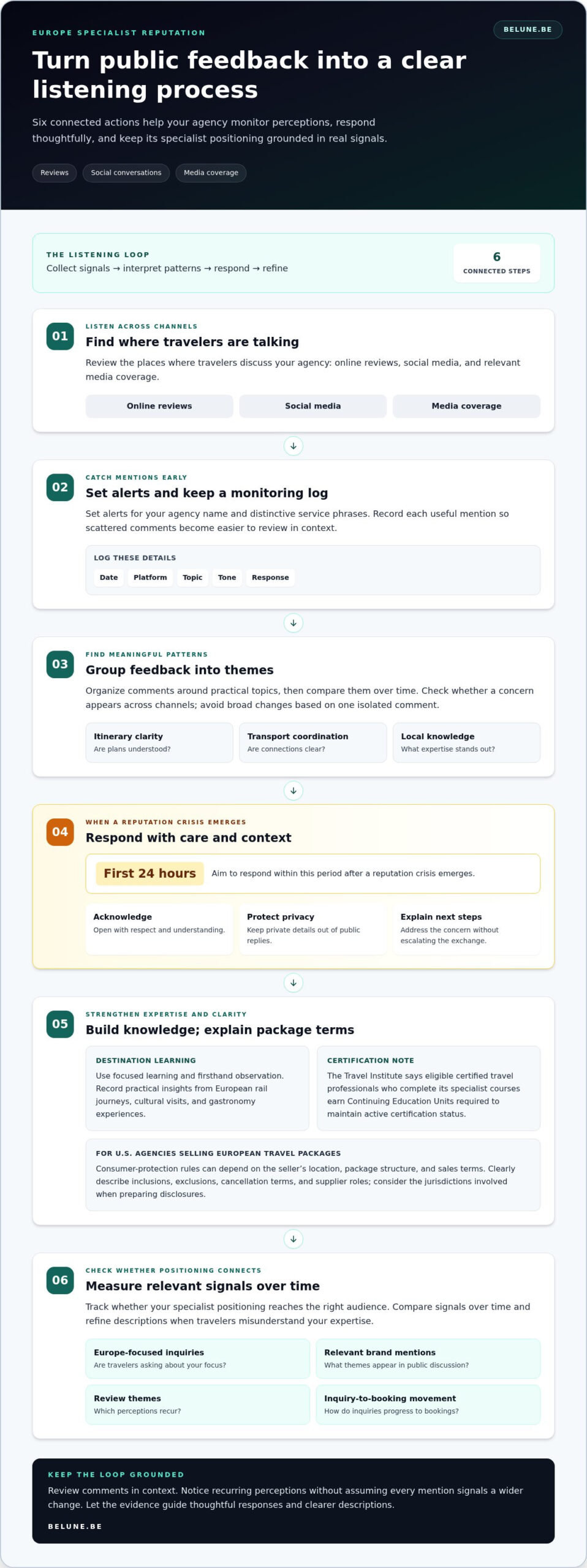
- Review the channels where travelers discuss your agency, including online reviews, social media, and relevant media coverage. Set alerts for your agency name and distinctive service phrases. Mentions can surface concerns before they become formal reviews.
- Keep a monitoring log with the date, platform, topic, tone, and response. Group feedback into themes such as itinerary clarity, transport coordination, or local knowledge, then compare them over time. Avoid making broad changes based on one isolated comment.
- Respond with care and context. Start with a respectful, understanding message when a traveler raises a concern publicly. Aim to respond within the first 24 hours after a reputation crisis emerges. Acknowledge the issue, protect private details, and explain the appropriate next step.
- For U.S. agencies selling European travel packages, consumer-protection rules can depend on the seller’s location, package structure, and sales terms. Clearly describe inclusions, exclusions, cancellation terms, and supplier roles. Consider the jurisdictions involved when preparing package disclosures.
- Build destination knowledge through focused learning and firsthand observation. The Travel Institute says eligible certified travel professionals who complete its specialist courses earn Continuing Education Units required to maintain active certification status. Record practical observations from European rail journeys, cultural visits, and gastronomy experiences.
- Measure whether your specialist positioning reaches the right audience. Track Europe-focused inquiries, relevant brand mentions, review themes, and the movement from inquiry to booking. Compare these signals over time. To keep building your agency’s reputation as a Europe specialist, refine your descriptions when travelers misunderstand your expertise.
A useful extension is to treat monitoring as a way to understand whether concerns are isolated or appearing across several channels. Healthcare brands can monitor public perception using social media and online reviews, and use alerts to identify brand mentions. That approach highlights the value of capturing relevant comments consistently, then reviewing them in context rather than reacting to a single post. For a Europe specialist, compare the themes in new feedback with the topics already recorded, and note whether the concern relates to an expectation that was unclear or an experience that needs a response. Keep the focus on what the comments actually indicate; do not assume that every mention represents a wider change in perception.
When a setback occurs, bring the available signals together before deciding whether your response has addressed the concern. Review social media, online reviews, and media coverage to see whether an issue continues to surface and whether public discussion has shifted. Consider the wording and tone of comments alongside the themes in your monitoring log. This helps distinguish a continuing issue from one that has become less prominent, and shows where further explanation may be needed. Use those observations to refine future responses and descriptions, while keeping private details out of public replies. Consistent review makes monitoring an ongoing way to understand public perception, not a task reserved for a crisis.
Agency differentiation and competitive advantage
Choose a clear European focus, then make its value visible in your offers and expertise. These steps can help you build a distinctive position without relying on broad claims.
-
Define the Agency’s Specialist Offer
Choose a European focus your team can explain precisely. It might be a region, such as the Benelux, or a theme, such as battlefield history or culinary travel. Define the travelers you serve, the experiences you design, and the knowledge behind your recommendations. Avoid presenting every European destination as equally familiar. A clear focus helps travelers see why your agency suits their plans.
-
Build Credibility Through Partnerships
Build working relationships with European tour operators, hotels, and tourism boards. Use these connections to deepen local insight and understand each partner’s contribution to the traveler’s experience. Describe collaborations accurately, including each organization’s role, and avoid implying that a partnership guarantees a particular outcome. Specific, transparent examples give prospective clients a concrete reason to trust your expertise.
- Select destinations and niches deliberately. Match your focus to your team’s knowledge, traveler interests, and the experiences you can plan well. For example, an agency might specialize in Benelux cultural heritage or build a distinctive offer around European food traditions. A defined theme is more memorable than a broad claim to know the whole continent.
- Compare itineraries on equal terms. Assess what each itinerary includes, such as accommodation, transport, guided visits, and time at each destination. Explain how the season, routing, and chosen experiences shape the offer. Rather than competing on price alone, show travelers what the itinerary’s design provides. Keep comparisons precise and avoid unsupported claims about other agencies.
- Address planning risks in the itinerary itself. Consider how transport connections, schedule changes, accessibility needs, and local operating conditions could affect the journey. Build sensible alternatives into the plan and explain key arrangements clearly. For a history-focused trip, for example, account for travel time between sites as well as the visits themselves. Thoughtful planning makes specialist knowledge practical, not merely promotional.
- Demonstrate expertise with useful detail. Publish destination guidance that answers real planning questions, and explain the reason behind each recommendation. Show why a route suits a cultural itinerary or how a regional food experience can enrich a visit. Encourage staff to share informed perspectives while keeping descriptions accurate and consistent. Travelers judge credibility by the detail and coherence of your advice.
Communicating with audiences
Make every message useful to a specific audience. Clear, consistent communication helps travelers understand what your Europe expertise means for their plans.
- Identify the audience before drafting. Distinguish tour operators, families, cultural groups, and independent-minded travelers. A tour operator may need operational detail, while a family may value a gentler pace and clear travel connections. Choose the audience first, then shape the message around its priorities.
- Translate expertise into practical answers. Replace broad claims with details travelers can use. Instead of saying “we know France,” explain how a Paris museum visit could fit alongside regional travel. A precise example helps readers picture the experience and decide whether it suits them.
- Use a consistent voice across channels. Align your website, social posts, email updates, and sales materials. If your website describes a thoughtful cultural itinerary, avoid social copy that suggests a rushed checklist. Consistency makes your agency recognizable and gives each message a coherent point of view.
- Make destination content valuable on its own. Answer specific planning questions about a route, a local custom, or the character of a cultural visit. For example, explain what travelers might notice on a guided walk through a historic district. Useful detail demonstrates knowledge without turning every post into a sales pitch.
- Invite meaningful audience participation. Ask focused questions that reveal interests, such as whether readers prefer art, food, or regional history. Use their responses to guide future content and itinerary ideas. Avoid requesting personal booking details in public comments; move sensitive conversations to an appropriate private channel.
- Address criticism with respect and understanding. Acknowledge the concern before explaining your perspective. If someone criticizes an unclear itinerary description, thank them for pointing it out and say how you’ll clarify it. Avoid arguing publicly or sharing private information about a traveler’s arrangements.
- Keep responses factual and measured. Check the relevant itinerary details before correcting a misunderstanding. If a post confuses included visits with optional activities, explain the distinction plainly. For a reputation crisis, businesses should ideally respond within the first 24 hours. Don’t speculate about causes or promise outcomes you can’t control.
- Review audience response and refine your message. Compare questions, comments, and engagement across channels. If readers repeatedly ask how a European rail connection fits into a trip, create a clear explanation. Let recurring questions shape future communications, keeping each answer accurate and easy to follow.
Maintaining a positive online reputation
Protect trust through consistent action, not polished claims alone. Client testimonials, reviews, and case studies can show how your agency supports a traveler’s journey and manages the details.
-
Use Client Testimonials and Reviews
Invite clients to describe specific parts of their experience, such as clear itinerary planning or thoughtful local guidance. Use their words accurately, and get permission before publishing a testimonial. Don’t edit feedback in a way that changes its meaning. A detailed, honest review gives prospective travelers a more useful picture than generic praise.
-
Showcase Case Studies
Build each case study around a real traveler need, your planning choices, and the resulting experience. For example, explain how a cultural group’s itinerary balanced meaningful visits with practical travel connections. Use factual details and approved images or quotations. Don’t suggest that one client’s experience guarantees the same result for every future journey.
- Respond promptly when a crisis emerges. Businesses should ideally respond within the first 24 hours after a reputation crisis emerges. Start by identifying the issue, gathering accurate details, and choosing one spokesperson. Acknowledge the concern respectfully. For example, if a public post describes unclear travel arrangements, explain what the agency is doing to address the communication gap.
- Explain corrective action clearly. Address reputation issues directly and state the steps you’re taking. If an itinerary description caused confusion, clarify the wording and update the relevant page. Give audiences a consistent account across channels. Avoid defensive language and promises beyond your control. A measured response shows how feedback leads to practical improvement.
- Publish constructive content about your strengths. Create useful destination guides, itinerary explainers, and client stories that reflect your expertise. This content can respond to criticism without appearing directly tied to negative material. Paid search may serve as a short-term measure while other reputation-management steps are put in place. Keep every claim accurate and relevant.
- Choose the right route for damaging content. If content appears to violate copyright or trademark laws, legal channels may help seek its removal. Avoid engaging publicly with damaging search results without relevant expertise. First consider the source, the claim, and the likely effect of a response. A poorly judged exchange can draw more attention to the original criticism.
Address reputation issues directly and explain the steps you’re taking. Before engaging publicly on social media about damaging search results, businesses without relevant expertise should consult a professional. Assess the source, the claim, and the likely effect of a response before replying. Keep your response focused on the issue and the steps being taken, rather than making promises beyond your agency’s control.
A damaging search result may appear on a site with little search visibility, while a negative blog post may become less prominent after moving from the homepage into the archives. These details can inform how you evaluate a result and choose a measured next step. Continue publishing accurate, constructive content that reflects your agency’s strengths, and handle damaging material carefully, seeking professional guidance when needed.
What defines a Europe specialist travel agency?
A Europe specialist turns regional knowledge into coherent, thoughtfully designed travel. Use these steps to make that expertise tangible, from the logic of an itinerary to how your team explains each choice.
- Set a defined geographic scope. Choose the European regions your team can describe in depth, rather than presenting the entire continent as equally familiar. For example, focus on the Benelux and explain how its cities, heritage sites, and transport connections relate. A clear scope helps travelers understand where your knowledge is strongest.
- Connect your focus to a recognizable theme. Decide whether your agency’s distinctive lens is art, food, architecture, history, or another meaningful interest. A cultural itinerary through Paris, for instance, can bring museums, historic neighborhoods, and local context into one narrative. Avoid adding unrelated stops simply to make a route look extensive.
- Show how the itinerary works in practice. Explain why each destination follows the previous one and how travelers move between experiences. A well-shaped route accounts for transfer time, visit duration, and the group’s pace. Describe the logic clearly so travelers can see the journey as more than a list of landmarks.
- Make local context part of your recommendations. Go beyond naming a monument or restaurant. Explain the cultural detail that gives a visit meaning, such as how a neighborhood’s history informs its architecture. Use precise, accessible language, and distinguish researched context from personal interpretation. This depth gives your itinerary a more considered point of view.
- Build operational fluency into your expertise. Understand how accommodation, transport, guiding, and scheduled visits shape a group’s experience. If a day includes a long transfer followed by a guided visit, consider whether the sequence feels comfortable. Specialist knowledge includes the practical structure behind memorable moments.
- State what your agency is best equipped to plan. Describe the travelers, themes, and trip styles your expertise serves. For example, explain whether your strongest work centers on cultural groups or history-led travel. Clear positioning attracts suitable inquiries and helps avoid expectations that don’t match your agency’s focus.
- Keep destination knowledge current. Review itinerary descriptions when routes, venue arrangements, or local conditions change. Replace outdated details with accurate information, and record what your team learns after each trip. A maintained knowledge base helps staff give consistent answers and keeps published guidance aligned with planning practice.
- Assess expertise through traveler questions. Notice whether prospective clients ask about the destinations and themes you intend to serve. If inquiries repeatedly reveal confusion about your regional scope, revise your website descriptions. If travelers ask detailed questions about a signature experience, develop content that explains its context and planning considerations.
For group journeys that bring European cultural experiences together, explore tailored group travel planning.
BELUNE: Hotel Accommodation Management
BELUNE supports tour operators and travel agents with Hotel Accommodation Management for group itineraries across the Benelux and Paris region. It’s a natural fit when your Europe-focused program needs coordinated accommodation as part of its practical arrangements.
Depending on the journey, you can also shape the experience with Coach Hire using BELUNE’s own fleet of buses, Local Guide Services, or Art & Culture Group Tours. These offerings connect itinerary logistics with cultural character, helping create a more coherent group travel experience.
For agencies developing group travel in Europe, BELUNE can bring accommodation and related arrangements into the planning conversation. Contact BELUNE to discuss your group itinerary.
Turn your specialist vision into the next journey
Building your agency’s reputation as a Europe specialist is ongoing work, shaped by every itinerary you create and every client experience that follows. Take a practical next step: choose a group program where local insight and smooth coordination matter, then make its character clear from the first conversation.
BELUNE can support that planning with Hotel Accommodation Management, Coach Hire using its own fleet of buses, and Local Guide Services. These offerings help tour operators and travel agents bring accommodation, transport, and on-the-ground knowledge together in a coherent group itinerary.
If you’re shaping a European group journey, contact BELUNE to discuss your itinerary. Give your specialist vision room to grow, one thoughtful travel experience at a time.
Frequently Asked Questions
How should an agency market its Europe expertise online and locally?
Use destination-specific pages online and in-person events locally to make your expertise easy to recognize. Create a page around a clear itinerary theme, such as European art and architecture, with practical details that help readers assess its fit. Locally, host a short travel presentation or join a community event, then invite attendees to explore a sample itinerary. Keep the message consistent across your website, event materials, and follow-up emails.
What Europe travel certifications and specialist training are available for travel agents?
The Travel Institute offers specialist courses. Eligible certified travel professionals who complete them earn Continuing Education Units required to maintain active certification status.